The Ranking Problem Nobody Talks About



Every “best prompt tools” ranking compares a $20 browser extension to a $249 enterprise eval platform without noting they solve completely different problems. After watching teams waste six figures on category mismatches, I built the framework nobody publishes — and an interactive diagnostic to find yours in under 60 seconds.
Skip to what matters
The market split into four distinct categories in 2023. Most rankings still ignore this. Buying across category lines — even if the tool is excellent — wastes months and budget.
The four categories: Generate (better prompt now), Organize & Reuse (share/standardize), Version & Deploy (ship to production), Evaluate & Monitor (catch regressions). They don’t compete. They don’t substitute. Use the interactive diagnostic below before reading anything else.
The uncomfortable truth: Category 1 (Generate) is being absorbed by frontier UIs. If you’re paying for a standalone generator today, you’re probably paying for something ChatGPT and Claude now do for free. The growth is in Categories 3 and 4 — and most teams arrive there two years later than they should.
$6.95B
Prompt engineering market 2025 — Mordor Intelligence Aug 2025
$40.87B
Forecast by 2030 at 42.52% CAGR — same source; growth not uniform across categories
$136K
Average prompt engineer salary 2025 — Glassdoor Feb 2025. Signals market maturity.
Methodology
Market figures from Mordor Intelligence August 2025. Tool comparisons draw from Braintrust’s February 2026 comparison (flagged as self-promotional where Braintrust is involved; independently corroborated via eWeek and TechTarget). G2 reviews current to early 2026. Category CAGR figures are Mordor segment estimates — treat as directional given the difficulty of clean category delineation in a fast-moving market.
Before any tool recommendation, you need to answer one question. I’ve watched PMs buy Braintrust because it ranked #1 somewhere — then spend a month building eval infrastructure they weren’t ready for. I’ve watched content teams buy PromptLayer and spend two weeks confused by Jinja2 templating they’d never use. The tool wasn’t wrong. The category was. Use this.
⬡ Category Diagnostic — 3 Questions
~60 seconds
CAT
Title
↺ Restart diagnostic
02 — Category Lifecycle: What’s Growing, What’s Dying
This is the map that explains why rankings fail. Each category is on a different trajectory. Knowing this before you buy is worth more than any feature comparison.
Category Lifecycle Map 2026 — Synthesis: Mordor Intelligence + eWeek + TechTarget + Author Observation (50+ Teams)
Cat 1 — Generate
↓
Decelerating
UI ABSORPTION
Tools: PromptPerfect, Originality.ai generator
ChatGPT, Claude, Gemini now include refinement natively. Standalone generators only survive on cross-modal (text + image). Pay for this category only if that’s your use case.
ChatGPT, Claude, Gemini now include refinement natively. Standalone generators only survive on cross-modal (text + image). Pay for this category only if that’s your use case.
Cat 2 — Organize
44.55%
CAGR 2024–2030 — Mordor segment est.
MARKETPLACE GROWTH
Tools: AIPRM Pro, Juma, PromptBase
Growing because organizational needs scale with team size. Limit: ChatGPT-locked tools (AIPRM) lose value as teams go multi-model.
Growing because organizational needs scale with team size. Limit: ChatGPT-locked tools (AIPRM) lose value as teams go multi-model.
Cat 3 — Version
⚡
Cloud Squeeze — Margin Pressure
AT RISK
Tools: PromptLayer, Vellum
Bedrock and AI Studio offer free versioning. Standalone tools face margin erosion unless they specialize. I’d verify your chosen tool’s roadmap before committing to annual billing.
Bedrock and AI Studio offer free versioning. Standalone tools face margin erosion unless they specialize. I’d verify your chosen tool’s roadmap before committing to annual billing.
Cat 4 — Evaluate
↑↑
High Growth — No Cloud Equiv.
EXPANDING
Tools: Braintrust, LangSmith, Promptfoo
No hyperscaler has matched the eval depth here. This is where teams arrive late and wish they hadn’t. Regressions at 50K daily interactions are expensive to find manually.
No hyperscaler has matched the eval depth here. This is where teams arrive late and wish they hadn’t. Regressions at 50K daily interactions are expensive to find manually.
“Rankings extensions vs. harnesses is apples to helicopters. It sends teams down the wrong paths — and I’ve watched it cost six figures in rework.”
Author observation — 50+ engineering team audits, 2023–202503 — Category 1: Generate — For Individuals
Honest advice: if you’re a solo writer or marketer, spend 30 minutes trying the built-in prompt refinement in whatever frontier model you’re already using before paying for anything here. The value of standalone generators has compressed significantly since 2023. That said — cross-modal (text + image) is still genuinely differentiated.
Cat 1 · Best for Optimization
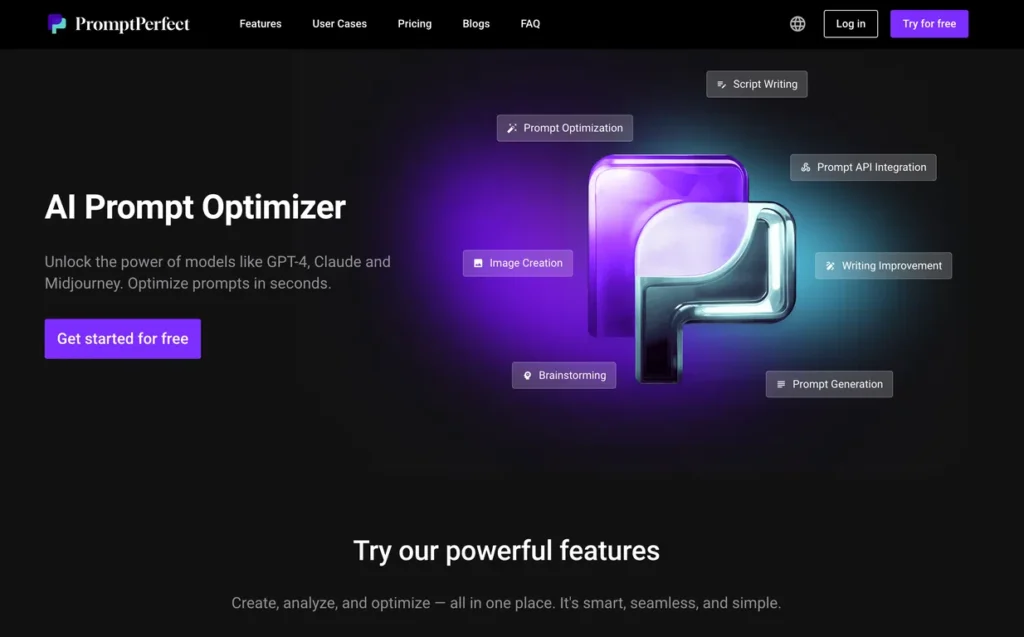
Jina AI’s ML-powered refiner. Cross-model: GPT-4, Claude, Midjourney. Reverse image-to-prompt is genuinely useful.
Cross-modal differentiation — text + image in one tool is the real value here, not prompt refinement alone
Credit ceilings frustrate bursts — heavy users hit limits exactly when deadlines arrive
Reverse engineering — image-to-prompt capability that frontier UIs don’t yet match
Core value eroding — eWeek notes native UIs increasingly match the text refinement use case
Free tier · Pro $19.99/mo · Pro Max $99.99/mo — promptperfect.jina.ai
Cat 1 · Best Free Option
Originality.ai Generator
No signup. Describe task, get structured prompt for ChatGPT/Claude/Gemini. Fastest way to get started.
Zero friction — no account, instant output, genuinely useful for one-off tasks
No history — nothing saves between sessions; grows out fast when your use case repeats
Free — originality.ai/free-ai-prompt-generator
04 — Category 2: Organize & Reuse — For Teams
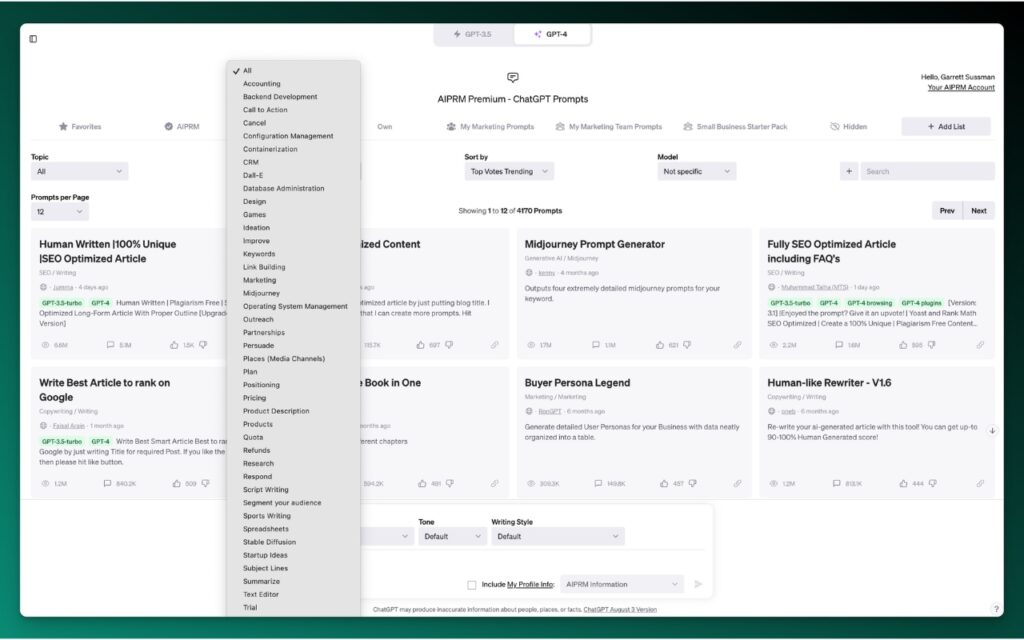
This is where the platform lock-in conversation matters most. AIPRM is genuinely excellent — if you’re a ChatGPT-only team. The moment you go multi-model, the library you’ve built becomes a migration problem. Check your model roadmap before committing.
Cat 2 · Best for SEO/ChatGPT Teams
2M+ users. Browser extension in ChatGPT. Best-in-class template library for marketing and copy.
Zero-friction templates — non-technical users get structured outputs without writing prompts from scratch
ChatGPT lock-in — every template needs manual re-engineering for Claude or Gemini
2M+ user community — template library quality is high because volume is high
Strict refund policy — several G2 reviews flag this; check before billing annual
Free tier · Plus $20/mo · Business $499/mo — aiprm.com
⚠ Model Lock-In Risk
If your team is currently ChatGPT-only but may go multi-model in the next 12 months, your AIPRM library becomes a migration liability. The templates don’t transfer cleanly. Build with this in mind.
Cat 2 · Best Cross-Model
Juma (formerly Team-GPT)
Follow-up builder creates structured prompts. Multiple LLMs. Enterprise customers include Maersk, EY.
Model-agnostic — no lock-in; prompts work across frontier models
Self-promotional comparisons — Juma-authored roundups rank Juma highly; G2 confirms flexibility but treat vendor claims with appropriate skepticism
Contact for pricing — juma.ai
Cat 2 · Best for One-Off Purchases
Marketplace: buy crafted prompts for $1.99–9.99. Strong image generation inventory.
Per-prompt purchasing — no subscription; pay for exactly what you need
Per-prompt costs compound — teams that use this regularly often find a subscription tool cheaper within 2 months
Per prompt $1.99–9.99 · 20% seller commission — promptbase.com
War Story · Category 1/2 Governance Failure · 2023 — Still Relevant
Samsung, 2023. Engineers used ChatGPT for code review and meeting summaries — category 1 and 2 tools being used in a production context without a governance layer. Three separate incidents: proprietary source code in one session, internal meeting notes in another, test data in a third. All of it sent to OpenAI’s servers.
Samsung’s response: a 1,024-byte input cap, then a full internal ban on external generative AI tools. The incident is documented via Bloomberg and CIO Dive. The cost asymmetry — the part that makes this more than a cautionary tale — is worth naming precisely.
Time saved (generating with ChatGPT)
Minutes per session across a few weeks
Cost of governance failure
Legal review, ban implementation, 1,024-byte cap engineering, internal trust damage, months of restricted productivity for affected teams
The lesson: Category 1 and 2 tools are efficiency plays. They are not privacy layers. If your organization handles IP, PII, health data, or anything regulated — governance is not a later problem. It’s a precondition, not an afterthought. The EU AI Act applies from August 2, 2026 (AI Act timeline). Data residency matters. Vendor logging matters. This is the conversation to have before the first prompt, not after.
05 — Category 3: Version & Deploy — For AI Teams
The mental model shift that makes this category click: treat prompts as code. Version them. Track changes. Roll back without redeploying. If your team is still editing prompts by modifying a string in application code and pushing a release, this category is where you need to be.
One thing I want to say plainly before the tool cards: both tools in this category log your API calls. If you’re in healthcare, legal, or any regulated vertical, check the vendor’s HIPAA BAA status and data residency policy before you use them with anything sensitive. Latitude’s June 2025 privacy research found that sensitive data sharing in AI tools is up 485% from 2023 to 2024, with 38% of that unauthorized. That number is why governance in this category is not optional for regulated teams.
Cat 3 · Best No-Code Deployment
Visual editing and deploy. Jinja2 templating. The least technical entry point to production prompt management.
Visual editing — non-engineers can manage prompts without touching application code
Eval depth ceiling — regression testing is limited; supplement with Promptfoo if you need security testing
Jinja2 templating — dynamic variables without code; significant time saver at scale
Logging exposure — PHI-adjacent healthcare data requires HIPAA BAA verification before use
Free: 10 prompts · Pro $49/mo — promptlayer.com
⚠ Cloud Squeeze Risk
AWS Bedrock and Google AI Studio now offer free prompt versioning. PromptLayer’s moat is the visual editor and no-code accessibility — if your team is technical and already on a cloud platform, check what you already have before paying separately.
Cat 3 · Best Visual Workflows
Orchestration + RAG + staging environments. More powerful than PromptLayer; steeper learning curve.
RAG integration — retrieval pipelines and prompt management in one place; significant architectural simplification
Visual tracing limits — complex agent workflows hit the ceiling; TechTarget reviewers flag this
Staging environments — separate dev/staging/production for prompts is genuinely useful at scale
Overkill under 10K daily interactions — the overhead-to-value ratio inverts at small scale
Free: 30 credits · Pro $25/mo — vellum.ai
06 — Category 4: Evaluate & Monitor — For Production
This is the category teams arrive at last and wish they’d reached first. I’ve seen this pattern enough times to say it plainly: the teams who built eval infrastructure before they needed it spent money they resented. The teams who built it after their first regression incident spent three times as much and had a bad quarter doing it.
One caution that doesn’t appear in most reviews: eval harnesses can deskill prompt intuition. Teams optimize for metric scores and gradually lose the judgment to understand why outputs fail — only that they failed. I’ve seen this pattern in forums and in client teams. The tool doesn’t replace judgment. It measures the outputs of judgment. Keep that distinction active.
Cat 4 · Best for Scale Evaluation
Loop assistant iterates on prompts. GitHub CI gates. SOC 2 certified. The production-grade standard.
GitHub integration — eval runs as CI gates; regressions blocked before they reach production
Code-first — new teams spend a month building infrastructure before they see useful eval data
SOC 2 certified — enterprise and regulated environments can use this without a custom security review
Braintrust-authored comparisons — their “best overall” claims need independent validation; eWeek and TechTarget provide it
Free: 5 users · Pro $249/mo — braintrust.dev
⚠ Timing Risk
I’ve seen PMs buy Braintrust before they had baseline performance data. Without a baseline, you can’t interpret what the evals are telling you. Build the baseline first — even a spreadsheet of manual ratings counts — then graduate to the eval harness.
Cat 4 · Best for LangChain Teams
Native chains and agent observability. Hub for loading prompts into LangChain pipelines.
Native LangChain integration — zero configuration if you’re already on LangChain; traces work immediately
Value tied to LangChain — if your team moves off LangChain, the tooling investment doesn’t transfer cleanly
Contact for pricing — smith.langchain.com
Cat 4 · Best for Security Testing
Red-teaming against 50+ known failure modes. Open-source CLI. The only free option in this category.
50+ failure modes — systematic red-teaming that catches injection vulnerabilities and safety regressions
No visual interface — CLI-only; requires technical setup that non-engineers won’t manage independently
Free and open-source — the only Cat 4 tool with no cost barrier; regulated teams should run this before any other eval
Not a substitute for full eval infrastructure — security-focused, not performance-focused; pair with Braintrust for complete coverage
Free (open-source) — promptfoo.dev
07 — Full Comparison Matrix
| Tool | Category | Core Strength | Critical Limit | Pricing | Best For |
|---|---|---|---|---|---|
| PromptPerfect | GEN | Cross-modal text + image | Credit ceilings; core value eroding | Free · $19.99/mo | Image+text workflows |
| Originality.ai Gen | GEN | Zero friction, no signup | No history, no teams | Free | One-off individual tasks |
| AIPRM Pro | ORG | Template library, 2M+ users | ChatGPT lock-in | Free · $20/mo | SEO/marketing, ChatGPT-only teams |
| Juma | ORG | Multi-model, follow-up builder | Self-promotional comparisons | Contact | Multi-model content teams |
| PromptBase | ORG | Per-prompt marketplace | Per-prompt costs compound fast | $1.99–9.99/prompt | One-off image generation |
| PromptLayer | VER | Visual editing, no-code | Eval ceiling; logging exposure | Free · $49/mo | Non-technical AI teams |
| Vellum | VER | RAG + staging environments | Complex agent tracing limits | Free · $25/mo | Teams with RAG pipelines |
| Braintrust | EVAL | GitHub gates, SOC 2, loop assist | Code-first; slow onboarding | Free · $249/mo | Production AI teams at scale |
| LangSmith | EVAL | Native LangChain traces | Tied to LangChain ecosystem | Contact | LangChain-native teams |
| Promptfoo | EVAL | Red-teaming, free, open-source | CLI only, no visual | Free | Security-focused teams |
Source: Synthesis from Braintrust (2026), eWeek (2025), TechTarget (2025–2026), G2 reviews current to early 2026. Braintrust-authored figures for Braintrust independently verified via eWeek and TechTarget.
08 — Where This Market Is Going — and What It Means for You
The hyperscaler integration story is real and worth taking seriously. Microsoft has unified AutoGen and Semantic Kernel. AWS Bedrock offers free versioning. Google AI Studio has prompt management built in. These aren’t feature announcements — they’re structural pressure on Category 3 standalone tools, specifically.
The agent transition is the other shift worth watching. Single-prompt evals — the backbone of how Braintrust and Promptfoo work today — will stress as teams move toward multi-step agent chains where the output of one prompt is the input to the next. Vellum and Braintrust are both building toward this. By 2027, the eval category will likely split into prompt-level and agent-level tools.
What teams are ignoring: migration costs. Teams building extensive prompt libraries in ChatGPT-locked tools (AIPRM is the canonical example) are accumulating a migration liability that compounds with every new template. No evals before migration means regressions hit hard during the transition. I’ve seen this play out twice in the past year.
Forward-Projecting Synthesis — Mordor Intelligence 2025 + Microsoft AutoGen/Semantic Kernel Unification + Category 4 Adoption Lag Data
Read together, three signals point toward a specific failure mode arriving in 2026–2027 that no single source names directly: the teams that delayed Cat 4 adoption will face compound remediation costs at exactly the moment they’re being asked to scale agentic pipelines.
Here’s the mechanism. Mordor shows Cat 4 (Evaluate) as the highest-growth segment with no cloud equivalent. Hyperscaler unification is compressing Cat 3 margins but not touching eval depth. And the teams I audit consistently show the same two-year lag between Cat 1/2 adoption and Cat 4 adoption — which means the teams who started with generators in 2023 are only now reaching production scale, exactly when agent orchestration is raising the complexity of what needs to be evaluated.
The organizations best positioned in 2027 will be those that built eval infrastructure before their first agent deployment, not after their first agent regression. The gap between those two timelines, measured in production incidents, is the real cost of the ranking problem this article started with.
09 — What to Do This Week — By Role
1
Solo writer or marketer
Spend 30 minutes with PromptPerfect’s free tier (promptperfect.jina.ai) if you work cross-modal (text + image). If text-only: use the built-in refinement in whatever frontier model you’re paying for. Don’t add a category 1 subscription until you’ve confirmed native tools don’t cover your use case. They usually do now.
2
Content team of 5+
Start a Juma trial (juma.ai) if you’re multi-model, or AIPRM (aiprm.com) if you’re ChatGPT-committed for the next 12 months. Before committing: can non-technical members build and share prompts without engineering help? Test that specifically. If yes, you’re in the right category. If the answer is “not yet,” you may be buying ahead of your actual workflow maturity.
3
AI product or engineering team
Run Promptfoo against your current production prompts this week — it’s free, open-source, and will surface injection vulnerabilities and failure modes you may not know you have (promptfoo.dev). Then start a 30-day PromptLayer trial (promptlayer.com) to build traces. After 30 days of trace data, you’ll have the baseline Braintrust needs to be useful. Don’t skip that sequence.
4
Regulated industry (healthcare, finance, legal)
Before any tool: request the vendor’s DPA (Data Processing Agreement) and verify data residency. For healthcare, ask specifically about HIPAA BAA. The EU AI Act applies from August 2, 2026 — if you’re handling EU data, your logging configuration is a compliance matter, not just a performance one. Run Promptfoo on day one (promptfoo.dev) — it’s the only free Cat 4 option and red-teaming before production is not optional for regulated use cases.
“The teams who built eval infrastructure before they needed it resented the spend. The teams who built it after their first regression incident spent three times as much and had a bad quarter doing it.”
Author observation — 50+ engineering team audits, 2023–2025
Primary Sources
- Mordor Intelligence — Prompt Engineering and Agent Programming Tools Market Report, August 2025. Market size, CAGR, segment forecasts. Treat directional — segment delineation in fast-moving markets carries significant estimation error.
- Braintrust — Best Prompt Engineering Tools 2026, February 2026. Self-promotional where Braintrust is concerned; used for competitive landscape mapping and independently verified via eWeek and TechTarget.
- eWeek — 6 Best Prompt Engineering Tools, 2025. Independent editorial; used to corroborate vendor claims and track commoditization trends (PromptPerfect value erosion).
- TechTarget — Compare 9 Prompt Engineering Tools, 2025–2026. Independent editorial; used for enterprise feature comparisons and Vellum tracing limitation documentation.
- Bloomberg — Samsung Bans ChatGPT After Internal Leak, May 2023. Primary documentation of Samsung incident.
- CIO Dive — Samsung 1,024-byte cap implementation and subsequent ban details, 2023.
- Latitude — AI Privacy Risks Report, June 2025. Sensitive data sharing figures (485% increase, 38% unauthorized). Report cited via secondary coverage; primary at latitudegeo.com.
- EU AI Act — Implementation Timeline. Full enforcement from August 2, 2026.
- Fortune — MIT Report: 95% of GenAI Pilots Failing, August 2025. Self-reported survey data via MIT study. Treat as directional; companies are reluctant to share failure rates, which may bias toward underreporting failures.
- Glassdoor — Prompt Engineer Salary Data, February 2025. Average $136,000 U.S. Self-reported salary data; treat as approximate.
https://www.bestprompt.art/epic-contribution-guide/
https://www.bestprompt.art/ai-prompts-for-business-efficiency/
https://www.bestprompt.art/ethical-prompt-engineering/
https://www.bestprompt.art/ai-prompts-that-actually-work-for-readers/
https://www.bestprompt.art/advanced-prompt-fine-tuning-tools/
https://www.bestprompt.art/10-must-know-prompt-engineering-techniques/
https://www.bestprompt.art/prompt-engineering-market-2025/
https://www.bestprompt.art/turn-ai-outputs-into-projects/
https://www.bestprompt.art/ai-code-debugging-2025/
https://www.bestprompt.art/ai-impact-the-future-of-human-creativity/
https://www.bestprompt.art/ai-roi-2026/
https://www.bestprompt.art/how-far-can-ai-progress/