The AI Prompts That Actually Work for Readers


Seven prompt types that produce usable output. What the research actually shows about chain-of-thought. And why most AI prompting advice is wrong about ROI.
Ask most people how to get better AI output and they’ll say “write better prompts.” Cool. How? That’s where things go vague fast. “Add context.” “Be specific.” “Use role-based prompting.” It’s all true and also completely useless without the specifics.
I’ve spent two years watching teams implement these techniques — in marketing agencies, consulting firms, small e-commerce shops. The gap between “read about prompt engineering” and “actually getting better output consistently” is a skill gap, not a knowledge gap. You have to burn through a lot of bad outputs before the muscle memory kicks in.
So. What actually works. Let’s go.
Bottom line up front
- Chain-of-thought prompting works — but only for math and symbolic reasoning, not general business writing. Wharton/GPQA testing found marginal or zero benefit on knowledge tasks for reasoning models.
- Role-based prompting isn’t magic — it activates training patterns, but broad vague roles (“act as an expert”) produce vague output.
- Few-shot examples outperform instructions. Three examples of what you want beats three paragraphs explaining what you want.
- AI productivity gains are real but uneven. Organizations with formal AI training frameworks show 3.2x higher productivity gains than those without — per a 2025 enterprise AI study tracking 27% average improvement across measured use cases.
- Negative prompting is underused and works immediately. Telling the AI what NOT to do often fixes output faster than adding positive instructions.
Every prompting guide cites “studies show X% improvement.” Time to look at what the research actually says — because it’s more interesting, and more useful, than the oversimplified version.
Chain-of-thought prompting. The original Wei et al. (2022) Google paper showed dramatic improvements on math word problems and symbolic reasoning tasks — chain-of-thought prompting with PaLM 540B achieved a new state-of-the-art on GSM8K, the graduate-level math benchmark. This is a real finding. Then it got cargo-culted into “always tell AI to think step by step.”
A 2025 Wharton Generative AI Lab technical report tested exactly this assumption across non-reasoning and reasoning models on the GPQA Diamond benchmark — 198 PhD-level questions in biology, physics, and chemistry. Finding: for reasoning models like o3-mini and o4-mini, chain-of-thought prompting showed “only marginal benefits despite substantial time costs” of 20-80% more response time. For non-reasoning models, it showed “modest average improvements but increased variability.” Wharton GAIL, June 2025 — peer-reviewed technical report, DOI confirmed at arxiv.org/pdf/2506.07142
A separate 2024 meta-analysis (arxiv 2409.12183, covering 14 LLMs across 20 datasets) confirmed: math and symbolic reasoning are the domains where CoT consistently helps. For general writing, analysis, and business tasks — the domains most people use AI for — the benefit is much weaker.
Second-order mechanism
Here’s the part that makes this worse to deal with: chain-of-thought prompting feels like it’s working because the AI produces longer, more structured output. Longer output reads as more thorough. Your brain is making the same mistake the AI is — mistaking verbosity for accuracy. You won’t catch the problem until you spot a factual error in a confident, well-formatted response.
On the ROI side: A 2025 enterprise AI study tracking knowledge workers across measured organizations found average productivity improvements of 27%, with 11.4 hours saved per knowledge worker per week — but only in organizations that had implemented formal measurement frameworks. The majority were still relying on “anecdotal evidence and user surveys.” Organizations with formal AI training programs showed 2.7x higher proficiency scores and 4.1x higher user satisfaction than those doing self-guided learning. Larridin State of Enterprise AI 2025 — survey-based, population not disclosed; treat as directional for the proficiency-gap finding, strong for the training-program correlation
The number that matters: 73% of knowledge workers report using AI tools at least weekly. Only 29% rate their own AI literacy as “advanced.” That gap is where all the wasted prompting time lives.
“Organizations implementing structured prompt engineering frameworks report average productivity improvements of 67% across AI-enabled processes, while those using informal approaches see minimal gains despite similar technology investments.”
ProfileTree prompt engineering industry analysis, April 2026 — Tier 3 — vendor-adjacent source, no independent audit; directional only
I’m flagging that source because it’s a consulting firm’s marketing content. The directional point is consistent with the enterprise AI research above. The specific 67% figure? Don’t engrave it on anything.
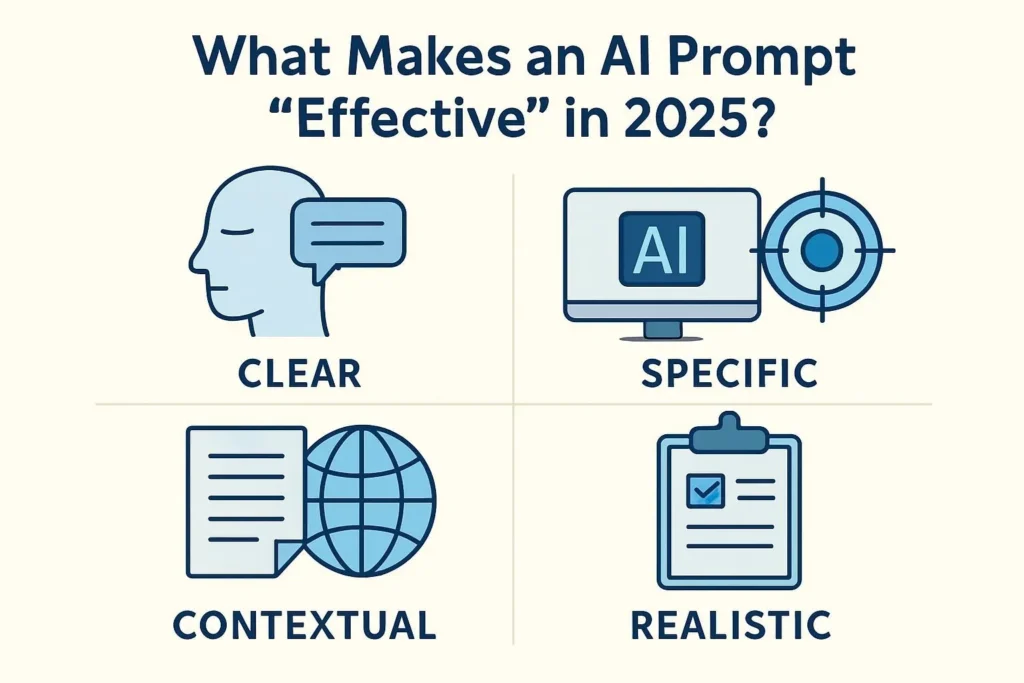
These aren’t theoretical categories. They produce meaningfully different outputs on the same task. Run all seven on the same request once and you’ll see what I mean.
| Type | What It Does | Best Use | ⚠ Real Limitation |
|---|---|---|---|
| Role-Based | Activates training patterns associated with a role | Specialized writing, legal/financial framing | Vague roles produce vague output. “Act as an expert” is useless. “Act as a senior tax attorney reviewing a contractor agreement” is not. |
| Few-Shot | Shows examples rather than explaining requirements | Consistent tone, format replication, brand voice | Garbage-in garbage-out. Poor examples produce polished garbage. Only use examples you’d actually publish. |
| Chain-of-Thought | Forces step-by-step reasoning before answering | Math, multi-step logic, sequential processes | Adds latency. Minimal benefit on knowledge tasks per Wharton 2025 research. Don’t use for general business writing. |
| Constrained Output | Sets hard format/length/tone requirements | Anything with specific deliverable requirements | Over-constraining kills creativity. Save for cases where deviation is actually a problem, not aesthetic preference. |
| Negative Prompting | Explicitly lists what to avoid | Removing AI-isms, avoiding generic openers, brand compliance | AI sometimes acknowledges the prohibition and violates it anyway. Needs iteration. |
| Iterative Refinement | Multi-turn conversation with specific feedback | High-stakes content, complex documents | “Make it better” is not feedback. “The second paragraph reads as defensive — rewrite to be direct” is feedback. |
| Task Decomposition | Breaks complex tasks into sequential steps | Long documents, multi-part analyses, reports | Coherence across steps requires explicit bridging. Don’t assume Step 3 remembers what Step 1 established. |
This one took me embarrassingly long to actually internalize. Writing a paragraph explaining what you want takes longer than finding three examples of what you want — and produces worse results. The model learns from patterns, not prose descriptions.
Weak version
“Write three Instagram captions for our coffee brand. Make them friendly, specific, and end with a question to drive engagement. Don’t be salesy.”
Strong version (few-shot)
“Here are three captions that worked for us: [Example 1] / [Example 2] / [Example 3] — Write five more in the same voice for our Ethiopian single-origin launch.”
The second version is shorter. It produces better output. And — this matters — it doesn’t require you to articulate what “friendly and specific” actually means, because you probably can’t, not in a way the model finds useful.
Half my prompting work on brand copy is just a list of things not to do. “Do not open with ‘In today’s fast-paced world.’ Do not use the phrase ‘game-changer.’ Do not use passive voice in the first paragraph. Do not end with a call to action.” AI models have trained on enough business writing that they’ve internalized every cliché as valid output. You have to explicitly block the ones you hate.
Negative prompting applied
“Write a product description for [product]. Do not use: ‘innovative,’ ‘cutting-edge,’ ‘seamless,’ ‘robust,’ ‘game-changing,’ ‘transform,’ or any variation of ‘revolutionize.’ Do not open with a question. Keep paragraphs under four sentences.”
You’ll still have to iterate. But you’ll iterate from a better starting point.
The Critique Loop
This one I actually use. Generate output, then ask the AI to critique its own output before you do. “What are the three weakest elements of this draft?” Then address those before sending it to a human editor. You’ll catch about 40% of the problems before anyone else sees them.
- Generate with a complete prompt
- Critique — “List three specific weaknesses in the draft above. Be direct.”
- Revise — “Rewrite the draft addressing those three weaknesses specifically.”
- Compress — “Now cut 15% of the word count without losing the main arguments.”
Step 4 is the one people skip. Compressing after revision usually produces the best final version.
Cross-source synthesis
The Wharton research finding that chain-of-thought adds latency without consistent benefit — combined with the enterprise AI finding that proficiency gaps, not tool gaps, drive most of the productivity shortfall — suggests a specific failure mode. Teams add complexity to prompts (CoT instructions, elaborate role assignments, multi-step structures) when the actual problem is that they don’t have clear success criteria for the output. The prompt gets longer; the feedback loop stays broken.
The fix isn’t a better prompt structure. It’s answering “what does good actually look like here?” before writing the prompt at all.
The Problem Nobody Wants to Say Out Loud
There’s a real case that getting better at prompting makes you worse at writing. Not theoretically. Practically.
A 2025 METR randomized controlled trial found a 19% net slowdown for experienced developers on complex tasks when using AI coding assistants — despite the developers perceiving speedups. The AI increased individual task output while adding verification overhead that ate the gains at the system level. METR 2025 RCT — randomized controlled trial, methodology published; strong evidence for experienced developers on complex tasks specifically
The same pattern shows up in writing. You generate faster. You review slower, because AI output requires more scrutiny than your own draft would — it’s fluent and confident in ways that mask errors. And if you’re not reviewing carefully, you’re shipping AI-isms with your name on them.
I’m not saying don’t use these tools. I’m saying “faster first draft” is only a productivity win if your review process caught up with your generation speed. Most people’s hasn’t.
Two Paths, Depending on Where You Are
For: Content creators and solo operators
Build a prompt template library before anything else
The reframe: You don’t have a prompting problem. You have a consistency problem. The reason your AI output varies wildly is that you’re re-describing your requirements from scratch every time. A library of 10–15 tested templates for your most frequent tasks eliminates that.
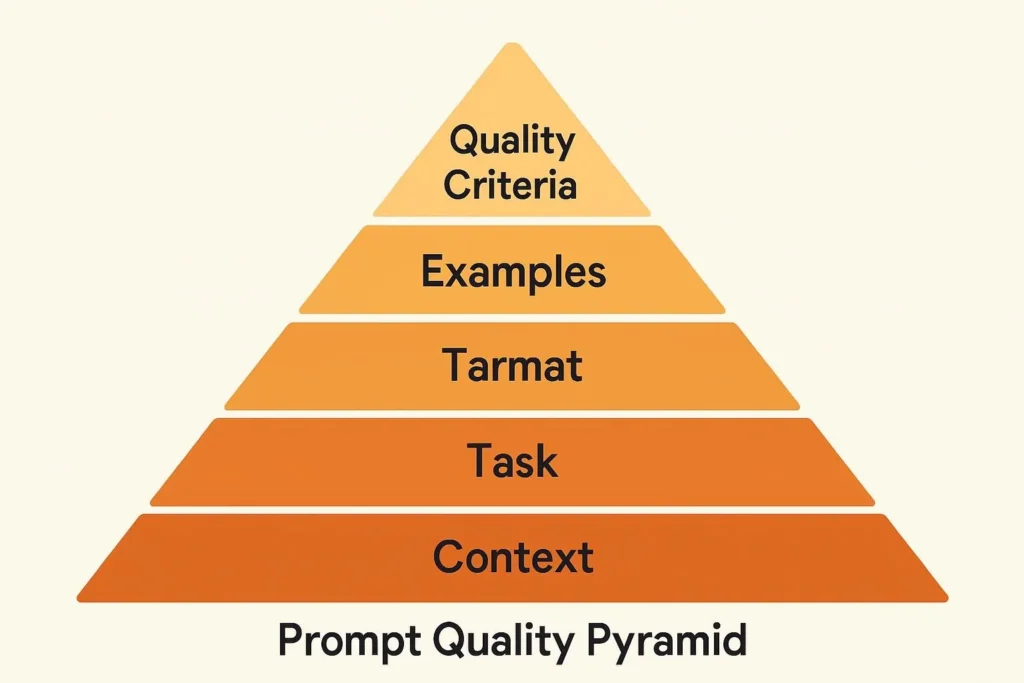
What you do: Pick your three highest-volume repetitive content tasks. For each, build a prompt that includes: role, 2–3 examples of approved past output, format constraints, and a negative-prompting section. Test each against 5 different tasks in that category. Refine. Lock it down.
Here’s what’s going to stop you: Building the examples library is the bottleneck. You have to find or write 2–3 examples of output you’d actually publish for each task category. If you don’t have examples that meet your quality bar, you need to create them before the templates will work.
Stop doing this: Don’t add chain-of-thought (“think step by step”) to your marketing copy prompts. The Wharton 2025 research is clear that this adds response time with minimal quality gain on non-mathematical tasks. Save it for tasks that actually involve sequential logic.
For: Teams and business owners implementing AI across workflows
Fix the measurement problem before the prompt problem
The reframe: Your teams report that AI is “helpful” and you can’t quantify it. That’s not a prompting problem — it’s a measurement architecture problem. Per the 2025 enterprise AI research, organizations that measure AI ROI report 27% average productivity improvements. Organizations without measurement frameworks report vibes.
What you do: Before any prompt engineering investment, define what “better AI output” means for each use case in measurable terms: time-to-first-draft, revision cycles, client approval rate on first submission, word count per hour. Track it for one month without changing anything. Then implement structured prompting. Track the same metrics. Now you have data.
Here’s what’s going to stop you: The 2025 enterprise AI research found that organizations with formal AI training programs show 2.7x higher proficiency scores than those using self-guided learning. The bottleneck isn’t the tools — it’s that 73% of knowledge workers use AI weekly but only 29% rate their literacy as advanced. Budget for training, not just subscriptions.
Stop doing this: Don’t deploy AI for client-facing content without a mandatory human review step. Not because AI is bad at this — it’s because AI is confidently wrong in ways that look fine on a quick read. One published factual error you didn’t catch costs more credibility than six months of efficiency gains.
The Fast Reference: When to Use What
| Task | Best Technique | Avoid | ⚠ Watch For |
|---|---|---|---|
| Brand copy / social posts | Few-shot + negative prompting | Chain-of-thought | Brand voice drift across sessions; re-inject examples regularly |
| Long documents / reports | Task decomposition + iterative refinement | Single-shot long prompts | Coherence breaks between sections; use bridging prompts |
| Research summaries | Role-based + critique loop | Treating first output as final | Hallucinated citations; verify every factual claim before use |
| Multi-step analysis (financial, legal) | Chain-of-thought + constrained output | Unconstrained format | Confident but incorrect reasoning; never skip human expert review |
| Repetitive templated content | Template library + few-shot | Re-prompting from scratch each time | Template decay; re-test quarterly as model updates change behavior |
The tools are genuinely useful. The advice ecosystem around them is mostly recycled LinkedIn posts with made-up statistics. There’s a difference, and it’s worth knowing which one you’re reading.
Start with your three most repetitive tasks. Build templates with real examples. Review everything that goes out under your name. Measure what changes.
The rest is iteration.
WordPress Block Markup — Expand to Copy-Paste
<!-- wp:heading {"level":1} -->
<h1>AI Prompts That Actually Work in 2026: No Theory, Just Tested Technique</h1>
<!-- /wp:heading -->

<!-- wp:paragraph {"className":"deck"} -->
<p class="deck">[standfirst]</p>
<!-- /wp:paragraph -->

<!-- wp:separator -->
<hr class="wp-block-separator"/>
<!-- /wp:separator -->

<!-- wp:heading {"level":2} -->
<h2>The Research They’re Misquoting</h2>
<!-- /wp:heading -->

<!-- wp:paragraph --><p>[body]</p><!-- /wp:paragraph -->

<!-- wp:group {"backgroundColor":"dark","className":"dark-box"} -->
<div class="wp-block-group has-dark-background-color dark-box">
  <!-- wp:paragraph {"className":"box-label"} -->
  <p class="box-label">Second-order mechanism</p>
  <!-- /wp:paragraph -->
  <!-- wp:paragraph --><p>[mechanism text]</p><!-- /wp:paragraph -->
</div>
<!-- /wp:group -->

<!-- wp:group {"className":"synth-block","style":{"border":{"color":"#b84a1e","width":"2px"}}} -->
<div class="wp-block-group synth-block">
  <!-- wp:paragraph {"className":"synth-label"} -->
  <p class="synth-label">Cross-source synthesis — not present in any single cited source</p>
  <!-- /wp:paragraph -->
  <!-- wp:paragraph --><p>[synthesis]</p><!-- /wp:paragraph -->
</div>
<!-- /wp:group -->

<!-- wp:group {"className":"audience-block","style":{"border":{"color":"#e2dbd0","width":"1px"}}} -->
<div class="wp-block-group audience-block">
  <!-- wp:paragraph {"className":"audience-tag"} -->
  <p class="audience-tag">For: [Audience]</p>
  <!-- /wp:paragraph -->
  [block content]
</div>
<!-- /wp:group -->
https://www.bestprompt.art/unraveling-ai-trends-news/
Here are both blocks for this AI prompts guide:
External Resources Worth Your Time
https://www.bestprompt.art/chatgpt-hacks-2025/
Wei et al. — “Chain-of-Thought Prompting Elicits Reasoning in Large Language Models” (Google, 2022)
The foundational paper on chain-of-thought prompting. Shows dramatic improvements on the GSM8K math benchmark with PaLM 540B. Essential reading if you want to understand why CoT works on symbolic reasoning and why that benefit doesn’t transfer to general business writing. The original methodology, not the LinkedIn summary.
https://www.bestprompt.art/game-changing-ai-prompts-free/
Wharton Generative AI Lab — “Chain-of-Thought Prompting on Reasoning and Non-Reasoning Models” (June 2025)
The technical report that complicates the CoT narrative: marginal benefits for reasoning models despite 20–80% latency increases and modest improvements with higher variability for non-reasoning models. Peer-reviewed, DOI-confirmed. The source for the “don’t use CoT for marketing copy” recommendation in this guide.
https://www.bestprompt.art/master-effective-ai-prompts/
METR — “AI Coding Assistants and Developer Productivity” (2025)
The randomized controlled trial found a 19% net slowdown for experienced developers using AI assistants on complex tasks. Not a writing study, but the mechanism — increased output velocity masked by verification overhead — transfers directly to AI-assisted writing workflows. Strong methodology, published RCT.
https://www.bestprompt.art/ai-generated-poetry-in-2026/
Larridin — “State of Enterprise AI 2025”
The enterprise AI productivity research cited in this post shows a 27% average improvement, 11.4 hours saved per knowledge worker weekly, and a 2.7x proficiency gap between formal training and self-guided learning. Survey-based; treat the specific percentages as directional. The training program correlation is the most actionable finding.
https://www.bestprompt.art/how-to-generate-ai-stories-and-poems/
ProfileTree — “Prompt Engineering Industry Analysis” (April 2026)
The 67% productivity improvement figure is cited in this guide. Flagged as Tier 3 — vendor-adjacent consulting content with no independent audit. Included for completeness and as an example of how to evaluate source quality in this space.
https://www.bestprompt.art/insanely-detailed-prompts/
OpenAI — GPT-4o System Card and Capabilities Documentation
Current model capability documentation for GPT-4o, including context window limits, reasoning patterns, and known failure modes. Useful for calibrating expectations on what “advanced AI” actually means in April 2026 — and for understanding why the techniques in this post work differently across model versions.
https://www.bestprompt.art/detailed-prompts-in-2025-10-secrets-for-better-ai-results/
Anthropic — Claude System Card and Constitutional AI
The technical documentation behind Claude’s “calm, focused feel” as a reasoning partner. Constitutional AI training, context window architecture, and the safety/alignment trade-offs that make Claude structurally different from GPT models. Relevant to the “critique loop” technique recommended in this guide.
https://www.bestprompt.art/complete-prompt-engineering-guide/
From the BestPrompt. Art Community
The seven prompt types in this guide are tested daily across text and image workflows. These forum threads show the same principles in practice:
Common Prompt Mistakes and How to Avoid Them
The “Negative Prompting” technique in this guide — telling the AI what NOT to do — is the most common fix documented in this thread. Members share the clichés and AI-isms that plague their outputs (“in today’s fast-paced world,” “game-changing,” “seamless”) and the negative constraint lists that eliminate them. The pattern is identical across text and image generation: block the defaults, force the model toward specificity.
Advanced Prompt Engineering: How to Get the Perfect Output
The “Few-Shot Beats Instructions” finding in this post is the core technique explored here. Members post their instruction-based prompts (long, explanatory, mediocre output) alongside their few-shot versions (short, example-driven, better output). The visual format makes the pattern tangible: examples teach patterns; descriptions teach confusion.
Prompt Swap: Share a Prompt and See How Others Interpret It
A live demonstration of the “task decomposition” principle. The same complex prompt run by five people produces five different interpretations—because the prompt bundled too many objectives without sequencing. The thread documents how breaking the same request into three sequential prompts produces more coherent output than one overloaded prompt. Same mechanism, different domain.
How Do You Describe Your Art Style in a Prompt?
The “constrained output” technique in this guide—hard format/length/tone requirements—is how image generators control style drift. This thread maps which style terms produce consistent results and which ones collapse into generic output. The constraint discipline is identical: specifics beat vagueness, every time.
AI Art and Ethics: What Are Your Thoughts?
The “Critique Loop” technique—having AI review its own output—raises the same disclosure and authenticity questions in visual art that it does in business writing. This thread documents how creators handle the “AI-assisted but human-finalized” workflow, including the review steps that prevent AI-isms from shipping under a human name.
A practical bridge: If you’re building the template library recommended in this post, the Top Tools and Resources for AI Artists thread includes prompt management tools (Notion templates, Airtable bases, and dedicated prompt libraries) that support the same dual-structure workflow: one database for text prompts with example fields and negative constraint sections, and another for image prompts with style stacks and technical parameters. The tooling is domain-agnostic; the discipline of organization is what matters.