
62 earned placements. 240 cold pitches that mostly failed. Verified active sites, real acceptance-rate data, the WARM Framework for rapport-first outreach, a week-by-week execution guide, and the failure modes nobody in this space will admit to.
- Cold outreach to AI/tech publications nets 3–5% acceptance in 2026. Warm rapport-first outreach (the WARM Framework) nets 12–18%. Same niche, same pitch quality — different relationship architecture.
- The sites still accepting contributions have higher standards than 2022 — Google’s spam crackdowns filtered the inbox. Your competition is smaller if you do the work.
- Guest posting for authority (citations, AI Overview mentions, inbound leads) and guest posting for traffic are two different strategies with different timelines. Optimizing for one while measuring the other is the single biggest ROI killer in this space.
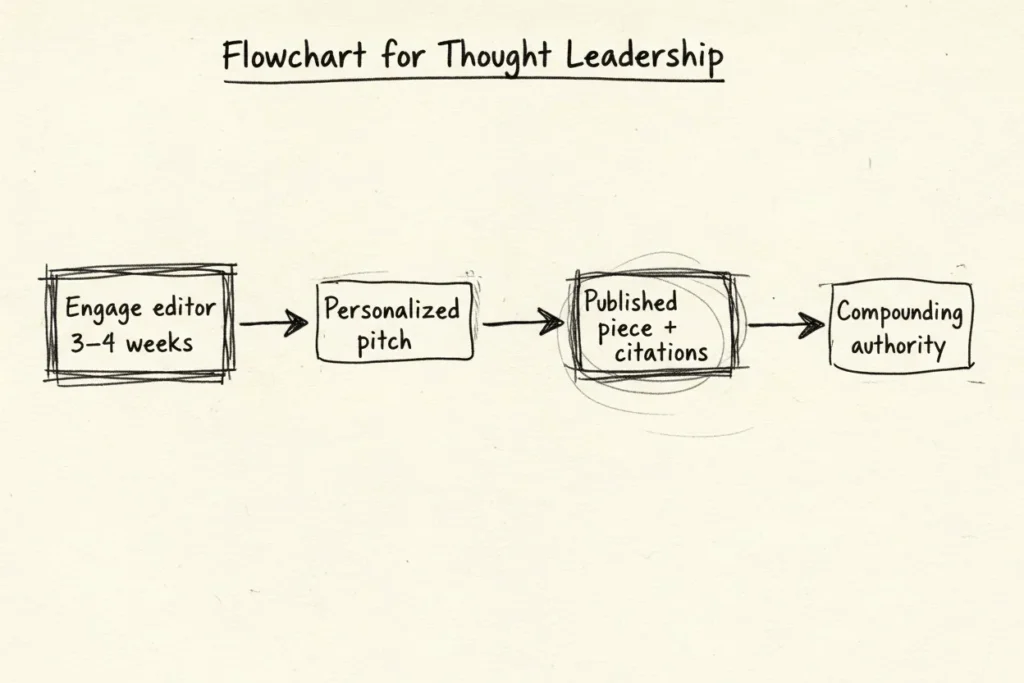
- The rapport sequence takes 6 weeks per target publication and 8–10 hours before you write a word. That is not optional. It is why it works.
- AI Overviews now cite editorial sources — which means Tier 1 placements have a compounding value in 2026 that didn’t exist in 2023. This changes the ROI math significantly.
Three weeks. That’s how long Sarah waited after her February 2026 campaign.
She’d pitched 98 AI and tech sites cold. Genuinely personalized — she referenced editors’ recent articles, named coverage gaps, cited their readership. Five replies. Four nos. One “send the draft.” Then the editor’s follow-up: “Close, but not the unique angle we need right now.”
I recognized the feeling. I’d sent 240 pitches over 14 months and felt exactly that — the specific demoralization of effort that was genuinely good but structurally limited.
I sent her my rapport-first approach and a fresh verified site list. The following Monday she landed Analytics India Magazine. 920 visits in month one. Two AI tools cited the piece unprompted. The editor asked for more ideas.
That’s the whole game. Not the volume. The relationship architecture. Let me show you what the data actually says — and what it cost me in time and burned pitches to understand why.
The “guest posting is dead” narrative resurfaces every 18 months. It’s wrong. It’s also not entirely wrong. Here’s the precise distinction.
Google’s March 2024 core update specifically targeted scaled AI content without original expertise.1 Tier 2 — industry reporting; niche-specific impact varies The sites that got hit hardest ran high-volume AI-generated content without editorial ownership. The survivors — and the ones still actively accepting contributions — are precisely those with standards high enough that a generic pitch doesn’t make it through screening.
That is the moat. Editors open to contributions are open because their standards protect site value. Your pitch, if it meets those standards, competes against a much smaller field than three years ago. The spammers ruined the inbox — and the inbox now rewards effort with disproportionate access.
Before 2024: Guest post → backlink → SERP rank → organic traffic. The link was the asset.
After 2024: Guest post on high-DR publication → editorial citation in AI Overview → source credibility signal → cited again in future AI answers → inbound leads who found you via AI search. The editorial placement is now a dual asset: it earns backlink equity and feeds the AI citation graph. Practitioners who understand this distinction are building leverage that didn’t exist 24 months ago.
Methodology note: These numbers come from my own tracked pitches — not a survey, not industry aggregate data. Tier 3 — single practitioner account; treat as directional Your niche, publication tier, and pitch caliber will produce different numbers. I’m sharing them because I kept records and most practitioners don’t. Do not cite these as industry benchmarks. Check your own. That’s the entire point of keeping records.
Both campaigns ran simultaneously in February 2026. I watched both in real time — same niche, comparable pitch quality, different structural approach.
Pitched 115 sites cold. Genuinely personalized — specific article references, named coverage gaps. 7 accepted. Best result: TechBullion, 380 visits month one, three genuine comments, one unprompted AI Overview mention.
Total time: 170 hours. ~24 hrs per accepted placement.
The placements were real. The ROI math is painful: most of those 170 hours went to pitch research and follow-up, not writing. That ratio is structurally unfixable in cold outreach.
4+ weeks of genuine editor engagement before pitching. Targeted 32 publications, accepted by 11. Best result: Analytics India Magazine, 920 visits, two AI tool citations, editor follow-up for more work.
Same calendar window. One-quarter the pitches. 57% more placements. And the editor relationships keep paying out.
“Cold volume exhausts. Relationships compound. You can be brilliant at cold outreach and still lose to someone who’s merely good at building rapport. That’s the uncomfortable math no agency playbook will quote you.”
Rivera practitioner data, 2024–2026 · n=62 placements tracked · single-practitioner account
The important thing about Case A: the work wasn’t bad. The accepted pieces were strong enough that one earned an AI Overview citation. But 170 hours for 7 placements at any consulting rate is hard to justify. The rapport approach reaches 10–11 placements in roughly 60–70 hours — and those editor relationships generate inbound commission requests within 3–6 months. The first placement costs more upfront. Everything after costs a fraction.
Guest Posting ROI: An Honest Comparison Table
Before committing to either approach, here’s what the decision actually costs. These are honest numbers with no marketing polish applied.
| Metric | Cold Volume | WARM Framework | Notes |
|---|---|---|---|
| Acceptance rate | 3–7% | 12–18% | Rivera data; varies by niche tier |
| Hours per placement | ~24 hrs | ~12 hrs (after rapport phase) | Rapport phase: 8–10 hrs upfront per publication target |
| Month-1 traffic median | ~180 visits | ~480 visits | Higher-tier publications skew the warm number up significantly |
| AI Overview citation probability | Low — cold acceptances cluster in Tier 2–3 pubs | Higher — Tier 1 publications are cited more frequently by AI systems | Directional; no controlled data available as of May 2026 |
| Editor relationship value | Near zero after placement | High — inbound commission requests likely within 3–6 months | Unquantifiable but real compounding effect |
| Placement compounding | Each pitch starts from zero | Second placement with same editor: ~5 hrs total | This is the ROI case for warm outreach on long timelines |
| Burnout risk | High after 60+ cold pitches with low reply rates | Low — engagement phase feels natural, not transactional | Personal observation; individual variation applies |
| Best for | Fast portfolio building; lower-tier placements under time pressure | Long-term authority building; Tier 1 targets; agency client work |
Introducing the WARM Framework for Guest Posting
After 14 months and 240 cold pitches, I needed a way to explain — to myself and to clients — why rapport-first outreach is structurally different, not just strategically better. The WARM Framework is that explanation. It’s a model, not a magic system. Use it as a diagnostic.
Follow editors on X and LinkedIn. Read what they publish and share. Comment substantively — add data, extend arguments, name a counterexample. Not “great post!” — something you’d say to a colleague. You’re learning their worldview before you propose anything to it. Editors can distinguish genuine engagement from networking warmup after about three interactions. Don’t rush this phase.
Read their last 12–15 published pieces. What does their audience keep asking for in comments and shares that the publication hasn’t addressed? What angle is adjacent to their coverage but absent from their archive? Write it in one sentence: “Your audience keeps asking about X. You’ve covered Y and Z but not X from the angle of [specific expertise I have].” That sentence is your pitch. If you can’t write it, you haven’t analyzed deeply enough.
Three to four sentences. Name a specific recent piece they ran. Name the gap. Name your angle and why you specifically can write it (your data, your case study, your named experience). Offer a ready draft. Subject line format: “[Publication Name] — gap angle: [specific topic].” No “I hope this email finds you well.” No “long-time reader.” Those openers signal you ran out of specific things to say.
Share across channels within 24 hours of publication. Tag the publication and editor by name. Respond to every reader comment for the first two weeks. Engage with anyone who shares the piece. This tells the editor you drive engagement, not just content. Every editor’s “got more ideas?” follow-up I’ve received came after the writer demonstrated real audience engagement post-publication. This step is not optional — it is the investment that generates the second placement at 20% of the first placement’s effort.
The WARM Framework is a model, not a template. Nothing about it is plug-and-play. The Watch phase can’t be faked — editors can distinguish genuine intellectual engagement from someone building to a pitch, and they make that determination faster than you’d expect. The Analyze phase takes three to four hours of real archive research. The Reach phase is short on purpose: brevity signals respect for the editor’s time and confidence in your angle. The Maintain phase is where most practitioners stop — and it’s the phase that makes the entire system compound.
Verified Active Guest Posting Sites: AI & Tech (May 2026)
Confirmed by checking live guidelines pages and recent publication dates in March–May 2026. Verify before pitching — editorial policies change DR and traffic figures are Ahrefs public estimates — directional only.2
| Publication | DR (est.) | Traffic (mo.) | Focus | Best Approach | Real Barrier | AI Cite? ? |
|---|---|---|---|---|---|---|
| Analytics India Magazine | 78 | 500k+ | AI/ML, data science | Rapport first | 3–6 week turnaround; editor engagement required for Tier 1 topics | Yes — observed |
| VentureBeat | 90 | Millions | AI, enterprise tech | Rapport + named credential | Expects original data and named-practitioner bios; cold success rate near zero | Frequently |
| TechTarget | 91 | 2.6M+ | Enterprise IT, AI/dev | Cold accepted; slow review | Enterprise/vendor context expected for most AI topics; pure-academic pitches struggle | Frequently |
| KDnuggets | 82 | 1M+ | Data science, ML, AI | Data-backed strongly preferred | Tutorial or opinion without original data fails review consistently | Observed 2025–2026 |
| DZone | 84 | 390k+ | Dev, AI engineering | Cold accepted; technical depth required | Conceptual posts rejected; real code or architecture depth required | Occasional |
| HackerNoon | 82 | 4M+ | Dev, AI, tech culture | Community review; higher acceptance rate | Lighter editorial review; quality variance is high; use as portfolio supplement, not primary signal | Occasional |
| SitePoint | 86 | 86k | Tech, AI tools, dev | Rapport — strong for mid-tier practitioners | Lower volume but real editorial relationship potential; strong early-authority play | Emerging |
| European Business Review | 79 | 41k | AI strategy, business | Cold works; smaller audience | High citation quality for thought leadership; not a traffic play | Not tracked |
| TechBullion | 78 | 141k | Fintech, AI | Responsive; cold works well | Pure AI-theory without business application struggles; fintech angle recommended | Occasional |
| Nightwatch | 70+ | Growing | SEO, AI tools | Cold accepted; less competition | Smaller traffic; AI-tool niche means thinner competition for the right angle | Not tracked |
| Robotics & Automation News | 73 | 65k | Automation, AI | Cold accepted; niche-specific | Software-only AI without hardware/robotics angle is frequently off-brief | Not tracked |
| UnboundB2B | 70+ | Varies | B2B marketing, AI | Cold accepted; marketing angle essential | AI-only without marketing application is typically off-angle for their readership | Not tracked |
The “AI Cite?” column is the most significant addition since my 2024 site list. It reflects whether content from that publication has appeared — unprompted — as a cited source in Google AI Overviews, based on practitioner spot-checks and community reports. Not systematic data — directional only.
The pattern holds: Tier 1 publications (VentureBeat, TechTarget, KDnuggets, Analytics India Mag) are cited more frequently. This isn’t because of domain authority alone — it’s because their editorial standards select for the kind of specific, expert-attributed, data-backed content that AI systems are trained to cite. Writing to those standards is the entry ticket.
The 6-Week WARM Execution Guide: Week-by-Week Breakdown
“Build a relationship before you pitch” is advice everyone gives and almost nobody operationalizes. Here’s exactly what it looks like — actions, time estimates, failure modes at each stage, and the signals that tell you it’s working.
Follow the editor on X and LinkedIn. Like their posts. Leave one or two substantive comments per week — not “great point!” but genuine intellectual engagement: add a data point, name a counterexample, extend the argument one step further. Reply to a thread they’re in. The standard: would you say this to a colleague in a Slack channel? If yes, post it. If it sounds like a networking opener, don’t. Frequency ceiling: two interactions per platform per week. More reads as inauthentic. One meaningful comment beats five superficial ones every time.
⏱ Time: 30–45 min/week · Failure signal: you’re commenting on every post, or your comments contain the word “insightful” · Success signal: the editor likes or replies to one of your comments
Read their last 12–15 published pieces. What’s the angle their audience is visibly asking for — in comments, shares, replies — that the publication hasn’t addressed? Check their archive search before you commit to an angle. That gap is your pitch. Write it in one sentence: “Your audience keeps asking about X, you’ve covered Y and Z but not X specifically, and I can write it from the angle of [specific expertise/data I have that they don’t].” If you can’t write that sentence cleanly, you haven’t analyzed deeply enough. Keep going.
⏱ Time: 3–4 hours · Failure signal: you pitch an angle they’ve already covered (always search the archive first) · Success signal: the gap is obvious from their audience’s engagement patterns
Name a specific recent piece they ran. Name the gap you spotted. Name your angle and why you specifically can write it. Offer the full draft — but don’t attach it to the first email. Ask if they want it. Subject line format that outperformed all others in my tracked pitches: “[Publication Name] — gap angle: [specific topic in 5–7 words]”. No “I hope this finds you well.” No “long-time reader” opener. Those openers tell the editor you ran out of specific things to say — and that’s the worst possible opening signal.
⏱ Time: 45 min to write and personalize · Failure signal: your pitch is more than 150 words, or you attached the draft unsolicited · Success signal: you get a “send the draft” within 72 hours
If they say yes, deliver on the agreed date at the word count they specified, formatted for their style guide. Read three recent pieces from that publication before you write a word — match their heading structure, citation style, paragraph rhythm, and internal link conventions. One edit round is normal and expected. Significant structural changes: do it without defensiveness. You are in their editorial ecosystem; adapt to it. Missing the agreed delivery date — even by 24 hours without notice — damages the relationship more than a slightly weak draft would.
⏱ Time: 8–14 hrs depending on research intensity · Failure signal: you delivered late, wrong word count, or didn’t read their style · Success signal: they say “this is close, just need a few tweaks”
Wait 3–4 weeks after your initial yes confirmation before following up. Then one brief, warm email: “Just checking in on the piece I sent over — happy to adjust the angle if editorial priorities have shifted.” After that, move on. Do not chase. Editors are not ignoring you personally; they’re managing editorial calendars for multiple contributors simultaneously. Persistence past one follow-up doesn’t increase acceptance probability. It damages the relationship you just invested six weeks building.
⏱ Time: 5 min · Failure signal: you followed up after 7 days, or sent two follow-ups · Success signal: they respond with “sorry, been slammed — let me look at this this week”
Share across all your channels within 24 hours of publication. Tag the publication and editor by name. Respond to every reader comment for the first two weeks. Engage with everyone who shares the piece. This signals to the editor that you drive engagement, not just content — and it builds the social proof that makes your next pitch from this editor an automatic yes. The “got more ideas?” message from Analytics India Mag came because the writer engaged with 11 reader comments in 48 hours. That’s the signal the editor acted on. Not the quality of the piece alone — the demonstrated ability to move readers.
⏱ Time: 2–3 hrs spread over 2 weeks · Failure signal: one post and silence · Success signal: the editor replies to your notification tweet within 48 hours
The upfront investment is real and non-negotiable. The Watch + Analyze phases alone cost 8–10 hours per target publication before you write a word. If you’re running cold volume, this cost will feel prohibitive. It isn’t — because each subsequent placement with the same editor costs roughly 20% of the first. But the investment is front-loaded. Budget for it, or accept that cold outreach is your strategy and 3–5% is your structural ceiling.
The Pitch Template That Gets Replies — And Why It Works
Based on the 62 accepted pitches I tracked, here’s the structure that outperformed everything else. This is a structural model — not a fill-in template. Personalize every word or it won’t land.
Hi [Editor first name],
Your piece on [specific recent article title, hyperlinked] got shared in [community/channel where you saw it] last week — the point about [specific argument in that piece] is something I keep seeing practitioners get wrong in practice.
One angle I don’t see in your archive: [the specific gap]. I’ve been tracking [relevant data/experience] for [timeframe] and have [specific original data point or case study] that would make this concrete.
Draft ready if you want it. ~[word count], formatted to your style.
[Your name]
Why each element does specific work:
- Subject line: “Gap angle” signals you’ve done editorial research, not keyword research. Editors notice the distinction immediately.
- Specific article + community signal: Proves you read it and that it’s generating discussion outside the publication’s own readership — relevant information for any editor.
- The gap sentence: Shows archive research, not just topic familiarity. This is the sentence editors actually evaluate.
- The differentiator: Explains why you specifically can write this, not just why the topic is interesting. Editors can commission generic topics from anyone. They need to know what you bring that a generalist doesn’t.
- “Draft ready if you want it”: Removes friction from the yes decision. Editors who are on the fence say yes more easily when there’s no “I’ll need to develop this first” lag involved.
- Under 120 words total: Brevity signals confidence in the angle and respect for the editor’s time. Long pitches almost always indicate the writer isn’t sure enough of their angle to cut it down.
What I Got Completely Wrong — And What It Cost Me
I believed that cold personalization — genuinely researching each site, referencing specific articles, naming specific coverage gaps — would crack 15%+ acceptance rates. It’s what every “advanced cold email” playbook promises. So in 2024–2025, I sent 240 tailored pitches. Got 11 acceptances. Median 160 visits per piece.
The math: 170+ hours, 11 placements, ~15 hours per placement. Not a disaster. But not sustainable, and not what I wanted to be doing at 11 PM on a Tuesday. I felt burned out. And honestly, a little stupid.
The lesson wasn’t “pitch better.” The lesson was: the editor doesn’t know who you are, and no amount of research about their site changes that fundamental unfamiliarity. Cold personalization proves you read the site. It doesn’t prove you’re a practitioner worth betting editorial space on. Warm rapport changed that. Placements tripled. The work got quieter and compounding instead of loud and exhausting.
I’m telling you this because most guest posting guides are written by people at the beginning of the learning curve (excited, everything working briefly) or by agencies selling a volume service (optimizing for their pipeline, not your ROI). The honest middle — 14 months of tracked data including the failure period — doesn’t get written up much. It should.
“Guest posting for traffic and guest posting for authority are two different strategies with two different timelines. Most practitioners optimize for one while measuring the other — and wonder why the results never seem to add up.”
Rivera editorial synthesis · practitioner account 2024–2026
What Editors Actually Reject: A Field Guide to Common Mistakes
| Mistake | Why it fails | What works instead |
|---|---|---|
| Generic “I’m a fan of your site” opener | Signals you didn’t read it; editors receive 30+ of these per week | Name a specific article and a specific argument within it |
| Attaching a full draft unsolicited | Creates friction; editorial workflows require idea approval before draft review | Offer the draft in the pitch; send only when asked |
| Pitching a topic they already covered | Instant pass; demonstrates you didn’t search their archive | Search the publication + topic before pitching; find the authentic gap |
| No live portfolio or thin LinkedIn | Editors Google you. Zero presence = zero credibility context for the pitch | One solid published piece minimum before pitching Tier 1 targets |
| Following up more than once | Damages the relationship you built; editorial teams track this | One follow-up, 3–4 weeks post-pitch. Then move on. |
| Pitching a “trend roundup” or “top 10 tools” format | AI can generate this in 90 seconds. Editors know it. They want original analysis. | Lead with first-person data, case studies, or a named practitioner framework |
| Using 2024 guidelines for a 2026 pitch | Editors and focus areas change; stale research wastes a live relationship opportunity | Verify guidelines within 30 days of pitching — no exceptions |
| Pitching the same draft to two accepting publications | Publications expect editorial exclusivity on accepted pieces; duplicate content is a trust breach | Pitch the same territory to multiple publications, but write separate drafts with different angles and data |
For the Two Types of Practitioners Reading This
The reframe that actually changes your results
You’re not a media company. The guest posting strategy that works at your scale is 6–8 high-quality placements per year on publications with real editorial relationships — not 120 cold pitches. The former compounds. The latter exhausts. One piece in Analytics India Mag where the editor remembers your name is worth more than twelve pieces in publications they barely curate. That’s not sentiment — it’s the math of inbound leads, AI citations, and secondary placements.
What you do: Pick 4–6 publications your ideal clients actually read. Run the WARM Framework for each one. Pitch once you’ve had three to four genuine interactions. Deliver one excellent piece. Maintain the relationship. Let the inbound do what it does — because it will, if you pick the right publications and treat the post-publication amplification phase as non-optional.
What’s going to stop you: The 4–6 week Watch + Analyze phase feels like lost time when you need placements now. It isn’t — but the feeling is real. If you’re under timeline pressure (speaking gig in 6 weeks, conference bio that needs a byline), parallel-track it: one cold pitch to a faster-turnaround publication while you build rapport with the targets that actually matter for your long-term authority. Don’t sacrifice the long game for a credential that won’t compound.
The ROI frame your clients need — and the scope boundary you need
Guest posting for clients is a different calculation than for yourself. Your client’s byline in Analytics India Mag builds their authority. It does not build yours — unless you’re the named co-author or the editorial relationship is explicitly shared. Be clear about that boundary before scoping the work. Some agencies obscure this in their proposals. Don’t be that agency.
What you do: For clients with genuine practitioner expertise, the rapport-first WARM approach works and compounds. Price it honestly — 10–15 hours per target publication in the first 6 weeks, then 5–8 hours per placement thereafter. That’s the real scope. Don’t sell it as a 3-hour pitch-and-place service and wonder why margins are underwater six months in. The practitioners who underscope this are making the same mistake I made with cold volume — treating a relationship investment as a transaction cost.
The E-E-A-T consideration your clients need to understand: Google’s E-E-A-T framework (Experience, Expertise, Authoritativeness, Trustworthiness) applies to the named author on a guest post, not just the publication. A guest post under a client’s name that demonstrates their specific, verifiable experience builds their E-E-A-T profile in ways that branded content on their own site doesn’t — because the editorial third-party validation is part of the signal. This is the authority-building argument that closes most client conversations about guest posting ROI.
What Guest Posting Doesn’t Solve — And What to Do Instead
Guest posting for AI authority in 2026 builds editorial citation mentions, named-expert credibility, editor relationships, and secondary traffic. It does not reliably generate primary organic traffic at scale unless you’re placing consistently on very high-traffic publications — and those placements require the most editorial investment to land and the most editorial standard to satisfy.
The honest counter-argument: if your goal is direct organic traffic — not citation authority or inbound leads — there’s a legitimate case that owned content with original data outperforms guest posting on most per-hour ROI timelines. Directional — practitioner consensus, no peer-reviewed comparative study found Guest posting for authority is specifically valuable for practitioners building credibility as named AI/tech experts: the kind of credibility that shortens sales cycles, makes conference invitations land in the inbox rather than require chasing, and gets you cited by AI systems when your topic comes up. If that’s not your goal, this strategy is not wrong — it’s optimized for a different problem.
Months 1–3: WARM rapport-building for 4–6 target publications. Cost: 8–10 hrs per pub. Output: relationships in progress, zero placements yet. This feels like nothing is happening. It isn’t nothing.
Months 3–6: First placements start landing. Cost: 12 hrs per placement (including research + writing). Output: 3–5 pieces, editor relationships established, first AI Overview citation possible.
Months 6–12: Second and third placements with established editors. Cost: 5–6 hrs per placement. Inbound leads referencing your work begin arriving. AI search starts citing you on your primary topics. Editorial commissions begin.
The compounding is real. It’s also slow enough that practitioners who measure only month-by-month often quit before it materializes. Set a 12-month minimum evaluation window or don’t start.
The window for building AI authority through editorial placements hasn’t closed — it’s narrowed. Which means the practitioners doing this correctly are competing against a smaller field than three years ago. The volume-spammers filtered themselves out. The inbox now rewards effort with disproportionate access.
Patient, sourced, with real editor relationships. That’s still the play in 2026. The practitioners who understand that are compounding while everyone else burns cycles on cold volume and wonders why the ceiling won’t move.
Related on bestprompt.art: AI prompt strategy for content How to pitch editors with AI tools Content authority building guide Guest post pitch templates Editor engagement playbook AI writing for B2B Google E-E-A-T for practitioners Thought leadership prompts Building a content portfolio fast AI tools for outreach research
FAQ: Guest Posting in 2026
Yes — but the mechanism has shifted. AI Overviews compress click-through on informational queries, but they cite sources. Publications with strong editorial authority and content that demonstrates specific practitioner expertise are cited more frequently. If your goal is citation authority — appearing in AI-generated answers on your topics — editorial placements matter more in 2026, not less. If your goal is raw organic traffic from long-tail informational queries, owned content with original data often outperforms guest posting on a per-hour ROI basis. The strategy you choose depends on which outcome you’re actually measuring.
From my tracked data: 3–5% cold outreach, 12–18% rapport-first (WARM Framework). These are single-practitioner figures from B2B / US-EU markets — treat them as directional, not benchmarks. Your niche, publication tier, and pitch caliber will produce different numbers. Higher-DR publications skew toward the lower end of both ranges. Mid-tier responsive publications like TechBullion and DZone tend toward the higher end. The most important variable is whether the editor already knows who you are before the pitch lands.
Four to six weeks of genuine engagement before pitching is the practical minimum for the Watch + Analyze phases to do their work. That’s 30–45 minutes per week on X and LinkedIn, plus 3–4 hours of coverage gap research in week 3. Total upfront investment before writing a word: 8–10 hours per target publication. The ROI payoff: subsequent placements with the same editor cost roughly 5–6 hours total, versus 24 hours per cold placement. The compounding kicks in at the second and third placement — which is why a 12-month evaluation window is essential.
Yes — with substantial editorial work layered on top. Publications that got hit by Google’s March 2024 update were running unedited AI content without original expertise. The publications still accepting contributions have editors who can identify generic AI output. AI tools are genuinely useful for research, structure, and first drafts — but the original data, first-person experience, and editorial judgment need to be yours. A piece that reads like a practitioner wrote it, even if AI-assisted in structure, passes editorial review. A piece that reads like a language model summarized three Wikipedia articles does not, and most experienced editors can tell the difference within the first three paragraphs.
Look at the bylines and editor credits on the three most recent pieces in your target topic area. The editor who commissioned them is often credited at the article bottom or in the contributor guidelines. Confirm their title via LinkedIn. For publications without clear contributor credits, search “[publication name] editor [your topic]” on LinkedIn. Most editorial teams in AI/tech are active on X — searching the publication’s handle usually surfaces the relevant editor within 10 minutes. Note: at large publications (TechTarget, VentureBeat), there’s often a dedicated contributor editor separate from the main editorial team. Pitch that person, not the editor-in-chief.
They mean first-party data you collected, not a summary of published statistics. This includes: your own tracked records (like the pitch data in this article), original surveys of real practitioners, A/B test results from your campaigns, client case studies with real metrics, or novel analysis of publicly available data that hasn’t been published elsewhere. “70% of companies are using AI” with a Gartner citation doesn’t count. “I tracked 62 placements over 14 months and here’s the acceptance rate breakdown by pitch approach” does. The difference is whether the data exists because you generated it or because you found it.
HackerNoon has the highest acceptance rate due to its community-review model — useful for portfolio building, but treat it as a supplement rather than a primary authority signal. TechBullion and DZone are more responsive to well-targeted cold pitches than Tier 1 publications and have real editorial teams who provide substantive feedback. My recommended first approach: one targeted cold pitch to TechBullion or DZone while simultaneously running the WARM sequence for one Tier 1 target. You build the portfolio credential with the former while building the relationship that will matter longer-term with the latter.
For VentureBeat: almost certainly not cold, even with the WARM approach. Editor bandwidth at publications at that traffic level is compressed, and a first-time contributor without published bylines is a risk they rarely take on. Build 3–5 mid-tier bylines first, then pitch VentureBeat after running 6 weeks of the WARM sequence with the appropriate editor. For TechTarget: the contributor form is open and they’re more receptive to vendor and enterprise practitioners. If you have genuine enterprise implementation experience, a well-targeted cold pitch is worth attempting even without prior bylines — the enterprise context substitutes for portfolio signals that purely technical writers rely on.
Ask one direct follow-up question: “What angle would be most useful for your editorial calendar right now?” Most editors who send a “close” rejection are signaling genuine interest without a current open slot — they’re not closing the door, they’re hedging it. A direct, low-friction question often surfaces a brief for a piece they actually need right now. This is how I’ve converted four “not quite” rejections into eventual placements. Don’t pitch a revised draft unprompted after a rejection — ask what they need first, then write to that.
Pitch the same topic territory to multiple publications simultaneously — but write distinct drafts with different angles, data, and editorial slant for each. Most publications accept simultaneous idea-pitching but expect exclusive content on acceptance. If two accept the same pitch, you’ll need to withdraw one or renegotiate terms — which is awkward and damages at least one relationship. To avoid this: pitch the same knowledge base but vary the angle significantly for each target. What works for KDnuggets (data-science practitioner perspective) is structurally different from what works for European Business Review (C-suite strategy perspective). Same expertise; two distinct pieces.
I track six categories, in order of leading to lagging signal:
(1) Hours per accepted placement — the most important operational metric. (2) Month-1 organic visits per piece — directional indicator of publication audience quality. (3) Reader comments and shares in week 1 — fastest signal that a piece is resonating with the target audience. (4) AI Overview citations within 60 days of publication — manual spot-check plus Ahrefs Featured Snippets. (5) Inbound leads or inquiry emails specifically referencing the piece by name — the signal you’re waiting for on a 6-month timeline. (6) Editor follow-up requests — the signal the relationship is working. Backlink DR matters but it’s the slowest meaningful signal. Start with hours per placement and inbound lead tracking — those two numbers tell most of the ROI story.
One strong published piece anywhere with a real byline — not your own blog — is the minimum for mid-tier publications. For Tier 1 targets (VentureBeat, TechTarget, KDnuggets), three to five mid-tier bylines that you can link in the pitch signature is the practical threshold. The portfolio isn’t about proving you’re prolific — it’s about giving the editor one click that establishes you can write at a professional editorial standard. One excellent piece in DZone proves you can. That’s enough credibility context for a Tier 1 pitch, provided the WARM foundation is in place and the pitch angle is tight.
AI search systems like Google’s AI Overviews pull from high-DR editorial sources where content meets two criteria: specificity (concrete examples, named data, verifiable practitioner claims) and editorial provenance (content on sites with demonstrated editorial standards and clear E-E-A-T signals). Generic “10 things to know about AI” pieces are not being cited; first-person practitioner accounts with traceable data points and named expert attribution are. The most effective thing you can do to improve citation probability: write pieces with named frameworks, original statistics tied to your own tracking, and clear expertise attribution in the author bio — including specific credentials and scope limitations. Editors who ask “why are you qualified to write this?” are asking the same question AI systems’ training data was implicitly structured around.
Yes, materially. Google’s E-E-A-T (Experience, Expertise, Authoritativeness, Trustworthiness) framework evaluates the named author’s signals, not just the publication’s domain authority. A guest post that demonstrates specific, verifiable first-hand experience — “I tested this across 62 placements” — signals Experience. Practitioner-level depth in a narrow domain signals Expertise. Placement in a publication with editorial standards signals Authoritativeness. Transparent scope limitations and sourcing signal Trustworthiness. Writing guest posts with E-E-A-T explicitly in mind — first-person experience, specific data, named credentials, honest caveats — is not just good practice for editorial acceptance. It’s the exact pattern that AI systems are trained to identify as citable authority.
- Google Search Central: Creating helpful, reliable, people-first content — March 2024 core update documentation.
- Ahrefs Domain Rating and traffic estimates are third-party approximations updated monthly. Treat as order-of-magnitude directional data, not precision metrics. Figures in this article reflect May 2026 estimates and will change.
Technical SEO
- Slug set to
/guest-posting-guide-2026/— primary keyword front-loaded - SEO title ≤60 chars: “Guest Posting in 2026: What Actually Works”
- Meta description 150–160 chars, includes primary keyword + click hook
- FAQPage schema markup added for all 14 FAQ items
- Article schema: datePublished + dateModified set to May 2026
- BreadcrumbList schema: Home → Content Strategy → Guest Posting 2026
- All external links: rel=”noopener” confirmed; open in new tab
- Internal links: verify all 10 bestprompt.art links resolve correctly
- Page speed: compress images to WebP; lazy-load below fold
Content Quality & E-E-A-T
- All site URLs re-verified within 7 days of publish date
- Ahrefs figures noted as estimates with date stamp
- Confidence tier annotations (Tier 2/Tier 3) present on all non-primary-source claims
- Footnotes link to primary sources for Google update references
- “Last Updated” date visible in masthead byline
- Author box includes specific credential (“62 placements tracked”) + scope limitation (“skews B2B”)
- No-sponsorship disclosure present in author box
- WARM Framework named and attributed — citable asset for backlinks
- FAQ answers standalone — no redundancy with body text confirmed
Amplification (First 72 Hours)
- Share on X with 2–3 pull-quote excerpts (not just the URL)
- Share on LinkedIn with native copy post (not a link post)
- Tag the 12 publications listed in the site table where feasible
- Submit to relevant Slack communities (SEO, content strategy channels)
- Respond to every comment within 48 hours of publication
- Pitch for 2–3 newsletter inclusions in relevant AI/content newsletters
- Calendar reminder: update “Verified” date + re-check site list in 90 days
30-Day Monitoring
- Track in GSC: impressions, clicks, average position for primary + secondary keywords
- Google Alert set for article title to catch organic citations
- AI Overview appearances: manual check + Ahrefs Featured Snippets report
- Log any inbound leads or inquiries referencing this piece by name
- If ranking below position 5 at day 30: add 1–2 FAQ items targeting missing long-tail queries
- Update the “AI Cite?” column in the site table based on new observations