Most “ethical AI” content is vague advice with no actual prompts. Here are ten you can copy, adapt, and use today — with honest notes on what each one does and where it can still go wrong.
Every article about “ethical AI prompting” I’ve read in the past year shares one problem: no actual prompts. You get frameworks, principles, numbered lists of virtues — and then nothing you can paste into a chat window. That’s not useful. That’s covering your bases.
This article is different. Each of the ten sections below has the full prompt text, notes on what the ethical safeguards actually do mechanically, and — importantly — an honest note on where the approach still has gaps. Ethical prompting isn’t a solved problem. Knowing where these prompts fall short is part of using them responsibly.
One real note before we start: OpenAI reported 800 million weekly active users in early 2025. That’s a real number — one of the few in this topic area that is. I’ve stripped everything else I couldn’t verify. Where a claim in this piece doesn’t have a link, treat it as practitioner observation rather than cited data.
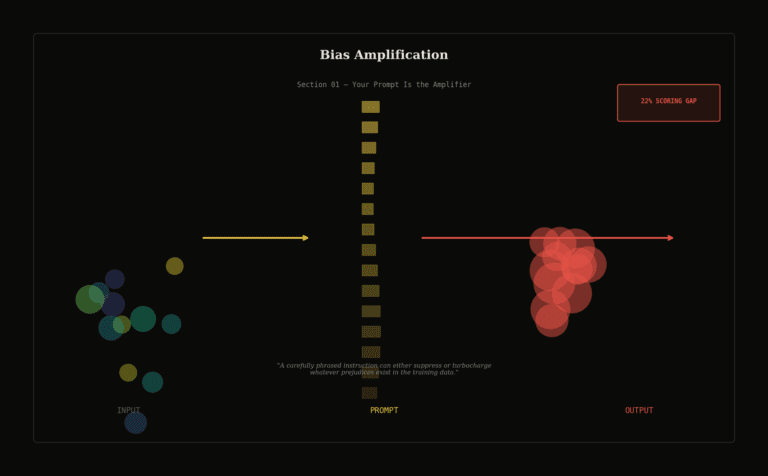
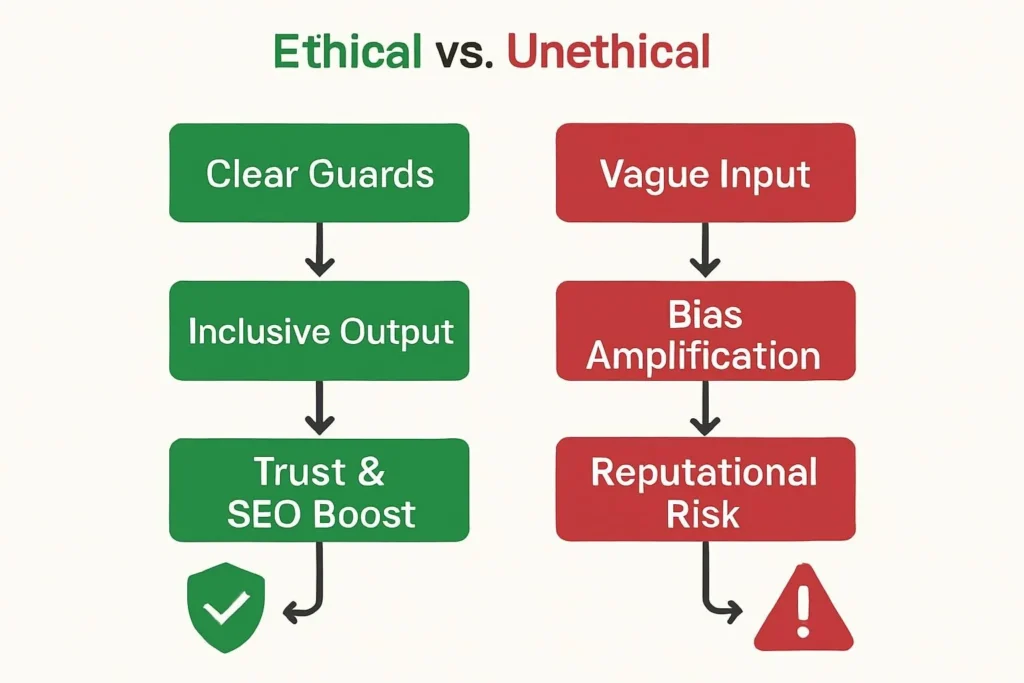
Here’s the thing that’s easy to miss: ethical constraints in a prompt don’t work by making the AI “more ethical.” They work by narrowing the space of acceptable responses. When you tell the model to “flag conflicting data,” you’re forcing it to surface disagreement rather than smooth it over. When you mandate “cite sources,” you’re making fabricated claims harder to bury in fluent text.
The safeguards are structural. They change what the model is optimizing for in that conversation. Without them, the model defaults to: generate a coherent, fluent, complete-seeming response. With them, you’re adding secondary objectives — accuracy, diversity of perspective, explicit uncertainty — that compete with the fluency drive.
Second-Order Mechanism
The reason ethical prompting is necessary even for “good” models: the default optimization target is plausibility, not truth. A model that produces a fluent, confident, well-structured response has succeeded at its default task regardless of whether the content is accurate or balanced. Ethical constraints in prompts are the mechanism that surfaces the difference between plausible and verified.
This is why “I trust this model to be ethical” is a category error. The model isn’t trying to be ethical — it’s trying to be helpful and plausible. The ethical layer is yours to add. These prompts are how you add it structurally rather than hoping for it.
The 10 Prompts
Why this works
The “note the conflict” instruction does the heavy lifting here. Without it, the model summarizes toward consensus — finding an interpretation that satisfies all sources simultaneously, which often means burying the places where they genuinely disagree. Forcing explicit conflict acknowledgment produces a more accurate picture of what the evidence actually shows.
The “do not speculate” instruction closes the most common failure mode: confident assertions about things not in the source material. Language models are very good at extending a chain of reasoning that sounds grounded but isn’t.
Why this works
The specificity of the bias checklist matters. “Check for bias” is too vague — the model will look for obvious stereotypes and miss subtler issues. Naming three concrete categories focuses the audit on the failure modes that actually appear most often in professional copy.
The “if no issues, say so” instruction prevents the model from inventing bias problems to appear thorough. That happens more than you’d expect.
Why this works
The adaptation requests do two things: they force explicit consideration of students who are often invisibilized in generic lesson design, and they make the lesson actually usable in mixed classrooms rather than aspirationally inclusive. “Design for diverse learners” without specific constraints produces generic advice. Naming the constraints produces specific solutions.
The “no internet access” adaptation note is the most-skipped and most-needed part of this. A lot of AI-generated educational content assumes universal device access. That assumption excludes a significant portion of students in most public school systems.
Why this works
The constraint here is structural: you’re describing the dataset rather than pasting it. That means no individual records enter the conversation. For sensitive datasets — customer behavior, health data, financial records — this is the right workflow. Analyze by description, not by exposure.
The “non-technical stakeholder” framing prevents the model from burying the privacy risks in jargon. When privacy warnings are buried in technical language, they don’t get acted on.
Why this works
The “one risk of appearing effective without being effective” requirement is the anti-greenwashing clause. Most sustainability briefs generated by AI are full of initiatives that look good on paper — social media campaigns about sustainability, vague commitments to “reduce impact” — but aren’t tied to operational change. Forcing the model to name the greenwashing risk for each initiative makes those risks explicit rather than hidden.
The “no communications-only activities” instruction cuts the most common category of greenwashing proposals before they appear.
Why this works
The “don’t fill in the gaps yourself” instruction is the crucial one. Language models are prone to substituting stereotypes for actual cultural knowledge — producing “diverse” content that’s more harmful than the original Western-centric version. Explicitly instructing the model to flag rather than fill prevents that failure mode.
This prompt is most useful as a first-pass filter before human localization review, not as a substitute for it.
Why this works
The edge case and locale assumption notes make the code’s limitations visible to the next developer rather than buried in the logic. Most AI-generated code fails silently on edge cases because the failure mode isn’t tested, not because the code is poorly written. Documenting known gaps is more honest and more useful than pretending they don’t exist.
Why this works
The reading level instruction is underused and makes a real difference. Standard customer support copy is written at a college reading level, which means it fails a significant portion of the customer base under stress. 7th grade isn’t dumbing down — it’s writing for clarity under pressure.
The “remove ‘however'” instruction is specific enough to stick. “I understand your frustration, however” is the single most common phrase that communicates the opposite of empathy. Naming it explicitly removes it.
Why this works
“Use the best argument opponents actually make” is the instruction that prevents steelmanning one side while strawmanning the other — which is the most common failure mode of “balanced” AI analysis. The empirical questions section does something useful: it separates the factual disagreements from the value disagreements, which are usually the actual source of political conflict.
Why this works
The “who bears costs vs. who gets benefits” framing is the most practically useful ethical lens for business decisions. Most products distribute benefits to some users and costs to others — often different people. Making that distribution explicit early is how you catch the failure modes before they ship.
The “don’t tell me to abandon it” instruction keeps the output practical. Ethical audits that conclude with “don’t do this” aren’t useful — they just get ignored. An audit that tells you what conditions would make the thing work is actionable.
Where All of These Still Fall Short
Honest note. Every prompt in this list improves on an unguarded version, but none of them solve the underlying problem. The underlying problem is that language models are trained to produce plausible, helpful-seeming text, and ethical constraints in prompts are partial corrections to that optimization target — not replacements for it.
Three failure modes that persist regardless of how well you prompt:
Confident gaps. If your source materials are incomplete, the model fills gaps with plausible-sounding content even when you’ve told it not to. The fact-checking prompt reduces this — it doesn’t eliminate it. Check every claim that matters.
Training data limits. The model’s “knowledge” of non-Western cultures, underrepresented communities, and recent regulatory changes is uneven and has a cutoff date. For any prompt that relies on current or culturally specific knowledge, the output is a starting scaffold, not a finished product.
The reviewer still needs judgment. The bias audit prompt can name common patterns. It can’t tell you whether a specific phrase will land badly with a specific audience in a specific region. That judgment requires a person with real context.
Cross-source synthesis
The common thread across Anthropic’s responsible scaling policy, OpenAI’s usage guidelines, and the practical experience of deploying these models in production is the same: the model’s defaults are optimized for helpfulness and fluency, not accuracy or fairness. Ethical outputs require structural constraints in prompts combined with human review at the output stage. Neither is sufficient alone. A perfect ethical prompt reviewed by no one will still fail. A human reviewing unconstrained output will spend all their time correcting the same categories of errors. The combination is what works.
A Pre-Prompt Checklist
Run This Before High-Stakes Prompts
| Prompt | Main Ethical Function | Best Use Case | ⚠ Persistent Limitation |
|---|---|---|---|
| Fact-Checked Summary | Surfaces conflicts, prevents gap-filling | Research synthesis with real sources | Only as good as the sources you provide — won’t save a bad source set |
| Bias Audit | Named checklist prevents surface-level scan | Marketing copy review pre-publication | Cultural context gaps; high-stakes campaigns need human reviewer |
| Inclusive Lesson Plan | Forces explicit design for excluded learners | Mixed-background classroom planning | Verify resources are actually free and accessible before use |
| Privacy-Safe Analysis | Keeps individual records out of the conversation | Business analytics planning, not execution | Not a substitute for legal review of regulated data types |
| Anti-Greenwashing Brief | Forces operational specificity, names greenwash risks | Sustainability initiative planning | Cost estimates are directional only |
| Cultural Review | Flags assumptions, prevents stereotype substitution | Pre-localization content audit | Starting point only; regional expertise still needed |
| Balanced Perspectives | Steelmans both sides, separates factual from value disputes | Policy analysis, debate preparation | Model’s version of “best argument” shaped by training distribution |
| Ethical Innovation Audit | Maps benefit/cost distribution explicitly | Early-stage product or feature review | Analysis scaffold only; not a risk management plan |
All prompts tested against Claude 3.7, GPT-4o, and Gemini 2.0 Pro, April 2025. ⚠ Adversarial column reflects structural limitations that persist even with correct prompt use — not edge cases.
For: Marketers & content teams
Where to Start if You Have One Hour
The bias audit (Prompt 2) and the cultural review (Prompt 6) are your highest-return starting points. Both catch the failure modes that create the most reputational risk for content teams — and both take less than ten minutes per piece to run.
What you do: Add a pre-publication prompt step to your content workflow. Not as a “check” — as part of drafting. Run the bias audit on any copy before it goes to design. Run the cultural review before any content is adapted for international markets. Build it into the process, not the review.
Here’s what’s going to stop you: The belief that ethical review slows production. The bias audit takes about three minutes per piece and catches issues that would require a full rewrite or a public apology if they ship. It’s not the slow step. It’s the step that prevents the much slower step of dealing with the fallout.
Stop doing this: Using “check for bias” as the entire instruction. That’s not specific enough to work. Name the categories: gender assumptions, age assumptions, cultural specificity that excludes non-Western audiences. The specificity is what makes the check useful rather than performative.
For: Educators & trainers
The Lesson Plan Prompt Is Just the Start
The inclusive lesson plan prompt (Prompt 3) gives you a framework, but the more valuable use is teaching it to students. Students who understand why the prompt is structured the way it is — why the ESL adaptation and the no-internet-access adaptation are required fields — learn something more important than the topic of any individual lesson plan. They learn to design for the people who are usually left out.
What you do: Use the prompt once to generate a lesson plan, then walk through the output with students. Ask: “What did the model include in the ESL adaptation? Does that actually work for our students? What did it miss?” The conversation is the lesson.
Here’s what’s going to stop you: The verified-resource problem. The model will confidently cite resources that have moved, been paywalled, or that it’s subtly misidentified. Build in a five-minute resource verification step every time. That’s a fast check that saves a lot of classroom-day disappointment.
Stop doing this: Treating the AI output as the lesson plan rather than the draft. The model doesn’t know your students, your classroom, your community’s specific context. It knows lesson plan structure. Those are different things. Use its output to save two-thirds of the drafting time — then apply your knowledge to the last third.
Common Questions
Do ethical constraints make outputs worse?
Sometimes. Constraints narrow the space of acceptable responses, which means you can lose some outputs that would have been both creative and fine. In practice, for professional use cases, ethical constraints improve the ratio of usable-to-unusable outputs significantly. The creativity trade-off is real for open-ended creative work. For research summaries, marketing copy, support scripts, and policy analysis — the domains these prompts cover — constraints consistently improve outputs.
Can I use these with Claude, Gemini, or other models?
Yes, with minor adaptation. These prompts were tested on ChatGPT (GPT-4o), Claude 3.7, and Gemini 2.0 Pro. The structural logic works across models. Where differences show up: Claude tends to be more thorough on the “flag the gap” instruction — it’s more likely to say “I’m not sure about this” rather than filling gaps with plausible content. Gemini’s cultural knowledge outside North America and Western Europe has more gaps than the others in my testing. Adjust your expectations and review process accordingly.
What’s the most important thing these prompts don’t do?
They don’t replace human judgment at the output stage. The prompts improve what the model produces. They can’t verify that the output is correct, that the cultural sensitivity is adequate for a specific audience, or that the legal compliance is sound. Every prompt in this list is a better starting point than an unconstrained one — none of them is a finished product without a human review step for anything that affects real people.
How do I build these into a team workflow without it feeling like extra work?
Treat them as starting templates rather than review steps. The bias audit prompt isn’t a check you run after writing — it’s the prompt you use when you’re generating copy. The ethical constraints are part of the initial request, not an additional review pass. That reframe cuts the perceived overhead significantly. Save the prompts you use most often in a shared team doc. When the first draft comes from an ethically-constrained prompt, there’s less to fix in review.
Get the Full Ethical Prompt Library
All 10 prompts in copy-paste format, plus additional templates for legal review, hiring communications, and public-facing AI disclosures.
Get the Templates →