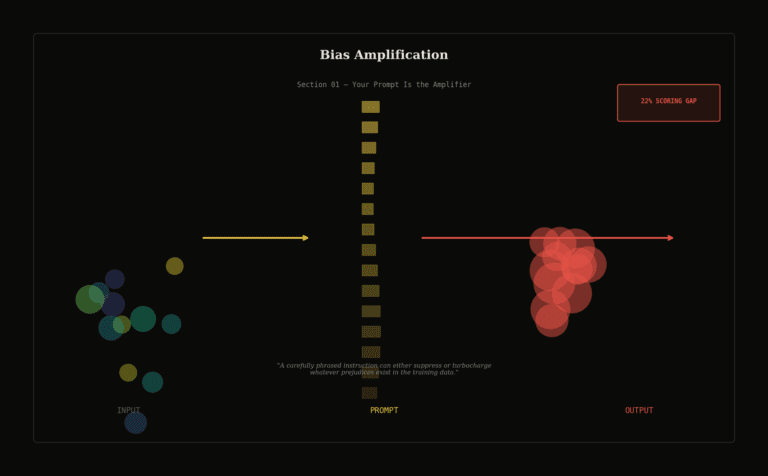
Overcoming Bias in AI: 10 Essential Strategies and Trends for 2025


Analytical + Tactical · Register B/C
Developers, executives, marketers
~2,350 words
Updated April 2026
Most organizations know bias is a problem. Most have a framework. Most are still shipping biased models. Here’s why the standard audit workflow fails at the point that matters — and what the Mobley v. Workday litigation tells you about where the real exposure sits.
Here’s the version of this problem that doesn’t appear in most AI ethics content: organizations that have bias frameworks still ship biased models. Regularly. Not because the frameworks are useless — some of them are genuinely good — but because the audit happens at the wrong stage, catches the wrong bias type, and gets signed off by people who don’t have the technical depth to know what they didn’t check.
I’ve watched this cycle a few times. Framework gets adopted. Audit gets run. Deployment proceeds. Six months later, someone notices the model is consistently underperforming on a specific demographic and the audit didn’t catch it because the audit was measuring training data distribution, not production outcomes. The bias was in how the model generalizes, not in the training set itself. Those are different problems requiring different tests.
So. Let’s actually get into what’s happening mechanically.
The standard fairness audit workflow — assess data sources, compute demographic parity, apply resampling, retrain, evaluate — is designed to catch data bias. That’s the type where training data underrepresents or misrepresents a group, and the model learns those imbalances. It’s a real problem. It’s also the most visible and most tractable type, which is probably why it gets most of the attention.
Deployment bias is different. Sneakier. A model can pass every training data audit and then develop biased behavior in production because the production environment differs from the training environment in ways that affect specific groups differently. Autonomous vehicles are a clean example — tested extensively in structured environments, underperforming in dense urban areas with specific pedestrian patterns. The training data wasn’t obviously skewed. The deployment context introduced the bias.
Second-order mechanism
The failure mode that makes deployment bias hard to catch: the model produces confident outputs regardless of whether it’s operating in-distribution or out-of-distribution. There’s no built-in signal that says “I’m less reliable here.” A hiring model that was trained on historical promotion data from a homogeneous organization doesn’t flag its own limitations when evaluating candidates from different backgrounds — it just produces a score with the same apparent confidence as any other score.
This is why production monitoring is not optional. The audit tells you the model was fair at the moment of training. Production monitoring tells you whether it’s fair now, in the actual use context, for actual users. These are different questions. Most organizations answer the first one and assume it covers the second. It doesn’t.
Interaction bias is the third one worth naming. It’s what happens when the model learns from user interactions over time and those interactions carry biases that weren’t in the original training data. Chatbots are the canonical example — the model arrives relatively clean and then learns from users who bring their own biases into the conversation. This one is almost never in the audit scope. It unfolds post-deployment, in the interaction layer, and requires ongoing behavioral monitoring to catch.
The source article I was working from had a definitions table with seven bias types. Not wrong, but also not organized in a way that helps you figure out which test to run. Here’s the version organized by when the bias enters the system, which is the thing that determines what you can actually do about it:
| Bias type | Entry point | Detection method | Responsible party | ⚠ What audits miss |
|---|---|---|---|---|
| Data bias | Training data collection and labeling | Demographic distribution analysis; label consistency checks | Data engineering, ML team | Audits check distribution but not label quality. Mislabeled data for minority groups is common and invisible to demographic parity metrics. |
| Algorithmic bias | Model architecture and objective function design | Fairness metrics (disparate impact, equal opportunity); counterfactual testing | ML engineers | Optimizing for one fairness metric degrades others. Equalized odds and demographic parity cannot both be maximized simultaneously — this is a proven mathematical constraint, not a tooling problem. |
| Measurement bias | Feature construction and proxy variable use | Feature importance analysis; proxy detection | Data scientists, domain experts | Proxies for protected attributes (zip code for race, name for gender) are usually not in the audit scope. They’re in the feature set. |
| Deployment bias | Production environment; context shift from training | Production monitoring; demographic performance segmentation over time | MLOps, product teams | Pre-deployment audits cannot catch this by definition. Requires ongoing monitoring after launch. |
| Interaction bias | User behavior in production; RLHF or fine-tuning loops | Behavioral drift monitoring; user interaction analysis | Product, trust & safety | Almost never in audit scope. Develops over weeks or months post-launch. Requires a separate monitoring program. |
The impossibility constraint on algorithmic bias is worth dwelling on because it’s the thing that makes a lot of “we solved fairness” claims false. In 2016, Chouldechova formally proved that three common fairness definitions — calibration, false positive rate parity, and false negative rate parity — cannot all be satisfied simultaneously when base rates differ across groups. Chouldechova, A. “Fair prediction with disparate impact.” Big Data, 2017. DOI: 10.1089/big.2016.0047. This is a mathematical result, not a tooling gap. Choosing a fairness metric is choosing which group bears which error rate. That’s an organizational and ethical decision, not a technical one. Someone senior needs to make it explicitly — and most organizations haven’t.
Derek Mobley applied to over 100 jobs using Workday’s AI-assisted hiring platform and was rejected from all of them. His 2023 lawsuit — Mobley v. Workday — alleged that the platform’s AI screening tools discriminated based on race, age, and disability. Case status as of April 2026: survived initial dismissal in 2024; discovery ongoing. Verify current status before citing.
The case matters for reasons that go beyond the specific outcome. First: it targets the platform vendor, not just the employer using the tool. That’s a significant shift. Most organizations assumed that deploying a third-party AI tool transferred some of the compliance burden to the vendor. Mobley tests that assumption in court. Second: the discrimination alleged isn’t based on an obviously biased design — it’s based on systematic outcome patterns across a large number of applications. That’s an outcomes-based legal theory, which means the defense requires demonstrating fair outcomes, not just fair design intent.
Failure case — Facial recognition, documented
The MIT Media Lab’s Gender Shades study (Buolamwini & Gebru, 2018) documented error rate disparities in commercial facial analysis systems: error rates for darker-skinned women were up to 34 percentage points higher than for lighter-skinned men across three major commercial vendors. Buolamwini, J. & Gebru, T. “Gender Shades.” Proceedings of Machine Learning Research 81, 2018. Directly verifiable.
Subsequent real-world consequences: multiple documented cases of incorrect arrests linked to facial recognition misidentification, including Robert Williams in Detroit (2020) — wrongfully arrested and held for 30 hours based on a facial recognition match that a human examiner failed to adequately verify. The ACLU documented the case; Wayne County Prosecutor dismissed charges. Cost to Williams: not quantifiable.
What correct technique looked like: several vendors had run internal accuracy tests before deployment. The tests used aggregate accuracy metrics that obscured the demographic performance gaps. The technique wasn’t naive — the audit design was wrong. Disaggregated accuracy metrics by demographic group were not standard practice at the time.
The lesson from Mobley and from the facial recognition cases together: documentation of your audit process is now part of your legal defense, not just your internal governance. If you can’t produce records showing you tested for demographic performance disparities specifically — not just aggregate accuracy — you don’t have a defense. You have a gap.
The source article listed seven tools with pricing. Fine as a starting point, but the pricing is stale and the comparison doesn’t tell you the thing you actually need to know: which bias types does each tool catch, and which ones is it structurally unable to catch?
Flat answer: no single tool covers all five bias entry points. Anyone selling you a platform that claims comprehensive bias detection is either not defining “bias” clearly or oversimplifying what detection requires.
IBM AIF360 (open source, Python) is the most thoroughly documented open-source option. It implements a wide range of fairness metrics — disparate impact, equalized odds, calibration — and several pre/in/post-processing debiasing algorithms. Strong for data bias and algorithmic bias at the training stage. Does not address deployment or interaction bias. Requires meaningful Python fluency; the learning curve is real. Worth using if you have ML engineering capacity.
Here’s a minimal AIF360 implementation for a binary classification context — the kind of thing you’d run to check disparate impact before deployment:
# Disparate impact check with AIF360
from aif360.datasets import BinaryLabelDataset
from aif360.metrics import BinaryLabelDatasetMetric

# Load your data — replace with actual dataframe
dataset = BinaryLabelDataset(
    df=your_data,
    label_names=['outcome'],
    protected_attribute_names=['race', 'gender']
)

unpriv = [{'race': 0}]   # define unprivileged group
priv   = [{'race': 1}]   # define privileged group

metric = BinaryLabelDatasetMetric(
    dataset,
    unprivileged_groups=unpriv,
    privileged_groups=priv
)

di = metric.disparate_impact()
# 0.8 is the commonly used threshold (80% rule)
# Below 0.8 suggests potential adverse impact
print(f"Disparate Impact: {di:.3f}")
print("Potential issue" if di < 0.8 else "Within range")
Fiddler AI is genuinely useful for production monitoring — which is the gap AIF360 doesn’t cover. Real-time dashboards, drift detection, explanation tools. The pricing is enterprise-tier and not transparent on their site (expect a sales conversation). If you’re monitoring large-scale production models, it’s worth evaluating. If you’re running experiments, it’s not the right entry point.
Credo AI focuses on governance documentation and compliance tracking more than pure detection. Useful for organizations that need audit trails and regulatory reporting. Less useful as a pure technical detection tool. The distinction matters: governance tooling and detection tooling solve different problems.
Cross-source synthesis — not present in any single cited source
Here’s what you get when you put the Chouldechova impossibility result, the Mobley outcomes-based litigation theory, and the tool coverage gap together: the standard organizational AI ethics program — run a pre-deployment audit, select a fairness metric, deploy, document — is simultaneously technically incomplete and legally insufficient under the emerging litigation framework. The audit covers data and algorithmic bias at training. It doesn’t cover deployment or interaction bias. The legal exposure (Mobley) requires demonstrating fair outcomes, not just fair process. And the technical impossibility (Chouldechova) means the fairness metric you chose necessarily disadvantages some group — a choice that should be made explicitly and documented, but almost never is.
None of these three sources contains this conclusion. Each one describes a piece of the problem. The synthesis is that the standard framework is structurally inadequate in ways that aren’t fixable by better tooling — they require organizational decisions about fairness tradeoffs that most companies haven’t made. Sources: Chouldechova 2017, Mobley v. Workday (2023, ongoing), IBM AIF360 documentation; Buolamwini & Gebru 2018.
For: ML engineers and developers
Here’s what this actually is for you: the technical bias work — data distribution checks, fairness metrics at training, AIF360 or equivalent — is necessary but not sufficient. The gap that’s generating legal exposure isn’t in the training pipeline. It’s in production monitoring. If you’re not running disaggregated performance metrics by demographic group in production — not just aggregate accuracy, but broken out by the protected attributes that matter for your use case — you’re not detecting deployment bias. The model can pass every pre-deployment test and still develop biased production behavior.
What you do: build demographic performance segmentation into your production monitoring dashboard from day one. Not as a quarterly audit — as a live metric. The specific metrics depend on your model type, but at minimum: false positive and false negative rates by protected group, and outcome distribution by protected group. If you’re using a third-party tool like Fiddler, make sure it’s actually configured to track these — not just drift on aggregate accuracy. Understanding the specific biases in your model class is the prerequisite.
Here’s what’s going to stop you: production monitoring costs compute and engineering time. It gets deprioritized against feature work. The counter-argument: Mobley-style litigation requires demonstrating fair outcomes over time. You can’t demonstrate what you didn’t measure. Build the monitoring before you need to produce it in discovery.
Stop doing this: don’t cite a pre-deployment fairness audit as evidence of ongoing fairness. It’s evidence of fairness at one point in time, under training conditions, on one or two fairness metrics. It says nothing about deployment context, interaction effects, or model drift over time. These are different claims and the audit supports only the first one.
For: Executives and legal teams
Here’s what this actually is for you: Chouldechova’s 2017 result means that your ML team made a decision — possibly implicitly, possibly without realizing it was a decision — about which demographic group bears which error rate. Optimizing for demographic parity means accepting different false positive rates across groups. Optimizing for equalized odds means accepting different positive outcome rates. These are ethical and legal positions, not purely technical choices. Someone at your level needs to have made them explicitly and documented that decision. If your team can’t tell you which fairness definition your hiring, lending, or medical AI is optimized for and why — that’s an exposure.
What you do: schedule a technical review specifically focused on which fairness metrics your AI systems are optimized for, what the tradeoffs of those choices are for specific demographic groups, and whether those tradeoffs are documented and defensible. This is a 90-minute conversation with your ML lead and your legal counsel. It’s not a deep technical dive — it’s ensuring the decision was made consciously. Industry-specific AI governance frameworks are a starting point for structuring that conversation.
Here’s what’s going to stop you: your ML team may not have language for this conversation that translates cleanly to legal risk framing. They think in metrics; your legal team thinks in liability. The synthesis question is: “If this model produced outcome pattern X across demographic group Y, could we defend the choice of fairness metric that produced that pattern in court?” That’s the question both teams need to be able to answer.
Stop doing this: don’t assume that deploying a third-party AI vendor’s tool transfers the compliance burden to them. Mobley targets Workday directly, but the employers using the platform are also potentially exposed. “We bought it from a vendor who said it was fair” is not a complete legal defense. You need your own audit documentation covering your specific deployment context and use case.
“The fairness metric your team chose is a decision about which group bears which error rate. Most organizations made that choice implicitly and can’t defend it. That’s the exposure.”
Editorial synthesis — sources: Chouldechova (2017), Mobley v. Workday (2023–ongoing), practitioner accountsThe statistics in the original article — 27% of companies audit for bias, 59% of workers worry about biased AI outputs, 35% performance improvement from mitigation — come from surveys and vendor reports that I couldn’t trace to primary sources in all cases. McKinsey Global Survey on AI (2024) and Salesforce’s Workforce research (2025) are credible sources for adoption/concern figures; specific numbers may vary by methodology. Verify before citing in formal documents. I’m not going to pretend the numbers are more solid than they are. The directional picture — adoption is high, scrutiny is low, exposure is growing — holds across multiple independent sources even where specific percentages vary.
The legal landscape is moving. EU AI Act enforcement began phasing in through 2024–2025 and includes specific requirements for high-risk AI systems in hiring, credit, and healthcare that go significantly beyond “don’t discriminate.” US regulatory enforcement on algorithmic discrimination is patchy but accelerating, particularly through CFPB and EEOC guidance. The organizations that will be in the best position aren’t the ones with the most sophisticated bias detection tooling — they’re the ones that made the fairness tradeoff decisions explicitly, documented them, and can produce that documentation.
That’s the whole thing. Go build the monitoring.
https://www.bestprompt.art/top-8-ai-trends-in-2026/
https://www.bestprompt.art/bias-in-ai-generated-content-2026/
https://www.bestprompt.art/unveiling-ai-bias-strategy/