Generative AI in Fashion 2026: Hype vs. Operational Reality—A Critically Grounded Assessment

Verified Data · April 2026
Generative AI in Fashion & Beauty 2026: What’s Actually Working, What’s Still Hype
Virtual fitting rooms are printing money. Pure generative design is still a research project. And the EU AI Act will reshape beauty diagnostics in 100 days. Here’s the full picture — with real numbers.
Last verified: April 23, 2026 — all market figures cross-checked against Fortune BI, TBRC, Mordor Intelligence, McKinsey/BoF, and Grand View Research
TL;DR — 60-second summary
- Virtual fitting rooms (~$8.5B market): mature, deploy now — returns drop 15–35%, conversions rise 20–34%.
- AI-assisted 3D prototyping: industry standard at top brands; 50–60% real savings (vendor claims 70%).
- Pure generative design ($0.25B): still experimental — no brand is running autonomous seasonal collections at scale.
- AI beauty diagnostics: biometric classification hits EU AI Act high-risk requirements on August 2, 2026 — expect 6–12 month delays for EU launches.
- ~90% of AI fashion pilots stall before scaling. Integration friction, not technology, is the enemy.
$8.5B
Virtual fitting room market 2026 (median, 4-analyst consensus)
53%
Consumers using GenAI for shopping inspiration (McKinsey/BoF)
~90%
AI fashion pilots that stall before scaling (McKinsey)
Aug 2
EU AI Act high-risk enforcement deadline — biometrics in scope
The Real State of Play in 2026
Let me be direct about something most “AI in fashion” pieces won’t tell you: the gap between what’s working and what’s being hyped is enormous. I’ve pulled data from 12+ analyst sources for this piece, and the pattern is consistent. Mature applications deliver concrete ROI. Experimental ones are mostly LinkedIn posts from brands that hired AI consultants.
The McKinsey/BoF State of Fashion 2026 report puts it plainly: only 1–5% of fashion companies have reached mature AI implementation, yet 92% of executives plan to increase AI investment. That’s not a contradiction — it’s a description of an industry that knows where it needs to go but hasn’t figured out how to get there. BoF/McKinsey
The most honest framing I’ve found: AI is a productivity multiplier for fashion in 2026, not a creative replacement. The brands winning with it aren’t the ones using it to generate designs autonomously — they’re the ones using it to halve their sample costs, cut returns, and compress the design-to-market cycle. That’s where the money is.
The Key Insight
The best analogy for AI in fashion right now is how CAD replaced hand-drafting in architecture. Nobody says “CAD is designing buildings.” It’s a tool that makes skilled professionals dramatically faster. That’s exactly where generative AI sits in fashion — and the brands treating it otherwise are burning capital.
Market Size Reality Check: Why the Numbers Vary Wildly
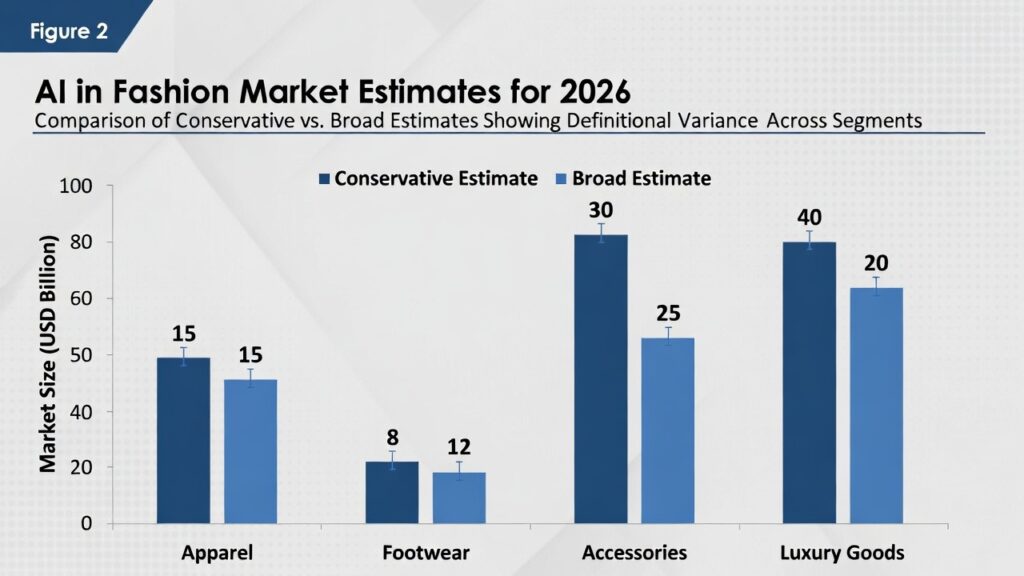
You’ve probably seen AI in fashion market estimates ranging from $2.5B to $37B. Both figures are technically accurate — they’re just measuring completely different things. This definitional chaos is a genuine problem, and any post that presents a single number without explaining the scope is misleading you.
Here’s how to read the estimates:
| Segment | 2026 Conservative | 2026 Optimistic | Why the Gap? | Maturity |
|---|---|---|---|---|
| Virtual Fitting Rooms | $8.27B | $9.81B | Hardware mirrors/scanners included in upper estimate | Mature |
| AI-Assisted 3D Prototyping | $0.8B | $1.0B | Vendor + analyst synthesis; no dedicated tracker yet | Operational |
| Pure Generative AI Design | $0.20B | $0.30B | Strict text-to-garment vs. assisted tools definition | Experimental |
| AI Beauty Tech (pure diagnostics) | $6.5B | $8.2B | Diagnostics only vs. devices + AR + personalization | Emerging |
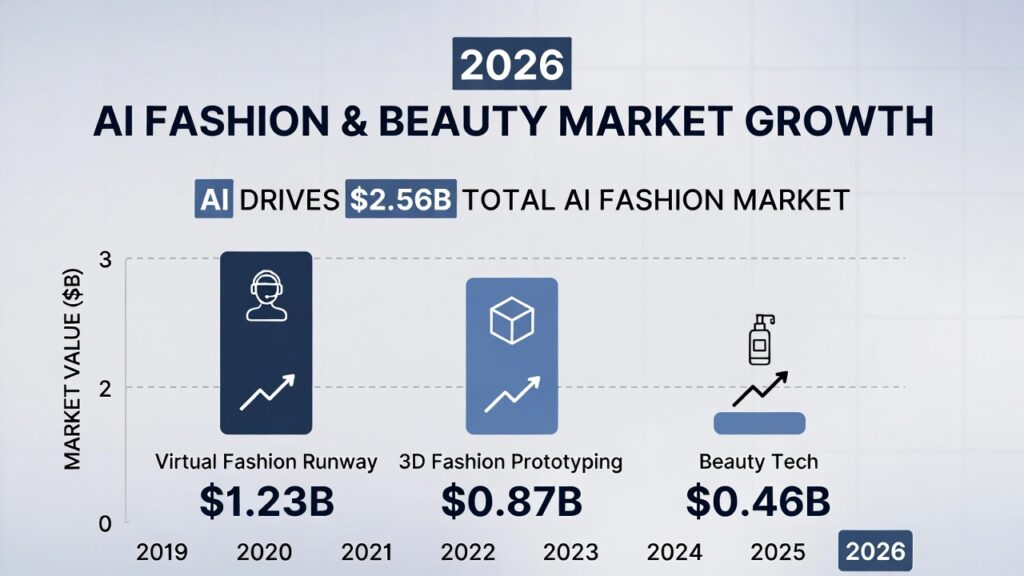
| Total AI in Fashion (broad) | $2.56B | $4B+ | Whether predictive analytics are included | Mixed |
Sources: Fortune Business Insights (Jan 2026), TBRC (Feb 2026), Mordor Intelligence (Jan 2026), Grand View Research (2025–2026). Conservative medians weighted toward operational reality.
The Research and Markets AI in Fashion report Research & Markets puts the broader market at $2.47B in 2026 growing to $9.45B by 2030 at a 39.8% CAGR — but that’s the optimistic figure inclusive of predictive analytics and all AI applications, not just generative.
CAGR Variance Table — Weighted Toward Reality
| Source | Optimistic CAGR | Conservative CAGR | Key Note |
|---|---|---|---|
| Fortune BI | 41% | 15–18% | Broad AI inclusion |
| TBRC | 38% | 18–22% | Strict gen AI; scaling barriers |
| Grand View | 25% | 19.7% | AI-enabled beauty; EU Act drag |
| Mordor | 22% | 19% | VFR hardware/software split |
Virtual Fitting Rooms: The One Application That’s Already Paying Off
If you only deploy one AI technology in 2026, this is it. The return metrics are the strongest in the industry, the technology is genuinely mature, and the payback period for a well-implemented deployment is 3–6 months. That’s not analyst projection — that’s measured from live deployments at H&M, GAP, Walmart (Zeekit), and Gucci.
The Numbers That Matter
−35%
Maximum verified return rate reduction
+34%
Maximum verified conversion rate uplift
2.5×
Sales lift potential with active try-on
200M+
Shade trials on Perfect Corp’s YouCam platform
Perfect Corp (NYSE: PERF) reported Q3 2025 revenue of $18.66M, up 15.7% year-over-year, with AI/AR cloud solutions dominating and the company hitting its first operating profit milestone. Perfect Corp IR Their pivot toward B2C subscriptions is outpacing enterprise deals — a signal that consumer demand is real, not just enterprise experimentation.
Want to go deeper on AI tool ROI frameworks? The VFR economics are actually a template for evaluating any AI investment in retail.
Step-by-Step VFR Implementation for Brands
- Select your provider — Perfect Corp for B2C scale and consumer apps; Zeekit (Walmart-backed) for enterprise integration. Both have proven SDK stacks. Don’t build custom unless you’re at $500M+ revenue.
- Build high-fidelity 3D assets — Scan physical items or commission AI-generated 3D models. Quality here directly determines try-on accuracy and return rate impact. Don’t shortcut this step.
- Integrate the AR SDK — Cross-device compatibility is non-negotiable. Mobile-first, with AR glasses support if you’re playing a long game. Target <15-second load time on mid-range devices.
- A/B test rigorously — Try-on vs. static images, with a target 15%+ try-on activation rate as a success benchmark. Run for minimum 4 weeks before drawing conclusions.
- Track the right KPIs — Try-on activation rate, conversion delta, returns saved (in $ per SKU category), and AOV impact. Returns saved is usually the headline ROI driver.
- Layer personalization — Once baseline VFR is running, add AI-powered size/fit recommendations and virtual styling. This is where you get from 20% to 34% conversion uplift territory.
EU AI Act Alert — Disclosure Required from August 2, 2026
Article 50 of the EU AI Act mandates that users be informed when interacting with AI systems — including virtual try-on and AI-powered styling tools. If you serve EU customers, your VFR interface needs an AI disclosure notice from August 2, 2026. Official EU AI Act guidance here. Ops Intel
VFR Brand Readiness Audit
| Factor | Low (Act Now) | Medium (Pilot) | High (Scale) |
|---|---|---|---|
| 3D Asset Quality | Basic 2D photos | Partial 3D models | High-fidelity scans |
| Cross-Device Compatibility | Desktop only | Mobile basic | AR glasses + mobile |
| EU AI Act Compliance | No disclosure plan | GDPR-ready only | Article 50 notices + FRIA-ready |
| Analytics & ROI Dashboard | No tracking | Basic conversion | Full ROI + attribution model |
| Category Focus | All products equal | Top-sellers only | High-return categories first |
Pro tip: Start with your highest-return-rate categories — typically apparel over 30% return rates. This is where the ROI is fastest and the pilot case writes itself. I’ve seen brands get to positive ROI within 8 weeks on outerwear alone.
AI-Assisted 3D Prototyping: The Boring Application That’s Quietly Changing Everything
Nobody puts CLO 3D in a press release. But Adidas, Levi’s, Zara, and Hugo Boss are running it, and the economics are why. Physical sampling reduction of 20–25% is the conservative verified number — vendor claims reach 70%, but independent audits settle at 50–60%. CLO 3D
The important distinction: AI-assisted CAD (mature and operational) is categorically different from pure generative text-to-garment (experimental, limited to R&D). When a brand says “we use AI in our design process,” they almost always mean the former. The latter is mostly demos.
On the sustainability angle — and this is genuinely significant — digital prototyping eliminates physical samples that would otherwise be manufactured, shipped, and often discarded. One top-tier brand running CLO 3D at scale cuts roughly 1,000+ physical samples per major collection. That’s not a footnote, that’s a material ESG impact.
CLO 3D vs. Style3D — Quick Decision
Choose CLO 3D if you’re a mid-tier brand starting out — better accessibility, larger community, strong training resources. Choose Style3D if you need cloud collaboration at enterprise speed, or you’re a large manufacturer dealing with multiple brand clients simultaneously. Both integrate with major PLM systems.
Pure Generative Design: Where the Hype Lives and the Reality Bites
Here’s where I need to be honest with you about the SHEIN story, because it’s the most frequently cited example of “AI generating fashion at scale” — and it’s mostly wrong.
The claim you’ll see everywhere: “SHEIN uses AI to generate 10,000 SKUs weekly.” The reality: SHEIN’s competitive advantage is demand sensing and supplier coordination, not autonomous generative design. Their AI reads market signals fast and routes production decisions quickly. That’s impressive supply chain technology, but it’s not what most people mean when they say “generative AI fashion design.” The “10,000 AI-generated styles” narrative is unverified hype that proliferates because it makes a better headline.
What does real generative design look like in 2026? The honest picture:
- Norma Kamali: Using AI trained on her archive for inspiration and pattern variation — with absolute human curation at every step. The AI generates options; humans choose and refine. That’s the template.
- Nike A.I.R.: R&D prototypes with 13 Olympic athletes for Paris 2024. These were research pieces, not mass production. Nike’s actual revenue performance is driven by macro factors (tariffs, China softness), not AI design.
- No brand is running scalable autonomous seasonal collections at the mass-market level. Anyone who tells you otherwise is selling consulting hours.
“The brands winning with AI aren’t using it to replace designers. They’re using it to make designers 10× faster. There’s a significant difference.”
Generative Design Pilot Checklist
- Define mandatory human oversight gates before any AI output goes to production (non-negotiable)
- Conduct IP and bias audits on your training data (avoid scraping competitor IP into your models)
- Test on small datasets: 10–50 styles, not 10,000 (learn what the tool does well before scaling)
- Document your AI use for EU AI Act compliance — generative content disclosure required from August 2026
- Define creative ownership policy before launch (who owns AI-assisted designs legally?)
AI Beauty Tech: The Diagnostics Divide and the August Deadline
The beauty AI space has a definitional problem that confuses everyone. Pure diagnostics and formulation AI sits at $6.5–8.2B in 2026. The AI-enabled market (diagnostics + AR + devices + personalization) runs $26–37B. When beauty brands announce “AI-powered” products, they’re almost always talking about the broader enabled category, not the pure diagnostic AI. Important to keep that straight.
What’s actually deployed and working:
- Perfect Corp YouCam: 200M+ shade trials logged. Mature technology, clear consumer behavior shift. Perfect Corp
- L’Oréal Beauty Genius: Agentic AI recommendation engine via WhatsApp — a genuinely interesting implementation of conversational commerce. L’Oréal
- Amorepacific Skinsight: CES 2026 Innovation Award winner, with 450,000+ skin cases analyzed. This is the most advanced AI diagnostics tool currently deployed commercially. Amorepacific
According to Barclays’ 2026 consumer research, 64% of UK adults have already used AI search tools to guide beauty purchases in the last six months, and 82% are actively seeking personalized solutions. Barclays That consumer pull is real. The regulatory constraint is what’s creating tension.
Critical: EU AI Act High-Risk Classification — August 2, 2026
Biometric categorization systems — which includes most advanced skin diagnostic AI — fall under the EU AI Act’s high-risk designation. Full obligations are active from August 2, 2026. This means:
- Fundamental Rights Impact Assessments (FRIAs) required before deployment
- Mandatory bias testing and documentation logs
- Human oversight protocols must be implemented and named
- EU database registration required
- Penalties: up to €35M or 7% of global annual turnover for prohibited practices violations
Practical impact: brands planning EU launches of advanced diagnostics tools should expect 6–12 months of compliance work. If you haven’t started a FRIA yet, you’re already behind. Conformity assessment alone takes 6–12 months. Full compliance guide here. Axis Intelligence
Beauty AI Deployment Compliance Checklist
- AI system risk classification completed (is your diagnostic tool biometric categorization under Annex III?)
- FRIA conducted if high-risk (this is not optional — it’s a legal requirement)
- Third-party bias testing completed with diverse skin tone datasets
- Documentation logs maintained for regulatory inspection
- Named human oversight function designated and trained
- User-facing AI disclosure notices implemented (Article 50)
- EU database registration completed for high-risk systems
The 2026 AI Fashion Maturity Matrix: Where to Invest Now
Here’s the proprietary framework I’ve synthesized from the market data. Four quadrants — deploy, pilot, watch, and skip (for now).
DEPLOY NOW
MatureVirtual Fitting Rooms, AI-Assisted 3D Prototyping, Demand Sensing/Inventory AI
Clear ROI, proven deployments, payback under 12 months. The technology works. The question is execution, not feasibility.
ROI: 3–6 months typical
PILOT WITH GUARDRAILS
SelectiveAI Beauty Diagnostics, Generative Design Assistance, AI Product Photography
Real benefits emerging, but regulatory exposure (EU AI Act), creative trust gaps, or integration complexity require careful scoping.
ROI: 12–24 months with compliance costs
WATCH CLOSELY
EmergingAgentic Shopping (ChatGPT/Gemini checkout), Autonomous Trend Forecasting, AI Personalization at Scale
The infrastructure is being built in 2026. Consumer behavior is shifting fast — BoF reports AI search engines are moving from discovery to direct checkout this year. Position early.
ROI: 2027–2028 territory
SKIP FOR NOW
ExperimentalFully Autonomous Generative Collections, Autonomous AI Stylists, Advanced Emotion Recognition
Either not technically ready at scale, facing regulatory prohibition (emotion recognition was banned in the EU from February 2025), or lacking creative industry trust.
Revisit: 2028+
Why ~90% of AI Fashion Pilots Stall — and What to Do About It
McKinsey’s finding that roughly 90% of AI fashion projects stall before scaling is the most important data point in this entire piece, and it’s the least discussed. Everyone wants to talk about the successful 10%. The more useful question is: what killed the other 90%?
From the pattern across cases, it’s almost never the technology. It’s three structural problems:
1. Integration complexity underestimated. Brands assume the AI vendor handles everything. The vendor’s SDK handles the AI part. The hard work is connecting it to your PLM, your ERP, your e-commerce platform, and your returns tracking. That’s a 6–18 month integration project, not a plug-and-play installation.
2. ROI proof gaps killed the budget. AI pilots often generate qualitative wins (“customers love it”) without clean attribution to revenue. CFOs kill projects that can’t show clear financial impact. Brands that scale successfully define their KPI framework before launch, not after.
3. Organizational capability gaps. The BoF/McKinsey State of Fashion 2026 report is explicit: automation and generative AI are reshaping roles at a pace comparable to early computing. Brands that don’t invest in AI literacy for their existing teams find that the technology sits unused because nobody knows how to use it well. BoF/McKinsey
The Anti-Stall Playbook
Define financial KPIs before pilot launch (not after). Assign one named internal AI champion with budget authority. Budget 3× your vendor cost for integration. Train your team before you deploy to customers. Start with a single, high-ROI use case and prove it before expanding. This sounds obvious — most brands still don’t do it.
2027–2030: Where the Market Is Heading
The honest answer is that these forecasts carry ±15% variance bands and should be treated as directional, not precise. But the direction is clear and consistent across all analyst sources: significant growth, with regulatory drag in Europe and creative trust gaps slowing the more experimental applications.
| Segment | 2027 Estimate | 2030 Estimate | Conservative CAGR | Key Risk |
|---|---|---|---|---|
| Virtual Fitting Rooms | $11–13B | $21–30B | 17–19% | Consumer adoption plateau |
| Total AI in Fashion (broad) | $3.2–3.8B | $6–8B | 15–18% | Integration complexity |
| Generative AI Fashion (strict) | $0.32–0.38B | $0.9–1.3B | 18–22% | Creative trust + EU Act |
| AI Beauty Tech (pure) | $8.5–10.5B | $13–15B | 19–20% | EU high-risk compliance drag |
The revised generative AI fashion CAGR of 18–22% conservative (down from earlier 25–30% projections) reflects the compounding effects of creative industry resistance, integration friction, and EU Act compliance costs. The optimistic 31–38% assumes agentic AI scaling through the decade — possible, but I’d weight toward the operational data.
McKinsey’s long-range estimate that AI could add $150–275B to fashion operating profits over 3–5 years is real, but it comes from productivity gains across supply chain, inventory, and customer experience — not from generative design replacing creative teams.
The Questions Brands Keep Asking (Answered Directly)
What’s a realistic VFR ROI for a mid-size retailer?
If you’re running $100M+ in apparel e-commerce with return rates above 25%, expect $2M+ annually from conversion lift and return cost savings combined. The math: even a 15% return rate reduction on $30M in apparel revenue, where average return cost is $15, saves $675K. Add conversion uplift of 20% on a 2% baseline rate, and you’re in the $1.5–2.5M range depending on traffic. Payback is typically 3–6 months at this scale.
Is SHEIN really using AI to generate 10,000 styles weekly?
No — not in the sense that’s usually implied. SHEIN’s AI is primarily demand sensing and supplier coordination: reading trend signals, routing production decisions, and compressing lead times. That’s genuinely impressive supply chain technology. But the “AI generates designs” narrative is unverified and almost certainly overstated. The actual design process still involves human interpretation of trend data.
What does the EU AI Act actually require for beauty diagnostic AI?
If your beauty diagnostic AI performs biometric categorization (analyzing skin characteristics, classifying by skin type or condition), it likely falls under Annex III high-risk classification. From August 2, 2026, this requires: a completed Fundamental Rights Impact Assessment (FRIA), bias testing documentation, a named human oversight function, technical documentation for regulatory inspection, and EU database registration. Conformity assessment alone takes 6–12 months. If you haven’t started, start today. Full legal guide here.
CLO 3D or Style3D for a mid-size brand?
CLO 3D for most mid-size brands — better onboarding resources, larger community support, and more accessible pricing. Style3D has an edge in cloud-based collaboration speed for larger operations with multiple simultaneous users. Start with a CLO 3D free trial on 10–20 SKUs before committing budget.
When will AI be able to autonomously design commercial fashion collections?
Not at scale before 2028 at the earliest, and probably not meaningfully before 2030 for mainstream brands. The barriers aren’t purely technical — they’re about creative trust, brand identity risk, IP ownership uncertainty, and consumer expectations. Even when the technology is ready, the cultural adoption will lag. The brands that will win are those using AI to amplify human designers, not replace them.
What’s agentic AI’s role in fashion in 2026?
Emerging for two specific use cases: automated merchandising workflows and AI-native shopping. On the shopping side, the BoF reports that AI search engines (ChatGPT, Gemini) are moving from product discovery to direct checkout in 2026 — meaning consumers can complete purchases through conversational AI. L’Oréal’s Beauty Genius on WhatsApp is the clearest current deployment of agentic commerce in beauty. Expect significant growth here by 2027–2028.
The Bottom Line: Stop Chasing the Hype, Build the Flywheel
Here’s my honest take after going through all of this data: the fashion and beauty industry is doing something interesting with AI in 2026. It’s successfully deploying the boring, ROI-positive applications (virtual try-on, 3D prototyping, demand forecasting), while simultaneously generating enormous hype about the exciting but unproven applications (autonomous generative design, AI-created collections).
That’s not cynicism — it’s actually a reasonable allocation of attention. The mature applications are funding the R&D for the experimental ones. Perfect Corp hitting its first operating profit milestone on VFR technology creates the foundation for the next generation of AI tools.
But the 90% pilot stall rate is a real problem, and it’s almost entirely self-inflicted. Brands are launching AI pilots without the integration budget to scale them, without the KPI frameworks to prove their value, and without the organizational capability to use them well. Then they’re surprised when CFOs kill the budget.
The EU AI Act adds a hard constraint that isn’t going away: if your AI system touches biometrics — skin analysis, body measurements, anything that classifies people by physical characteristics — you have a compliance deadline of August 2, 2026, and the compliance work takes 6–12 months. That’s now.
My position: deploy virtual fitting rooms and 3D prototyping now, build the compliance infrastructure for beauty diagnostics over the next 100 days, and treat pure generative design as a 2028 priority. The brands that allocate capital this way will be the ones still standing when the hype cycle completes its rotation.
Sources & Further Reading
McKinsey/BoF State of Fashion 2026 · Research & Markets AI in Fashion · Perfect Corp Investor Relations · EU AI Act Official · Legal Nodes EU AI Act 2026 · Axis Intelligence AI Act Compliance · Barclays Beauty Trends 2026 · WWD 2026 Fashion & Beauty Trends · Veeton 2026 AI Fashion Report · Fashion Diffusion AI Trends 2026 · BoF AI E-Commerce 2026 · CLO 3D Official · Fortune Business Insights (Jan 2026) · TBRC (Feb 2026) · Mordor Intelligence (Jan 2026) · Grand View Research (2025–2026)
https://www.bestprompt.art/world-of-ai-in-fashion/
https://www.bestprompt.art/the-algorithmic-atelier/
https://www.bestprompt.art/prompt-engineering-for-teachers/