The Algorithmic Atelier: How Generative AI Rewrote Fashion’s Creative Code



Expert Analysis · Fashion × Generative AI · 2026
From speculative renders to operational backbone — the definitive expert breakdown of how generative AI is dismantling and rebuilding every stage of fashion design in 2026.
70%
of leading apparel companies now integrate generative AI into daily workflows — McKinsey 2026
45%
year-over-year growth in the digital fashion and virtual prototyping market
40%
reduction in material waste achieved in AI-enhanced smart manufacturing facilities
Three years ago, “AI in fashion” meant a Midjourney prompt producing a surrealist gown no seamstress could touch. Today, it means a pattern-grading engine running overnight in Shenzhen, a trend-prediction model trained on four billion social signals, and a 3D drape simulator that tells a Jakarta manufacturer whether their new denim blend will hold a crease at 18°C — before a single bolt of fabric ships.
The transition from novelty to necessity is now complete. According to McKinsey’s State of Fashion 2026 report, AI has graduated from competitive differentiator to business-critical infrastructure. Executives have stopped asking whether to adopt and started asking how fast they can scale.
This shift is visible in the numbers: more than 35% of fashion executives already use generative AI in areas such as online customer service, image creation, copywriting, consumer search, and product discovery. But design-layer adoption has surged far beyond that baseline in 2026 — and it is transforming the creative process itself.
“2026 is the year fashion stopped treating AI as a photogenic party trick and started treating it as load-bearing architecture.”
If you want to understand how to craft better prompts for fashion design tools, the research team at BestPrompt.art has published a comprehensive library of prompt structures tested across the leading AI fashion platforms.
The Modern AI-Powered Fashion Design Pipeline — 2026
Concept Prompt
Text / sketch input
→
AI Design Gen
Variants in seconds
→
3D Simulation
Fabric physics
→
Pattern Grading
Auto size scaling
→
Smart Production
Zero-waste cutting
→
Virtual Try-On
AI product imagery
Advertisement
The most immediate transformation has occurred at the top of the creative funnel. Modern AI platforms compress what was once a multi-week iteration loop — sketch to mood board to pattern to physical sample to revision — into a workflow measured in hours.
The dominant paradigm shaping 2025–2026 is “Prompt-to-3D.” A designer describes a silhouette in natural language or uploads a rough sketch, and tools like Fashion Diffusion or Style3D iDesigner return a photorealistic 3D garment with simulated fabric physics within minutes. Neural texture synthesis renders denim weaves, silk sheen, or technical mesh with physical accuracy — not as illustrative approximations, but as production-viable references manufacturers can actually work from.
Sketch-to-render pipelines
Upload a line drawing and receive multiple fabric, color, and silhouette variants in seconds — with correct construction logic baked in.
Automated pattern grading
Generative models scale patterns across size ranges with construction-aware accuracy, replacing days of manual technical work.
Trend-driven mood boards
Platforms like Adobe Sensei and Fashwell synthesize runway data, social signals, and purchase history into precise creative direction.
Virtual digital sampling
Digital twins replace physical pre-production samples entirely, cutting lead times and reducing material waste before a single bolt ships.
Expert Insight
The critical distinction in 2026 is that AI design tools are now trained on actual garment construction principles — not aesthetic databases. Early tools failed because they had no understanding of seam allowances, grain lines, or structural integrity. The current generation understands that a bias-cut silk dress and a structured wool blazer have fundamentally different construction logics, and it generates accordingly.
According to Style3D’s 2026 industry analysis, over 60% of global fashion houses have integrated some form of AI-driven design automation — and the market for digital fashion tools has grown by more than 45% year-over-year. For designers looking to develop fluency in prompt-based creative tools, BestPrompt.art maintains a curated, constantly updated prompt library specifically for fashion design workflows.
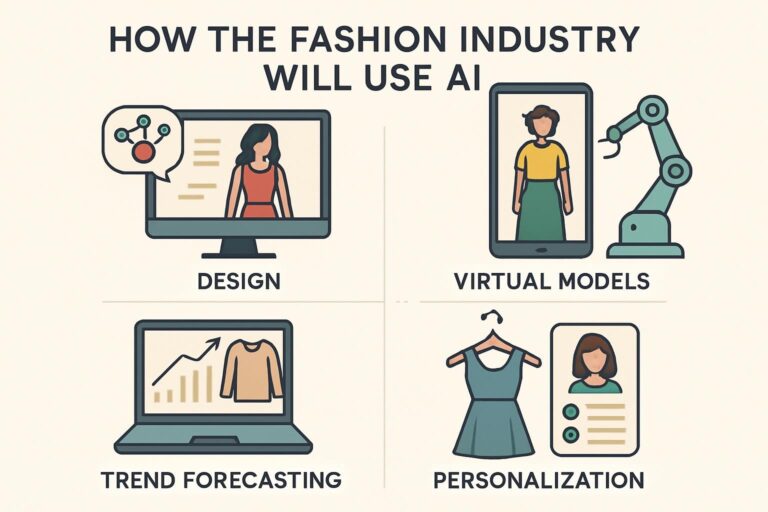
Trend forecasting has historically been fashion’s most expensive guessing game. Brands commissioned reports, sponsored runway seats, and hired trend agencies — then still overproduced. AI has transformed this from an art form dependent on a handful of expert intuitions into a probabilistic science drawing on billions of real-time data points.
Current systems from Heuritech — detecting over 2,000 fashion attributes across social platforms — and WGSN scan social media imagery, search query volume, resale velocity, and historical sales curves simultaneously. They don’t just identify what’s trending; they identify where in the adoption curve a micro-trend sits, and forecast when it will reach mass-market viability. Brands receive actionable signals 6–18 months before a trend becomes visible to unassisted human analysts.
“The brands winning in 2026 are not the ones with the best taste. They’re the ones who built taste prediction infrastructure two years ago.”
The underlying process involves scanning billions of social media posts and search queries, running image recognition across fashion content to detect color, silhouette, and texture signals, correlating those signals with historical sell-through data, and weighting the output by geographic market and demographic segment. The result is a probabilistic forecast that assigns confidence intervals to trend trajectories — not hunches, but probability distributions a buying team can actually act on.
| Capability | Traditional Method | AI-Powered Approach | Speed Gain |
|---|---|---|---|
| Trend forecasting | Runway analysis + expert intuition (6–12 months lag) | Billions of social signals processed in real-time | 6–18 months earlier |
| Design iteration | Sketch → sample → revise (3–6 weeks) | Prompt → 3D render → variant (minutes) | 100× faster |
| Pattern grading | Manual technical work (days per style) | AI construction-aware auto-grading (minutes) | 40–60× faster |
| Physical sampling | 3–5 physical samples per style, $200–800 each | Zero-sample digital prototype (near zero cost) | Zero-sample standard |
| Demand forecasting | Historical sales + buyer gut feel | Multi-variable ML prediction with confidence intervals | 30–50% fewer stockouts |
Advertisement
The transformation extends deep into manufacturing. Deloitte’s 2026 fashion manufacturing outlook documents AI-enhanced facilities achieving up to 30% faster production turnaround and a 40% reduction in material waste through AI-optimized fabric cutting and predictive maintenance scheduling.
Digital twin technology now allows brands to simulate a garment’s entire production lifecycle before committing to physical production. IoT sensor data feeds in real time into AI systems that adjust cutting patterns dynamically based on actual fabric bolt dimensions — reducing off-cut waste to levels previously impossible at scale.
2022–2023
The novelty era
Generative AI produces striking concept visuals. Fashion media coverage peaks. Commercial application remains minimal and disconnected from production reality.
2024
Pilot programs proliferate
35%+ of executives adopt AI for copywriting, image creation, and customer service. Design applications emerge in pilot form at major houses.
2025
Prompt-to-3D breaks through
Text and image inputs generate instantly viewable 3D garment prototypes with physical fabric simulation. Digital sampling becomes viable at scale.
2026 (now)
Operational backbone achieved
70%+ adoption among leading brands. AI integrates across design, production, retail, and supply chain. McKinsey designates it a “business necessity,” not an optional edge.
2030 (projected)
Digital-first becomes the default
Over 90% of apparel design expected to originate in digital-first environments. Zero-sample manufacturing standard. Circular fashion tracking via digital garment twins.
The following brands are not testing AI in isolated labs — they have embedded it into production workflows:
ASOS
Embedded a full generative AI design toolbox across operations in February 2026, including on-model imagery generation without physical shoots.
Stitch Fix
Launched “Vision” — generative personalized imagery showing customers wearing AI-recommended outfits before purchase.
The RealReal
AI tools “Shield” and “Vision” have identified over 200,000 counterfeit items using pattern and material recognition trained on their product database.
Zara / Inditex
Demand forecasting AI reduces overstock by analyzing real-time sell-through data, cutting unsold inventory cycles significantly.
Style3D clients
Brands using Style3D iDesigner report Prompt-to-3D generation replacing the majority of physical pre-production sampling costs.
Independent designers
AI tools now allow solo creators to compete with global brands by removing cost barriers to high-quality digital garment creation and prototyping.
For Designers & Creatives
If you’re an independent designer exploring these tools, the prompt engineering resources at BestPrompt.art offer practical, tested frameworks for getting production-quality outputs from tools like Midjourney, DALL·E, Adobe Firefly, and dedicated fashion AI platforms — without requiring a technical background.
The Consumer Interface: Shopping Reimagined
The retail experience has undergone equally dramatic change. Virtual try-on — once a novelty feature — has become a primary product photography tool. Brands now generate on-model product imagery entirely in-house: choosing the model, styling direction, and set design without a physical shoot. The cost reduction is substantial; the brand control is absolute.
Personalization engines have crossed a critical threshold too. When a customer sees themselves wearing a recommendation — in their size, in their preferred aesthetic context — the imagination gap that plagued e-commerce since its inception closes entirely. Conversion rates at brands that deploy this technology reflect that behavioral shift decisively.
McKinsey’s 2026 report documents one further disruption: customers are increasingly using large language models as shopping advisors — comparing products, requesting style recommendations, and receiving wardrobe counsel from AI agents. AI chatbot responses have become the new SEO. Brands optimizing for LLM-mediated discovery rather than keyword ranking are acquiring first-mover advantages that will compound for years.
Advertisement
The Accountability Layer: What Can Go Wrong
No honest expert analysis of generative AI in fashion omits the failure modes. There are four that warrant genuine strategic attention in 2026:
⚠ Algorithmic homogenization
When many brands use similar trend models trained on the same data, outputs converge. Competitive distinctiveness erodes. Fashion produced by AI consensus risks looking indistinguishable across brands.
⚠ IP and training data liability
Ownership of AI-generated designs and the use of existing creative work for model training remain legally unresolved globally. Brands need platforms with auditable generation steps and clear copyright policies.
✖ Bias in sizing and representation
Models trained on incomplete or skewed datasets generate incorrect sizing curves and culturally insensitive outputs. Active bias detection and diverse training data are non-negotiable for responsible deployment.
✖ Transparency deficit
Consumers and regulators increasingly demand disclosure of AI involvement in design and marketing. Brands without clear governance frameworks face growing reputational and regulatory exposure.
These risks are not arguments against adoption — they are arguments for responsible adoption. The brands building AI governance frameworks now will be insulated from the compliance shocks that are already forming in the EU’s AI Act regulatory pipeline.
What 2030 Looks Like from Here
Industry consensus places over 90% of apparel design originating in digital-first environments by 2030, with generative AI embedded at every stage. The trajectory points toward real-time co-creation: designers working inside shared 3D cloud environments where AI suggests trims, flags structural issues, and recommends colorways based on live market signals — simultaneously, across geographically distributed teams.
The integration of AI-generated 3D designs with automated cutting systems and on-demand manufacturing closes the loop entirely, making zero-inventory fashion economically viable at scale. Digital twins will track a garment from concept through recycling, enabling the circular fashion economy that has remained aspirational for a decade.
For creators navigating this shift, the foundational skill is not coding or data science — it is prompt fluency: the ability to communicate creative vision to AI systems with precision and intentionality. The team at BestPrompt.art publishes ongoing research and tested prompt frameworks specifically for creative professionals working across fashion, design, and visual AI tools.
The Bottom Line for Practitioners
The competitive window for early-mover advantage in AI adoption is closing. Brands that invested in AI design infrastructure in 2023–2024 now operate with structural cost and speed advantages that compound every quarter. For brands still treating AI as a tactical experiment rather than a core capability, the gap is widening — and it will not close through observation alone.
Expert Verdict
The Definitive Assessment
Generative AI in 2026 fashion is neither a threat to creativity nor a shortcut around it. It is infrastructure — as foundational to competitive fashion design as computer-aided design was in the 1980s, or digital supply chains in the 2000s. The designers who will define the next decade are not those who resist it, but those who develop the fluency to direct it with genuine creative authority. The tools have matured. The question now is solely one of human vision and strategic will.
Primary Sources & Further Reading
- McKinsey & Company — State of Fashion 2026 Report
- Style3D — AI Fashion Trends 2026: From Gimmick to Gears
- Veeton — A 2026 Report on AI’s Newest Capabilities for Fashion
- AIMultiple — Top AI in Fashion Use Cases & Examples 2026
- Fashion Diffusion — AI Fashion Trends 2026: Key Industry Insights
- Master of Code — Generative AI in Fashion: 2026 Insights
- Printful — AI Fashion Trends 2026: Data-Driven Style and Innovation
- Deloitte — Fashion Manufacturing Outlook 2026
- FitInline — AI in Fashion Design and Product Development 2026
- BestPrompt.art — AI Prompt Engineering Resources for Fashion & Design
The Bold New World of AI in Fashion: Explore the AI Art Gallery
How the Fashion Industry Will Use AI in 2026
Generative AI for Marketing and Advertising: Best Guide 2026
Generative AI in Fashion 2026: Hype vs. Operational Reality—A Critically Grounded Assessment