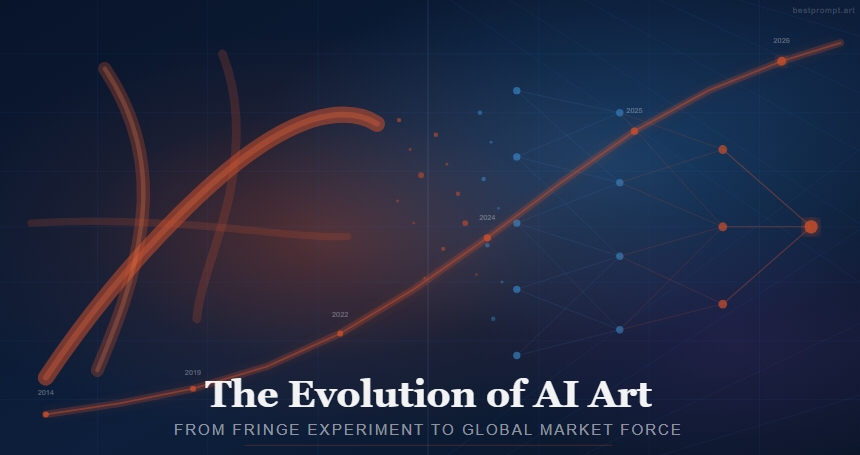
The Evolution of AI Art: From Fringe Experiment to Global Market Force

AI Art · June 2026 Deep Dive
How a technology dismissed as a gimmick in 2022 landed at Christie’s in 2025, rewired professional creative workflows, and opened a $7 billion market — while leaving copyright law scrambling to catch up.
The first thing Jason Allen said after his Midjourney image won the Colorado State Fair in August 2022 was not a victory speech. It was a warning: “AI is not going away.” The 1,200 people who signed petitions in protest didn’t disagree. They just didn’t believe it mattered yet. Three years later, Christie’s ran its first all-AI auction and sold $728,784 worth of machine-assisted work in a fortnight. Both things — the panic and the market — turned out to be correct predictions. This piece is about how we got from one to the other, and what it reveals about where AI art actually stands in mid-2026.
$7.2B
AI in Art & Creativity Market
2026 forecast · 25% CAGR
42%
Annual growth rate
Generative AI art segment 2025–26
35%
Fine art auctions now include AI works
As of early 2026
50M+
Active users across top AI image platforms
Midjourney, DALL-E, Stable Diffusion combined
Every article on AI art starts with DALL-E or Stable Diffusion. That’s a mistake, because it skips the half-century of failures, legal fights, and philosophical arguments that made 2022’s explosion feel inevitable to anyone who’d been watching.
Harold Cohen began building AARON in 1973 — a rule-based program he’d teach to draw autonomous images. By the 1990s AARON could paint recognizable forms in color. Cohen died in 2016, three years before the neural nets that descended from his conceptual lineage would make his life’s work look quaint. But the question AARON posed — whose intention is this? — is the same one the Supreme Court was still arguing about in March 2026.
The turning point that actually mattered came in 2014, when Ian Goodfellow sketched the Generative Adversarial Network (GAN) architecture on a napkin during a Montreal bar argument. Two neural networks — a generator and a discriminator — locked in competitive feedback. One creates. One judges. The generator gets better at fooling the discriminator. The discriminator gets better at catching fakes. Eventually the system produces images that neither it nor a human can reliably distinguish from real photographs. This idea, more than any subsequent product launch, is the engine underneath everything that followed.
1973
Harold Cohen builds AARON
The first AI system capable of generating original drawings. Cohen would spend 40 years refining it — and never resolved whether the work was his or the machine’s.
2014
Goodfellow publishes GAN architecture
The generator-discriminator feedback loop becomes the conceptual foundation for all subsequent image-generation systems.
2021
DALL-E (v1) and CLIP — OpenAI
Text-to-image joins the consumer imagination. CLIP’s ability to bridge language and visual semantics makes prompt-based generation possible at scale.
2022
The Year Three Tools Go Public Simultaneously
Midjourney open beta (July), Stable Diffusion open-source release (August), DALL-E 2 public access (September). Allen wins Colorado State Fair. The backlash begins.
2023
Legal pressure and platform maturity
Three artists sue Stability AI, Midjourney, and DeviantArt. Adobe Firefly launches trained on licensed content only — the “responsible AI” counterproposal. DALL-E 3 integrates with ChatGPT.
2024
Video generation and institutional acceptance
Runway Gen-4, Google Veo 2, Midjourney V6 push quality thresholds. Sotheby’s sells Ai-Da’s portrait of Alan Turing for over $1 million. AI art enters museum programming worldwide.
2025
Christie’s “Augmented Intelligence” — the first all-AI auction
$728,784 total. Refik Anadol’s Machine Hallucinations – ISS Dreams – A fetches $277,200. 37% of bidders are first-time Christie’s buyers. Simultaneously, the DC Circuit court rules: AI alone cannot create copyrightable work.
2026
Dataland opens — the world’s first AI art museum
Refik Anadol’s Dataland, housed in Frank Gehry’s Grand L.A. complex, opens June 20 in Los Angeles. Supreme Court declines AI copyright case in March. AI art market projected at $7.2B in 2026, on track for $17.25B by 2030.
By mid-2026, three dominant architectures serve the vast majority of the world’s AI image work. They don’t compete on price — they compete on philosophy.
| Platform | Architecture | Aesthetic signature | Commercial licensing | Training data transparency | Best suited for |
|---|---|---|---|---|---|
| Midjourney V7 | Proprietary diffusion | Cinematic, painterly, mood-driven | Yes (paid tiers) | Undisclosed | Visual artists, concept art, editorial |
| DALL-E 3 / GPT-4o | OpenAI diffusion + CLIP | Literal, high prompt fidelity, cleaner text rendering | Yes | Partial | Marketing teams, non-artists, rapid iteration |
| Stable Diffusion (SDXL/3) | Open-source latent diffusion | Highly variable — user-defined | Depends on model weights used | Public training data documented | Developers, fine-tuners, niche style models |
| Adobe Firefly | Proprietary, licensed data | Polished, slightly conservative | Commercially safe | Adobe Stock + public domain only | Agencies, brands needing legal certainty |
The fork between Midjourney and Adobe Firefly isn’t really about output quality — by 2025 the quality gap had largely closed. It’s about legal risk tolerance. An agency billing a Fortune 500 client can’t use Midjourney for a product campaign without serious intellectual property exposure. Firefly exists to solve that problem, at the cost of some creative range. The open-source Stable Diffusion community, meanwhile, has splintered into hundreds of specialized fine-tuned models for everything from anime to architectural visualization to medical illustration — a wild ecosystem that no corporate product team could replicate or control.
Practical note for creators
If you’re building a prompt practice from scratch, the most useful skill isn’t learning any single platform — it’s understanding how to describe light source, camera angle, and artistic reference simultaneously. Those three variables transfer across every tool. BestPrompt.art maintains a structured prompt library organized exactly this way, covering each major platform’s syntax differences.
The “Augmented Intelligence” results from March 2025 get cited constantly as proof that AI art has arrived at institutional legitimacy. That reading is incomplete.
The sale totaled $728,784, surpassing Christie’s $600,000 estimate. Forty-eight percent of bidders identified as Millennials or Gen Z, and 37% were first-time buyers at Christie’s. Those numbers tell a real story about audience expansion. But the auction also had 34 lots — and 14 either received no qualifying bids or sold below estimate. Pindar Van Arman’s Emerging Faces, touted as a highlight, drew no qualifying bids at all.
What the selective headline coverage missed: this was a market testing its own edges. The works that sold well — Refik Anadol’s data-driven installations, pieces by artists with documented institutional track records — had backstories and provenance that pre-dated the auction. The works that failed were essentially unknown prompts from unknown operators. The collectors weren’t buying AI. They were buying the artist’s relationship with AI over time. That distinction matters enormously for anyone building a creative practice in this space.
“Collectors weren’t buying AI. They were buying the artist’s relationship with AI over time.”
By 2025, the average lot value for Refik Anadol’s work had grown by +1,535% relative to previous minimum estimates. Between 2024 and 2025 alone, average price year-over-year growth reached +837%. But in January 2026, one of his editions failed to find a buyer at Sotheby’s. Even the market’s star performer isn’t immune to selectivity. The lesson is that AI art’s market is maturing in the same way early photography’s market did — separating technical novelty from artistic vision. It took photography about 30 years. AI art is on a faster clock.
On March 2, 2026, the U.S. Supreme Court declined to hear Thaler v. Perlmutter. The case had been running since 2018, when computer scientist Stephen Thaler applied to copyright an image generated entirely by his AI system DABUS. The Copyright Office rejected it. A district court rejected it. The DC Circuit rejected it. The Supreme Court refused to review that rejection.
The result: fully AI-created works cannot receive copyright protection without human authorship under current U.S. law. The DC Circuit’s language was precise: “the Creativity Machine cannot be the recognized author of a copyrighted work because the Copyright Act of 1976 requires all eligible work to be authored in the first instance by a human being.”
This is the settled part. Now for the unresolved part, which is where most working artists and platforms actually live.
The three open questions no court has answered yet
1. How much human input is enough? A 30-word prompt? 200 iterations of refinement? Post-production in Photoshop? The Copyright Office has offered guidance, but no bright-line rule. Cases involving human-AI collaboration are being evaluated individually.
2. Is training on copyrighted images fair use? The class action lawsuits filed in 2023 against Stability AI, Midjourney, and DeviantArt were still moving through courts as of mid-2026. The outcome will either require retroactive licensing agreements across the industry or confirm that model training is transformative use.
3. What happens in jurisdictions outside the U.S.? The EU AI Act, which came fully into force in 2025, imposes transparency requirements on AI systems used in creative work. China has its own regulatory framework. The international patchwork means a work legally produced in one country may have ambiguous status in another.
The practical implication for creators: if you’re using AI in commercial work, the safest posture right now is to document your creative process — prompts, iterations, post-processing decisions — in the same way you’d keep a production file for a traditional illustration. That documentation is currently your strongest evidence of human authorship if ownership is ever disputed.
The term gets used carelessly. Here’s what the data actually shows.
AI in Art & Creativity Market — Size & Projections (USD Billion)
The AI in art and creativity market is expected to reach $7.16 billion in 2026, growing at a compound annual rate of 24.9%. Projections from InsightAce Analytic put the market at $54 billion by 2035 at a 25.4% CAGR. These are large numbers. They also include enterprise creative software, AI-augmented design tools, and music generation — not just the image generators that dominate public discourse.
The more telling number: approximately 35% of fine art auctions now include AI-created artworks, and AI art’s share of the contemporary art market is estimated to have surpassed 5% in 2025. In a market that has historically moved in decades rather than years, that’s a seismic shift in category acceptance.
What “mainstream” doesn’t mean yet: universal acceptance. When Christie’s launched its AI auction in early 2025, approximately 6,500 artists signed an open letter demanding its cancellation, calling AI-generated art a form of “mass theft.” That petition didn’t stop the sale. It also didn’t resolve the underlying tension — it just documented that the tension exists at scale.
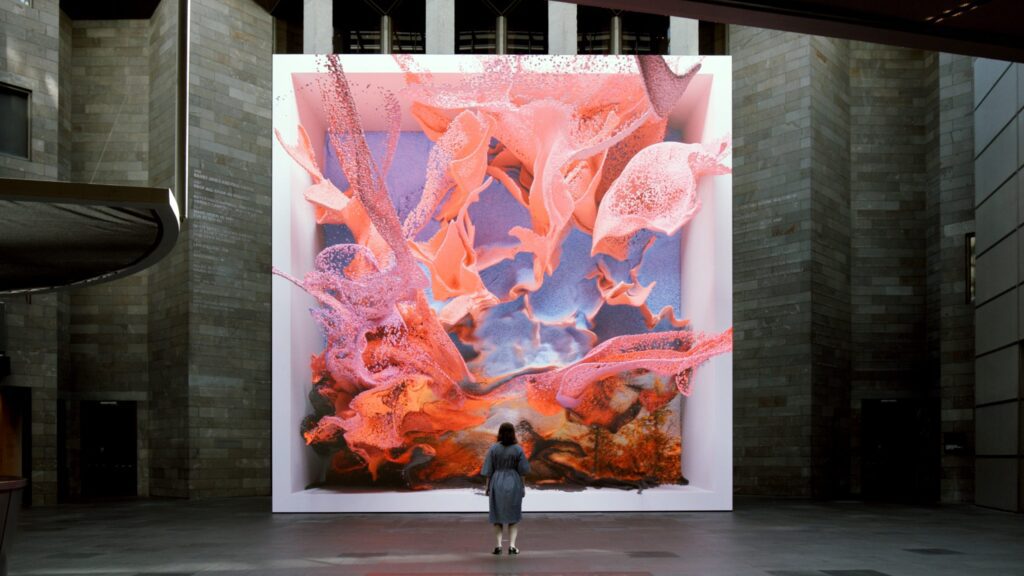
If there is one figure who has done more than anyone else to translate AI art from internet subculture to institutional legitimacy, it’s Refik Anadol. His influence is worth examining not because he’s the most technically sophisticated artist working in this space, but because he solved a problem no other AI artist has: how to make data feel like it has stakes.
His Large Nature Model: Coral series — which fed millions of coral reef photographs into a machine learning system to create large-scale dynamic visualizations of what we’re losing to ocean warming — isn’t primarily about AI. It’s about grief. The AI is a method for processing a scale of information that no human could hold simultaneously. The emotional register is entirely human.
Dataland, the world’s first AI art museum, is set to open on June 20, 2026. The Los Angeles institution, housed inside Frank Gehry’s Grand L.A. complex, was founded by Anadol and his partner Efsun Erkiliç, adding to a cultural corridor that includes MoMA’s West Coast presence, the Broad, and the Walt Disney Concert Hall.
The museum’s first exhibition uses Anadol’s Large Nature Model to simulate alternate rainforests by processing vast quantities of ecological data — birdsongs, plant life, weather systems — into what he calls “digital sculptures.” It is, depending on your view, either the most ambitious environmental art project of the decade or an extremely expensive screensaver. That ambiguity is probably the point.
The uncomfortable truth that no one in the AI art boosterism camp wants to say plainly: most people using AI image generators are not making art. They’re automating aesthetic production. The distinction matters, because “AI art market growing at 42% annually” includes both Refik Anadol’s museum and someone using Midjourney to generate placeholder images for a Shopify storefront. Both are real. Only one of them is the thing galleries will hang in fifty years.
The response to AI training on human artwork hasn’t only been legal. The University of Chicago’s Glaze project developed software that subtly alters digital artwork in ways invisible to human eyes but that “poison” AI training data. Models trained on Glazed images produce distorted outputs for the specific artist’s style. Nightshade, a companion tool, takes a more aggressive approach: it actively corrupts model training in ways that bleed across entire style categories.
These tools represent a technological arms race that legal frameworks have been too slow to referee. As of mid-2026, adoption among professional illustrators is significant — particularly those on DeviantArt and ArtStation, where model scraping was most aggressive in 2022–23. Whether the tools remain effective as training methods evolve is an open question.
The broader point: artists are not passive in this story. They are developing defensive infrastructure in parallel with the expansion of the tools that threaten their livelihoods. Any honest account of AI art’s evolution has to hold both trajectories simultaneously.
The mythology around AI art is that it requires no skill — anyone can type a sentence and get a striking image. This is true in the same way that anyone can aim a camera. The gap between an iPhone snapshot and a Richard Avedon portrait is not the camera. It’s the knowledge of light, composition, subject relationship, and intention that the person behind the camera brings.
Effective prompt engineering in 2026 involves at minimum: understanding how each platform interprets reference artists and styles; knowing which keywords activate which aesthetic modes; controlling composition through aspect ratio, camera perspective, and lighting descriptors; and using negative prompting to suppress common AI artifacts (oversmoothed skin, anatomically wrong hands, floating objects).
Where to build this practice
The most systematic prompt libraries currently available are organized by output intent rather than by platform. BestPrompt.art structures its resources around the three variables that transfer across every major tool: light source, compositional anchor, and stylistic reference. Worth exploring if you’re moving from occasional experimentation to consistent production.
Lighting specificity. “Studio lighting” produces a different result than “north-facing window light at 4 PM in January.” The first is a category. The second is a scene. AI models have been trained on enough photography to know the difference.
Negative space intent. Most AI generators default to filling the frame. If your composition requires negative space — for type, for tension, for breathing room — you have to actively engineer it. “Minimalist composition with subject occupying lower left quadrant” is not overcomplicate prompt syntax; it’s basic compositional direction.
Iteration logic. Allen’s Midjourney image that won Colorado took 80+ hours and 600+ prompt iterations. The first output is almost never the final output. Treating AI image generation as a one-shot process is the most common mistake made by people who conclude the tools aren’t capable of professional-quality work.
Image generation in mid-2026 is a mature market with established leaders, pricing pressure, and narrowing quality gaps. Video generation is approximately where image generation was in early 2022: technically impressive, inconsistent, frequently wrong about physics, and clearly about to be a very big deal.
Google’s Veo 2, Runway Gen-4, and Kling 2.0 all made significant quality leaps in late 2025, particularly around temporal consistency (keeping objects, faces, and lighting coherent across frames — the failure mode that made early AI video look like a fever dream). OpenAI’s Sora, which generated enormous attention at its February 2024 announcement, has remained in controlled release — suggesting that the gap between demo-quality and production-quality is wider than the initial announcement implied.
For creative professionals, the practical implication is that motion graphics, storyboarding, and short-form video concept work are the next domains where AI will move from “experimental tool” to “expected capability.” The timeline is probably 18 to 30 months for this to become a production-grade workflow in mid-tier studios.
The Questions Worth Taking Seriously
Mainstream coverage of AI art tends to oscillate between hype and panic. Neither frame is analytically useful. Here are the questions that actually determine what this space looks like in five years.
Will the copyright cases settle on licensing or on fair use? If courts ultimately find that training on copyrighted work requires retroactive licensing, the current business models of every major closed-source AI art platform are non-viable. The platforms know this, which is why they’ve been building artist compensation programs and exploring licensing frameworks even while litigating. A settlement — rather than a court ruling — is the most likely outcome, but the terms will shape the industry for a decade.
Does quality convergence commoditize creative work? As the output quality of Midjourney, DALL-E, Firefly, and Stable Diffusion converges, the differentiator shifts from the tool to the operator. This is actually good for skilled prompt engineers and bad for people who thought “access to a tool” was itself a competitive moat. The market is selecting for taste, judgment, and creative direction — exactly the skills that experienced human designers have always monetized.
What happens to the training data when the current open data era ends? The models that power today’s tools were largely trained on web-scraped content from 2010–2023. New high-quality training data is increasingly locked behind paywalls, consent requirements, and legal uncertainty. Future model generations may be trained on synthetic data — AI-generated images used to train better AI image generators — with unpredictable effects on output diversity and quality.
Here’s what the next generation of AI art observers will probably find strange about this moment: the intensity of the debate about whether AI art is “real” art. In the same way we don’t argue about whether photography is real art, or whether digital design is real design, the medium question will eventually feel beside the point. The relevant question — the one that persists regardless of the tool — is whether the person making it had something worth saying. That question is as hard as it’s ever been. The tools don’t change it. They just make it more visible, faster.