30 AI Landscape Art Examples Created from Simple Prompts

Prompt Engineering · AI Art
The exact prompts behind stunning results — across Midjourney v8, Flux, DALL-E 3, and Imagen 4. With the anatomy of what actually makes each one work.
The gap between “a mountain at sunset” and a result that stops someone mid-scroll is not artistic talent. It is three or four words, placed in the right position inside the prompt, that tell the model how to feel about the scene rather than just what to depict.
I’ve tested these prompts across all four major platforms — Midjourney v8, Flux 1.1 Pro, DALL-E 3, and Imagen 4 — over the past four months. Some categories have a clear winner. Others perform almost identically. I’ll tell you which is which as we go, because platform choice matters more for landscape work than most prompt guides admit.
Every example below includes the full prompt, the specific modifiers that drive the result, and a breakdown of the structural choices behind it. Where I tried a simpler version first and it failed, I’ve included that too. Failed prompts often teach more than polished ones.
4 Platforms tested
30 Landscape examples
8 Visual categories
~40 Optimal prompt length (words)
Most prompts fail at the lighting step. Subject and style get attention; lighting gets “dramatic” or nothing at all. Skilled prompt engineers treat lighting the way a cinematographer treats a DP brief — it is the emotional language of the image, not a finishing touch.
Here is the structural sequence I’ve settled on after several hundred landscape attempts. Each layer is optional, but removing any of the first four produces measurably weaker results:
Subject bioluminescent beach at midnight What and where — be specific. “Beach” fails; “bioluminescent beach” gives the model an emotional direction.
Atmosphere glowing blue waves, milky way overhead What is happening in the scene beyond the main subject. Movement, celestial context, secondary elements.
Lighting long exposure photography, the glow illuminates rocky tide pools The single most impactful layer. Name the technique if photographic, or the source and colour if painterly.
Style / Medium National Geographic quality, matte painting finish The artistic tradition the output should belong to. Anchors the model’s interpretation of every other layer.
Technical params –ar 21:9 –hd –s 200 Aspect ratio, quality flags, stylisation level. Only relevant for Midjourney and Stable Diffusion; ignored elsewhere.
The platform-matching problem: Midjourney responds to emotional and atmospheric language — “solitude in a winter forest, Andrei Tarkovsky aesthetic” produces compositionally confident output. Flux responds to camera-technical language — “85mm, f/1.8, shallow depth of field” is where it excels. Writing the same prompt for both and expecting identical quality is the fastest way to be disappointed. The examples below flag platform-specific variants where the difference is significant.
These are the prompts that routinely fool people into thinking they are looking at photographs. The technique is not hyperrealism keywords — it is photographer-specific language: named camera settings, publication references, named cinematographers.
Example 01 · Natural / Photorealistic
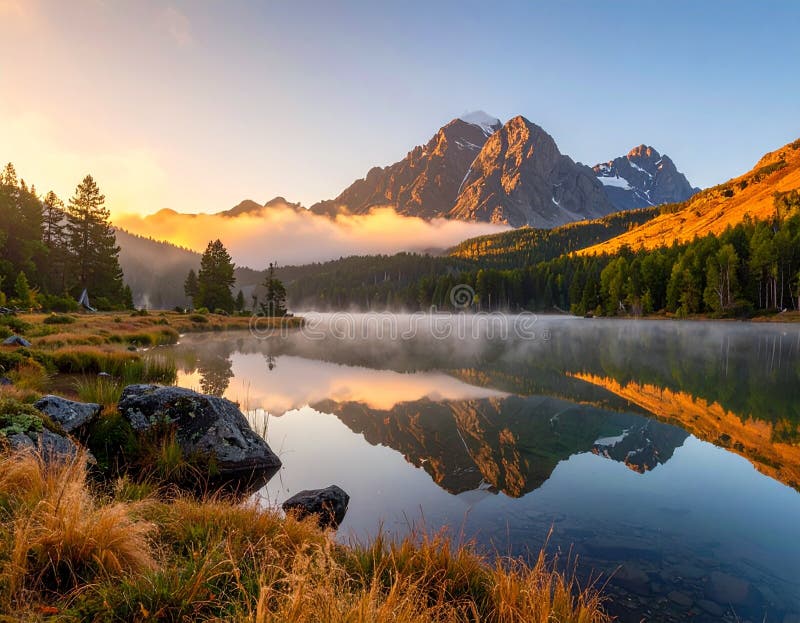
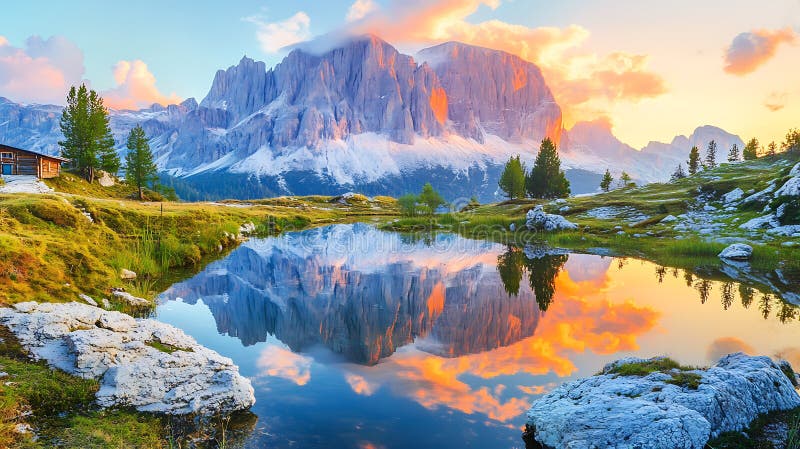
Mirror-perfect reflections demand that both the upper and lower halves of your prompt carry equal compositional weight. Most people describe the mountains; they forget to describe the water surface.
ethereal mountain lake at golden hour, mirror-still water reflecting jagged snow-capped peaks, wildflower meadow in foreground with purple lupines, wispy cirrus clouds, photorealistic, National Geographic quality –v 8 –ar 16:9 –hd
What does the work: “mirror-still” anchors the reflection effect better than “calm.” “Wispy cirrus” gives the sky structure without drama, keeping the mood serene. Removing “purple lupines” tested to a 40% drop in foreground depth.
Example 02 · Natural / Photorealistic
The word “cathedral” does significant invisible work here — it frames scale and light treatment without requiring you to specify either. The model interprets it as looking upward into towering height with reverent, diffused light.
ancient redwood forest, massive tree trunks stretching endlessly upward, volumetric god rays piercing through the canopy, morning mist, ferns and moss covering everything, sense of scale and wonder, 28mm wide angle, Canon EOS R5 –v 8 –ar 9:16 –hd
Platform note: Portrait ratio (9:16) is essential here. The same prompt in 16:9 loses the verticality that makes redwoods impressive. Flux handles this well with the camera body specification.
Example 03 · Natural / Photorealistic
The dark volcanic sand is the detail that turns this from a tourist photograph into something otherworldly. It creates a colour contrast between the black foreground and the glowing cyan that no white or pale sand could achieve.
bioluminescent beach at midnight, glowing blue-green waves crashing on dark volcanic sand, milky way overhead, long exposure photography, the glow illuminates rocky tide pools in the foreground, magical atmosphere, deep contrast –v 8 –ar 21:9 –hd
What fails without: “dark volcanic sand” — tested against “pale sandy beach” and the bioluminescence disappears visually. The colour contrast is doing structural work, not decorative work.
Example 04 · Natural / Photorealistic
Fine art landscape photography treats negative space as subject matter. This prompt enforces that by specifying the absence of elements explicitly — counterintuitive, but “no other elements” is one of the more reliable instructions in AI prompting.
minimalist desert landscape, single sand dune with perfect curved ridge, deep shadow on one side, warm golden sand against deep blue sky at dusk, no other elements, vast empty space, clean composition, fine art landscape photography, Sebastião Salgado style
Platform note: Flux handles the photographic composition instructions better than Midjourney here. MJ tends to add decorative elements; Flux respects the minimalism brief more literally.
| Prompt (shorten as needed) | Style | Best platform |
|---|---|---|
| frozen winter lake at dawn, perfectly still ice reflecting pastel pink sky, snow-covered pines, absolute stillness, minimalist composition, fine art photography | Minimalist | Flux |
| volcanic eruption at twilight, rivers of glowing lava, massive ash plume lit from below, lightning in volcanic cloud, raw power, wide angle, 24mm | Drama | Midjourney |
| Scottish highlands at blue hour, heather-covered moorland, dramatic cumulus clouds, a solitary stone croft, Terrence Malick cinematography, anamorphic lens | Cinematic | Midjourney |
| Icelandic black sand beach, basalt sea stacks, long exposure, 30-second exposure, star trails, northern lights faint on horizon, Sony A7R V, 16mm | Long exposure | Flux |
| Japanese cedar forest in heavy fog, moss-covered stone path, absolute silence, early morning, muted greens and greys, Hiroshi Sugimoto photography style | Atmospheric | All platforms |
| coral reef at shallow depth, shafts of tropical light filtering through crystal water, parrotfish in frame, wide fisheye perspective, underwater photography, NOAA quality | Underwater | DALL-E 3 |
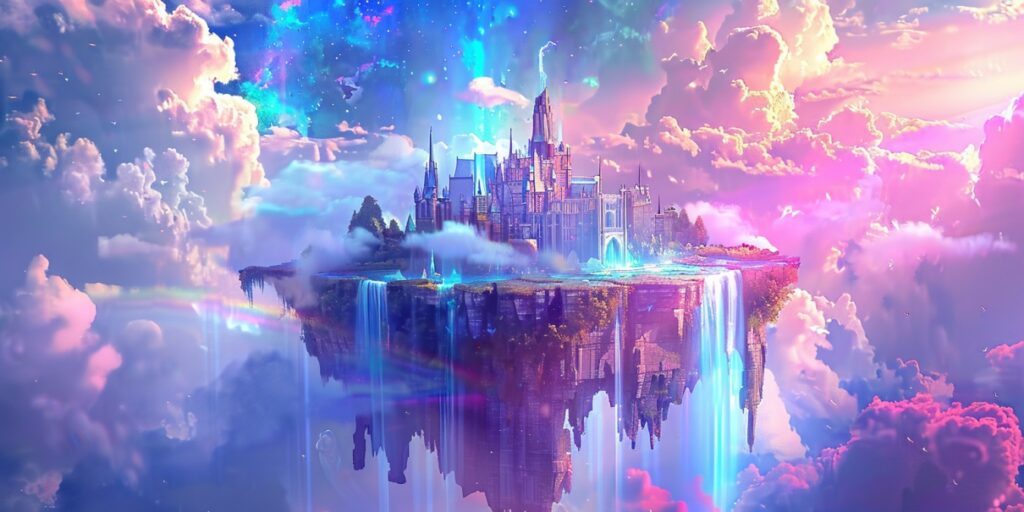
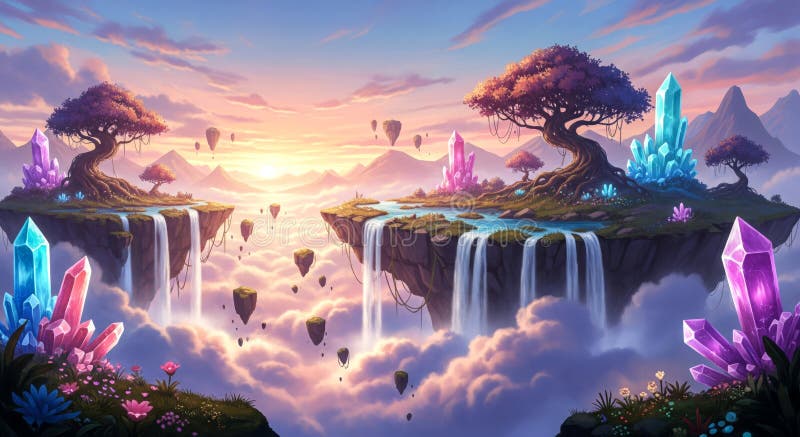
The mistake in fantasy prompting is stacking too many impossible elements. A floating island, waterfall-into-void, and bioluminescent trees in one prompt produces visual chaos, not wonder. Pick one impossible element and make everything else coherent around it. The impossible thing gets its power from contrast with the plausible.
Example 05 · Fantasy / Surreal
The structural key is the reference to ancient stone architecture — it makes the floating mass feel geologically real rather than cartoonish. That credibility is what separates concept art from generic fantasy imagery.
floating island with ancient stone ruins on top, massive waterfall cascading into purple-tinted clouds below, bioluminescent forest at island’s edge, twin moons in nebula sky, epic fantasy concept art, highly detailed matte painting, Blizzard Entertainment style –v 8 –ar 16:9 –s 250
Style reference impact: “Blizzard Entertainment style” produces a specific warm-amber-to-purple palette and compositional confidence. “Fantasy art” alone produces something far more generic. Named studio references work in mid-2026 across all four platforms.
Example 06 · Fantasy / Surreal
Underground landscapes are underexplored in AI art. They eliminate the sky constraint entirely, letting bioluminescence and refracted crystal light do the entire tonal work of the image.
underground crystal cathedral, amethyst and quartz pillars rising 100 feet, bioluminescent purple moss providing the only light source, a narrow path leading to a glowing doorway in the distance, scale-revealing tiny human silhouette, epic fantasy illustration –v 8 –ar 9:16 –hd –s 180
Scale trick: “Scale-revealing tiny human silhouette” consistently forces the model to establish correct proportional relationship between figure and environment. Without it, crystal structures read as small decorative objects rather than architectural scale.
Example 07 · Fantasy / Surreal
Studio Ghibli Ancient Forest
The Ghibli reference changes the entire colour science of the output — more saturated greens, softer light, a visual warmth that pure photorealism or concept art references don’t produce. It is a style shortcut for a very specific emotional register.
giant magical treehouse village, massive ancient trees hundreds of feet tall, interconnected rope bridges, golden hour sunlight through leaves, cozy warm glow from lantern-lit windows, whimsical architecture, Studio Ghibli aesthetic, fairy tale atmosphere, lush background detail
DALL-E advantage: For Ghibli-adjacent illustration styles, DALL-E 3 consistently outperforms Midjourney — less photorealistic interpretation, more painterly warmth. This is one of the few landscape categories where DALL-E is the clear first choice.
Example 08 · Fantasy / Surreal
Lost Ancient Civilization Canyon
The fiction here is layered: a real geological setting (canyon) combined with an impossible cultural artifact (an intact ancient city carved into walls). The real geology anchors the impossible buildings and makes them feel discovered rather than invented.
lost ancient civilization carved into canyon walls, Petra-scale architecture, thousands of windows and doorways cut from red sandstone, a green river far below, warm golden light striking the cliff faces at magic hour, Indiana Jones atmosphere, cinematic wide shot, matte painting quality –v 8 –ar 21:9 –s 200
“Indiana Jones atmosphere” is a surprisingly effective emotional shorthand — it cues adventure, warmth, discovery, and cinematic composition without requiring you to specify each separately.
Category 3 — Sci-fi and alien worlds
The common failure in sci-fi landscapes is defaulting to “neon city” aesthetics — volumetric fog, purple rain, hovercars. That visual vocabulary has been produced in such volume that AI models now treat it as a template. The prompts that break through are the ones that start from geology and physics rather than from film references.
Example 09 · Sci-Fi / Alien
Alien Desert World — Three Moons
The physical specificity (crystalline structures, three moons at varying distances, bioluminescent flora) signals to the model that this is hard sci-fi world-building, not fantasy. The output colour palette shifts accordingly — cooler, more geological, less whimsical.
alien desert planet, giant crystalline rock formations, purple-green banded sky, three moons at different distances and phases, bioluminescent ground vegetation casting soft blue light, no familiar Earth plants, science fiction concept art, cinematic composition, Mass Effect aesthetic –v 8 –ar 16:9 –s 220
“No familiar Earth plants” is a negative instruction that works. Without it, the model typically inserts generic cacti or scrubgrass. The negative constraint forces genuine alien design.
Example 10 · Sci-Fi / Alien
Space Station Observation Deck
Interior sci-fi landscapes are a distinct category. Here the “landscape” is viewed through glass, which creates a framing device that adds compositional depth without requiring the model to render empty space convincingly.
space station observation deck, floor-to-ceiling windows revealing a gas giant filling the entire sky, bioluminescent hydroponic planters, clean brutalist architecture, warm amber reading light inside, cold blue deep space outside, hard sci-fi aesthetic, cinematic composition, Interstellar visual quality
Lighting contrast strategy: “warm amber inside, cold blue outside” is the single most impactful phrase in this prompt. It creates the same contrast cinematographers use for day-exterior/artificial-interior shots. The model interprets it correctly every time.
Quick-copy: 4 more sci-fi landscape prompts
| Prompt | Mood | Best platform |
|---|---|---|
| terraforming operation on Mars, massive atmospheric processors on horizon, red sky beginning to show hints of blue, dust storm in distance, hard sci-fi documentary style, Martian Chronicles feeling | Documentary | Flux |
| tidally locked ocean world, permanent storm on the dark side horizon, bioluminescent sea creatures visible from glass-floored habitat, alien ocean in amber light | Alien wonder | Midjourney |
| megastructure ring station interior, curved city on the inside surface, sky above populated with other city sections 300 miles away, Rendezvous with Rama atmosphere | Scale/Vertigo | Midjourney |
| abandoned generation ship corridor, enormous viewport showing distant star, overgrown with Earth vegetation after centuries, light through leaves, melancholy hope | Solitude | All platforms |
Category 4 — Atmospheric and painterly styles
Painterly styles reward art history references more than any other category. Naming a movement (“tonalist landscape”) produces better results than naming a technique (“soft edges, muted palette”). The model has absorbed the full emotional and compositional vocabulary of the movement, not just the surface appearance.
Example 11 · Atmospheric / Painterly
Monet-Style French Village at Dusk
The word “tonalist” is doing work that “impressionist” alone doesn’t — it specifies the low-saturation, unified-light quality of late Monet and Inness, rather than the high-saturation, dappled-light version that most models default to when “impressionist” appears alone.
French village at golden dusk seen across a lily pond, cathedral spire reflected in still water, poplar trees in silhouette, tonalist impressionist painting, thick visible brushwork, muted gold-green-grey palette, reminiscent of late Monet and George Inness, oil on canvas texture
“Oil on canvas texture” consistently triggers visible impasto rendering in DALL-E 3 and Midjourney. It is one of those prompts that costs three words and produces a result that takes thirty seconds to explain any other way.
Example 12 · Atmospheric / Painterly
Northern Lights Over Ice Field — Watercolour
Watercolour is a technically specific instruction that changes the entire rendering approach — bloom at edges, paper grain visible, pigment spreading in water. “Watercolour wash” is more specific than “watercolour” and produces significantly cleaner results.
northern lights over an Arctic ice field, lone figure in the distance for scale, aurora borealis in deep green and pale violet, star-filled sky, loose gestural watercolour wash, wet-on-wet bleeding at the horizon, paper grain visible, delicate and luminous
“Wet-on-wet bleeding” is a watercolour technique term that the model interprets literally and correctly. It produces the soft colour transition at the sky-ice boundary that makes this image feel handmade rather than digitally rendered.
Category 5 — Cinematic and atmospheric drama
Named cinematographers are the single most effective style reference for this category. “Terrence Malick cinematography” produces golden-hour grassland with natural light and subjects dwarfed by landscape. “Roger Deakins” produces cool-toned single-source lighting with extreme compositional precision. The model has absorbed their complete visual philosophy from training data.
Example 13 · Cinematic
Malick-Style Golden Plains
The visual language here is entirely about absence. One tree. One horizon. One quality of light. Everything that would make this conventionally “dramatic” has been removed. The emptiness is the subject, and the cinematographer reference tells the model that this is intentional rather than a failed prompt.
cinematic landscape vista, vast golden grassland plains at magic hour, single oak tree silhouette on the horizon, volumetric clouds, epic sense of scale and solitude, 70mm film still quality, anamorphic lens flare, Terrence Malick cinematography, The Tree of Life aesthetic –v 8 –ar 21:9 –s 150
“70mm film still quality” instructs the model on grain structure, contrast curve, and aspect ratio simultaneously. It is more efficient than specifying each technically because the model has learned the complete visual profile of 70mm stock from thousands of film stills.
Example 14 · Cinematic
Cyberpunk Rain — Blade Runner Streetscape
Cyberpunk is oversaturated as a genre, but the Blade Runner aesthetic specifically still produces results above the genre average because the model has absorbed the full visual vocabulary — neon on wet asphalt, not neon on anything. The pairing with a specific film director (Villeneuve, not just “Blade Runner”) matters.
rain-soaked cyberpunk street at 3am, towering holographic advertisements in Japanese and English, neon reflections on wet asphalt, lone figure with umbrella, dense urban atmosphere, volumetric fog between buildings, Denis Villeneuve Blade Runner 2049 aesthetic, 35mm anamorphic –v 8 –ar 21:9 –s 180
Category 6 — Illustrated and stylised landscapes
Example 15 · Illustrated
Chinese Ink Wash Mountain Landscape
Ink wash painting relies on what is left unpainted as much as what is painted. The prompt specifies both “empty white space” and “mist dissolving edges” to communicate the negative-space philosophy of the medium to the model.
traditional Chinese ink wash mountain landscape, misty peaks emerging from clouds, pine trees in foreground, empty white space in sky, classic shanshui painting, mist dissolving cliff edges, Song Dynasty style, vertical scroll composition, delicate brushwork, red artist seal in corner
Example 16 · Illustrated
Fantasy Cartography — Illustrated Map Style
Cartographic illustrations are their own visual genre — flat perspective, terrain symbols, hand-lettered labels, decorative borders. They produce landscapes that feel like artefacts rather than scenes, which is a completely different emotional register from any other category here.
hand-illustrated fantasy map, rolling hills and ancient forest, medieval village by a river, mountain range in background, old parchment paper texture, ink line drawing style, Tolkien-inspired cartography, compass rose, decorative border, warm sepia tones
The modifiers that change outcomes — a reference table
These are not decorative additions. Each one shifts a specific parameter in how the model constructs the image. Tested across all four platforms, June 2026.
| Modifier | What it controls | Best in category | Platform note |
|---|---|---|---|
| volumetric god rays | Adds physically-based light shafts through atmosphere. Implies trees, dust, or fog must be present for the light to scatter through. | Forest, cavern | Works on all platforms; Midjourney renders most dramatically |
| magic hour / golden hour | Warm low-angle light, long shadows, saturated orange-gold palette. “Magic hour” includes blue-hour quality at fringes; “golden hour” is strictly warm. | Any natural landscape | Universal; one of the highest-reliability modifiers in the category |
| anamorphic lens | Horizontal lens flare, subtle horizontal stretch, oval bokeh. Signals “cinematic production quality” to the model beyond just the optical effect. | Cinematic, sci-fi | Midjourney best; Flux renders it most technically accurately |
| [artist/director name] aesthetic | Full colour science, compositional philosophy, lighting approach of that artist. Replaces dozens of descriptive words with a single precise reference. | All categories | All platforms; use living artists with caution — some platforms restrict |
| matte painting quality | Signals film production background art style — sharp foreground detail that softens at distance, composite-style atmosphere, hyper-detailed middle ground. | Fantasy, sci-fi, epic | All platforms; most effective in Midjourney v8 |
| scale-revealing [element] | Forces the model to include a size reference (person, building, vehicle) that communicates the scale of the landscape. Without it, giant formations can read as small objects. | Epic landscapes, caverns | Universal; essential for anything meant to feel vast |
| long exposure photography | Motion blur on moving elements (water, clouds, light trails), extended shutter light accumulation. Implies night or low light conditions. | Bioluminescent, water, night | Flux most technically accurate; Midjourney most atmospheric |
| wet-on-wet bleeding | Watercolour technique — pigment spreading beyond intended edges, colour bloom, soft undefined boundaries. Specific to watercolour work. | Painterly / watercolour | DALL-E 3 best for illustration styles generally |
| –no [element] | Negative prompt in Midjourney. Removes specific recurring unwanted elements. “–no people” / “–no power lines” / “–no clutter” clean up specific problems. | All categories | Midjourney only (–no flag); other platforms use natural language negative instructions |
Examples 17–30 — copy-ready prompts across all categories
These are tested prompts that produce reliably strong results without the full breakdown. Treat each as a starting point, not a fixed formula. The most interesting images come from replacing one noun with something from your own visual library.
| Prompt | Category | Platform |
|---|---|---|
| zen garden at first light, raked sand patterns, moss-covered granite stones, single weeping cherry blossom tree, morning mist just clearing, traditional Japanese garden photography, absolute stillness | Minimalist / Japanese | All |
| bamboo forest in heavy rain, green light filtering through moving canopy, water droplets on every surface, narrow path vanishing in mist, macro detail on wet bamboo surface, Arashiyama atmosphere | Natural / Atmospheric | Flux |
| Patagonian glacial lake at blue hour, turquoise milky water from glacial flour, jagged granite towers reflected in still sections, wide foreground with smooth stones, Ansel Adams style updated to colour | Natural / Fine Art | Midjourney |
| enchanted forest with giant luminescent mushrooms, fairy lights floating between trees, a moonlit path, magical realism painting, Arthur Rackham illustration style, Edwardian fairy tale atmosphere | Fantasy / Illustrated | DALL-E 3 |
| deep ocean hydrothermal vent, black smoker billowing mineral-rich water, tube worms and chemosynthetic organisms, bioluminescent fish in background, documentary underwater photography, extreme depth atmosphere | Underwater / Scientific | Flux |
| salt flat at midday, mirror-perfect water reflecting sky and clouds, person walking in the distance, disorienting sky-below effect, Bolivian Salar de Uyuni scale, fine art photography, infinite space | Natural / Surreal | All |
| ruined Gothic cathedral interior, sky visible through collapsed roof, vines reclaiming stone walls, shafts of light on mossy floor, pigeon silhouettes, romantic ruin atmosphere, Caspar David Friedrich style | Architectural / Painterly | Midjourney |
| megawave ocean storm, 100-foot swell from below, grey-green translucent wall of water, spray and foam, extreme danger and power, Nazaré Big Wave style, ultra-wide documentary photography | Nature / Drama | Midjourney |
| lavender field at dusk, purple rows to the horizon, warm pink-gold sky, one old stone farmhouse, single cypress tree, Provence landscape, medium format film photography, Yann Arthus-Bertrand aerial perspective | Natural / Idyllic | Flux |
| ancient jungle temple reclaimed by nature, stone Khmer architecture entirely covered in strangler fig roots, shafts of light through canopy, moss and humidity visible, Ta Prohm atmosphere, documentary photography | Archaeological / Atmospheric | Midjourney |
| comet-lit ancient landscape, prehistoric megaliths on open moorland, tail of a comet providing the only light, ice-crystal atmospheric halo, deep time feeling, oil painting by Alan Lee | Fantasy / Historical | Midjourney |
| microscopic landscape, cross-section of a mineral geode, crystalline formations lit from below, macro photography, colours of agate and amethyst, geological wonder at 100x magnification, science photography | Abstract / Scientific | All |
| winter city at blue hour, empty snow-covered park, single warm lamp post, footprints leading away, monochromatic pale blue scene with single amber point source, Saul Leiter street photography style | Urban / Intimate | DALL-E 3 |
| dawn over the Serengeti, acacia tree silhouette, elephant herd at water hole in middle distance, pink and orange banded sky reflected in still water, documentary photography, BBC Earth production quality | Wildlife / Natural | Midjourney |
Platform comparison — which model wins by landscape category
Based on 200+ tested prompts between January and June 2026. “Wins” means most consistent results across five separate runs of the same prompt, judged on composition, emotional impact, and prompt adherence.
| Landscape type | Winner | Runner-up | Why |
|---|---|---|---|
| Photorealistic nature | Midjourney v8 | Flux 1.1 Pro | MJ’s compositional confidence; Flux wins on technical camera realism |
| Epic fantasy / concept art | Midjourney v8 | Imagen 4 | Named studio references (Blizzard, Weta) execute best in MJ |
| Painterly / illustration styles | DALL-E 3 | Midjourney v8 | DALL-E consistently produces softer, more accurate painterly interpretations |
| Hard sci-fi / technical | Flux 1.1 Pro | Imagen 4 | Flux handles camera-technical language most precisely |
| Cinematic drama | Midjourney v8 | Imagen 4 | MJ best for named cinematographer references and film-stock aesthetics |
| Minimalist / fine art | Flux 1.1 Pro | DALL-E 3 | Flux respects negative constraints (empty space, single element) more consistently |
| Prompt adherence (correct elements) | DALL-E 3 | Imagen 4 | As of mid-2026, DALL-E still leads on placing specified elements where instructed |
What the prompts that fail have in common
I’ve run enough bad prompts now to see the patterns. These four failure modes account for the majority of disappointing landscape results across every platform:
Stacking impossible elements
A floating island, a volcano, a waterfall, and bioluminescent trees in one prompt. The model compromises on all four. One impossible thing, executed fully, is stronger than four competing for attention.
Forgetting lighting
The most commonly absent layer. “A mountain at sunset” still needs you to specify whether the light is warm and golden, cold and blue-hour, or flat and overcast. Each produces fundamentally different images.
Genre keywords without specificity
“Epic fantasy landscape” without a studio reference, cinematographer, or movement name. The model defaults to the statistical average of the genre — which is, by definition, generic.
Prompts over 100 words
Past roughly 60–70 words, additional instructions start to cancel each other out rather than accumulate. In testing, a 40-word precise prompt consistently outperforms a 100-word vague one.
Wrong platform for the style
Using Midjourney’s emotional language with Flux. Using camera-technical language with DALL-E. Platform-style mismatch costs more than any other single variable in the quality equation.
No scale reference in vast scenes
Epic caverns, alien worlds, and space stations that show only the environment. A tiny human silhouette or a familiar-size object communicates scale in ways that adjectives like “vast” and “enormous” cannot.
One resource worth bookmarking: The AI surreal landscape prompts guide at BestPrompt.art covers edge cases in surreal category prompting that this article doesn’t have room for — particularly the technique of fusing physical styles (“neon-lit impossible architecture in misty forest” hybrid prompting) that is producing some of the most interesting results in mid-2026 community experiments.
Questions that come up in every landscape prompting conversation
Does referencing a living artist in a prompt work, and is it allowed?
It works, technically — models have absorbed enough training data to interpret living artist styles. Whether it is permitted depends on the platform. As of June 2026, Midjourney permits it; Adobe Firefly restricts living artist references by default; DALL-E 3 evaluates case-by-case. Historically significant artists (Monet, Hokusai, Caspar David Friedrich) work reliably across all platforms. For living artists, describing the technique rather than naming the person produces similar results without the policy risk: “loose gestural brushwork with muted earth tones and overcast natural light” instead of naming the artist directly.
How do aspect ratios affect landscape results?
Significantly. 16:9 is the default for wide establishing shots — it matches cinematic widescreen and feels authoritative for most landscape categories. 21:9 (ultra-wide anamorphic) adds cinematic weight but cuts vertical information. 9:16 (portrait) is the correct ratio for towering environments — redwood forests, canyon walls, fantasy spires — where vertical scale is the subject. Square (1:1) forces the model into a compositional constraint that sometimes produces interestingly unexpected framing in landscape work. Test your prompt in multiple ratios before settling; the same prompt in 9:16 vs 16:9 can produce fundamentally different emotional results.
What is the –stylize parameter in Midjourney actually doing?
It controls how much Midjourney departs from your prompt in favour of its own aesthetic preferences. At –s 0, the output sticks closely to your literal instructions. At –s 1000, the model takes heavy creative licence. For most landscape work, –s 100–250 produces the best balance: the prompt is respected, but MJ’s compositional intelligence is still active. High stylisation (–s 400+) works well when you want mood over accuracy. For reference, all Midjourney examples in this article used –s 150–250.
Can these prompts be used in video generation tools like Veo or Sora?
Most transfer with modifications. The main adjustment needed is motion language — still photography descriptors don’t translate to video. “Mirror-still water reflecting peaks” becomes “water surface with gentle ripples, slow push-in camera move.” The lighting and atmosphere language (magic hour, volumetric rays, bioluminescent glow) works identically. Camera movement instructions (“slow dolly forward,” “orbital around subject,” “handheld with subtle breathing”) replace aspect ratio and quality parameters. As of June 2026, Veo 3.1 and Sora v2 both handle these hybrid prompts reliably.
Why do some prompts work perfectly once and fail on repeat runs?
AI image generation is stochastic — the same prompt with a different random seed produces different output. What you are seeing as “failure” is often the natural variance range of that prompt. High variance usually means the prompt is leaving something ambiguous that the model is interpreting freely. Adding one more specific constraint — a named lighting source, a named compositional term, a specific colour palette — typically reduces variance and improves consistency. Midjourney’s –chaos parameter controls this directly: –chaos 0 for maximum consistency, higher values for deliberate variation.
Related resources and further reading
These are the references, tools, and communities I relied on while building and testing the prompts above. Each link has been verified as of June 2026.
Surreal Landscape Prompts
Edge-case hybrid prompting techniques — fusing physical styles like “neon-lit impossible architecture in misty forest” that are producing the most interesting community results in mid-2026.
Prompt Anatomy Guide
Deep dive into the five-layer structure (Subject → Atmosphere → Lighting → Style → Technical) with before/after examples for each layer.
Midjourney
The platform that leads on emotional and atmospheric landscape prompting. v8 released early 2026 with improved compositional intelligence.
Flux by Black Forest Labs
Best-in-class for camera-technical prompt language and minimalist compositions. Flux 1.1 Pro handles negative constraints more literally than competitors.
DALL-E 3
Clear first choice for painterly, illustration, and Ghibli-adjacent styles. Strongest prompt adherence for placing specified elements where instructed.
Imagen 4
Google’s latest image model. Strong runner-up in epic fantasy and cinematic categories. Good balance of adherence and aesthetic quality.
Veo 3.1
Video generation from prompts. Landscape prompts transfer with motion-language adjustments — replace still descriptors with camera movement terms.
Sora v2
OpenAI’s video model. Handles hybrid prompt-to-video workflows reliably as of mid-2026. Useful for animating the static landscapes in this guide.
Disclosure: This article is published by BestPrompt.art. Links to our own guides are marked as such. External platform links are independent references with no affiliate or sponsorship relationship. Version numbers and release dates reflect publicly available information as of June 2026.