The Future of AI and Human Creativity


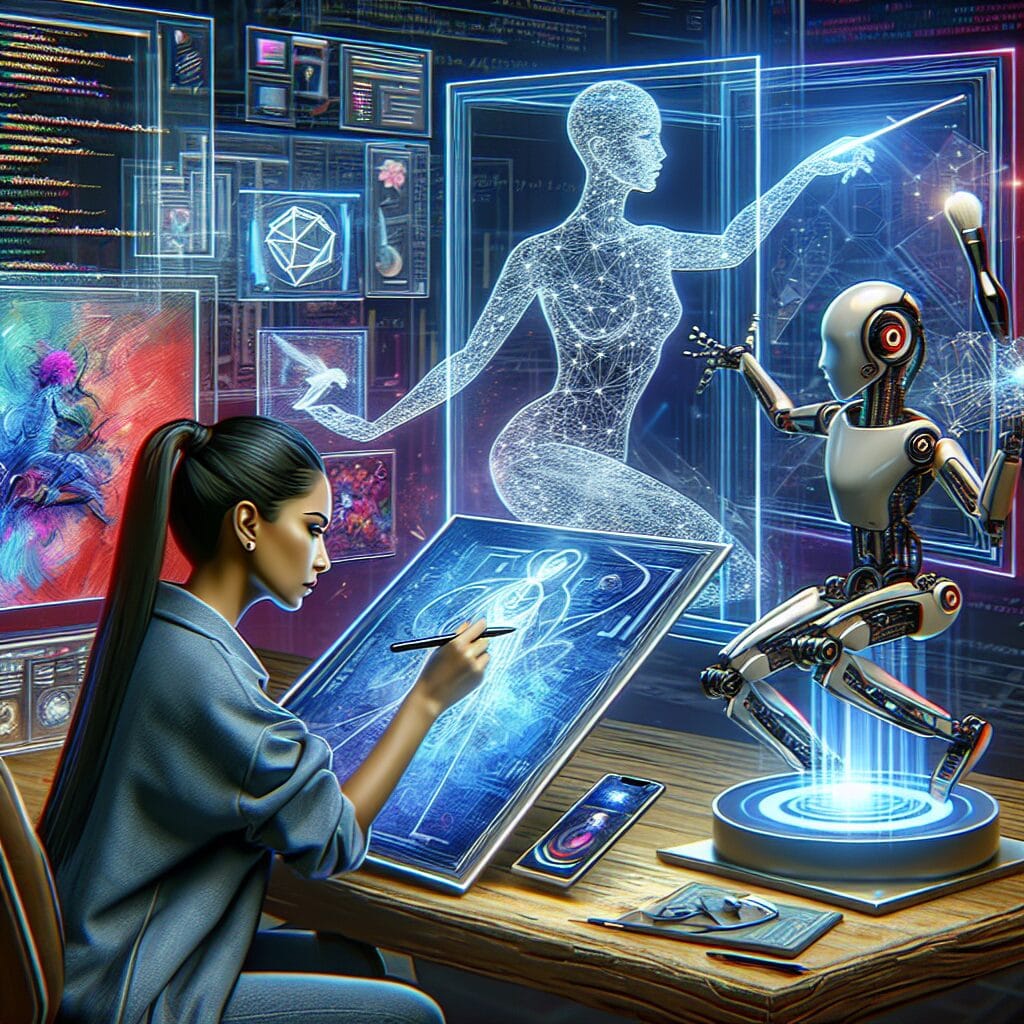
Analysis · April 2026
The science is more complicated than the hype. AI doesn’t automatically make you more creative — but used deliberately, it can. Here’s what the research says, what copyright law has settled, and what practitioners need to stop getting wrong.
TL;DR — Key Takeaways
- A 2026 Swansea University study (800+ participants) found AI-generated design galleries spark deeper engagement and better outcomes — but only when structured to show diverse options, not just optimized ones.
- Cambridge research confirms: simply adding AI to a creative workflow doesn’t automatically improve output. Co-creation skills — how humans learn to interact with AI — drive the gains.
- A January 2025 US Copyright Office report settled the authorship question for now: purely AI-generated works cannot be copyrighted. Human creative contribution remains the legal threshold.
- AI accelerates idea generation but can trigger premature convergence — killing the iterative experimentation that produces genuinely original work.
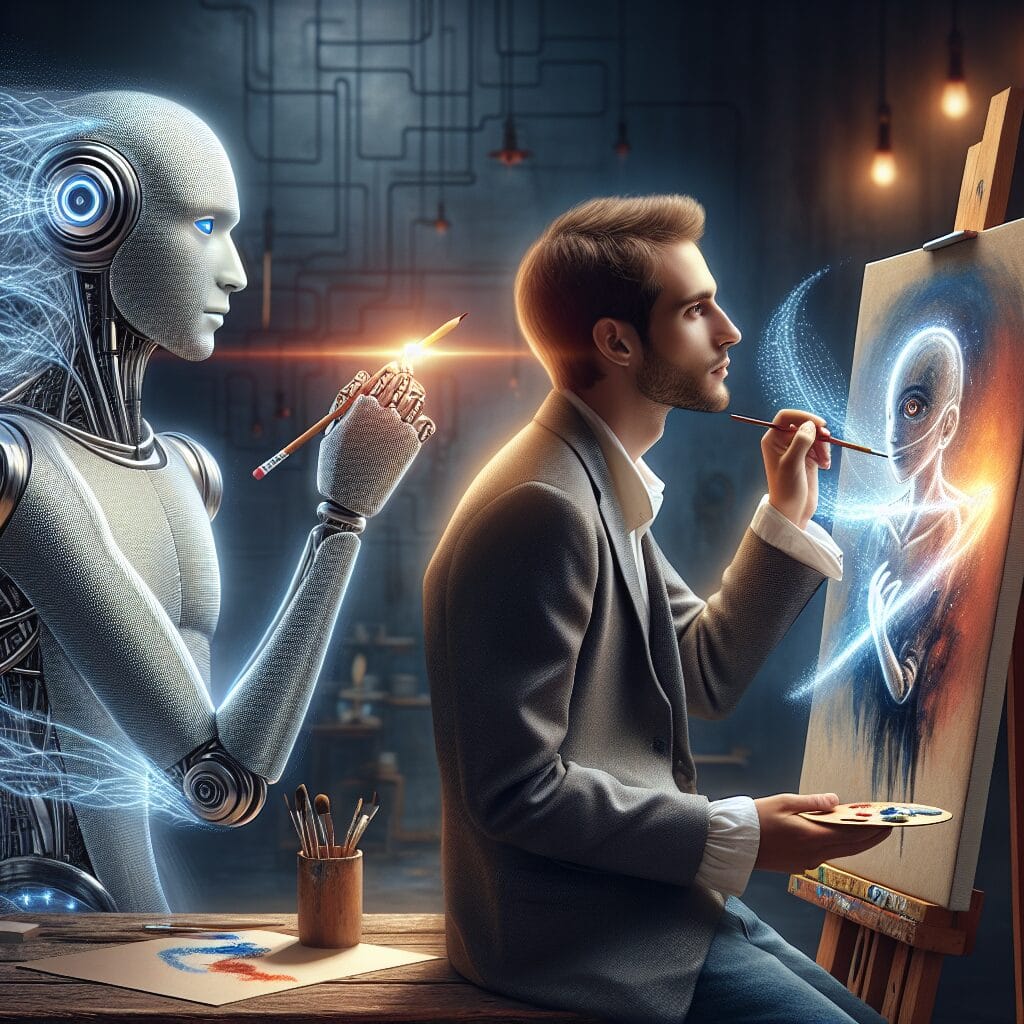
Here’s something that surprised me when I first read the research: human-AI creative collaboration does not automatically produce better work. Not after one session, not after many. Cambridge Judge Business School research published in late 2025 confirmed this directly. Joint creativity improves over time — but only when humans receive explicit guidance on idea co-development. Left to figure it out alone, most people just use AI as a faster autocomplete. That’s not collaboration. That’s delegation.
This matters because the public narrative about AI and creativity has mostly collapsed into two camps: utopians insisting AI unlocks infinite human potential, and dystopians certain it is homogenizing culture into beige mush. Both are wrong — or rather, both are right under different conditions. The question worth asking isn’t whether AI changes creative work. It’s how, and for whom, and under what working practices.
The evidence is now substantial enough to answer that precisely.
Swansea University’s study, published in March 2026 in ACM Transactions on Interactive Intelligent Systems, is one of the largest human-AI creative collaboration experiments to date. More than 800 participants designed virtual cars using an AI system built on MAP-Elites — an algorithm that generates diverse visual galleries, including high-performing designs, unusual ideas, and deliberately imperfect ones. The finding: exposure to that gallery of varied suggestions led to greater engagement, longer exploration of design space, and better outcomes than working without AI support.
Note what that result depends on. The AI wasn’t optimizing. It was diversifying. It was showing participants options they wouldn’t have reached alone — including the weird, the impractical, and the unexpected. Remove that diversity and you remove the benefit. An AI that only surfaces “best” solutions produces exactly the premature convergence that kills originality.
Research Finding
A January 2026 Frontiers study of engineering students found that AI accelerated idea generation but also encouraged premature convergence, narrowed exploration, and compromised functional refinement. Human-only teams produced designs of higher functional quality and greater ideational diversity. The authors argue for “process-aware frameworks that balance augmentation with human agency.”
That finding from Nazarbayev University’s engineering education study (published January 2026 in Frontiers in Artificial Intelligence) sits in genuine tension with the Swansea result — and the tension is the insight. AI helps when it expands what you can see. AI hurts when it narrows what you consider. The difference is the design of the interaction, not the presence of AI itself.
A 2025 Scientific Reports paper from Vrije University Amsterdam further complicates the picture. Their systematic review of human-AI co-creative systems found that self-efficacy — a person’s belief in their own creative ability — is a critical moderator. People who already feel confident as creators tend to use AI suggestions as launching pads. People who don’t tend to accept AI output passively and stop there. In other words: AI amplifies existing creative dispositions rather than replacing them. It’s not a great equalizer. It’s a multiplier.
“Human collaboration with AI does not automatically enhance creativity even after many rounds, but joint creativity does improve over time with instructions on idea co-development.”
— Luan, Kim & Zhou, Information Systems Research, November 2025 (Cambridge Judge summary)
The Originality Problem — and Why It’s Real
AI models learn from existing work. Vast quantities of it. That means their suggestions are, by definition, weighted toward what has already been done. Ask an AI to help you write a melody and it will produce something statistically likely — competent, often pleasant, and shaped by the accumulated patterns of every melody it trained on. That’s not nothing. But it’s not originality either.
The risk is subtle. You don’t feel like you’re being pushed toward the average. The output usually feels fresh, because you haven’t heard this specific combination before. But you’re exploring a space defined by what existed, not extending it. The frontier doesn’t move.
This is where the 2025 fixation bias research from OCTO Technology/Accenture, published in Frontiers in Psychology, becomes relevant. The study tested ChatGPT-4o on the “egg task” — a standard creativity measure assessing divergent thinking and resistance to fixation. AI performed well on average scores but showed human-like fixation bias: once it latched onto a category of solutions, it tended to stay there. Sound familiar? The research suggests AI systems may reproduce not just human outputs, but human creative limitations.
None of this means AI is useless for originality. It means the human’s job shifts. Less generation, more curation and constraint. The creative act becomes knowing which AI suggestions to reject.
How These Forces Play Out Across Creative Fields
Table 1: AI’s Creative Impact by Domain — Evidence Summary
| Domain | Documented Benefit | Documented Risk | Evidence Quality |
|---|---|---|---|
| Visual Design | Increased exploration, better outcomes (Swansea 2026, 800+ participants) | Premature convergence when AI optimizes rather than diversifies | Strong — RCT |
| Engineering / Product Design | Faster ideation, higher quantity of initial concepts | Lower functional quality, reduced ideational diversity (Frontiers, Jan 2026) | Moderate — quasi-experimental |
| Writing / Literature | Assists brainstorming, drafting, structural variation | Emotional depth and lived-experience nuance not reliably reproduced; fixation bias documented | Moderate — mixed methods |
| Music Composition | Generates harmonic and melodic options outside composer’s habitual range | Statistical weighting toward existing patterns; genuine frontier-pushing requires strong human curation | Limited — mostly practitioner reports |
| Collaborative / Team Design | Augmented learning for joint creativity improves over time with structured co-development practice | No automatic benefit from simply introducing AI to teams (Cambridge, Nov 2025) | Strong — longitudinal |
The pattern across domains is consistent: AI provides the most value when it expands the option space and the human imposes discipline — deciding what to pursue, what to discard, and what to push further. The domains where AI appears to hurt outcomes share a common feature: the human defers to AI selection rather than using AI selection as raw material.
The Copyright Question: What’s Actually Settled
A lot of practitioners are operating on fuzzy intuitions about who owns AI-assisted work. The legal picture in the United States is now fairly clear — though not without nuance.
In January 2025, the U.S. Copyright Office published Part 2 of its AI copyrightability report. The core holding: works generated entirely by AI cannot receive copyright protection. Human authorship remains the bedrock requirement. Critically, prompts alone — even detailed, effortful ones — do not constitute sufficient human creative control to establish authorship.
What the Copyright Office settled (January 2025):
- Purely AI-generated works: not copyrightable
- Prompts alone, however detailed: insufficient for authorship
- AI used as an assistive tool (editing, ideation, enhancement): doesn’t remove copyright from the underlying human work
- Human modifications or creative arrangements of AI outputs: potentially copyrightable — assessed case by case
- Human-authored elements visible within AI outputs: copyrightable as derivative works
The practical implication for creative professionals is this: if you are using AI to generate raw material that you then substantially shape, select, arrange, and modify — you likely retain authorship in those decisions. If you are copying AI output with minimal human intervention and publishing it, you may own nothing. The line is genuinely blurry at the edges. What’s not blurry: the U.S. and EU legal frameworks treat human creative involvement as the decisive factor, and courts have consistently upheld this in every case decided to date.
The international picture is worth noting. A February 2025 Harvard International Law Journal analysis found that China took a different path in a 2023 landmark ruling, recognizing copyright for an AI-generated image where the work demonstrated originality reflecting human intellectual effort. Most jurisdictions, however, continue to require measurable human creative input for any copyright claim to stand.
Table 2: Copyright Status of AI-Assisted Creative Work by Contribution Type
| Human Contribution | Copyright Outcome (US) | Source |
|---|---|---|
| Prompt only (however detailed) | Not copyrightable — “insufficient human control” | USCO Report, Jan 2025 |
| AI used to assist human process (ideation, editing) | Does not remove copyright from underlying human work | Skadden analysis, Feb 2025 |
| Human-authored elements identifiable in AI output | Copyrightable as derivative work | Foley & Lardner, Feb 2025 |
| Creative arrangement or modification of AI outputs | Potentially copyrightable — case-by-case assessment | US Copyright Office AI guidance |
| Purely AI-generated work, no human modification | Not copyrightable in the US; case law consistent since 2023 | USC IP Law, Feb 2025 |
The Ethical Terrain: Three Problems That Haven’t Been Solved
The legal questions may be settling. The ethical ones are not. Three deserve honest treatment.
Training data and artist consent. The lawsuits against OpenAI, Meta, and Stability AI — still unresolved as of early 2026 — center on whether training AI models on copyrighted material constitutes infringement. Legal analysts at USC note that if courts rule against AI developers, licensing arrangements with creators could reshape the economics of model development entirely. This is not a settled area. It is active litigation with industry-defining stakes.
Style imitation without infringement. AI can learn to generate work that strongly resembles a living artist’s distinctive voice or visual style — without technically copying any specific protected expression. As a January 2026 comparative legal analysis notes, existing frameworks were built for a pre-AI era. They do not adequately address stylistic reproduction, even when that reproduction effectively undermines the economic position of the original creator.
Access and concentration. The most capable AI creative tools are not freely available. Access costs money, technical fluency, and time. Whether AI democratizes creative possibility or concentrates it among those already well-resourced is an empirical question — and the current evidence doesn’t support easy optimism. The gap between what someone with a $20/month subscription and a sophisticated prompting practice can produce, versus someone without, is already significant and growing.
Where This Goes: Three Patterns Worth Watching
Prediction is treacherous here, so I’ll stick to patterns visible in current research and practice rather than speculation dressed as forecast.
Co-creation skills will bifurcate creative professionals. The Cambridge research makes this structural: AI doesn’t lift all boats. Practitioners who develop genuine fluency in working with AI — knowing when to take suggestions, when to reject them, how to use AI as a constraint-generator rather than an output-generator — will produce qualitatively different work than those who treat AI as a shortcut. The gap between those two groups is likely to widen. This is already visible in design, where the best AI-assisted work is being produced by people with strong prior creative foundations who use AI to extend their range, not replace their judgment.
Legal frameworks will continue lagging behind practice. The US Copyright Office’s 2025 report explicitly acknowledges that its assessment of prompts may change as technology evolves. The EU AI Act, taking effect in phases through 2025-2026, introduces transparency obligations around AI-generated content but doesn’t resolve authorship in the way the US framework does. Cross-jurisdictional analysis confirms there is no agreed international standard. Creative professionals working globally will need to track multiple legal regimes simultaneously — which is not a prediction, it’s already the situation.
The homogenization risk is real but not inevitable. The concern that AI pulls all creative output toward a statistical mean is well-founded at the model level. But it depends on how practitioners use AI and whether institutions — editors, curators, audiences — reward AI-accelerated average work or continue placing premium value on genuinely distinctive creative vision. The research from Nazarbayev on engineering students shows convergence as a documented risk, not an inevitability. Skilled human curation is the countermeasure. That makes curation — the ability to distinguish different from expected from better than expected — an increasingly critical creative skill.
What Practitioners Should Do Differently, Starting Now
The research points to concrete practice changes — not platform recommendations, just behavioral shifts backed by evidence.
Designers: When using AI for ideation, set an explicit rule: evaluate the three most unexpected suggestions, not the three that feel most immediately useful. The Swansea study found that exposure to diverse options — including imperfect and unusual ones — produced the strongest outcomes. Optimized suggestions alone didn’t.
Writers: Use AI for structural variation and brainstorming before writing, not for drafting. The fixation bias documented in 2025 research applies to your workflow too: once you accept an AI-generated sentence, you anchor to its framing. Generate options for how a section could work; write the sentences yourself.
Creative directors and team leads: The Cambridge finding is unambiguous — simply adding AI to your team’s workflow changes nothing by default. If you’re rolling out AI tools without also training people in structured co-development practice (how to build on AI suggestions rather than accept or reject them), you’re deploying infrastructure without a use model. The training investment is not optional.
Anyone publishing AI-assisted work commercially: Document your human contribution at each stage of production. Not for aesthetic reasons — for legal ones. The US Copyright Office’s case-by-case assessment of human contribution means the difference between owning your work and owning nothing may come down to whether you can demonstrate, specifically, what creative decisions you made and where.
Here’s what I keep coming back to: the research doesn’t show AI replacing human creativity. It shows AI changing which aspects of creativity matter most. Generation becomes cheap. Curation, judgment, and the ability to recognize genuine novelty become scarce. The human role doesn’t disappear — it shifts. Whether that shift is an upgrade or a diminishment depends entirely on whether individual practitioners and institutions adapt their practice deliberately, or just let the tools reshape them by default.
That’s not inevitable. It’s a choice. Make it consciously.
Sources
- Walton, Evans et al. “From Metrics to Meaning: Time to Rethink Evaluation in Human–AI Collaborative Design.” ACM Transactions on Interactive Intelligent Systems, 2026. Via ScienceDaily summary, March 2026.
- Luan, Y.L., Kim, Y.J. and Zhou, J. “Augmented learning for joint creativity in human-GenAI co-creation.” Information Systems Research, November 2025. Via Cambridge Judge summary.
- Tsakalerou et al. “AI-assisted design synthesis and human creativity in engineering education.” Frontiers in Artificial Intelligence, January 2026. Full text via PubMed.
- Singh, Hindriks, Heylen, Baraka. “A Systematic Review of Human-AI Co-Creativity.” Vrije University Amsterdam, 2025. arXiv preprint.
- Desdevises, Joy. “The paradox of creativity in generative AI.” Frontiers in Psychology, August 2025. Full text via PubMed.
- US Copyright Office. Copyright and Artificial Intelligence, Part 2: Copyrightability. January 2025. Full report (PDF).
- Harvard International Law Journal. “Why the Obsession with Human Creativity?” February 2025. Full article.
- Anantrasirichai and Zhang. “Advances in Artificial Intelligence: A Review for the Creative Industries.” arXiv, January 2025. arXiv:2501.02725.
- Bekturganova et al. “AI, Authorship, Copyright, and Human Originality.” MDPI Encyclopedia, January 2026. Full text.
- Harvard Law Review. “Artificial Intelligence and the Creative Double Bind.” April 2025. Full article.
https://www.bestprompt.art/ai-copyright-infringement/
https://www.bestprompt.art/human-authorship-in-2025-who-really-owns-it/
https://www.bestprompt.art/ai-creativity-vs-human-creativity-2025/
https://www.bestprompt.art/ai-impact-the-future-of-human-creativity/
https://www.bestprompt.art/best-creative-ai-prompts-for-stunning-results-in-2025/