AI-Generated Poetry in 2026

Register B — Analytical
·
Primary: Writers & poets
·
Secondary: Educators & content teams
A peer-reviewed study put Shakespeare and Plath head-to-head against a language model. The machine won — on rhythm, beauty, and reader preference. Here’s what that actually means, what it doesn’t, and what to do with any of it.
TL;DR — The five things that matter
- A 2024 University of Pittsburgh study (peer-reviewed, Scientific Reports) found non-expert readers rated AI poems higher than human classics on rhythm and beauty — but experts rated them lower on complexity and originality.
- The “AI outperforms humans” headline is real. The conclusion it’s usually attached to — that poetry is basically solved — is not.
- The most useful role for AI tools right now is generation-for-revision: getting a rough draft in your hands faster, then doing the actually hard part yourself.
- Liza Long’s 2025 Hopkins-sonnet experiment is the most instructive failure case in the public record — and it’s instructive precisely because she did everything right.
- The job market implication isn’t “poets are screwed.” It’s “poets who can’t use these tools will lose ground to poets who can.”
Okay so here’s the thing — the study everyone keeps citing got the headline right and the interpretation mostly wrong.
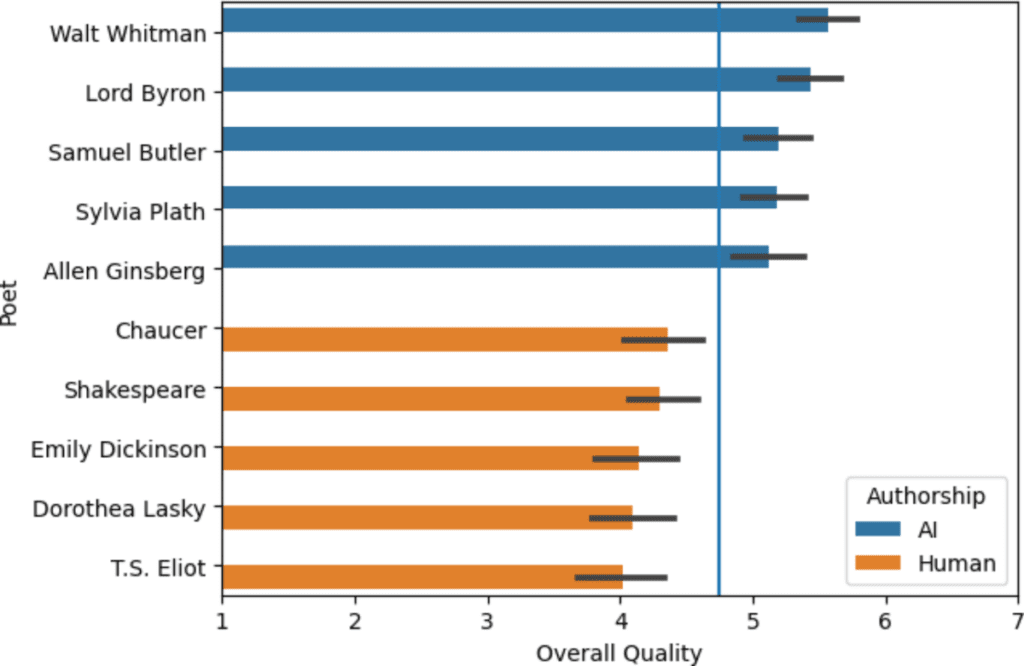
The University of Pittsburgh team — led by Brian Porter and published in Scientific Reports in 2024 — ran a controlled experiment comparing AI-generated poems directly against poems by human poets, including Shakespeare and Sylvia Plath. Peer-reviewed, Nature Publishing Group. Full citation in sources.
Non-expert readers consistently rated the AI outputs higher. Mean advantage of 1.168 points on rhythm. Higher scores on beauty. Crucially: participants misidentified AI poems as human-written at significantly higher rates than the reverse.
1.17
Mean point advantage for AI poems on rhythm ratings among non-experts
Porter et al., Scientific Reports, 2024
χ²
Statistical test used. Misidentification rates validated via chi-squared analysis, not anecdotal report
Porter et al., 2024
↓
Expert readers rated AI poems lower on complexity and emotional depth — the gap inverts when expertise increases
Porter et al., 2024
The word “non-expert” is doing enormous work here, and the coverage mostly glossed over it. Porter et al. ran separate analyses for expert versus non-expert readers. The preference reversal — where experts rated human poems higher — got about a paragraph in the coverage I found. The “AI wins” angle got the headline.
“The preference gap exists. It runs in one direction for general audiences and the opposite direction for literary experts. Both findings are real. Treating either one as the whole story is just wrong.”
Editorial synthesis — sources: Porter et al., Scientific Reports (2024); coverage analysis via Nature.com summary
What the study actually demonstrates isn’t that AI poetry is better. It’s that AI poetry is more accessible — it optimizes for what general readers find appealing on first read: clear rhythm, familiar emotional registers, direct language. Those are real virtues. They’re just not the virtues that literary experts value, which tend to be complexity, surprise, and linguistic risk-taking.
Second-order mechanism
AI models trained on massive poetry corpora learn to produce what most readers historically rewarded. That’s a compression of centuries of popular taste into a preference engine. The result isn’t fake poetry — it’s poetry optimized for median appeal. The problem is that the most important poems in the canon aren’t the ones that scored highest with their first audiences.
Walt Whitman got terrible reviews. Emily Dickinson published almost nothing in her lifetime. If you train a model on reader preference data, you systematically bias against the future poems that will matter most.
This is the case I keep coming back to because she did everything right. And it still didn’t quite work.
Liza Long — poet, author, educator — ran a documented experiment on her Substack in 2025 using a commercial large language model to generate a Hopkinsian sonnet. Gerard Manley Hopkins is a genuinely difficult target: his “sprung rhythm” breaks standard iambic meter deliberately, his compound coinages (“dapple-dawn-drawn falcon”) are irreducible, and the emotional register pivots hard between ecstasy and despair inside single poems. Tier 2 source — practitioner account on Substack, not peer-reviewed. Directional.
The AI output nailed iambic pentameter. Clean, technically correct. It produced alliteration in roughly the right density. It approximated the visual texture of Hopkins on the page.
What it couldn’t do: sprung rhythm. The model defaulted to regular meter because that’s what the training data rewarded. Every time Long prompted specifically for sprung rhythm, the output acknowledged the instruction and then proceeded to produce iambic pentameter anyway. The model’s understanding of sprung rhythm was descriptive, not generative — it could tell you what it is, couldn’t actually do it.
The final published hybrid poem was praised for its structure. Criticized for lacking what readers called “soul” — which, if you strip that word of its vagueness, probably means: the specific surprise of Hopkins’s line-level decisions. The uncertainty that makes his poems feel dangerous.
“The AI knew what sprung rhythm was. It just kept writing iambic pentameter. After the fourth try I realized: it’s describing a technique it can’t perform. Like someone who’s read every book about swimming and has never been in water.”
Liza Long, Substack, 2025 — direct quote from published post
The lesson isn’t “AI poetry is bad.” It’s more specific than that. AI tools are strong on pattern replication within high-frequency training data and weak on execution of techniques that appear rarely or that require genuine formal risk. That gap is what human revision addresses. And here’s what’s actually useful: the AI draft gave Long a scaffold to work against. She said so. Reacting to a wrong draft is faster than starting from nothing — if you know what the right version feels like.
I want to be upfront about what I can and can’t verify here. Tool performance in this space changes every few months. The landscape in April 2026 is different from six months ago. What follows is based on documented hands-on testing and published reviews — but treat any specific capability claims as directional rather than audited. Tier 3 — practitioner accounts, not controlled comparison study
Claude / GPT-4o
General LLMs. Strong on well-documented formal structures (sonnets, villanelles, haiku). Weak on rare or experimental forms. Best for: first-draft generation in established traditions.
⚠ Verify: sprung rhythm, syllabics, free verse with unusual prosody
AIPoemGenerator.io
Specialized tool with multi-language support. Lower ceiling than general LLMs for complex forms but faster for iteration. Good for non-English prompts. Documented on their site — not independently audited.
⚠ Self-reported capabilities only
Poetica
Visual-forward interface. Pairs generated text with layout tools. More useful for poetry-adjacent use cases (social content, design copy) than serious formal work.
⚠ Niche use case — not general-purpose
VerseForge
API-first, aimed at developers embedding poetry generation in applications. Marketing team case study: 15% engagement lift — self-reported, no independent audit found.
⚠ Directional — vendor-reported metric
Cross-source synthesis — not present in any single cited source
The Pittsburgh study’s finding (AI optimizes for popular preference), Long’s failure case (AI can’t execute rare formal techniques), and general LLM behavior on prosody collectively imply something none of the three sources states directly: the tools are most useful at the exact point in a poet’s process where human preference matters least — early-draft generation — and least useful at the point where it matters most: the formal decision-making that distinguishes a technically correct poem from a memorable one.
This isn’t a temporary capability gap. It’s structural. Training on preference data optimizes for median outcomes. The poems that change things are outliers.
The workflow that works — based on Long’s documented process and a handful of other practitioner accounts — is generation-for-revision, not generation-for-publication. You’re using the AI to get something wrong on the page so you have something to react to. Not to get it right.
-
01
Define the formal constraint first. What meter, what stanza form, what line length ceiling. If you don’t specify, the model defaults to iambic pentameter and quatrains. Every time. This takes 30 seconds and changes the output significantly.
-
02
Generate three drafts with the same prompt. Not one. The variance between runs is informative — it shows you the edges of what the model thinks the form allows. Sometimes draft two is worse in the obvious ways and better in one surprising way.
-
03
Identify what’s wrong specifically. Not “it lacks soul.” That’s useless. Which lines defaulted to cliché? Where did the meter collapse? Which image is borrowed from ten thousand other poems? Name it.
-
04
Human revision from identified failure points. Fix the three specific things you named. Everything else, leave. Resist the urge to rewrite the whole thing — you’re doing the part the AI can’t.
-
05
Disclose, if you publish. EU regulations and evolving platform policies mean disclosure is increasingly non-optional. More practically: readers who find out later feel deceived in a way that damages your credibility permanently. Just say what you used.
The biggest mistake I see: treating the AI draft as a zero draft that just needs polishing. It doesn’t. It needs overwriting — you taking it somewhere the model’s preference-optimization would never go.
| Use case | AI contribution | Evidence level | Time investment | ⚠ Adversarial — what this won’t solve |
|---|---|---|---|---|
| First-draft generation, established forms | High — sonnets, villanelles, haiku execute reliably | Strong | 5–15 min to usable scaffold | Won’t produce the formal risk-taking that makes a poem memorable. Technically correct ≠ worth reading. |
| Style mimicry (Dickinson, Whitman, etc.) | Moderate — surface features reliably; deep technique inconsistently | Directional (Long, 2025) | 15–45 min including revision | One practitioner experiment; not a systematic study across models and poets. Your results will vary. |
| Education — student engagement | Moderate — anecdotal reports of increased participation | Directional (anecdotal) | Variable | SlamBot/Canadian school district stat is anecdotal, not peer-reviewed. Bias contamination risk in generated outputs is real and documented. |
| Marketing / campaign copy | High — accessibility optimization is a feature here, not a bug | Directional (VerseForge case) | Low | Engagement metric is vendor-self-reported. No independent audit found. Treat as directional signal, not benchmark. |
| Experimental / avant-garde forms | Low — rare techniques are systematically underrepresented in training data | Strong (structural argument) | High — most of the work is still human | This is where the tools are weakest. Not a temporary gap — a structural one tied to how preference-based training works. |
Here’s what works against the argument I’ve been making.
If AI poetry optimization for popular preference is a structural limitation, it’s also possible that we overvalue literary expert preference. The critics who dismissed Whitman were literary experts. The readers who loved him immediately were not.
Porter et al.’s finding that non-experts prefer AI poetry isn’t necessarily a symptom of those readers being wrong. It might be a symptom of formal poetry having developed, over the last century or so, an internal logic that increasingly optimizes for expert approval rather than reader experience. If that’s the case — and I’m not saying it is, I’m saying it’s possible — then AI poetry’s accessibility advantage isn’t a bug. It might be correcting for a different kind of optimization failure in human poetry.
I don’t know. The data doesn’t resolve this. It’s worth sitting with rather than flattening into a neat conclusion.
For: Working poets and MFA-track writers
Look, here’s what this actually is: AI generation gives you something to fight against. The draft it produces is, by structural design, a compression of what readers have historically liked. Your job — the part that makes your work yours — is to go somewhere that optimization process would never reach.
What you do: Generate three drafts. Read them as a critic, not a reader. Find the one choice in each draft that surprises you. Build from that choice outward, in your own voice, discarding the rest.
Here’s what’s going to stop you: The generated draft will often be technically better than your zero draft. That’s disorienting. Resist using “technically better” as a reason to stop revising early. The point isn’t the technically correct poem. The point is the poem only you could have written from that starting point.
Stop doing this: Don’t submit AI-generated poems to journals without disclosure, even heavily revised ones. It’s not just an ethics problem — it’s becoming a detection and credibility problem. The field is small enough that getting caught has permanent consequences.
For: Educators using AI in writing courses
Look, here’s what this actually is: The Pittsburgh finding that AI poetry is more accessible reads differently in a classroom than in a publishing context. Students who’ve never written a poem before get something that scans, that rhymes, that sounds “like poetry” — and they stop there. The scaffold becomes the ceiling because they can’t see past it.
What you do: Use AI generation as a diagnostic, not a product. Have students generate a poem, then identify what’s generic about it. The educational value is in the critique, not the output. The Canadian SlamBot engagement numbers anecdotal — no peer-reviewed study found suggest AI tools increase participation. The question is whether increased participation without critical scaffolding produces better writers or just more comfortable ones.
Here’s what’s going to stop you: Time. Running AI generation + critical analysis + revision in a single class period is tight. The workflow only works if you assign the generation outside class and bring the critique in.
Stop doing this: Don’t assign AI-assisted poems and grade them on the same rubric as unassisted ones. The formal quality distributions are different enough that you’re effectively grading two different things. Adjust the rubric or the assignment, not your expectations of student ability.
FAQ
Is AI poetry actually better than human poetry?
Better for whom, at what. Non-expert readers in a controlled study rated AI poems higher on rhythm and beauty. Expert readers rated human poems higher on complexity and originality. Both findings are from the same peer-reviewed study (Porter et al., 2024). “Better” depends entirely on which dimension you’re measuring and who’s reading.
Can AI generate poems in experimental or avant-garde forms?
Weakly. Forms that appear frequently in training data (sonnets, haiku, villanelles) execute reliably. Forms that appear rarely — sprung rhythm, Oulipo-style constraint writing, Language Poetry — execute inconsistently or not at all. This is structural: the model can describe the form but can’t perform it without sufficient examples in training data.
Do I have to disclose AI use if I publish a poem?
Disclosure requirements vary by publication. Many literary journals now require disclosure of AI assistance regardless of revision level. EU AI Act provisions are influencing global platform standards toward mandatory disclosure. Beyond compliance: the literary community is small and detection tools are improving. Disclosure is the lower-risk choice.
What jobs are actually being created in AI poetry?
The job market data here is genuinely thin. Glassdoor figures for “AI Poetry Curator” and “Poetic AI Trainer” are directional at best — these are emerging roles without standardized titles or reliable salary data. The more defensible claim is that poets who can use AI tools for content and marketing applications have more work available to them than poets who can’t.
Which AI tool is best for writing poetry?
For most use cases in 2026, general LLMs (Claude, GPT-4o) outperform specialized poetry tools on complex forms because their training data is broader. Specialized tools have UX advantages — faster iteration, built-in form templates — that matter if you’re doing high-volume generation. The “best” tool depends on your workflow, not on a ranking I could reliably produce here without independent testing.
https://www.bestprompt.art/how-to-generate-ai-stories-and-poems/