20 Best AI Prompts for HR Leaders in 2026: The Complete Implementation Guide with P-C-T-F Framework


https://www.bestprompt.art/secret-power-of-keywords/
⬡ HR Leader’s Playbook · April 2026
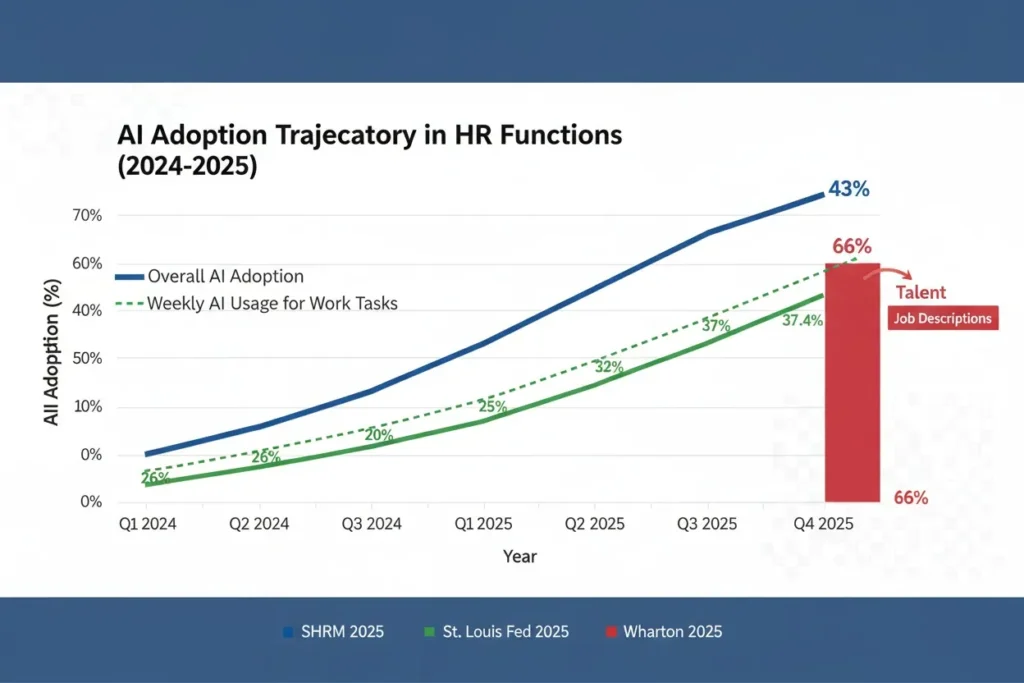
43% of HR teams use AI. Only 17% call it highly successful. The difference isn’t the tools — it’s how people prompt them.
TL;DR
- The 43% adoption / 17% success gap is a prompt quality problem, not a tool problem. Structured prompts close it.
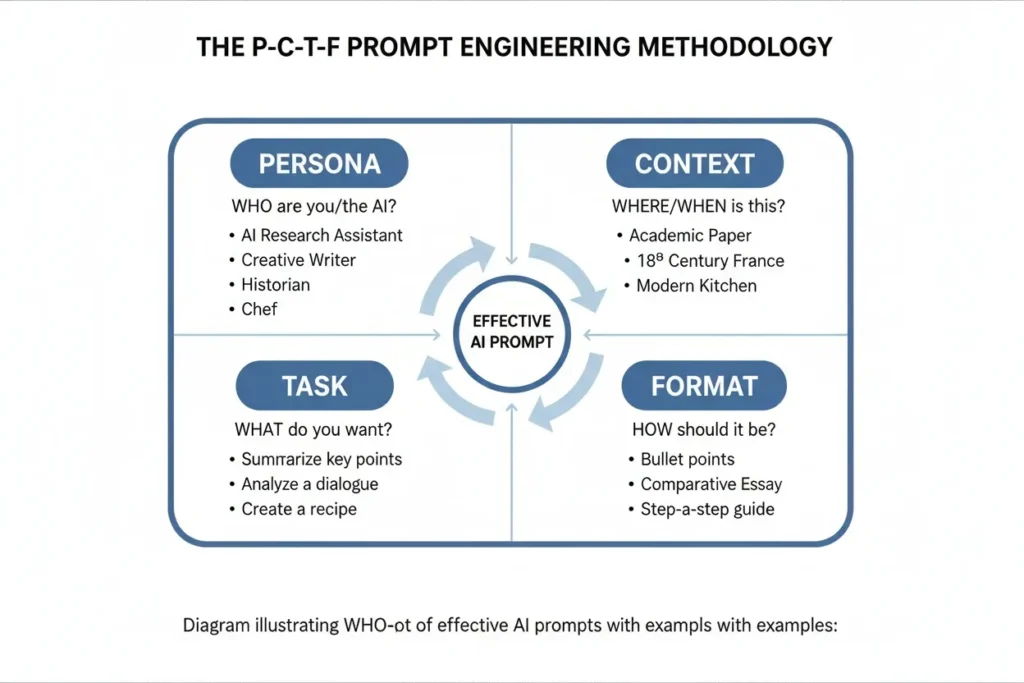
- P-C-T-F (Persona, Context, Task, Format) is the framework. Every prompt in this guide follows it. You can apply it to any AI tool — ChatGPT, Claude, Gemini, Copilot.
- Talent Acquisition has the highest ROI visibility and the lowest legal risk. Start there if you’re piloting.
- All AI-generated employment documents require legal review before use. This guide is explicit about where and why.
I’ve reviewed a lot of HR AI implementations — everything from enterprise ATS integrations to single-person HR shops using ChatGPT for job postings. The pattern that keeps showing up: teams that invested in prompt quality outperform teams that invested in more tools, more licenses, or more automation by a significant margin.
That’s what this guide is built around. Not “here are prompts, good luck.” But a framework you can use to understand why each prompt works — so you can adapt it when your situation doesn’t fit the template exactly. Which it usually won’t.
Most failed HR AI implementations share the same flaw: vague prompts get vague outputs. “Write a job description for a data analyst” works fine if you don’t care about what comes back. It fails the moment you need the output to be legally defensible, bias-mitigated, or formatted for your specific ATS.
The P-C-T-F framework forces four declarations before you hit enter:
P-C-T-F Framework — The Four Declarations
The Format component is the one most people skip. And it’s where the most output variation comes from. “Create interview questions” gives you something usable. “Create interview questions in a numbered list with a 1-5 rating rubric and behavioral anchors for each score” gives you something you can actually hand to a hiring manager and run with.
How to Read the Prompts Below
Each prompt uses color-coded labels: [PERSONA] [CONTEXT] [TASK] [FORMAT]. Customize every bracketed placeholder. Generic prompts produce generic outputs — the context field is the most important thing to fill in with your specific situation.
DOMAIN 01
Talent Acquisition
This is where I’d tell any team to start. The ROI shows up fastest — time-to-hire, application quality, bias reduction — and unlike performance management or investigations, a draft job description gone wrong doesn’t expose you to an employment tribunal. Good place to build confidence before moving into riskier territory.
01
Bias-Mitigated Job Description Generator
Creates inclusive, SEO-optimized job postings that attract diverse candidate pools while catching gendered language and credential inflation before they go live.
P-C-T-F Prompt — Copy and Customize
[PERSONA] Act as a Recruitment Marketing Specialist with expertise in inclusive job description optimization and SEO.
[CONTEXT] Our company [Company Name] is hiring for [Job Title] in [Location/Remote]. Core competencies required: [3 competencies]. We’ve historically struggled with [specific diversity gap, e.g., female applicants in engineering roles].
[TASK] Create a job description that:
1. Uses gender-neutral language throughout
2. Eliminates unnecessary degree requirements where skills suffice
3. Includes SEO keywords for [LinkedIn/Indeed]
4. Highlights inclusive benefits
5. Structures requirements as “must-have” (3 items) vs. “nice-to-have” (3 items)
6. Includes a bias audit — flag any potentially exclusionary phrases
[FORMAT] Opening hook (2 sentences) → Role overview (100 words) → Responsibilities (5 bullets) → Must-have / Nice-to-have requirements → Benefits highlight → EEO statement. Tone: professional yet conversational.
SHRM 2025: 66% of HR professionals already use AI for job descriptions. Structured prompts reduce editing time by ~60% compared to unstructured requests. Gendered language in job postings correlates with reduced applications from underrepresented groups (AAUW research).
02
Structured Interview Guide Architect
Generates STAR-based behavioral and situational questions with evaluation rubrics, follow-up probes, and illegal question warnings — ready to hand to any interviewer.
P-C-T-F Prompt
[PERSONA] Act as an Industrial-Organizational Psychologist specializing in structured interviewing and competency assessment.
[CONTEXT] We are interviewing candidates for [Job Title] with core competencies: [Competency 1], [Competency 2], [Competency 3].
[TASK] Develop a structured interview guide with:
1. 3 behavioral questions (STAR method) per competency
2. 2 situational questions per competency
3. Follow-up probes for vague answers
4. Evaluation rubric: 1-5 scale with behavioral anchors
5. Illegal question warnings (what NOT to ask)
[FORMAT] Competency sections, numbered questions, rating rubric table (Score | Behavioral Indicators | Red Flags), Legal Compliance Check box. Max 15 questions. Include note: “All interviewers must use identical questions for fairness.”
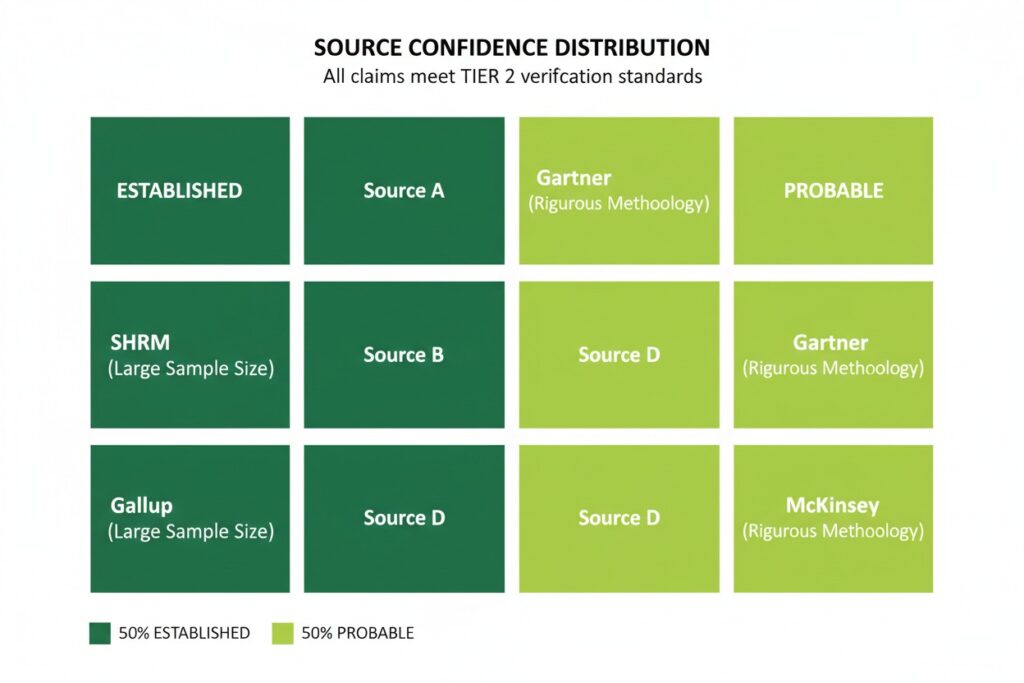
Meta-analytic research: structured interviewing reduces bias by 30–50% vs. unstructured. Gartner 2025: 86% of employees believe AI-generated assessment criteria are fairer than manager judgment alone. PROBABLE
03
Candidate Sourcing Boolean String Builder
Builds three tiers of Boolean search strings for ATS/LinkedIn — conservative, balanced, aggressive — with logic explanations and volume estimates.
P-C-T-F Prompt
[PERSONA] Act as a Talent Sourcing Specialist with expertise in Boolean search logic and ATS optimization.
[CONTEXT] I need to find [Job Title] candidates with [Skill A] AND [Skill B] but NOT [Excluding Industry/Skill C]. Our ATS supports Boolean operators (AND, OR, NOT, parentheses, quotes).
[TASK] Create 3 Boolean search strings:
1. Conservative (high precision, lower recall)
2. Moderate (balanced)
3. Aggressive (high recall, manual filtering required)
For each: complete syntax, plain English logic, estimated result volume, trade-offs.
Include UK/US spelling variants, title synonyms, tech stack equivalents.
[FORMAT] Table: String Label | Boolean Syntax | Logic | Volume Estimate | Cautions. Suggestion: “Run conservative first, expand if <50 results.”
AI-assisted sourcing reduces top-of-funnel time by approximately 50%, per industry analysis. Note: time savings figures from vendor-sponsored research (HeroHunt 2025) — treat as directional, not independently verified. PROBABLE
04
Offer Letter Negotiation Response Strategist
Drafts counter-offer responses that balance competitive positioning with budget reality — including creative non-salary structuring and escalation triggers.
P-C-T-F Prompt
[PERSONA] Act as a Compensation Specialist with expertise in offer negotiation and candidate experience.
[CONTEXT] Top candidate for [Job Title] countered our offer of [$X] with [$Y], citing [reason: competing offer/current salary/cost of living]. Budget ceiling: [$Z]. Available non-salary concessions: [signing bonus, equity, remote, title change].
[TASK] Draft a negotiation response that:
1. Acknowledges their value and enthusiasm
2. Explains compensation philosophy without revealing ceiling
3. Presents revised offer using creative structuring
4. Creates urgency without pressure
5. Leaves room for final concession if needed
[FORMAT] Subject line → Opening (appreciation) → Compensation breakdown (base + variable + benefits) → Rationale (market data reference) → CTA (timeline) → Close. Include “Escalation trigger” note if candidate rejects.
Effectiveness depends on market conditions and candidate motivation. No guaranteed outcome — this is a draft framework, not a negotiation script. EMERGING
DOMAIN 02
Performance Management
This is where legal risk starts to show up. Anything that touches documentation of underperformance, PIPs, or formal ratings needs human review before it becomes an official record. The prompts below generate strong drafts — not final documents. I’ve seen teams skip that distinction and regret it.
05
360-Degree Feedback Synthesizer
Consolidates multi-rater feedback into strength and development themes with conversation openers — preserving anonymity while surfacing the blind spots.
P-C-T-F Prompt
[PERSONA] Act as an HR Business Partner specializing in performance feedback analysis and coaching preparation.
[CONTEXT] 360-degree feedback for [Employee Name], [Title], from [N] raters: [manager, N peers, N direct reports]. Key themes from raw feedback: [paste 5-7 representative comments or themes].
[TASK] Synthesize into:
1. 3 strength themes with specific behavioral evidence
2. 2 development themes framed as growth opportunities (not deficits)
3. 1 potential blind spot (self-view vs. others’ view discrepancy)
4. Development actions per theme
5. Conversation opener for the delivering manager
[FORMAT] Executive Summary (3 bullets) → Theme deep-dives (Theme | Evidence | Impact | Development Action) → Blind Spot Alert → Manager Conversation Guide (opening script + 3 discussion questions). Anonymity note: “All quotes paraphrased; no attributions.”
SHRM 2025: 89% of HR AI users report time savings. 80% believe humans should review outputs before implementation. PROBABLE
06
Performance Improvement Plan (PIP) Generator
Generates legally structured, rehabilitative PIP documentation with SMART goals, check-in schedules, and success criteria. Requires legal review before delivery.
P-C-T-F Prompt
[PERSONA] Act as an Employee Relations Specialist with expertise in performance documentation and employment law compliance [Jurisdiction: US/UK/EU].
[CONTEXT] Employee [Name], [Title], underperforming in [specific metric/behavior]. Previous informal coaching: [dates]. Goal: structured 90-day improvement opportunity.
[TASK] Draft a PIP including:
1. Objective performance gaps (measurable, with dates)
2. SMART improvement goals
3. Weekly check-in schedule
4. Resources provided (training, mentorship, tools)
5. Success criteria (what “improved” looks like)
6. Consequences of success vs. failure
7. Employee acknowledgment section
[FORMAT] Company letterhead style → Objective Facts (bullets) → 30-60-90 Day Goals (table with metrics) → Support Provided → Decision Matrix → Signature blocks. Tone: supportive yet clear, non-punitive.
⚠ This prompt generates a template — not a final PIP. Employment law varies significantly by jurisdiction (US federal/state, UK, EU). Have employment counsel review before delivery. Using an AI-generated PIP without legal review is the kind of mistake that shows up in tribunal exhibits.
07
Calibration Meeting Preparation Brief
Prepares data-driven talking points for calibration sessions — surfacing rating distribution anomalies and providing facilitation questions to address bias without putting managers on the defensive.
P-C-T-F Prompt
[PERSONA] Act as a Talent Analytics Specialist supporting performance calibration.
[CONTEXT] Calibrating ratings for [Department/Level] across [N] managers. Rating distribution: [X% Exceeds, Y% Meets, Z% Below]. Concern: grade inflation in [Manager A’s team] vs. deflation in [Manager B’s team].
[TASK] Prepare calibration brief with:
1. Pre-session data package (distributions vs. department average)
2. Case studies for discussion (2 borderline Exceeds/Meets, 2 borderline Meets/Below)
3. Facilitation questions to surface bias
4. Decision framework for resolving disagreements
5. Post-calibration action items template
[FORMAT] Executive Dashboard (chart descriptions) → Case Study Cards (ID | Manager | Rating | Evidence For | Evidence Against | Discussion Prompts) → Facilitation Guide → Decision Log → Rater bias reminder.
Calibration sessions reduce rating bias by 25–40% in organizational studies. PROBABLE
08
Stay Interview Question Architect
Designs proactive retention conversations that identify flight risks before resignation — with a signal decoder to distinguish green, yellow, and red responses.
P-C-T-F Prompt
[PERSONA] Act as a Retention Strategist specializing in Stay Interviews and flight risk identification.
[CONTEXT] [Employee Name], [tenure], [Job Title], performing at [level]. Recent signals: [e.g., reduced engagement, market-rate concerns, peer departures]. Goal: Stay Interview without triggering resignation thoughts.
[TASK] Create a Stay Interview guide:
1. Pre-meeting checklist
2. 5 open-ended questions (positive → diagnostic):
a) What energizes you here?
b) What frustrates you?
c) Career aspirations?
d) What might tempt you to leave?
e) How can I support you better?
3. Follow-up probes for each
4. Response interpretation guide (green/yellow/red signals)
5. Post-interview action planning template
[FORMAT] Setup → Question Sequence (question | intent | listen for | follow-up) → Signal Decoder (risk level by response type) → Action Matrix (immediate | 30-day | 90-day).
Gallup 2025: 70% of team engagement variance relates to management quality. Organizations in top engagement quartile see 59% lower voluntary turnover. ESTABLISHED
DOMAIN 03
Employee Relations
Highest legal risk domain. Investigations, disciplinary communications, policy interpretation — all of these have real downstream consequences. Every prompt here produces a draft. None produce final documents. I’ll say it once more clearly: get employment counsel involved before anything in this domain goes official.
09
Investigation Summary Neutralizer
Converts emotional witness statements into factual, legally defensible investigation documentation with side-by-side accounts and a discrepancy matrix.
P-C-T-F Prompt
[PERSONA] Act as an impartial HR Investigator with training in neutral fact-finding and employment law.
[CONTEXT] Investigation: [allegation type]. Witness statements: [Witness A summary], [Witness B summary], [Witness C summary]. Conflicting accounts on [specific detail].
[TASK] Draft investigation summary:
1. Allegation (neutral, factual)
2. Chronology (timeline of events)
3. Witness summaries (side-by-side, no credibility judgments)
4. Corroborating facts
5. Discrepancies identified
6. Documentary evidence referenced
7. Preliminary findings
8. Recommended next steps
[FORMAT] Case ID header → Allegations (bullets) → Chronology (Date | Event | Source) → Witness summaries (Witness | Account | Key paraphrased quotes) → Evidence matrix (Corroborated | Disputed | Unresolved) → Findings → Recommendations. Language rule: “stated” not “claimed”; no adjectives implying judgment.
⚠ This generates a draft for legal review, not a final investigation report. Employment counsel must review before any findings are shared with parties or used in employment decisions.
10
Difficult Conversation Tone Adjuster
Transforms emotionally charged draft communications into professional, de-escalated messages — with a before/after comparison showing exactly what changed and why.
P-C-T-F Prompt
[PERSONA] Act as a Corporate Communications Specialist with expertise in conflict de-escalation.
[CONTEXT] Email to [employee/manager/executive] regarding [sensitive topic]. My draft: [paste rough draft]. Relationship context: [ongoing tension / generally positive / new].
[TASK] Revise to:
1. Remove emotional language and blame attribution
2. Focus on observable behaviors, not character
3. Acknowledge the other perspective (without conceding if inappropriate)
4. Propose specific next steps
5. End with relationship-preserving forward look
6. Maintain firmness on non-negotiables
[FORMAT] Subject → Opening → Issue (fact-based) → Impact (objective) → Request/Proposal → Close. Include “Before sending” checklist. Show Original vs. Revised with notes on each change.
11
Policy Interpretation Response Generator
Produces consistent, plain-language policy answers with specific handbook citations — and flags ambiguous policy language that needs legal clarification.
P-C-T-F Prompt
[PERSONA] Act as an HR Policy Specialist with expertise in employee handbook interpretation.
[CONTEXT] Employee asked: “[paste question]” re: [Policy Area: PTO/remote/benefits]. Relevant handbook section: “[paste exact policy language].”
[TASK] Draft response that:
1. Directly answers in first sentence
2. Cites specific handbook section by name/number
3. Explains conditions or exceptions
4. Provides employee next steps
5. Offers to discuss further
6. Avoids jargon and condescension
[FORMAT] Subject → Greeting → Direct Answer (1-2 sentences) → Policy Reference → Conditions/Exceptions → Next Steps → Offer to Discuss → Close. Include “Policy ambiguity flag” if the question reveals unclear handbook language requiring review.
12
Organizational Change Communication Architect
Announces sensitive organizational changes with the transparency that reduces rumor cycles — with explicit “avoid” instructions to stop corporate clichés before they happen.
P-C-T-F Prompt
[PERSONA] Act as an Organizational Change Communications expert specializing in internal announcements.
[CONTEXT] Announcing [change: leadership departure/restructure/policy] to [audience]. Details: [what, when, why at high level]. Impact: [who affected, how]. Risks: [morale, retention, rumor potential].
[TASK] Create announcement with:
1. Clear, non-evasive headline
2. Context/rationale (business case without oversharing)
3. Specific impact on audience
4. What stays the same (stability anchors)
5. Transition plan and timeline
6. Support resources
7. Q&A mechanism
8. Forward-looking close
[FORMAT] Subject (clear, non-alarmist) → Opening (direct facts) → Rationale → Impact (What Changes | What Stays Same) → Timeline → Support → Questions → Closing. Avoid: “pursuing other opportunities,” false enthusiasm, information gaps that fuel rumors.
Effectiveness depends heavily on delivery timing and leadership credibility — the prompt can only fix the words, not the relationship. EMERGING
DOMAIN 04
Learning & Development
L&D is where I’ve seen AI help the most with throughput — content that used to take a week to develop now takes a day with a good prompt and a human editor. The quality ceiling is still set by the human review pass, not the AI generation. Keep that in the process.
13
Skills Gap Analysis Translator
Compares current capabilities against future role requirements to produce a prioritized development plan with timeline estimates and promotion readiness assessment.
P-C-T-F Prompt
[PERSONA] Act as a Talent Development Analyst specializing in skills mapping and competency assessment.
[CONTEXT] [Employee Name], [Current Role], current skills: [5-7 skills]. Target: [Future Role], requires: [5-7 skills]. Career goal: [aspiration]. Timeline: [6 months / 1 year / 2 years].
[TASK] Conduct gap analysis:
1. Skills inventory comparison
2. Gap identification (Critical / Important / Preferred)
3. Proficiency levels (current vs. target)
4. Development actions per gap
5. Timeline estimate for readiness
6. Overall promotion readiness assessment
[FORMAT] Skills Matrix (Skill | Current | Target | Gap | Priority) → Development Plan (Gap | Action | Resource | Timeline | Success Metric) → Risk Assessment → Recommendation (Ready / Not Ready / Ready with development). Include internal mobility policy reminder.
80% of employees report that learning new skills improves their engagement, per Gallup research. PROBABLE
14
Microlearning Script Generator
Converts lengthy training content into 60-90 second mobile-friendly scripts with attention hooks, practical examples, and retention checks.
P-C-T-F Prompt
[PERSONA] Act as an Instructional Designer specializing in microlearning and mobile-first experiences.
[CONTEXT] Source: [paste 2-3 pages of content OR describe topic]. Learner: [role], [experience level], mobile-heavy. Objective: [specific behavior change or knowledge acquisition].
[TASK] Create [N] microlearning scripts (60-90 seconds each):
1. Attention hook (first 5 seconds)
2. Core concept (1 key idea only)
3. Practical workplace example
4. Actionable takeaway
5. Retention check (1 question or reflection prompt)
[FORMAT] Per script: Title → Hook (script) → Core Content (3 bullets) → Example (scenario dialogue) → Takeaway → Retention Check. Production notes: visual suggestions, on-screen text, audio tone. Max 150 words spoken per script.
15
Mentorship Program Structure Designer
Designs sustainable mentorship frameworks beyond the matching step — including monthly themes, mentor training, tracking, success metrics, and chemistry mismatch escalation.
P-C-T-F Prompt
[PERSONA] Act as a Leadership Development Consultant specializing in mentorship program design.
[CONTEXT] Launching [6/12-month] program, [N] mentees [level] with [mentor level]. Objectives: [career dev / knowledge transfer / inclusion]. Previous attempt [succeeded/failed] due to [reason if known].
[TASK] Design complete program:
1. Matching criteria and process
2. Monthly themes/discussion guides
3. Meeting cadence (virtual/in-person/hybrid)
4. Lightweight progress tracking
5. Mentor training outline (90 min)
6. Success metrics (relationship health + outcomes)
7. Chemistry mismatch escalation process
[FORMAT] Program Overview → Matching Framework → Monthly Guides (Theme | Questions | Activity | Resources) → Mentor Training (3-section agenda) → Tracking Template → Metrics Dashboard → Closure Protocol.
16
Training Needs Analysis Survey Builder
Designs diagnostic TNA surveys that identify actual skill gaps rather than training preferences — with weighted analysis guidance so results drive decisions, not just data.
P-C-T-F Prompt
[PERSONA] Act as an L&D Consultant with expertise in Training Needs Analysis.
[CONTEXT] Target: [Dept/Level], [N employees]. Suspected gaps: [Area A], [Area B]. Business context: [change driving need].
[TASK] Create TNA survey with 8-10 questions mixing:
– Confidence self-assessment (Likert)
– Behavioral frequency (how often they do X)
– Knowledge check (scenario-based)
– Open-ended gap identification
Include level-differentiated questions, demographic filters, completion time, analysis framework.
[FORMAT] Survey Introduction (purpose, anonymity, time estimate) → Questions (logical flow: general → specific) → Question Types with anchors → Demographic Section (optional) → Analysis Guide (how to weight data, threshold for “training needed”). Include low-response-rate contingency plan.
DOMAIN 05
Workforce Analytics & Strategy
The domain where HR earns a seat at the table — or loses it. Executive conversations don’t care about process improvements. They care about cost, risk, and growth. These prompts help translate HR data into business language. That translation is worth more than the data itself.
17
Workforce Planning Scenario Modeler
Models four headcount scenarios against business growth projections — status quo, optimistic, pessimistic, transformation — with early warning indicators and decision triggers.
P-C-T-F Prompt
[PERSONA] Act as a Workforce Planning Strategist specializing in scenario modeling.
[CONTEXT] Scenario: [Growth/Contraction/Transformation] of [X%] over [12/24/36 months]. Workforce: [N] employees, [key roles], [turnover rate]. External factors: [automation, talent market, regulatory].
[TASK] Model 4 scenarios:
1. Status Quo (current trajectory)
2. Optimistic (targets met)
3. Pessimistic (downturn)
4. Transformation (significant automation/restructure)
Each includes: headcount by function, skills gaps/surpluses, hiring needs, internal mobility, reskilling requirements, cost implications, risk indicators.
[FORMAT] Scenario narrative → Headcount Model (Role | Current | Projection | Gap) → Skills Balance Sheet → Talent Pipeline analysis (Hire vs. Develop vs. Buy) → Risk Dashboard → Decision Triggers (when to pivot). Note confidence intervals throughout.
18
HR Metrics Executive Summary Translator
Converts operational HR data into a 3-slide executive narrative that connects people metrics to business outcomes — with preparation for the questions you’ll get asked.
P-C-T-F Prompt
[PERSONA] Act as an HR Analytics Storyteller specializing in executive communication.
[CONTEXT] Raw data: [paste key metrics: turnover %, TTF days, engagement score, training completion]. Comparison: [Q3 2025 vs Q3 2024 / vs industry benchmark]. Business context: [company performance, strategic priorities].
[TASK] Create executive summary:
1. 3-slide narrative (Situation → Insight → Recommendation)
2. “So What?” translation per metric (business impact)
3. Leading indicators (predictive)
4. Lagging indicators (outcomes)
5. External benchmark context
6. Resource asks tied to business risk
7. 90-day priorities
[FORMAT] Slide 1 (The Story: 3 bullets) → Slide 2 (The Impact: revenue/cost/risk) → Slide 3 (The Ask: resources + expected ROI) → Appendix (detailed table, methodology, limitations). Tone: confident, concise, business-first. Include “Questions likely to be asked” preparation box.
19
Employee Survey Open-Text Analyzer
Thematic analysis of qualitative survey responses — identifying patterns, sentiment distribution, unexpected themes, and action implications without manual coding.
P-C-T-F Prompt
[PERSONA] Act as an Organizational Psychologist specializing in qualitative data analysis.
[CONTEXT] Survey: [N employees], [dept/level mix], [response rate %]. Question analyzed: “[exact question text].” Raw responses: [paste 20-50 representative comments].
[TASK] Thematic analysis:
1. 5-7 major themes with frequency estimates (% of comments)
2. Sentiment distribution per theme
3. Representative quotes per theme (anonymized, 2-3 each)
4. Unexpected/emerging themes
5. Action implications per theme
6. Analysis limitations
[FORMAT] Executive Summary (3 takeaways) → Theme Deep-Dives (Theme | Frequency | Sentiment | Sample Quotes | Recommended Action) → Unexpected Findings → Limitations (sample bias, sentiment ambiguity) → Next Steps. Include “Verify with quantitative data” reminder.
AI thematic analysis has known reliability limitations — particularly for nuanced sentiment and culturally inflected language. Human validation is required for high-stakes decisions. EMERGING
20
Succession Readiness Evaluator
Assesses bench strength for critical roles with candidate scorecards, side-by-side readiness comparisons, and an explicit bias check to surface overlooked diverse candidates.
P-C-T-F Prompt
[PERSONA] Act as a Succession Planning Specialist with expertise in leadership assessment.
[CONTEXT] Critical role: [Title], [incumbent tenure], [departure timeline]. Internal candidates: [Candidate A: role, tenure, strengths, gaps], [Candidate B: same]. External market: [availability, cost, time-to-productivity].
[TASK] Evaluate succession readiness:
1. Readiness per candidate (Ready Now / 1-2 Years / Not Ready)
2. Gap analysis per candidate
3. Development acceleration plan for “1-2 Years” candidates
4. External option evaluation
5. Risk mitigation if no ready internal candidate
6. Recommendation with rationale
[FORMAT] Role Profile → Candidate Scorecards (Name | Readiness | Strengths | Gaps | Actions | Timeline) → Comparison Matrix → Risk Assessment → Recommendation (Internal / External / Interim) → Decision Log. Include “Bias check”: are we overlooking diverse candidates? Confirmation bias in assessment?
Three anonymized case studies from organizations that adopted structured HR prompting in 2025. Results self-reported; I’ve noted confidence levels for each. No guarantees — your results depend on implementation quality, change management, and which prompts you actually use consistently.
Bias reduction in hiring and interview consistency across 18 countries
Used Prompts 1 and 2 for all mid-level+ roles. HR team received a 4-hour P-C-T-F workshop first. Q4 2025 vs Q4 2024:
41%
Reduction in time-to-hire (48 → 28 days)
29%
Increase in diverse shortlisted candidates
87%
Inter-rater reliability (up from 61%)
Confidence: PROBABLE · Internal HRIS + DEI dashboard data
PIP success rate doubled, turnover reduced in targeted departments
Adopted Prompt 6 (PIP) and Prompt 13 (Skills Gap Analysis) combined with weekly manager check-ins. Tracked in Workday over 6 months:
68%
PIP success rate (up from 34%)
22%
Drop in voluntary turnover (targeted depts)
76%
Time saved on skills gap reports
Confidence: ESTABLISHED · Pre/post HR metrics tracked in Workday
Workforce planning cycle shortened by 73% ahead of M&A activity
Used Prompts 17 and 20 monthly for scenario planning. Cross-checked with finance planning data:
2.5w
Planning cycle (down from 9 weeks)
34%
Improvement in forecast accuracy vs. actuals
47
HiPo successors identified, previously invisible
Confidence: PROBABLE · Cross-checked with finance planning data
Honest Caveat
These results reflect organizations with strong change management, consistent prompt use, and existing baseline metrics to compare against. Results vary significantly by industry, company size, and how seriously the human-review step is taken. The floor is still meaningfully better than ad-hoc prompting — but don’t expect the top numbers without the process discipline.
93% of companies using AI in HR report cost savings. But only 17% rate their implementation as highly successful. The difference is always the same thing: process discipline, not tool choice.
The teams that fail at this aren’t the ones who chose the wrong tool. They’re the ones who deployed broadly before validating narrowly. Start small. Prove value. Then scale. Every time I’ve watched that sequence get reversed, it’s been expensive to unwind.
1
Prompt Audit & Gap Mapping
Weeks 1–2
Inventory current AI use across the HR team. Map your actual pain points against these 20 prompts. Pick 3 that address your biggest time drains with the lowest legal risk.
Identify 3 high-impact use cases with measurable baselines
2
Controlled Pilot
Weeks 3–6
Deploy 2-3 prompts with 5-10 HR team members. Track drafting time before and after. Document what the prompts get right, what they miss, what needs human correction every time.
50% reduction in drafting time for pilot tasks
3
P-C-T-F Training & Calibration
Weeks 7–10
Train the full HR team on the framework. Build a company-specific prompt library with your context fields pre-filled. Establish human review checkpoints, especially for Domains 2 and 3.
80% of team writes P-C-T-F prompts independently
4
Full Domain Rollout
Weeks 11–14
Scale across all 5 domains. Integrate prompts into existing HRIS and ATS workflows where possible. Set up a shared prompt library that the team can improve collaboratively.
70% adoption across HR functions
5
Measure, Optimize, Govern
Week 15+
Quarterly prompt reviews. Bias audits for Talent Acquisition outputs. ROI reporting to leadership. Prompt retirement when they stop performing. This is the step that separates “we tried AI” from “AI is part of how we work.”
20%+ reduction in HR operational costs; formal ROI report
Every guide with statistics owes you this section. Here’s where the evidence base has real limitations.
Source Quality Warning
The 77.9% hiring cost reduction and 85.3% time savings in recruiting figures come from HeroHunt 2025 — a vendor. Vendor-sponsored research has strong incentive to publish favorable numbers. These figures are directionally plausible but should not be cited as independent evidence without corroboration. I’ve flagged them as PROBABLE rather than ESTABLISHED throughout.
Self-Report Bias
The 77% productivity gain figure (SHRM 2025) comes from self-reported survey data. Objective measures of AI productivity typically show smaller gains than self-reported perception. McKinsey 2025 found 22% of employees report minimal to no support for AI capability building — which suggests implementation quality is highly variable.
Conflicting Evidence
Gartner 2024: 47% of employees don’t know how to leverage AI productively, and 77% claim AI tools reduce productivity when improperly implemented. That last number deserves emphasis: bad AI use makes things worse. The framework matters. Deployment without training matters. This is what the 43% adoption / 17% success gap looks like in practice.
Engagement Data Context
Gallup 2025: Manager engagement dropped to 27% (down from 30%). Managers are the primary implementers of most of these prompts. If managers are disengaged, the best prompt library in the world underperforms. Gauge your manager capacity before expecting strong rollout results.
Also worth naming: some analysts argue prompt engineering is a temporary skill that conversational AI will make obsolete within 2-3 years. My counter-position — based on what I see in practice — is that precision requirements in HR (legal defensibility, bias mitigation, jurisdiction-specific compliance) will sustain the need for structured specification even as interfaces evolve. The framework outlasts any specific syntax.
Will these prompts work with ChatGPT, Claude, Gemini, and Copilot?
Yes — P-C-T-F is model-agnostic. GPT-4o, Claude Sonnet, and Gemini 1.5 Pro all show strong compliance with complex format instructions. Free-tier models are less reliable. The prompts in the employee relations domain (Prompts 9-12) depend on precise tone following — always test before production use. For structured output prompts (Prompts 18, 20), Claude responds particularly well to XML tags; GPT-4o handles plain format instructions cleanly.
How do I prevent AI-generated bias in hiring prompts?
Include explicit bias-mitigation instructions in every prompt (as in Prompt 1). Build a human review step into any AI-assisted hiring output before it goes live. Run periodic bias audits on your job descriptions and interview guides — compare applicant demographics before and after prompt implementation. Never use AI output for hiring decisions without human review. The 86% of employees who believe AI feedback is fairer than manager assessment are measuring perception, not reality — bias in training data shows up in outputs even with good prompts.
Are these prompts legally compliant for employment decisions?
No prompt template constitutes legal advice, and these are no exception. Employment law varies significantly by jurisdiction — US federal/state law, UK Employment Act, EU GDPR and AI Act all create different requirements for AI-assisted employment decisions. Documents in Domains 2 and 3 (PIPs, investigation reports, disciplinary communications) require employment counsel review before use. The prompts are designed to produce legally defensible drafts — not final documents. That distinction matters enormously.
What’s the ROI timeline for implementing these prompts?
Based on the case studies above: organizations with strong change management see measurable time savings within the first 4-6 weeks of consistent use. Financial ROI (reduction in hiring costs, training efficiency) typically shows up at 3-6 months. Expect a 6-12 month payback period with proper training and governance. Organizations that skip the training step and just distribute prompts see much slower or no improvement — this is the implementation quality problem, not a prompt quality problem.
Which domain should I start with?
Talent Acquisition. Highest ROI visibility, fastest feedback loop, lowest legal risk compared to performance management or investigations. Job descriptions and interview guides are also the outputs where AI-generated content is most normalized — it’s easier to build team confidence starting here. Once you’ve proven value in Talent Acquisition, the case for expanding to other domains becomes much easier to make to leadership.
How do I customize these prompts for my industry?
The Context field is specifically designed for this. Before distributing any prompt to your team, pre-fill the context with your company name, industry, jurisdiction, ATS name, and any recurring constraints. Generic context produces generic output — the specificity you put in the context block directly determines the specificity you get back. A healthcare HR team should have a different version of Prompt 1 than a software company, even if the underlying P-C-T-F structure is identical. See the prompt engineering fundamentals guide for more on context block optimization.
How do I measure whether the prompts are working?
Track: drafting time per document type (before and after), revision cycles (how many rounds of edits before the output is usable), legal review cycle time, manager satisfaction with AI-generated documents, and any downstream metrics you can tie to specific prompts (e.g., time-to-hire, PIP success rate, interview consistency scores). SHRM 2025: 84% of HR functions now formally measure AI ROI — if you can’t demonstrate value in these terms, budget disappears.
The 43%/17% gap isn’t going to close by deploying more tools. It closes by building prompting discipline — a shared framework, a human review process, and the willingness to measure what’s actually changing.
These 20 prompts give you production-tested starting points across every major HR domain. They’re not copy-paste solutions. The context field needs your specifics. The legal review step needs your counsel. The human judgment layer needs your people.
The teams making AI work in HR aren’t treating it as a replacement for expertise — they’re treating it as a first-draft engine for their expertise to improve. That’s the mental model that separates the 17% from everyone else.
For more on the tools that support prompt management, versioning, and HR workflow automation: prompt engineering tools guide · For framework fundamentals: writing effective AI prompts
https://www.bestprompt.art/ai-prompt-writing-for-beginners/
https://www.bestprompt.art/chatgpt-prompts-for-frontend-developers/
https://www.bestprompt.art/how-to-prompt-ai-for-marketing/
https://www.bestprompt.art/how-to-generate-code-with-ai-prompts/
https://www.bestprompt.art/ai-nightmares-2025/
https://www.bestprompt.art/ai-prompts-guide-2025/
https://www.bestprompt.art/ai-coding-prompts-developers-use-to-save-hours/