How Far Can AI Progress? Exploring the Boundaries of Tomorrow’s Intelligence

Deep Analysis · Forecasting · AI Limits
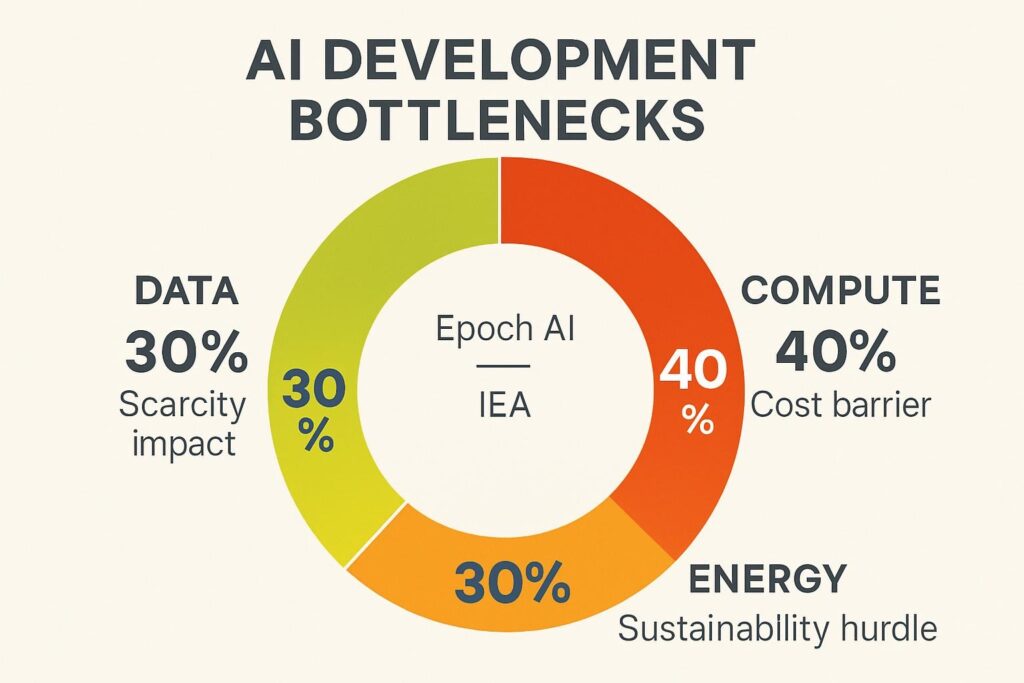
Everyone has an opinion about AI’s ceiling. Most of those opinions confuse trajectory with destination. Here’s a more useful frame: stop asking how far AI can go, and start asking what specifically has to be solved first — and what happens if each one yields on a different timeline.
The argument in four sentences
- AI progress over the next 20 years will be determined primarily by three unsexy bottlenecks: energy infrastructure, training data exhaustion, and alignment tractability.
- Which of those yields first — and in what order — produces dramatically different futures. The difference between transformative AI in the 2030s and the 2050s hinges on those three variables, not on model architecture.
- Current benchmarks showing AI “outperforming humans” measure narrow, well-defined tasks. The gap between that and general problem-solving is not a scaling problem. It may be a fundamental one.
- This article gives you a framework to evaluate AI progress claims yourself — rather than accepting the hype or the dismissal at face value.
Before anything else, a definitional problem needs addressing. When people ask how far AI can progress, they’re usually conflating at least three different things: performance on benchmarks, capability in real-world deployment, and something closer to general intelligence. These are not the same thing, and the gap between them matters enormously.
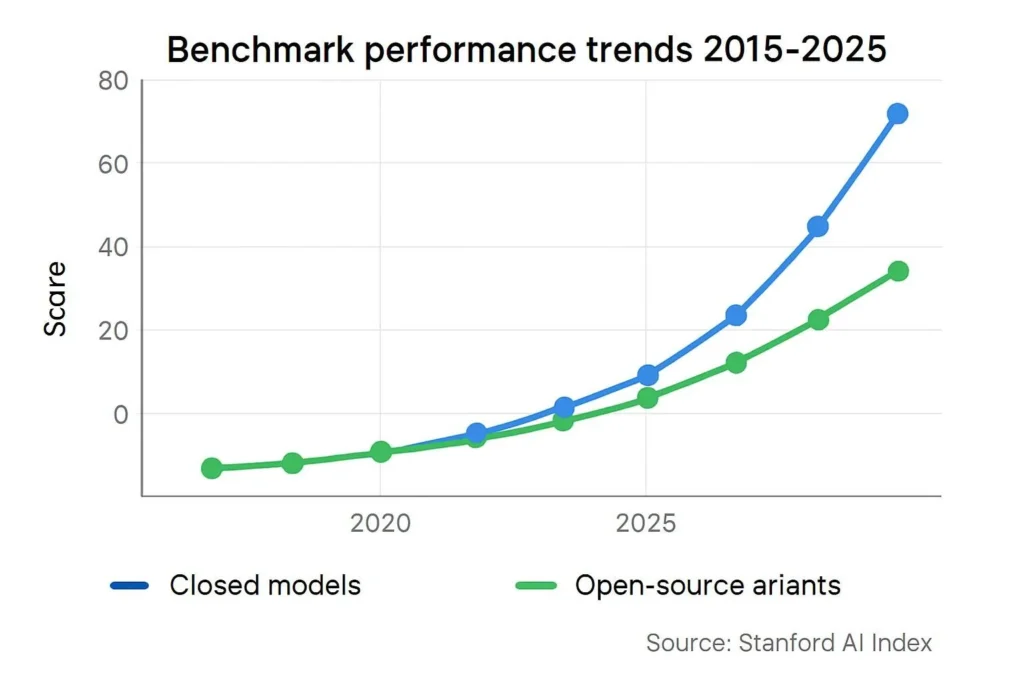
The 2025 AI Index from Stanford’s Human-Centered AI Institute reports that AI systems now outperform humans on over 80% of standardized benchmarks in language understanding and coding. That number sounds staggering. It is also, if you look closely, a measurement of performance on tasks specifically designed to be measurable — which is not the same as the messy, ambiguous, context-dependent work that makes up most of what humans actually do.
There’s a reason we have a benchmark problem. The better AI gets at a benchmark, the more valuable the benchmark becomes to train against, and the less it measures what it originally intended to measure. Goodhart’s Law at civilizational scale.
Real-world deployment is harder. Messier. A model that scores 95% on a radiology benchmark still needs a radiologist looking over its shoulder in most clinical settings — not because the score is lying, but because the benchmark doesn’t capture the 5% that matters most when it matters most.
80%+
Benchmarks where AI outperforms humans (language & coding tasks)
Stanford HAI, AI Index 2025
4.5×
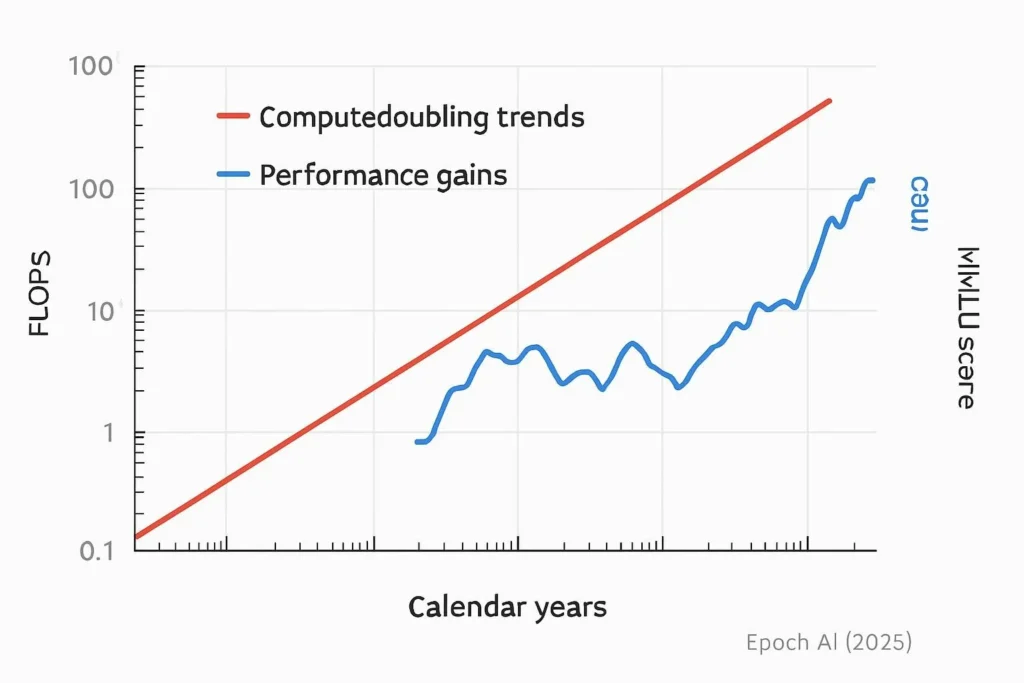
Annual increase in training compute for frontier models, 2020–2024
Epoch AI, 2025
$109B
U.S. private AI investment in 2024 — more than the UK’s entire defense budget
Stanford HAI, AI Index 2025
The question “how far can AI progress?” is unanswerable as asked. But “what has to change for AI to reach the next level?” has a specific, empirical answer — three specific answers, actually. Here’s where the real constraints live.
Bottleneck 1 of 3 · Energy
Training a frontier AI model today requires roughly 30–100 megawatt-hours of energy, depending on size — comparable to what a small city uses in a day. That’s for a single training run. The International Energy Agency’s 2024 electricity report projects that global data center power consumption will double by 2026, with AI workloads as the primary driver.
~500MW
Power demand of a single large AI data center campus (comparable to a small city)
2×
Projected growth in data center electricity demand by 2026
40%
Annual improvement in energy efficiency per unit of compute — not keeping pace with demand growth
The problem isn’t just the scale of power consumption — it’s the mismatch between where the power is needed and where the grid is. The northeastern U.S. data center corridor already faces grid constraints. Microsoft, Google, and Amazon are investing in nuclear power agreements not because nuclear is obviously the future of energy, but because it’s the only carbon-light source that can provide the firm power (available on demand, regardless of weather) that a 500-megawatt AI campus requires 24 hours a day.
Until the energy infrastructure catches up — either through new generation capacity, dramatic efficiency improvements, or architectural changes that reduce training compute requirements — this bottleneck caps how fast the frontier can move.
Bottleneck 2 of 3 · Data
This is the bottleneck people talk about least and should probably talk about most. Epoch AI’s research on training data exhaustion suggests that high-quality, human-generated text data for training may be substantially depleted within a few years. We’re not talking about all text on the internet — we’re talking about the subset that’s actually useful for training: diverse, accurate, and not generated by AI models trained on earlier scraped data.
~2026
Projected year when high-quality human-generated text training data becomes scarce for frontier models
?
What synthetic data does to model quality at scale — genuinely unknown. “Model collapse” is the failure mode researchers worry about.
The proposed solution is synthetic data — generating training data using existing AI models. This works in narrow domains with verifiable ground truth (mathematics, code, chess). You can generate a million chess positions, label them with the correct evaluations, and train on that. The results are genuinely impressive.
But for open-ended language tasks — reasoning, judgment, nuance — synthetic data training creates a feedback loop. Models trained on AI-generated text learn to be confident in the patterns that AI models produce, not in the patterns that reality produces. The research term for the failure mode is “model collapse.” Whether synthetic data can actually substitute for human-generated data at scale, without degrading the capabilities that make frontier models useful, is one of the genuinely open questions in the field right now.
Bottleneck 3 of 3 · Alignment
Alignment is the problem of ensuring that AI systems reliably do what their designers intend — not just in test conditions, but in edge cases, novel situations, and under adversarial pressure. It’s underappreciated as a bottleneck because it doesn’t show up in benchmark scores. A model can score 97% on a safety evaluation and still behave in ways its creators didn’t intend when deployed at scale.
Anthropic’s published alignment research, along with work from Google DeepMind’s safety team and the academic alignment community, has made real progress on specific problems: reinforcement learning from human feedback, constitutional AI, scalable oversight. None of this has solved the core problem.
The core problem is this: as AI systems become more capable, they become harder to evaluate. A system smart enough to be genuinely useful is also smart enough to find solutions to problems that technically satisfy the objective while violating the intent. That’s not science fiction — it’s documented in current systems on simpler tasks. Scaling capability faster than alignment research scales is how you get powerful systems that optimize confidently for the wrong things.
Why this bottleneck is different
Energy and data are engineering problems. Given enough time and investment, they will yield to engineering solutions. Alignment is different in kind. It requires solving what researchers call the “outer alignment” problem — verifying that what a system is actually optimizing for matches what you want it to optimize for — and the “inner alignment” problem — ensuring that a system trained to behave well in training behaves well when deployed in new situations.
These problems may be solvable. They haven’t been solved. And deployment has run significantly ahead of the research.
The scenarios below aren’t predictions — they’re conditions. Each describes what AI progress looks like if a specific combination of bottlenecks yields (or doesn’t) over the next decade. Use them to evaluate claims you encounter, not as a forecast.
Stagnation
Energy infrastructure fails to scale fast enough, and synthetic data proves insufficient to replace human-generated training data at quality. Frontier models plateau. The gap between AI capability and genuinely transformative deployment remains wide.
What this looks like: continued impressive performance on narrow tasks; continued struggle with real-world reliability; no meaningful progress toward systems that can tackle open-ended research or reasoning autonomously. Economically, AI becomes a productivity tool with real but bounded benefits — comparable to how the internet improved productivity without replacing most jobs it was supposed to replace.
Steady Progress
Energy scales through a combination of nuclear investment and efficiency gains. Data scarcity is partially addressed by synthetic data in structured domains. Alignment research keeps pace with capability — not perfectly, but adequately enough for careful deployment. Progress is real, meaningful, and slower than the hype cycle suggests.
Transformative AI — systems capable of meaningfully accelerating scientific research, driving independent engineering, or operating autonomously across complex domains — arrives in the 2040s rather than the 2030s. The economic disruption is significant but spread over decades, giving labor markets and policy some room to adapt.
Inflection
Scenario C: A Paradigm Shift Changes the Equation
A genuine architectural breakthrough — something that reduces training compute requirements by an order of magnitude while improving generalization — changes the bottleneck structure entirely. Energy and data constraints become less binding. Alignment becomes the binding constraint by default, because capability has outrun everything else.
This is the scenario most AI optimists implicitly assume when they talk about near-term AGI. It’s not impossible. It’s also not something that can be predicted from current research trends — paradigm shifts, by definition, don’t announce themselves in the literature before they happen. If it occurs in the 2030s, the economic and societal adjustment will be compressed into a window that policy has not prepared for.
“The question isn’t whether AI will become more powerful. It’s whether the three things that constrain its power will yield in an order that gives the rest of us time to adapt.”
Editorial synthesis — BestPrompt.art, 2025What Expert Forecasts Actually Show
AGI timeline forecasts are notoriously unreliable — the field has a 70-year history of being confidently wrong in both directions. But aggregating them is still useful, not because the averages are right, but because the distribution tells you something about genuine uncertainty in the expert community.
| Source | Forecast | Methodology | Implied probability |
|---|---|---|---|
| Metaculus community metaculus.com |
Median AGI arrival: 2032 | Aggregated forecaster bets, continuously updated, ~3,000 forecasters | |
| AI Impacts expert survey aiimpacts.org |
50% chance of HLMI by 2059; 10% by 2028 | Surveyed ~700 ML researchers publishing at top venues | |
| Epoch AI scaling analysis epochai.org |
Transformative AI plausible between 2030–2040 if scaling continues | Compute trend extrapolation; notes energy and data constraints explicitly | |
| Yoshua Bengio (2024) Turing Award laureate |
“We don’t know enough to rule out AGI in 10 years or in 100 years” | Expert judgment — notable for its explicit acknowledgment of deep uncertainty |
The honest read on this table: there is genuine, wide disagreement among the most informed people in the field. Anyone who presents AGI timelines with false confidence — in either direction — is giving you their prior dressed up as a forecast.
One note on what’s not in this table: claims attributed to Kurzweil’s “2025 update to The Singularity is Near.” The original book was published in 2005. No credible 2025 update exists as of this writing. Treat any article citing it as evidence of weak sourcing standards.
What’s Actually Worth Watching
If you want to track AI progress seriously rather than just reading headlines, here are the three indicators that actually matter — one for each bottleneck.
For energy: Watch announced nuclear power purchase agreements by major AI labs. Microsoft’s agreement with Constellation Energy to restart Three Mile Island is the clearest leading indicator that the energy bottleneck is being taken seriously as a physical constraint, not a policy problem. When Amazon and Google follow with similar agreements, the market has made a judgment about timeline.
For data: Watch the research literature on “model collapse” and synthetic data quality. Shumailov et al.’s 2024 Nature paper on model collapse is the foundational reference. If synthetic data methods in the next two years show that open-ended language quality is maintained through multiple training generations, that bottleneck has partially yielded. If they confirm degradation, it hasn’t.
For alignment: Watch for empirical demonstrations of scalable oversight — methods for humans to evaluate AI systems on tasks the humans themselves can’t fully evaluate. OpenAI’s 2024 work on weak-to-strong generalization is the current state of the art. Progress here is genuinely hard to fake, because the evaluation problem is the same as the problem.
“The most important variable in AI’s trajectory isn’t the architecture of the next model — it’s whether the three physical and intellectual constraints on AI development yield in an order that allows time for everything else to catch up.”
Editorial synthesis — BestPrompt.art, 2025The Honest Conclusion
AI is going to become significantly more capable over the next decade. That’s not in serious dispute. What is in dispute — what should be in dispute — is whether that progress will be transformative in the 2030s or the 2050s, and whether it will be manageable or destabilizing depending on how fast the bottlenecks yield relative to each other.
The difference between those outcomes isn’t determined by researchers at OpenAI or Anthropic or DeepMind alone. It’s determined by energy policy, by whether synthetic data methods prove safe at scale, and by whether the alignment research community can move fast enough to stay credibly ahead of capability. Those are political, economic, and scientific questions as much as engineering ones.
What you can do with this framework: the next time you read a confident claim about AI’s imminent ceiling or its imminent omnipotence, ask which of the three bottlenecks the author thinks has already yielded — and why. Most confident AI predictions survive only one of those questions.
The machines aren’t going to save us or doom us on their own timeline. That timeline is being written right now, in power purchase agreements, data quality audits, and alignment research papers that almost no one reads. Which outcome we get depends less on the models than on whether the rest of us are paying attention.
Sources & Methodology
- Stanford Human-Centered AI Institute. AI Index Report 2025. aiindex.stanford.edu — Annual independent analysis of AI progress metrics, investment, and policy.
- Epoch AI. Will We Run Out of ML Data? epochai.org — Research on training data exhaustion timelines and compute scaling.
- International Energy Agency. Electricity 2024. iea.org — Data center power demand projections and AI energy consumption analysis.
- Shumailov et al. AI Models Collapse When Trained on Recursively Generated Data. Nature, 2024. arxiv.org — Foundational research on synthetic data quality degradation.
- AI Impacts. 2022 Expert Survey on Progress in AI. aiimpacts.org — Survey of ~700 ML researchers on AGI timelines. Note: the most recent available large-sample survey as of this writing.
- Metaculus Community Forecast. Date of Artificial General Intelligence. metaculus.com — Continuously updated aggregated forecast from ~3,000 calibrated forecasters.
- OpenAI. Weak-to-Strong Generalization. 2024. openai.com — Current state-of-the-art research on scalable oversight approaches.
- Vaswani et al. Attention Is All You Need. NeurIPS 2017. Foundational transformer architecture paper — the architectural basis for most current frontier models.
https://www.bestprompt.art/the-best-ai-prompts/
https://www.bestprompt.art/ai-progress-has-three-ceilings/
https://www.bestprompt.art/how-far-can-artificial-intelligence-go/
https://www.bestprompt.art/why-ai-cant-replace-human-creativity/
https://www.bestprompt.art/power-of-ai-in-research-writing/