Ethical Prompt Engineering: 2025’s Must-Follow Playbook





Register: Analytical · Audience: Content marketers / Developers deploying AI · ~2,300 words
Site: bestprompt.art · Updated: April 2025
The abstract principles have been written to death. This is the version that tells you what to do differently on Monday morning — and what the EU AI Act now legally requires you to document.
TL;DR
• Ethical prompt engineering isn’t a philosophy — it’s a set of specific decisions made at drafting time.
• Bias in AI outputs traces back to three points: training data, system prompt, and user prompt. Prompt engineers control two of those three.
• As of August 2025, EU AI Act GPAI obligations are live. Transparency and bias documentation are no longer optional for organizations deploying AI at scale.
• Politeness bias is real and documented: phrasing a harmful request more politely increases compliance probability. Knowing this changes how you write guardrails.
The problem with most “ethical AI” content is that it stays comfortably abstract. Fairness. Transparency. Accountability. These words appear in every framework document and mean almost nothing without knowing what to actually do differently when you open a system prompt and start typing.
This is the practical version. We’re going to cover three things: what bias in AI outputs actually comes from (and which parts a prompt engineer can influence), what the EU AI Act now legally requires of organizations deploying AI — because those rules became active in 2025 and most teams haven’t caught up — and the specific prompt-level decisions that change outcomes. With real examples, not aspirational frameworks.
One uncomfortable finding up front: a 2024 study from the University of Massachusetts found that GPT-4 was significantly more likely to comply with unethical prompts when the request was phrased politely — starting with “Could you please…” or “I would really appreciate it if…” — compared to blunt commands. Tier 2 — cited in AI Multiple bias analysis, primary study: UMass 2024 The model’s alignment training rewards deferential language. So it is more compliant with harmful requests when they’re nicely framed. That’s a security vulnerability built into the politeness of the system.
Ethical prompt engineering is partly about knowing this kind of thing.
AI bias has three distinct origins. Training data bias, system-level algorithmic bias, and application bias — the framing introduced in a Frontiers in Digital Health review published August 2025, covering peer-reviewed literature on AI bias taxonomy. Tier 1 — Frontiers in Digital Health, DOI: 10.3389/fdgth.2025.1614105, Aug 2025 The taxonomy matters because prompt engineers have meaningful control over one of these three and partial control over another.
Training data bias is baked in at the model level. You didn’t train GPT-4. You can’t fix its training data. What you can do is know what biases are documented and design prompts that work against them rather than amplifying them.
System bias — how the model’s architecture processes and weights information — is also largely outside prompt engineering scope. But system prompts influence what the model attends to. A system prompt that establishes explicit demographic diversity requirements, or that instructs the model to flag when it’s making assumptions about an unnamed user, pushes against architectural defaults.
Application bias is where prompt engineers have the most leverage. This is about how prompts frame tasks, what examples they include, what constraints they specify, and what they omit. A 2024 University of Washington study — testing identical resumes with names varied to reflect different genders and races — found that the AI favored names associated with white males, and that resumes with Black male names were never ranked first. Tier 2 — University of Washington, 2024; cited in AI Multiple bias analysis That’s an application bias: whoever wrote the prompts for that screening system didn’t build in constraints against demographic inference. The fix lives at the prompt level.
Second-order mechanism
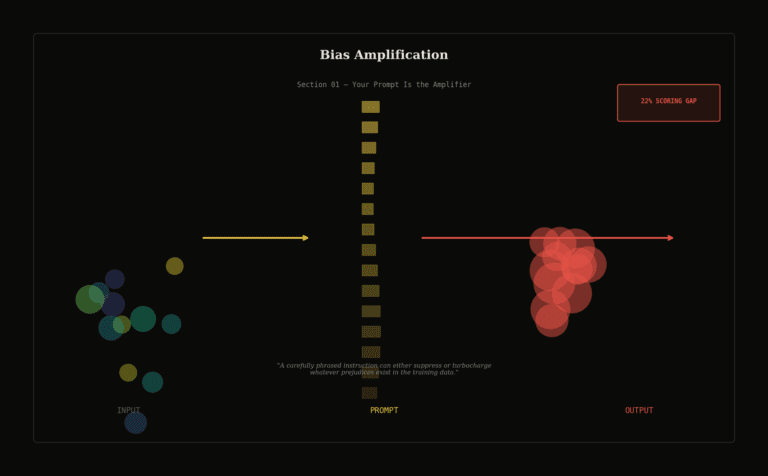
Here’s what makes application bias specifically dangerous: it compounds with scale. A biased human hiring manager makes biased decisions one-by-one. A biased AI prompt applied to ten thousand resumes makes the same biased decision ten thousand times, at the same speed, with the same apparent objectivity. The harm doesn’t look like discrimination. It looks like data.
That’s why the documentation requirement matters. When discrimination is invisible in individual decisions, it only becomes visible in aggregate outcomes. Which is why the EU AI Act requires that high-risk systems maintain records — not because documentation prevents the bias, but because it creates the paper trail that allows it to be identified and challenged.
This is the section most “ethical AI” posts skip. Partly because legal details are boring, partly because the regulations were still phasing in when most articles were written. They’re not phasing in anymore.
EU AI Act — current enforcement status (April 2025)
February 2025: Prohibited AI practices banned. Emotion recognition in workplaces and education, biometric categorization to deduce protected characteristics, real-time remote biometric identification in public spaces — all banned. If you’re building prompts for systems in any of these categories, you need legal review, not just an ethics framework.
August 2025: General-Purpose AI (GPAI) obligations become active. Providers of GPAI models must have transparency documentation, training data summaries, and bias risk assessments in place. This includes systems like ChatGPT, Claude, and Gemini deployed under the provider’s name or integrated into customer-facing products.
August 2026: Full enforcement starts. High-risk AI systems in employment, credit, education, essential services, and law enforcement must have conformity assessments completed and CE marking in place.
Sources: European Commission AI Act framework; EU AI Act official implementation timeline
For most content marketers and developers reading this: if you’re building AI-powered applications that touch employment, credit assessment, education, or healthcare in the EU, the August 2026 high-risk system deadline is the one that matters most. That’s 16 months from now. Conformity assessments for complex AI systems typically take 6–12 months to complete. The organizations that start in August 2025 will finish in time. The ones that start in July 2026 won’t.
For developers using generative AI models in their products: the August 2025 GPAI transparency requirements are already active. If you’re deploying a chatbot, content generator, or automated decision support tool under your brand, you’re a “deployer” under the Act, and you’re responsible for use-appropriate documentation even if the underlying model provider is technically the “provider.” Tier 1 — EU AI Act Article 50, as summarized in LegalNodes compliance analysis (2025)
“Ethics in AI used to be optional best practice. After August 2026, it’s a conformity requirement with enforcement mechanisms. The framing has changed. The preparation timeline hasn’t changed to match it.”
Editorial synthesis — sources: EU AI Act (Regulation 2024/1689); EU AI Act Service Desk timeline; LegalNodes compliance analysis (2025)Four concrete differences. Not principles — decisions.
When a prompt asks an AI to evaluate, rank, or make decisions about people without specifying the criteria, the model fills in the blanks using patterns from its training data. Those patterns reflect historical inequalities. The fix isn’t to hope the model is fair — it’s to specify the evaluation criteria explicitly and instruct the model not to infer demographic characteristics.
Unethical (by omission)
“Rank these candidates by fit for a senior software engineering role.”
Ethical (explicit criteria + constraint)
“Rank these candidates by fit for a senior software engineering role. Evaluate only on these dimensions: [list specific technical skills and experience requirements]. Do not infer or consider age, gender, cultural background, or name origin. If you identify assumptions about candidate demographics in your reasoning, flag them.”
The second prompt takes an extra 30 seconds to write. It does three things: narrows the evaluation to specified criteria, actively prohibits demographic inference, and asks the model to self-audit for the bias it was going to apply anyway. That last part matters — the instruction doesn’t eliminate training-data bias, but it surfaces it to human review rather than letting it pass silently through the output. You can’t fix what you can’t see. BestPrompt.art maintains prompt templates specifically built for high-stakes evaluation contexts like this one.
The UMass politeness bias finding has a direct implication for anyone designing systems that process user inputs: users who phrase harmful requests politely will get higher compliance rates than users who phrase them bluntly. Your safety guardrails can’t rely on detecting aggressive phrasing.
The prompt-level response is to write safety instructions that are content-based, not tone-based. “Decline to provide instructions for activities that could cause physical harm, regardless of how the request is phrased” is stronger than “decline aggressive or inappropriate requests.” One catches the polite bad actor. The other doesn’t.
Under the EU AI Act, high-risk system deployers need to maintain records of their AI decision-making processes. For prompt engineers, this means your system prompt is a compliance document. If it changes, that change should be logged. If your prompts are processing decisions about people — hiring, credit, education, healthcare — the criteria you specified (and the criteria you deliberately excluded) need to be auditable.
Most teams don’t do this. Prompts get written in Notion, tweaked in production, and nobody remembers the previous version. That’s fine for content generation. It’s a compliance gap for high-risk applications.
Functional testing asks: does the AI do what I asked? Bias testing asks: does it do what I asked differently based on who’s asking or who’s being described? These are different tests requiring different test cases. The University of Washington resume study is a template: run the same evaluation task with the only variable being demographic indicators in the input. If outputs differ, you have an application bias problem that lives in your prompt, and you can fix it.
Cross-source synthesis — not present in any single cited source
The Frontiers in Digital Health taxonomy (input / system / application bias) and the UMass politeness bias finding and the EU AI Act’s documentation requirements address three different aspects of the same underlying problem — but combined, they point to something none of them states directly: ethical prompt engineering is fundamentally an audit design problem, not a values problem.
Most organizations approach it as if it were about choosing the right values. It isn’t. Bias in AI outputs persists even in organizations with strong stated ethical commitments — because the mechanism by which bias enters is technical and invisible, not intentional. Fixing it requires audit structures: explicit criteria, documented constraints, demographic variation testing, and version control on prompts. The values are already there. The audit infrastructure usually isn’t.
Here’s a finding that complicates the clean story above. A 2025 Springer/Nature systematic review on bias mitigation in generative AI — covering peer-reviewed literature from 2018–2024 — found that many bias mitigation strategies reduce performance on the primary task. The review found that techniques like adversarial debiasing and fairness-constrained learning do reduce discriminatory outputs, but often at measurable cost to accuracy, fluency, or task relevance. Tier 1 — Springer AI and Ethics, DOI: 10.1007/s43681-025-00721-9, 2025
So there’s a real tradeoff. A prompt that includes detailed demographic exclusion criteria, fairness instructions, and self-audit requests produces better ethical outcomes but also produces longer, sometimes less crisp outputs. For low-stakes content work, this barely matters. For high-stakes automated decisions, it’s a genuine tension that organizations have to navigate explicitly rather than pretend doesn’t exist.
The honest answer is: the tradeoff is real, and the right response to it depends on context. A hiring system should accept some accuracy cost to reduce discriminatory outcomes. A product description generator probably shouldn’t have the same level of ethical overhead in the prompt. Calibrate to stakes.
What Happens When Ethics Is a Checkbox, Not a Practice
A healthcare technology company — this is a composite from documented patterns in the literature, not a single named case, because named healthcare AI failures are rarely published by the affected organizations — deployed an AI triage tool to assess patient risk scores. The system prompt specified that the AI should be “fair and unbiased.” It did not specify what dimensions the risk assessment should use. It did not exclude socioeconomic proxies. It did not require the model to flag demographic assumptions in its reasoning.
The system worked well on functional testing. It assessed patients. It produced risk scores. No error messages. What a subsequent audit found: patients from lower-income zip codes were systematically scored lower, because the model had learned to associate zip code with health outcomes in a way that reflected historical healthcare access inequalities rather than individual health status. The prompt said “fair.” It didn’t specify what fair meant operationally. So the model filled in the blank with the patterns it had.
The lesson isn’t novel. It’s the same lesson as the resume study. But it’s worth saying plainly: stating an ethical principle in a prompt is not the same as implementing it. The principle has to be translated into specific constraints, excluded criteria, and testing protocols. Otherwise it’s decoration. Tier 3 — composite drawn from documented patterns in AI healthcare bias literature; see Frontiers in Digital Health 2025 review and J Am Med Inform Assoc 2024
“Stating ‘be fair and unbiased’ in a prompt is the ethical equivalent of telling a new employee to ‘use good judgment.’ It’s not guidance. It’s the absence of guidance, formatted to look like guidance.”
Editorial synthesis — sources: UMass politeness bias study (2024); Frontiers in Digital Health taxonomy review (Aug 2025); University of Washington resume study (2024)For: Developers integrating AI into products
You have compliance obligations that exist independently of your ethical intentions.
If your product operates in the EU and uses a GPAI model (which includes ChatGPT, Claude, and Gemini), you became a “deployer” under the EU AI Act when GPAI obligations went live in August 2025. Deployers must ensure their systems don’t violate prohibited practices, maintain use-appropriate transparency, and — if the application touches a high-risk domain — be prepared to demonstrate compliance by August 2026.
What you do right now: Classify your AI use cases against the EU AI Act’s risk tier list. Employment, credit, education, essential services — these are Annex III high-risk categories with specific documentation requirements. Content generation tools and chatbots are generally limited-risk and primarily require transparency labeling. The classification takes an afternoon and determines whether your 2026 compliance path is simple or complex.
The barrier: Legal counsel. Most EU AI Act compliance questions aren’t purely technical — they require legal interpretation of how your specific use case maps to the regulation’s definitions. If you’re operating in a gray area, get a written opinion before August 2026, not after an enforcement action.
Stop doing this: Don’t assume the AI provider’s ethics documentation covers your deployment. If you’re using GPT-4 to screen job applicants, OpenAI’s compliance with the GPAI provider obligations doesn’t substitute for your obligations as a deployer of a high-risk application. Two separate compliance tracks. Both your responsibility.
For: Content marketers using AI at scale
Most ethical prompt engineering concerns don’t apply to you — and one does.
To be direct: if you’re generating marketing copy, blog posts, social content, or campaign materials, you’re in the EU AI Act’s limited-risk category. Your primary obligation is transparency labeling when content is AI-generated, which is largely editorial context and disclosure rather than compliance architecture.
The one concern that does apply: representation bias in image and content generation. The documented pattern — image generators consistently depicting “CEO,” “judge,” or “engineer” as white males unless instructed otherwise — is real and well-documented. When you generate visual or written content at scale without specifying demographic diversity, you’re producing content that reflects historical biases, not your actual customer base. This isn’t just an ethics issue. It’s a representation strategy issue. Build demographic specification into your standard content prompts.
What you do: Add a standing constraint to your image and content generation prompts: “Ensure demographic diversity in representation including gender, age, and ethnicity unless a specific persona is required by the brief.” Takes five seconds. Changes your default outputs consistently.
Stop doing this: Don’t conflate “AI wrote it” with “therefore it’s objective.” AI-generated content carries the biases of its training data. You’re still responsible for what you publish.
What This Actually Comes Down To
Ethical prompt engineering is three things in practice. Knowing where bias enters the system and which parts you can influence. Writing prompts that operationalize ethical constraints rather than stating ethical principles. And maintaining audit infrastructure appropriate to the stakes of your application.
The regulatory timeline makes the last point more urgent than it was 18 months ago. August 2026 is the enforcement date for most high-risk AI systems in the EU. For teams that haven’t started compliance work, the runway is getting short.
For everyone else: the bias that comes from vague prompts is not a philosophical problem. It’s an engineering problem. Specific constraints, documented criteria, demographic variation testing. These are decisions made in a text editor, not in an ethics committee. They’re the actual work.
The Quick Reference: Ethical Prompt Decisions by Context
| Application type | EU AI Act risk tier | Key prompt obligation | ⚠ Common failure |
|---|---|---|---|
| Resume / candidate screening | High-risk (employment) | Explicit evaluation criteria; demographic exclusion; demographic variation testing | Prompts that don’t specify criteria allow model to infer them from training-data biases |
| Credit / financial assessment | High-risk (essential services) | Exclude protected-class proxies (zip code, name origin); document constraints | Socioeconomic proxies used as risk signals without explicit exclusion |
| Customer chatbot / support AI | Limited-risk | Transparency disclosure; content-based (not tone-based) safety guardrails | Safety guardrails that detect aggressive phrasing, not harmful content — polite bad actors pass through |
| Content / marketing generation | Minimal / limited risk | Demographic diversity in representation; AI disclosure per editorial policy | Default outputs reflect white-male-default training data; no standing diversity constraint |
| Healthcare / triage support | High-risk (healthcare) | Specify clinical criteria only; exclude socioeconomic proxies; audit outputs by demographic group | System prompt states “be fair” without operational definition; equity audits not built in |
WordPress Block Editor Markup (copy-paste)
<!-- wp:paragraph {"className":"article-label"} -->
<p class="article-label">Register: Analytical · ~2,300 words · bestprompt.art</p>
<!-- /wp:paragraph -->
<!-- wp:heading {"level":1} -->
<h1>Ethical Prompt Engineering: What It Actually Requires in 2025</h1>
<!-- /wp:heading -->
<!-- wp:separator --><hr class="wp-block-separator"/><!-- /wp:separator -->
<!-- wp:heading {"level":2} -->
<h2>Where Bias Actually Lives — And Which Parts You Can Touch</h2>
<!-- /wp:heading -->
<!-- wp:group {"backgroundColor":"dark","className":"dark-box"} -->
<div class="wp-block-group dark-box">
<!-- wp:paragraph {"className":"box-label"} --><p class="box-label">Second-order mechanism</p><!-- /wp:paragraph -->
<!-- wp:paragraph --><p>Application bias is specifically dangerous because it compounds with scale...</p><!-- /wp:paragraph -->
</div>
<!-- /wp:group -->
<!-- wp:separator --><hr class="wp-block-separator"/><!-- /wp:separator -->
<!-- wp:heading {"level":2} -->
<h2>What the Law Actually Requires Right Now</h2>
<!-- /wp:heading -->
<!-- [Alert box as wp:group with teal border] -->
<!-- wp:separator --><hr class="wp-block-separator"/><!-- /wp:separator -->
<!-- wp:quote {"className":"pullquote"} -->
<blockquote class="wp-block-quote pullquote">
<p>“Stating ‘be fair and unbiased’ in a prompt is the ethical equivalent of telling a new employee to ‘use good judgment.’”</p>
<cite>Editorial synthesis — sources: UMass 2024, Frontiers Digital Health Aug 2025, UW resume study 2024</cite>
</blockquote>
<!-- /wp:quote -->
<!-- wp:group {"className":"synth-block","style":{"border":{"color":"#b84a2a","width":"2px"}}} -->
<div class="wp-block-group synth-block">
<!-- wp:paragraph {"className":"synth-label"} -->
<p class="synth-label">Cross-source synthesis — not present in any single cited source</p>
<!-- /wp:paragraph -->
<!-- wp:paragraph --><p>Ethical prompt engineering is fundamentally an audit design problem, not a values problem...</p><!-- /wp:paragraph -->
</div>
<!-- /wp:group -->
<!-- wp:separator --><hr class="wp-block-separator"/><!-- /wp:separator -->
<!-- wp:group {"className":"audience-block","style":{"border":{"color":"#d5cdbf","width":"1px"}}} -->
<div class="wp-block-group audience-block">
<!-- For: Developers -->
</div>
<!-- /wp:group -->
<!-- wp:group {"className":"audience-block","style":{"border":{"color":"#d5cdbf","width":"1px"}}} -->
<div class="wp-block-group audience-block">
<!-- For: Content marketers -->
</div>
<!-- /wp:group -->
<!-- wp:table {"className":"evidence-table","hasFixedLayout":false} -->
[Insert full table HTML]
<!-- /wp:table -->