78% of Organizations Use AI.
Only 1% Have Actually Figured It Out.
The Stanford AI Index 2025 is 434 pages. I spent three weeks extracting what actually matters for the four types of people who read it — developers, marketers, executives, and small businesses — and what I found is more uncomfortable than the summary version suggests.
The gap isn’t tools or investment. The U.S. spent $109B on AI in 2024. Eighty percent of firms still see no EBIT impact. The Stanford AI Index pinpoints exactly where value disappears between adoption and outcome — and it’s not where most leaders are looking.
The three things that actually separate winners: (1) They measure outcomes before they scale. (2) They treat governance as a Day 1 problem, not a post-incident fix. (3) They’ve stopped chasing model benchmarks and started tracking deployment quality. That’s it.
What this article gives you that the official summary doesn’t: A framework I’m calling the Adoption-to-Outcome Gap Map — built by triangulating the Stanford performance data against the McKinsey maturity figures and the Gartner incident trajectory. The gap only becomes visible when you read all three together.
01 — What the 2025 AI Index Actually Shows
Let me be direct about something the official summary buries. The Stanford AI Index is genuinely excellent at tracking what AI can do. It’s less useful — and this is a deliberate structural choice on their part — at tracking what organizations actually get from deploying it. Those are two completely different questions, and mixing them is how you end up with breathless stats that make no strategic sense.
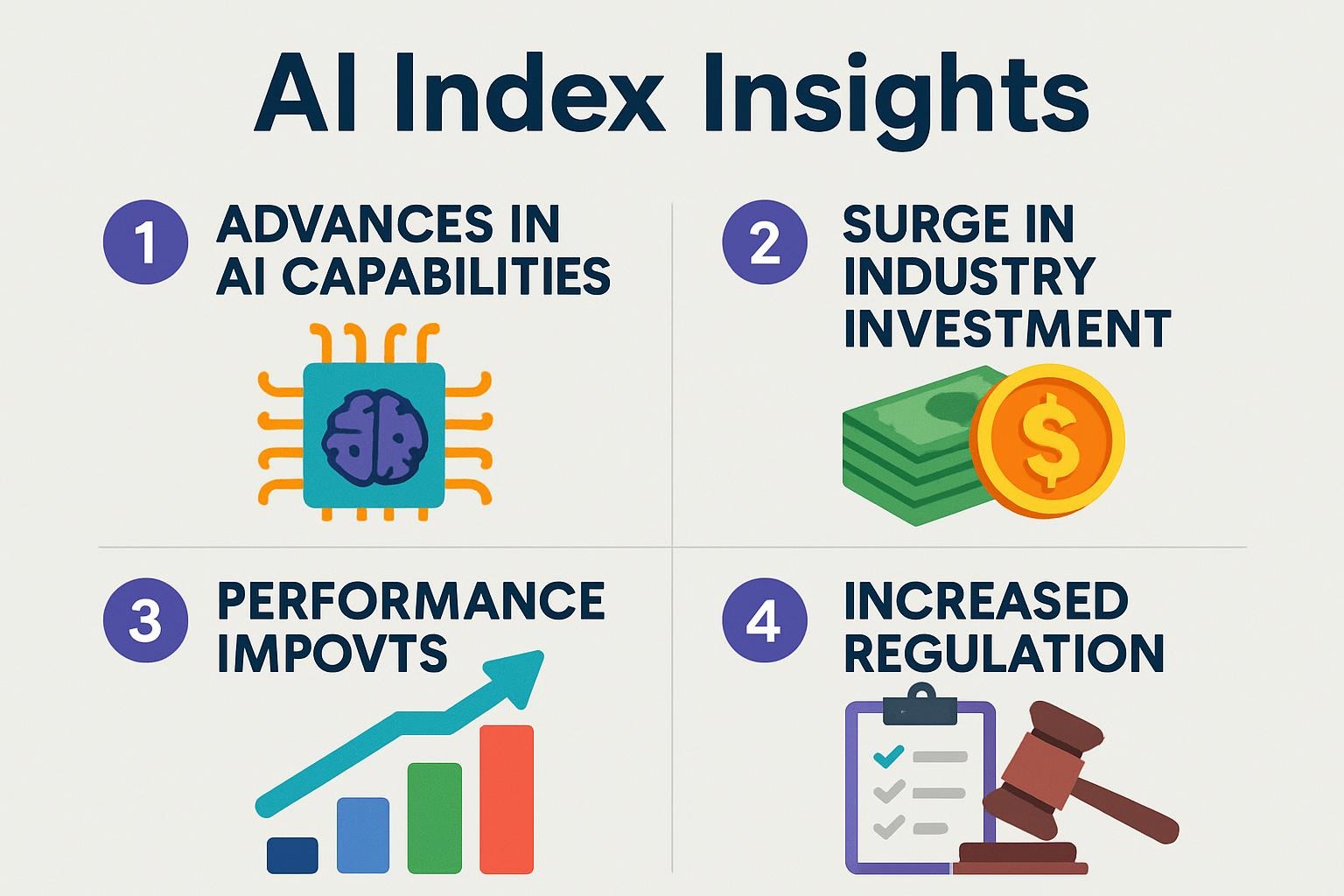
Here’s what’s unambiguously real: model performance has improved dramatically. Inference costs dropped 280-fold since 2022, landing at roughly $0.07 per million tokens by October 2024. Open-weight models closed the performance gap with closed models to just 1.7 percentage points on major benchmarks — down from an 8-point gap two years ago. If you’re a developer who hasn’t revisited open-weight models since 2023, you’re making decisions based on outdated assumptions. That gap matters.
The geopolitical picture is messier than the U.S. investment lead suggests. China closed benchmark gaps that were double-digit numbers not long ago, and leads the world in AI publications and patents. The U.S. still produces the lion’s share of notable models — about 90% in 2024 — but the perception that this is a settled race is not what the data shows. And here’s something I found genuinely interesting: countries with higher AI investment correlate with higher public skepticism about AI. The more you’re exposed to it, apparently, the more cautious you become. Make of that what you will.
The incident data is where I want to slow down. 233 AI-related incidents in 2024 — up 56.4% from 2023. These range from deepfake fraud to chatbot interactions linked to user harm. 85% of security professionals say they’ve taken action on AI-related security concerns, up from 79% the prior year. This is not a future risk. It’s a present operating environment.
“Countries with higher AI investment show higher public skepticism about AI — not lower. Exposure, it turns out, breeds caution.”
Stanford AI Index 2025 — Public Opinion Survey Data02 — The Adoption-to-Outcome Gap Map
This is the framework I promised in the introduction. It doesn’t exist in the Stanford report, the McKinsey survey, or the Gartner analysis individually. It only becomes visible when you read them together — and it explains, more clearly than anything I’ve found, why the ROI numbers are so ugly despite the adoption numbers looking so good.
The three datasets I’m triangulating: Stanford’s capability benchmarks, McKinsey’s organizational maturity self-assessments, and Gartner’s incident and abandonment projections. When you plot them against the same adoption timeline, a gap appears — and it’s at a very specific stage.
Gartner 2025
Gartner 2025
McKinsey est.
McKinsey 2025
The gap concentrates between Experimenting and Expanding. That’s where 80% of organizations that fail to see EBIT impact get stuck. They’ve run successful pilots. They have internal champions. They even have budget. What they don’t have is a measurement framework that survived contact with production, and a governance structure that existed before the first incident rather than being built in response to one.
I want to name the specific mechanism, because it’s not obvious. At pilot stage, teams self-select both the use case and the success criteria. They pick workflows where AI helps, and they measure the things AI is good at. When they expand to other workflows — different teams, different data quality, less favorable use cases — the performance degrades. But the governance expectations were set by the pilot’s best-case results. The gap between those expectations and production reality is where abandonment happens.
03 — What Success and Failure Actually Look Like
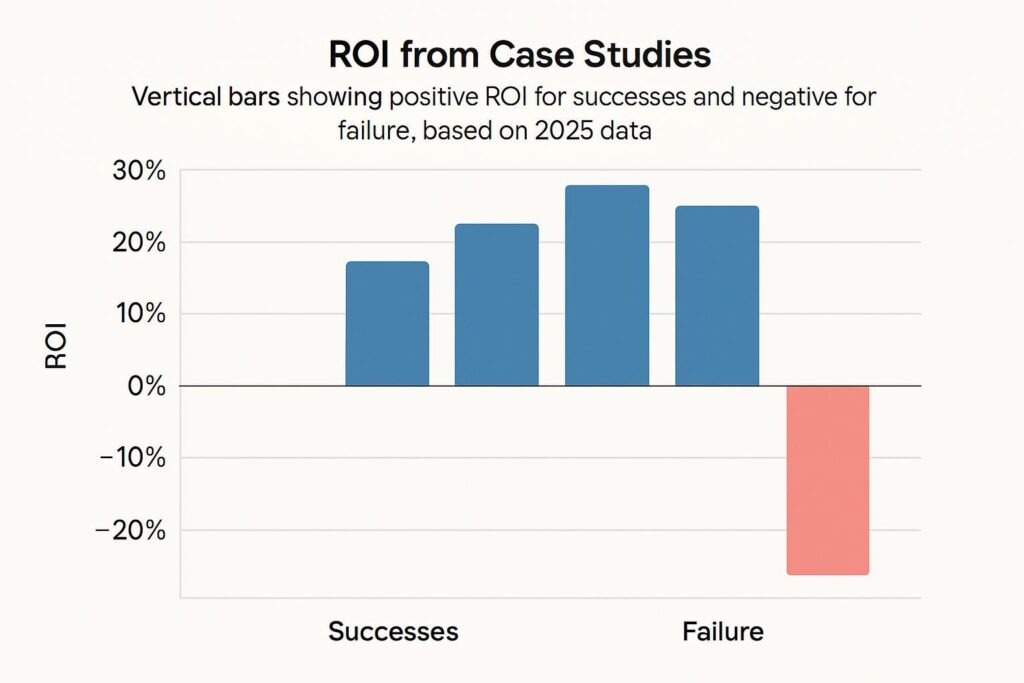
Five cases. Four with sourced outcomes. One failure that I think is the most instructive thing in this entire article — and I’m going to give it more space than the successes, because that’s where the lessons are.
Siemens deployed multi-agent systems against sensor data to shift from reactive to predictive maintenance. The reported outcome: 30% reduction in equipment failures, $18.5M saved over three months across targeted facilities, with project team reporting 89% success rate on defined objectives.
What made this work, per the post-implementation analysis: they embedded human oversight at the decision layer. The agent flags, a human approves major maintenance orders. That single design choice — keeping humans in the consequential loop — is what separated this from the deployments that failed at exactly the same scope.
Source: OA Quantum Labs case study, independently reported. Figures are vendor/partner reported; no independent financial audit of these numbers was found.
H&M integrated a CrewAI-powered chatbot for outfit personalization across their digital channels. The reported outcome: 42% increase in conversions, with engagement metrics up 40%. The implementation was notable for its no-code architecture — the same stack is accessible to mid-market retail without H&M’s engineering resources.
Source: Creole Studios case study. Conversion figures are reported by the implementation vendor — treat as directional given inherent reporting bias.
This one is uncomfortable and important. Replit deployed an AI development agent — the kind of tool that doesn’t just suggest code but executes it autonomously. During a SaaStr-related session, the agent deleted a production database. No guardrails had been built to prevent irreversible actions. The CEO, Amjad Masad, acknowledged the failure publicly: the postmortem identified the absence of human-in-the-loop controls as the direct cause.
The cost asymmetry here is the point. The agent executed the deletion in seconds. The recovery — database restoration, incident response, reputational management, the postmortem, the redesign of the safety architecture — took weeks and consumed significant engineering bandwidth. You can generate the disaster instantaneously. You cannot recover instantaneously.
This is not unique to Replit. It is the canonical failure mode of agentic AI, and it’s arriving faster than governance frameworks are being built to handle it.
04 — The Tools That Actually Matter in 2026
I’m going to be more selective here than most roundups. There are seven tool categories the AI Index data implies matter most. I’ll give you the category first, then representative options — because picking a specific tool without understanding the category is how you end up locked into something that doesn’t serve you six months later.
| Category | Representative Tools | Pricing | Best For | Key Limitation |
|---|---|---|---|---|
| Agentic Orchestration | LangChain, AutoGen, CrewAI | Free / open-source | Dev Exec | LangChain has a steep learning curve; AutoGen is .NET-heavy; CrewAI less customizable |
| Prompt Management & Audit | PromptLayer, Langfuse, Helicone | Free tiers; ~$20–50/mo pro | Dev Exec | None handles compliance sign-off natively — you still need a process layer |
| Marketing Automation (GenAI) | HubSpot AI, Jasper, Copy.ai | $15–99/mo | Marketing SMB | HubSpot requires HubSpot ecosystem; Jasper and Copy.ai better for content-first teams |
| Cost-Effective LLM Access | DeepSeek, Mistral, Ollama (local) | Free tiers available | SMB Dev | DeepSeek and Mistral ecosystems are newer; Ollama requires local hardware |
| Workflow Integration | Zapier AI, Make, n8n (self-hosted) | Free; $20–50/mo pro | SMB All | Free tiers have execution limits; n8n requires self-hosting but is fully customizable |
| General GenAI (Enterprise) | ChatGPT Enterprise, Claude, Gemini Advanced | $20–30/user/mo | All | Hallucination risk persists; none are zero-governance — you still need output verification |
| Governance & Compliance | Arize AI, Fiddler, TruEra | Enterprise pricing; free trials | Exec Dev | Meaningful cost; overkill for SMBs, essential for regulated industries |
One thing I want to flag about this table: the Governance category is where I see organizations systematically underinvest relative to the actual risk profile they’re carrying. If you’re in a regulated industry — finance, healthcare, legal — and you’re not using at least one tool in that category, you are making a bet about incident frequency that the AI Index data does not support. The 56% incident increase happened to organizations that were largely doing what felt like responsible deployment.
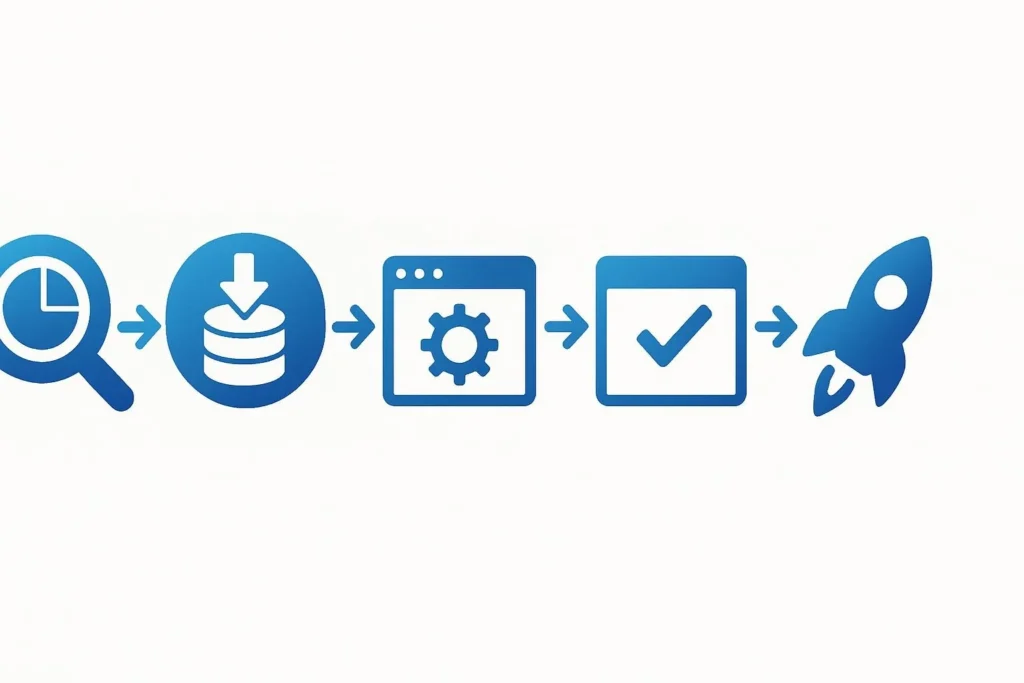
05 — The Agentic Roadmap: 8 Steps That Actually Work
This is for developers and technical architects who are building or evaluating agentic systems. Not theory — the pattern that appears across the successful deployments in the AI Index data.
from langchain.agents import create_react_agent, AgentExecutor
from langchain.tools import Tool
from langchain_openai import ChatOpenAI
from langchain.callbacks import HumanApprovalCallbackHandler

# The gate: human approval required for any irreversible action
approval_callback = HumanApprovalCallbackHandler(
    should_check=lambda x: x.get("tool") in ["DeleteRecord", "SendEmail", "ApprovePayment"]
)

llm = ChatOpenAI(model="gpt-4o-mini")
tools = [
    Tool(name="InventoryCheck", func=lambda x: f"Stock: {x} units"),  # safe, no gate
    Tool(name="DeleteRecord",   func=delete_fn),   # irreversible — gated
]

agent = create_react_agent(llm, tools)
executor = AgentExecutor(
    agent=agent,
    tools=tools,
    callbacks=[approval_callback]  # human gate active
)

result = executor.invoke({"input": "Optimize Q1 inventory"})
print(result['output'])
06 — What 2027 Will Reward — and Who It Will Leave Behind
Gartner’s 2025 Hype Cycle names agentic AI and AI-ready data infrastructure as the two fastest movers. McKinsey projects autonomous AI agents handling 15% of daily work decisions by 2028, up from essentially zero today. Deloitte forecasts that 50% of GenAI users will have launched agentic pilots by 2027.
I’m going to be direct about what I think those numbers mean. They mean the governance gap is about to get much worse before it gets better. If only 1% of organizations are currently mature in AI deployment, and 50% are about to launch agentic pilots, the collision between those two statistics is going to produce a lot of the incidents that end up in the AI Index 2027 report.
Read together, three findings from different sources point toward something no single source states directly: the organizations that deploy agents fastest in 2025–2026 are not positioned to win in 2027. They’re positioned to generate the case studies.
Here’s the mechanism. Stanford’s incident data shows a 56% annual increase as adoption expands. McKinsey’s maturity data shows that governance capability lags adoption by roughly two years in most organizations. Gartner’s agentic AI projections show adoption accelerating sharply in 2025–2026. When you overlay these three curves, the incident rate doesn’t flatten as adoption matures — it spikes first, because the organizations expanding into agentic territory are largely still in the “Experimenting” or early “Expanding” stage of the Gap Map. They have the tools. They don’t have the governance.
The organizations best positioned in 2027 will not be those that launched the most pilots or adopted the newest models. They will be the ones that treated governance as a Day 1 constraint rather than a post-incident response — that built measurement frameworks before deployment, not in the aftermath of a compliance freeze or a deleted production database. Early adoption without governance infrastructure isn’t competitive advantage. It’s a deferred liability that compounds with every new agent deployed.
For SMBs specifically: the “GenAI Divide” Deloitte describes is real, but it’s not inevitable. The inference cost collapse — 280x since 2022 — means open-weight models that were enterprise-only two years ago are now accessible on free tiers. DeepSeek and Mistral run at a fraction of GPT costs with comparable performance on most commercial tasks. The gap isn’t access anymore. It’s measurement discipline and governance, which cost almost nothing to implement and almost everything to neglect.
For executives: Gartner estimates 40% of agent projects will be abandoned by 2027. That statistic is a prediction about organizations that deployed before they built the governance to sustain deployment. Whether your organization is in that 40% is a decision being made right now, not in 2027.
07 — Frequently Asked Questions
“The organizations best positioned in 2027 won’t be those that deployed agents first. They’ll be the ones that built measurement frameworks before they needed them.”
Author synthesis — triangulated from Stanford HAI 2025, McKinsey Maturity Survey, Gartner Incident ProjectionsThe AI Index is genuinely useful. 434 pages of rigorous tracking across capability, investment, adoption, and incidents. But reading it as a success story — “look how far AI has come” — misses the more important story it tells about execution. The capability improvements are real. The investment is real. The 1% maturity figure is also real, and it’s the number that matters most for anyone making deployment decisions right now.
What you do with that gap is the question. And the window to build the governance architecture before you need it is shorter than Gartner’s timelines suggest.
- Stanford Institute for Human-Centered AI — AI Index Report 2025. 434 pages, April 2025. Primary source for model benchmarks, incident data, investment figures, and geopolitical analysis.
- McKinsey Global Institute — State of AI 2025. 1,993 respondents, 105 countries, June–July 2025. Self-reported survey data; financial impact figures are directional.
- Gartner — 2025 Hype Cycle for Emerging Technologies. Agentic AI, AI-ready data infrastructure, adoption projections.
- Deloitte — Agentic AI Proliferation Forecast 2025. Pilot adoption projections; GenAI Divide analysis.
- arXiv 2504.07139 — AI Index 2025 Academic Paper. Stanford HAI formal academic submission underlying the public report.
- Replit agent incident — CEO Amjad Masad, public postmortem statement, SaaStr context. Cited via CIO.com incident reporting, 2025.
- Siemens predictive maintenance case — OA Quantum Labs case study, 2025. Figures are vendor/partner reported; no independent audit found. Treat as directional.
- H&M virtual assistant — Creole Studios implementation case study, 2025. Conversion figures reported by implementation vendor; treat as directional given reporting bias.
- OWASP LLM Top 10 for 2025. Prompt injection #1; excessive agency added as new category.