The 30-Day Prompt Challenge: What Actually Happens When You Refine One Prompt, Once a Day, For a Month

Challenges & Experiments
The 30-Day Prompt Challenge
Not “write 30 new prompts.” One prompt. Thirty small revisions. It’s a slower, less flattering exercise than most prompt-engineering content admits — and the research on why single-shot prompts fail explains exactly why it works.
Day 01Baseline draft. No constraints, no format spec. Works maybe half the time.
Day 08Format spec added. Output stops drifting between list and prose.
Day 15Constraint isolated. One failure mode fixed; a new one appears.
Day 22Eval set built. You can finally measure “better” instead of guessing.
Day 30Versioned, tested, mostly boring. Still one open failure mode from a Tuesday edge case, logged for the next cycle.
What changed in this update (Sept 14, 2026): every research claim below now links to its primary source instead of a secondary summary — several of the original figures came from papers cited inside other papers, and tracking down the originals changed how a couple of numbers should be read. We also added a section on the API cost and temperature settings that running eval sets repeatedly actually requires, sharpened the line between “the prompt is wrong” and “the model can’t do this,” and rewrote the closing section so it doesn’t oversell how tidy day 30 actually looks.
On this page
Most “30 prompts to try” content optimizes for a different goal than yours: variety. A 30-day refinement challenge optimizes for the opposite thing — depth on one task, one prompt, until the failure modes stop surprising you.
That distinction matters more than it sounds like it should. A single well-written prompt feels finished the moment it produces one good output. It usually isn’t. The gap between “worked once” and “works reliably” is where almost all practical prompt engineering actually happens, and it’s invisible if you never run the same prompt against the same task more than once.
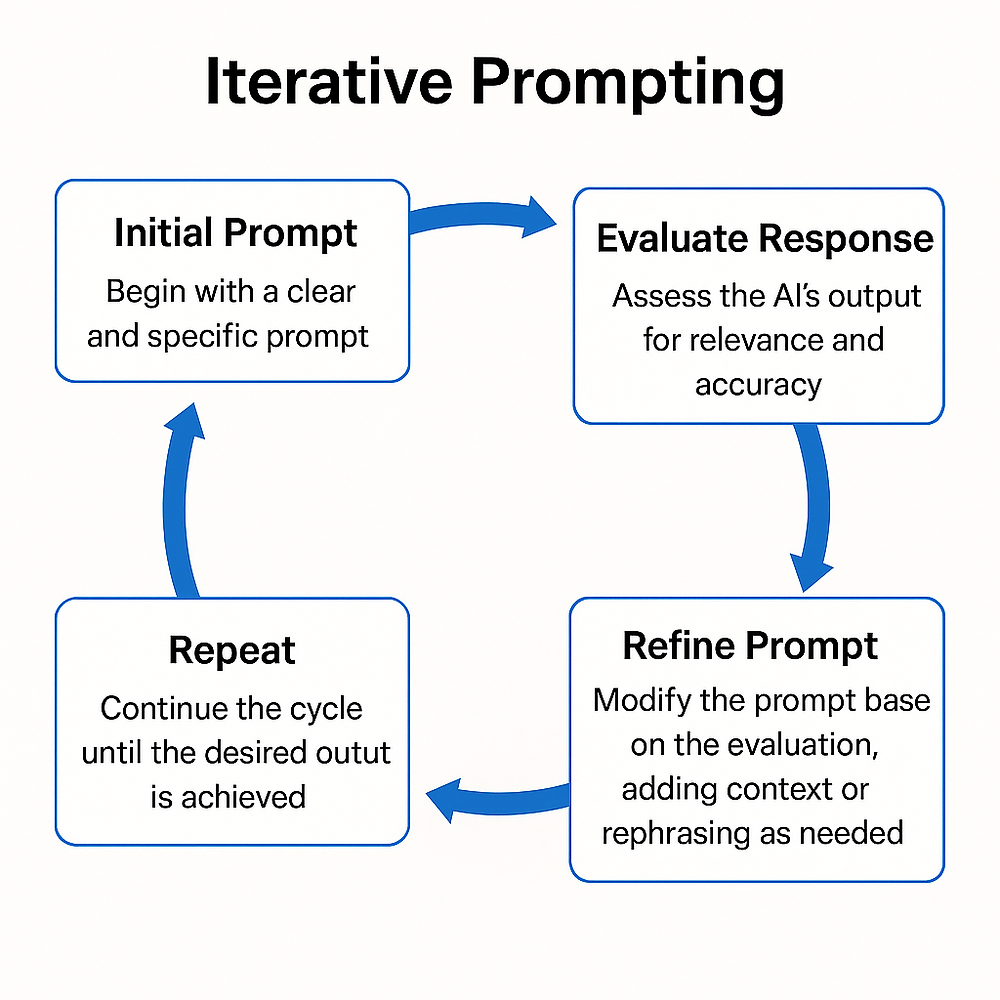
The 30-day structure forces that repetition. Each day you touch the same prompt again — not to replace it, but to isolate one thing that’s still going wrong and fix only that. It’s closer to how a developer hardens a function against edge cases than how most people picture “prompting.”
What this actually is: this isn’t a personal 30-day diary with before/after screenshots — we’re not going to pretend we ran one specific dated experiment and hand you our raw numbers as if that generalizes to your task. What follows is a structured framework built on published research into why prompts fail and how iterative refinement measurably helps, so you can run your own 30 days against your own task and trust the mechanism, not our anecdote.
The instability nobody mentions in “just write a better prompt” advice
Here’s the uncomfortable starting fact: large language models are far more sensitive to prompt phrasing than most guides let on, and that sensitivity is now a well-documented research area, not a hunch.
Here are the four findings this section leans on, with what they actually measured — not the rounded, decontextualized version that circulates in secondary summaries (including, on reflection, an earlier draft of this piece):
- Sclar et al., ICLR 2024 — “Quantifying Language Models’ Sensitivity to Spurious Features in Prompt Design”. Testing open-source LLMs in few-shot settings, formatting choices alone — spacing, separators, layout — produced accuracy swings of up to 76 percentage points on LLaMA-2-13B. The sensitivity held even as model size, few-shot example count, and instruction tuning increased. Scope: classification-style few-shot tasks, not open-ended generation.
- Hager et al., Nature Medicine 30, 2613–2622 (2024), DOI 10.1038/s41591-024-03097-1. On a 2,400-case clinical diagnosis dataset built from real patient records, the authors permuted the order in which history, labs, and imaging were presented to several LLMs. Diagnostic accuracy ranged by as much as 18.0 percentage points for one model on pancreatitis cases, with smaller but still material ranges (5.4–7.9 points) on other model/pathology pairs. Scope: clinical diagnosis specifically, not a general-purpose figure — treat it as evidence that ordering matters, not as a number that transfers directly to, say, marketing copy.
- Cao et al., 2024 — “On the Worst Prompt Performance of Large Language Models”, which introduces the RobustAlpacaEval benchmark of semantically equivalent prompt paraphrases. Llama-2-70B-chat showed a 45.48-point gap between its best- and worst-performing paraphrase of the same request, with worst-case performance dropping as low as 9.38%. This is the source of the “45%” figure that circulates widely — it’s a best-vs-worst spread within one model on one benchmark, not an average effect size across all models.
- Salinas & Morstatter, ACL Findings 2024 — “The Butterfly Effect of Altering Prompts”. Across eleven text classification tasks, they found that trivial edits — a trailing space, a politeness marker — could flip an LLM’s labeling decision, and that requesting structured output formats (like a Python list) measurably improved consistency over free-form responses.
Put together, and read at the grain each study actually supports: prompt wording, order, and format are not cosmetic choices. They are levers that move accuracy by double digits in the specific settings tested — few-shot classification, clinical ordering, paraphrase robustness. A prompt you wrote once, liked, and never touched again is very likely leaving performance on the table somewhere in that space. Whether it’s costing you 5 points or 40 depends entirely on your task, which is exactly why the eval set later in this piece matters more than any single number above.
The 30-day structure is, functionally, a manual version of what these papers do with automated perturbation testing: you keep the task fixed, vary one element of the prompt at a time, and watch what actually moves the output.
The five-lever revision cycle
BestPrompt.art’s prompt library is already organized around five variables that transfer across every model and platform: directive, context, constraints, format, and evaluation. The 30-day challenge is just that structure run on a timer — one lever examined per cycle instead of all five guessed at once.
| Lever | What it controls | Typical Day-1 mistake |
|---|---|---|
| Directive | The actual task instruction — the verb, the goal | Vague verbs (“help with,” “look at”) instead of a concrete action |
| Context | Audience, background facts, prior examples the model needs | Assuming context the model doesn’t have and never stating it |
| Constraints | Length, tone, things to avoid, hard rules | No constraints at all — model fills the gap with defaults |
| Format | Structure of the output — table, list, JSON, prose | Asking for “a good answer” with no shape specified |
| Evaluation | How you’ll judge whether an output is actually better | Judging by feel instead of a repeatable check |
Most first drafts get directive and context roughly right — people are used to explaining what they want. Constraints, format, and evaluation are where drafts stay weak indefinitely, because nothing forces you to notice they’re missing until an output goes wrong in a way you can’t easily fix.
How the 30 days actually break down
This is a week-by-week shape, not a rigid daily script — some days you’ll only make a one-line edit, and that’s the point.
Week 1 — Baseline and diagnosis (Days 1–7)
- Day 1: Write the prompt cold. No research, no polish. Run it 3–5 times and note where outputs disagree with each other.
- Days 2–4: Run the unmodified prompt again on 5–10 real inputs from your actual task, not toy examples. Log every failure in one line each — don’t fix yet.
- Days 5–7: Group the failures into categories (wrong format, missing context, tone mismatch, factual gaps). You now have a prioritized punch list instead of a vague feeling that “it’s not quite right.”
Week 2 — Lever isolation (Days 8–14)
Fix exactly one category of failure per day, re-run the same test inputs, and keep the previous version. If an edit doesn’t measurably reduce the failure you targeted, revert it before moving on — this is the step almost everyone skips, and it’s why prompts accumulate contradictory instructions over time.
Week 3 — Constraint and format hardening (Days 15–21)
By now the core instruction usually works. This week is about edge cases: unusual inputs, adversarial phrasing, empty fields, inputs at 10x normal length. This is where format specs earn their keep — a prompt that says “respond in this exact structure” degrades far more gracefully under weird inputs than one that just describes the goal in prose.
Week 4 — Evaluation and versioning (Days 22–30)
Build a small held-out test set (more on sizing below), record a baseline score, and stop editing by feel. Version the prompt like a code artifact — BestPrompt.art’s own developer guide on treating prompts as software artifacts lays out a workable pattern: tie each prompt version to the model it was tested on, the date it was evaluated, and its baseline accuracy on your held-out set.
Set expectations for what day 30 actually feels like, because it’s not the clean finish line the “versioned and tested” framing implies. More often, it’s a prompt that reliably clears your eval set, plus one or two freshly discovered edge cases from a real input that showed up on day 27 — a format the model handles oddly, an input length you hadn’t tested — that you’re now weighing whether to patch immediately or log for the next cycle. That’s not the process failing. A held-out eval set catching a new failure mode late is the eval set doing its job; the alternative is not knowing about that failure mode until a user hits it in production.
What the improvement curve really looks like
The single most consistent finding across iterative-refinement research is diminishing returns, and it shows up early. In Madaan et al.’s foundational SELF-REFINE paper (2023), models that iteratively critiqued and revised their own outputs improved by roughly 20% on average across seven tasks — but the gains were front-loaded. On Code Optimization, scores moved from 22.0 to 28.8 across three refinement rounds; on Constrained Generation, from 29.0 to 49.7. In both cases, and across the broader literature that followed, the first one or two revision rounds capture most of the total gain, with an effective plateau setting in around round three or four.
Worth being precise about what transfers and what doesn’t: SELF-REFINE measures a model critiquing and revising its own output automatically, across a handful of rounds, on benchmark tasks. A 30-day human editing cycle is a different mechanism — you’re the one spotting the failure and deciding what to change, across weeks instead of rounds, on your own task instead of a benchmark. The mapping from “round 3 of automated self-refinement” to “day 22 of your prompt” is an analogy, not a measured equivalence. What does transfer, and what the broader diminishing-returns literature supports fairly directly, is the shape: early edits fix the big, obvious gaps; later edits fix smaller, more specific ones, and at some point additional editing stops moving the needle. That shape is the actual argument for pacing a 30-day cycle the way this piece describes — not a claim that your improvement curve will numerically resemble Madaan et al.’s benchmark scores.
In practice: the biggest single jump in quality usually happens in week one, from adding a format spec and one or two missing constraints. Weeks two through four aren’t about chasing that same jump again — they’re about closing smaller, stubborn gaps that only surface under unusual inputs, which is less exciting but still necessary work.
Illustrative shape, not measured data from a specific run — modeled on the diminishing-returns pattern reported in Madaan et al. (2023) and later self-refinement studies. Your own curve will depend on your task and starting prompt.
Three refinement mechanisms show up repeatedly in the literature on managing this variance, and they’re worth knowing even if you only use one:
| Mechanism | How it works | Best used for |
|---|---|---|
| Self-refinement | Model critiques and revises its own prior output using feedback | Open-ended writing, reasoning, code — tasks with room for judgment |
| Voting | Generate several prompt variants, aggregate or pick the best result | High-stakes single answers where consistency matters more than speed |
| Distillation | Generalize lessons from multiple refinement rounds into one robust prompt | Prompts that will run unattended, at volume, in production |
Framework as described by PromptHub’s research review of prompt-consistency strategies — see sources below.
What breaks around week two — and the mistake behind it
The most common failure in a self-run refinement challenge isn’t a bad prompt. It’s stopping too early because a single good output feels like proof. It doesn’t — the sensitivity research above is explicit that even unmodified, unaltered prompts produce meaningfully different outputs across repeated runs on the same input. One good result is one data point, not a pattern.
An honest mistake worth naming: the easiest trap in week two is treating a prompt that just started working as “done” and moving on to editing five other things at once. When something breaks a few days later, you can no longer tell which of the five changes caused it. The fix is boring but non-negotiable: change one lever at a time, and re-test against the same inputs before touching anything else.
The second common breakage is over-constraining. Week two is where people, having just learned that constraints fix problems, start stacking rules until the prompt reads like a legal document — and the model starts ignoring the least recently mentioned ones. If a constraint list is getting long, that’s usually a sign the format spec should be doing more of the work instead.
The eval set you actually need — and it’s smaller than you think
You don’t need a research-grade benchmark. Practitioner guidance converges on a workable minimum: a small, representative set of 30–100 real input/output pairs for any prompt that matters, built from actual examples rather than synthetic ones, run before and after every change.
- Pull real inputs — from support tickets, past requests, actual documents — not idealized examples you invented to make the prompt look good.
- Include the edge cases you already know are painful: the shortest input, the longest, the one with missing fields.
- Score consistently — a simple pass/fail against 3–5 concrete criteria beats a 1–10 “vibes” score that drifts day to day.
- Re-run the full set on every meaningful edit, not just the cases you were trying to fix — this is how you catch a fix in one area breaking something else.
This is also where the 30-day framing pays off structurally: building an eval set on day 1, before you’ve fallen in love with any particular version of the prompt, is far easier than trying to reconstruct “what good looks like” retroactively on day 25.
The mechanics nobody budgets for: temperature and call volume
A 30-day refinement cycle isn’t free, and treating it as a pure discipline exercise skips a real constraint: every eval run is a batch of API calls, and those calls need to be set up correctly or the numbers you’re comparing are noise.
- Set temperature to 0 (or as close to it as your provider allows) for eval runs specifically. Sampling variance and prompt-driven variance are different things, and if you leave temperature at a creative default, you can’t tell which one moved your score. Keep a separate, higher-temperature setting for whatever the prompt does in actual production use — just not while you’re scoring a change.
- The call volume compounds faster than it feels like it will. A 50-example eval set, re-run after each meaningful edit, across roughly 15–20 edits over 30 days, is 750–1,000 additional API calls beyond whatever exploratory runs you do — on top of your normal usage of the prompt. That’s not a reason to skip evaluation; it’s a reason to keep the eval set as small as it can be while still being representative, and to batch runs rather than firing them off one at a time.
- Cache or log the raw outputs, not just the scores. When a score drops, you’ll want to see the actual output that caused it, and re-running to reproduce a failure wastes calls you’ve already paid for once.
- If you’re testing across multiple models, multiply accordingly — and budget for the fact that, per the sensitivity research above, a prompt tuned against one model’s quirks may need a genuinely separate round of evaluation on another, not just a re-run of the same edits.
When this challenge is the wrong move
A 30-day single-prompt refinement cycle isn’t the right tool for everything, and it’s worth naming the cases plainly instead of glossing over them:
- One-off tasks. If you’ll use the prompt once, the ROI on 30 days of iteration is negative. Spend 20 minutes on directive, context, and format, and move on.
- Fast-moving underlying tasks. If the task itself changes weekly (a shifting product catalog, a live news topic), a rigid eval set built on day 1 becomes stale before day 30.
- When the real problem is the model, not the prompt. Refinement optimizes within a capability ceiling — it doesn’t raise the ceiling. A practical tell: if your best day-1 attempts and your best day-15 attempts are failing on the same kind of case in the same way (not just occasionally, but consistently, regardless of how you phrase the instruction), that’s a capability gap, not a wording problem. Multi-step arithmetic, reasoning about long documents near a model’s context limit, and tasks requiring knowledge the model wasn’t trained on are common examples. The self-refinement research above is itself a useful diagnostic here: Madaan et al. found only marginal gains from iterative refinement on math reasoning tasks specifically, because the model struggled to identify its own reasoning errors without external feedback — no amount of prompt polish fixes a model that can’t tell it got the answer wrong.
- Team prompts without an owner. Iterative refinement assumes someone is actually tracking versions and re-running the eval set. Without that discipline, “day 30” quietly becomes five contradictory versions floating in different Slack threads.
Related reading on BestPrompt.art
Frequently asked questions
Do I really need 30 days, or is that arbitrary?
The number is a discipline device, not a magic threshold. What matters is running enough cycles to get past week one’s easy wins into the harder edge-case work — for most people that’s somewhere between two and four weeks. Thirty days maps to a month, which makes it easy to actually schedule.
Can I run this challenge on a prompt I already use in production?
Yes, and it’s often more useful than starting fresh — you already have real failure data. Just don’t edit the live version directly; version it, test the new draft against your eval set, and only promote it once it beats the baseline on your held-out examples.
What’s the difference between refining a prompt and just writing a longer, more detailed one?
Length isn’t the target — reliability under variation is. A longer prompt with unresolved contradictions can perform worse than a shorter one with a clear format spec. Refinement means testing whether each addition actually reduces measured failures, not accumulating instructions.
Do I need a different eval set for every model I test the prompt on?
No — keep the same input set and scoring criteria across models so results are comparable, but do record which model each score came from. Research on prompt sensitivity consistently finds that the same prompt performs differently across models, so a prompt tuned on one model needs re-validation, not a full rebuild, when you switch.
Is self-refinement (having the model critique its own output) reliable enough to automate this?
It’s a legitimate accelerant — the SELF-REFINE research shows real, measured gains — but it isn’t a substitute for your own eval set. Self-critique can plateau or even degrade quality on tasks like nuanced math reasoning where the model struggles to spot its own errors without external ground truth.
How many revisions per day is too many?
If you can’t clearly state which single change caused a result, you made too many changes. One lever, one day, one re-test is the safer default, especially in week two when it’s tempting to fix everything you’ve noticed at once.
What should I actually track for each day’s version?
At minimum: the date, the model and version it was tested on, what changed from the prior version, and the score against your eval set. That’s enough to answer “why did we change this” months later without re-deriving it from memory.
Does this apply to image or art-generation prompts, or just text tasks?
The underlying lever structure (directive, context, constraints, format, evaluation) transfers reasonably well — “format” becomes composition and framing, “constraints” becomes negative prompts and style locks. The sensitivity research cited here is mostly from text and code tasks, so treat the exact percentages as illustrative rather than directly transferable to image models.
What’s a realistic first-week improvement I should expect?
Based on the pattern reported across iterative-refinement studies — front-loaded gains, diminishing returns by round three or four — expect the largest single jump in week one from adding a missing format spec or constraint, not from later polish. Treat any specific percentage promised to you without your own eval data as marketing, not measurement.
What temperature setting should I use while running the eval set?
Zero, or as close to zero as your provider allows, specifically for scoring runs. Otherwise you can’t separate a real improvement from that run’s random sampling. Use your normal production temperature separately, when the prompt is actually doing its job rather than being scored.
How do I know if I’ve hit a model capability ceiling instead of a prompt problem?
Watch for the same category of failure recurring consistently regardless of how you reword the instruction — that’s a sign the task may be outside what the model can currently do, not a phrasing issue. Multi-step math, reasoning over documents near the model’s context limit, and knowledge the model was never trained on are common places this shows up.
Glossary
- Prompt sensitivity
- How much a model’s output changes in response to small, meaning-preserving edits to a prompt’s wording, order, or formatting.
- Self-refinement
- A technique where a model generates an output, critiques it, and revises it using its own feedback, without additional training.
- Eval set
- A fixed, representative sample of real inputs (and ideally expected outputs or scoring criteria) used to test a prompt consistently across versions.
- Diminishing returns (in refinement)
- The well-documented pattern where the first one or two rounds of revision produce most of the quality gain, with later rounds yielding smaller improvements.
- Format spec
- An explicit instruction defining the structure of the desired output — a table, a JSON schema, a fixed list length — rather than describing the goal in open prose.
- Capability ceiling
- The upper limit of what a given model can do on a task regardless of prompt quality. Refinement improves performance within this ceiling; it cannot raise it.
Sources
- Madaan, A. et al. (2023). SELF-REFINE: Iterative Refinement with Self-Feedback. arXiv:2303.17651.
- Sclar, M., Choi, Y., Tsvetkov, Y. & Suhr, A. (2024). Quantifying Language Models’ Sensitivity to Spurious Features in Prompt Design. ICLR 2024. arXiv:2310.11324.
- Hager, P. et al. (2024). Evaluation and mitigation of the limitations of large language models in clinical decision-making. Nature Medicine 30, 2613–2622. DOI: 10.1038/s41591-024-03097-1.
- Cao et al. (2024). On the Worst Prompt Performance of Large Language Models. arXiv:2406.10248.
- Salinas, A. & Morstatter, F. (2024). The Butterfly Effect of Altering Prompts: How Small Changes and Jailbreaks Affect Large Language Model Performance. Findings of ACL 2024. arXiv:2401.03729.
- PromptHub. Strategies for Managing Prompt Sensitivity and Model Consistency. prompthub.us.
- BestPrompt.art — Prompt Keywords: the five-lever structure; AI Prompt Engineering for Developers.