15 Copywriting Prompt Examples That Generated Viral Content


15 Copywriting Prompts, Annotated
The structure behind copy that converts — every decision explained, every weakness flagged
“Write me a viral Twitter thread about our SaaS product.”
The thread it produced was so generic it could have been about any SaaS product ever made. It got 4 impressions. One was me, checking whether it posted.
— Composite anecdote assembled from real audits. Details changed; the failure pattern is real.
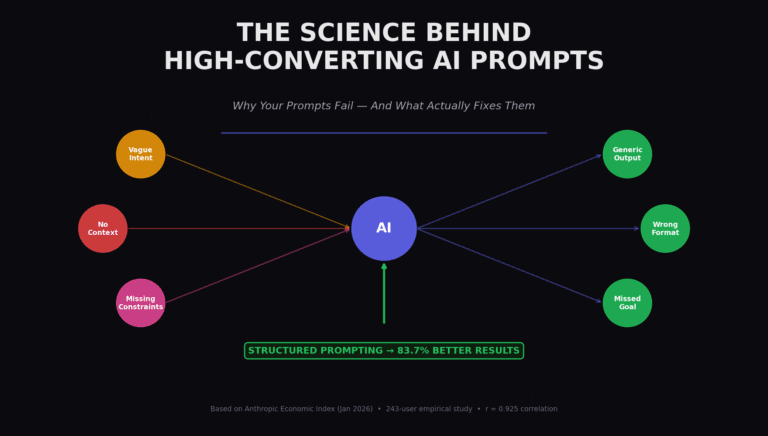
The problem wasn’t the AI. The problem was that the prompt was a wish, not a brief. No audience, no moment, no conflict, no voice — so every decision left unmade got made by the model, which resolves ambiguity toward the median.
Most “copywriting prompt” articles solve this with volume: 40, 100, 500 templates. That fails too, and it fails silently. A template with empty slots is a wish wearing structure — and the slots that matter most (the observation, the objection, the number) are exactly the ones a template can’t fill for you.
So this guide does two things differently.
First, there are 15 prompts, not 40. While editing this piece, we cut 26 prompts that were, on inspection, the same five decisions repeated with different adjectives. The survivors are the ones where the structure does work a worse version wouldn’t.
Second, every prompt marks its evidence slot — the input only you can supply — and states what happens if you leave it empty. The rule underneath everything here: never run a prompt whose evidence slot you can’t fill. If you can’t fill it, that isn’t a prompt problem. It’s your to-do list.
What this guide claims — and what it doesn’t
We don’t claim these prompts “generate viral content.” No prompt does. Virality is a function of idea, audience, timing, and distribution; a prompt affects copy quality — one input among several.
We do claim that structured briefs produce better first drafts than unstructured wishes, and that the annotations will teach you to write your own prompts — which is the actual point.
Labeling convention, applied throughout: mechanism claims are tagged [heuristic] when they reflect practitioner consensus without controlled evidence (most of copywriting falls here, and pretending otherwise is how the field got its folklore problem), [opinion] when they’re ours, and [source] when something citable exists. Two examples of the honesty this requires: banning the word just is a [heuristic] — we keep it because it’s a near-free constraint with plausible upside, not because a study proves it. “Yes/no closes get more replies than open-ended asks” is a [heuristic] strong enough to act on and weak enough to test.
The anatomy: six components, one rule
Every prompt here is built from six components. When people strip one, quality drops — not because the model got dumber, but because every unmade decision gets made toward the average.
| Component | What it does | Example |
|---|---|---|
| Role | Sets the lens; forces domain word choice | “You are a direct-response email copywriter specializing in SaaS onboarding…” |
| Context | The audience moment — what’s true about the reader right now | “Users signed up 48 hours ago; activation = creating one task.” |
| Task | One measurable outcome, not “write some copy” | “Get them to first activation within 72 hours.” |
| Format | Hard limits that beat vague requests for “concise” | “Under 120 words, plain text, no bullets.” |
| Constraint | Breaks model defaults; bans the patterns AI reaches for | “Never the word just. No ‘I hope this finds you well.'” |
| Evidence | The real inputs that must be used, not invented | “Here are 8 real support-inbox questions: …” |
The first five are teachable in an afternoon. The sixth — Evidence — is where every prompt lives or dies, and it’s the component every prompt list buries. It’s promoted to first-class here.
The specificity trap [opinion]. More detail is not better. If you specify the angle, the vocabulary, and the conclusion, you’ve written the copy yourself and asked the model to format it. Give enough to stop guessing — objective, moment, format — and leave voice and ideas under-specified on purpose. If the output never surprises you, your prompt is too tight.
Frameworks: what they are, what they aren’t
A framework tells the model which psychological job the copy must do. “Write persuasive copy” delegates that choice to the model, which will pick the wrong framework for your reader’s awareness level almost every time.
Some honesty first [opinion]: most framework history is folklore. AIDA is commonly attributed to Elias St. Elmo Lewis (~1898); the documentation is thinner than the confidence of that attribution. PAS, BAB, FAB, and PPPP circulate in direct-response practice with contested origins. The one sourced model worth building on is Eugene Schwartz’s awareness spectrum (Breakthrough Advertising, 1966): the copy’s job changes with how aware the reader is of their problem and of solutions. Everything below maps frameworks onto that.
| Reader’s state | Copy’s job | Framework that fits |
|---|---|---|
| Unaware — doesn’t know they have the problem | Interrupt the pattern; create the problem in their head | AIDA, or a story (BAB) |
| Problem-aware — knows the pain, not the solutions | Agitate the cost of the status quo, then resolve | PAS |
| Solution-aware — knows solutions exist, not you | Differentiate; prove you’re the better instance | FAB → PPPP |
| Product-aware — knows you, hasn’t bought | Kill the specific objection; remove the last risk | PAS on the objection; 4 C’s to edit |
| Most-aware — ready; deciding now | Make action easy; state terms plainly | Clear CTA + honest microcopy |
Layering [heuristic]: strong copy rarely uses one framework. PAS for the hook, FAB for the body, a plain CTA to close. The prompts below name a primary framework; stacking is noted where it matters.
A warning: frameworks are lenses for you, not incantations. A PAS email with a made-up problem still has a made-up problem.
How to use these prompts
Three rules, then the prompts.
- Run twice, then edit. The first output shows what the prompt produces; the second shows its variance. If both are interchangeable, the prompt is over-constrained — the model has no room to add value. Pick the stronger draft and edit it yourself. The last 10% — the anecdote only you know, the verb only you’d dare use — is your job, and it’s the part audiences notice.
- Read it aloud before shipping. Audiences aren’t rejecting AI-assisted writing; they’re rejecting universal writing — copy with no person behind it. Ask: “Would someone with something at stake write this sentence?” If not, fix it.
- Measure, with honest statistics. Every prompt implies a metric (activation, reply rate, CTR). Define it before writing. And be honest about power: at 400 sends per variant, you cannot reach significance on a 5% baseline [heuristic — standard power arithmetic]. Use sequential reads, longer windows, or directional calls you label as directional. “Feels better” is an opinion; a tested win with a real n is an asset.
Email is where prompt quality shows fastest: bad copy isn’t flagged as spam; it’s behaviorally ignored — and over a sequence it trains people to stop opening.
Prompt 1 — Onboarding activation (PAS)
You are a SaaS onboarding email specialist. Product: [product, one sentence]. A user signed up [X] hours ago and has not completed their first key action: [specific action, e.g., “created their first project”].
Write one plain-text email, under 100 words, using PAS. Acknowledge the signup-to-action gap without shaming. One link, one clear instruction. Never the word just. Never “I hope this email finds you well.”
Evidence slot: the activation definition and the time gap — pull both from your analytics, not your aspirations.
The decisions:
- Under 100 words forces prioritization; “write a short email” produces 250.
- Without shaming blocks the passive-aggressive default of onboarding sequences (“We noticed you haven’t…”).
- Never “just” is a [heuristic] cheap constraint: “just click here” is the most common filler in model output, and removing the habit costs nothing.
Where it breaks: if your activation definition is wrong — if “one task” isn’t the behavior that predicts retention — the email will be competently written and pointed at the wrong target. The prompt can’t save a bad metric.
Prompt 2 — Cold outreach
You are a B2B cold email specialist. Write a cold email to a [job title] at a [company type]. We help [target type] solve [specific problem]; we typically see [specific, verifiable result].
Under 75 words. No preamble about how you found them. No call request in email one. End with a yes/no question.
Evidence slot: the result. Only use a number that is real and verifiable. An invented credibility claim poisons everything downstream — every later email, the call, the close.
The decisions:
- The yes/no close is the highest-leverage line in the prompt [heuristic]: “Does this sound familiar?” asks for a one-tap reply; “Would you be open to learning more?” asks for a decision. Binary questions reduce friction at the exact point friction kills replies.
- The 75-word cap prevents the pitch-deck-summary email.
Where it breaks: deliverability and list quality dominate cold email outcomes; copy is a distant third. If reply rates are near zero, fix the list before you fix the prompt.
Prompt 3 — Subject lines, with the psychology made explicit
Generate 10 subject lines for an email about [topic] to [audience].
Rules: none ending in “?”; none starting with a number; none containing “you need to know”; at least 3 under 30 characters; at least 2 that create curiosity and deliver on it. Banned words: tips, tricks, hacks, game-changer, ultimate.
Label each with its mechanism: curiosity gap, specificity, social proof, contrarian, open loop.
The decisions:
- The labeling requirement forces intentional psychological logic instead of “sounds catchy” pattern-matching [opinion].
- “Curiosity and deliver on it” encodes the line between a curiosity gap and clickbait: the gap must close inside the email.
Where it breaks: subject-line performance is heavily list- and sender-dependent. Never retire a working control on the strength of one send; test against it.
Social
Audiences aren’t calibrated against AI; they’re calibrated against averageness. The fix isn’t hiding tool use — it’s putting something specific (a real observation, a real number, a real opinion) into the prompt so something specific comes out.
Prompt 4 — LinkedIn post
Write a LinkedIn post for [name/brand] in [industry]. Voice: direct, data-backed, occasional dry humor, never motivational.
The post is about this observation: [specific observation — required]
Structure: line 1, a true-but-counterintuitive statement under 12 words; next lines, one specific example (a named company, study, or metric); then the implication most people haven’t connected; end with a question that invites disagreement, not agreement. Never “What do you think?”
Evidence slot: the observation. This prompt is inert without one. The model cannot supply it; if the slot is empty, close this document and go find one — in your support inbox, your analytics, your last five sales calls.
The decisions:
- “Named example” kills “many companies are discovering…”, the leading cause of unmemorable LinkedIn content.
- “Invites disagreement” is the engagement instruction that matters [heuristic]: a position people want to refute earns more comments than a question inviting agreement.
Where it breaks: LinkedIn’s algorithm rewards early engagement velocity, which copy only partially influences. Distribution, network, and timing decide most of what happens after posting.
Prompt 5 — X/Twitter thread
Write a thread about [topic] for [audience]. Tweet 1: a specific claim most people would initially disagree with. Tweets 2–7: one point each, each able to stand alone as a quote-tweet. Final tweet: end at the sharpest point, not the safest. No tweet over 240 characters. Never “Thread 🧵” in the hook, never “In conclusion.”
The decisions:
- “Ends at its sharpest point” is the line that separates remembered threads from forgotten ones; model-written threads reliably collapse into reassuring summaries at the end [opinion — a pattern you can verify in five minutes on your own timeline].
- “Stand alone as a quote-tweet” is a test of intrinsic value per tweet — and quote-tweets are where threads actually spread.
- 240 characters leaves headroom for quote attribution without truncation.
Where it breaks: the hook claim does most of the work. If you can’t state a defensible counterintuitive claim about your topic, no structure will rescue the thread.
Prompt 6 — The repurposing engine
Here is a [post/script/transcript]: [paste]
Repurpose into: one LinkedIn post (angle: what this means for the industry, not a summary); three posts on X, each a different angle (contrarian, practical, data-focused); two Instagram captions (one educational, one story-based); five video hooks under 8 words. Adapt format and tone per platform. Never open with “In this article…”
The decisions:
- The three forced X angles produce differentiation; without them, you get three versions of the same post.
- “What this means, not a summary” is the LinkedIn instruction that separates skippable from discussable [opinion].
Where it breaks — stated plainly: the ceiling is the source. A weak article repurposed is five weak posts. This prompt multiplies; it does not elevate.
Ads
Ad copy is the format most sensitive to over-prompting. Too many instructions and the output reads like it was written by committee. These carry fewer constraints than the email prompts by design.
Prompt 7 — Meta headlines, as coherent units
Act as a Meta Ads copywriter. Five headlines for [product] to [audience], built on [primary benefit]. Each under 8 words. One leads with a specific number; one names the audience; one leads with the problem. Banned: transform, revolutionize, unlock, discover, boost. For each headline, write one supporting body sentence under 25 words.
The decisions:
- Paired body text forces coherent ad units instead of disconnected headline lists — what you actually upload.
- The three required mechanisms map to different awareness levels (see the framework table), which is why they’re required: you don’t know which reader you’re getting.
Where it breaks: five headlines is the wrong output if your account history already shows which mechanism wins for this audience. In that case, constrain to the winner and vary within it. Data beats diversity.
Prompt 8 — Short-form video hooks (TikTok / Reels / Shorts)
Write 5 hooks for the first 3 seconds of a video about [topic], audience [audience]. Each: under 8 words, opens on emotion or surprise, implies a story not yet told, and works spoken — test: say it aloud with no punctuation; it must still land. For each, add a visual suggestion that complements the audio without repeating it.
The decisions:
- The spoken test is the key instruction: hooks that only read well fail as audio.
- Visual pairing turns the output into a production brief, not just copy — audio and visual doing different jobs is what makes the first 3 seconds feel professional [heuristic].
Where it breaks, stated honestly: hooks buy 3 seconds. Retention after that is content, pacing, and topic — none of which this prompt touches.
Prompt 9 — Retargeting by drop-off reason
Write retargeting copy for someone who visited [product page / pricing page / checkout] and didn’t convert. Product [product] at [price]. The most common reason for leaving at that page: [reason]. Address that one reason only. No discount unless it already exists in the offer. Three headlines + two body lines, within Meta character limits.
Evidence slot: the drop-off reason — find it in analytics, session recordings, or support tickets, in that order of reliability.
The decisions:
- “That page” does real work: someone leaving pricing has a different objection than someone leaving the product page. Generic retargeting averages two messages and convinces neither.
- “One reason only” prevents the objection-kitchen-sink ad that dilutes to nothing.
Where it breaks: if you misdiagnose the reason, you’ll write a confident, well-structured ad aimed at the wrong fear.
Landing pages
Prompt 10 — Hero section
Write the hero for a SaaS landing page. Product: [name + one line]. Visitor arrived from [source, e.g., “a Google ad on [keyword]”].
Deliver: H1 under 8 words — the one thing true of this product that no competitor can honestly say. Subhead: 1–2 sentences, the outcome of the outcome. CTA label under 5 words, not “Get started,” not “Try free.” One line of microcopy under the CTA that answers the biggest conversion fear. Banned words: platform, solution, seamless.
The decisions:
- “That no competitor can honestly say” is the qualifier that matters [opinion]: an unbelievable differentiation claim converts worse than none.
- “Outcome of the outcome” — not what the feature does, but what that makes possible — is what gives a subhead resonance instead of specification.
- Banning platform and solution removes two of the most common SaaS headline nouns, forcing a real claim into the H1.
Where it breaks: the H1 question is genuinely hard and iterative. Budget five runs. A prompt produces candidates, not your positioning.
Prompt 11 — Case study narrative (BAB, with anti-fabrication guardrails)
Write the narrative of a B2B case study for [client]. Raw facts: [paste notes — situation, what was tried before, what changed, results with numbers].
BAB structure. Before: the situation — name the approaches that failed before you arrived. After: specific results with the timeframe to reach them. Bridge: how you got there, max 3 steps, in the customer’s operational language, not your product language.
No magnitude adjectives (revolutionary, game-changing). Every claim traces to my notes. A number not in my notes becomes [NEEDS NUMBER] — never invent one.
The decisions:
- Naming failed approaches is what makes a case study believable [heuristic]: nothing-was-tried-before-you stories read as fiction.
- The
[NEEDS NUMBER]system exists because inventing plausible metrics is the model’s most dangerous case-study habit — and because inflated numbers get discovered at the worst possible moment, on a sales call, by the prospect. - “Customer’s operational language” keeps the bridge section out of feature-speak.
Where it breaks: if your raw notes are thin, the output is thin with good grammar. The interview, not the prompt, is the craft.
Prompt 12 — Comparison page
Write a “[Us] vs [Competitor]” page. Defensible differences: [3–5 real differentiators]. Structure: 2-sentence intro saying who each product is for — including who should pick them; a 5-row table using only real differences; a “choose them if…” section with 2 honest scenarios; a “choose us if…” section with 2 scenarios. No trash-talking; nothing we can’t verify in a sales call.
The decisions:
- “Choose them if” is the counterintuitive move that makes the whole page credible [heuristic]: readers arrive skeptical of comparison pages because most are hit pieces; conceding fit signals confidence and makes your “choose us” claims believable.
- The differentiator-list constraint stops the model from inventing advantages you’ll be asked to defend.
Where it breaks: if the honest answer is “we’re worse here,” the page must say so or skip the dimension. A comparison page you can’t defend does your competitor’s marketing for them.
Systems (where prompt work compounds)
Prompt 13 — Voice extraction → voice matching
Part 1. Build a voice guide for [brand]. Writing we admire (not ours): [2–3 samples]. Writing we produce now: [2–3 samples]. Audience: [description].
Deliver: voice in 3 adjectives and 3 we are not; 5 words we use that competitors don’t, 5 we never use; sentence-rhythm rules; three before/after rewrites of our current copy with the reason for each change.
Part 2. Voice guide: [paste result]. Rewrite: [draft copy]. Match vocabulary and rhythm, not just topic. Preserve every factual claim — reword, never add or remove. If a sentence can’t fit the voice without losing meaning, flag it, don’t force it. After: list the 3 changes that most improved fit, one line each.
The decisions:
- The “not” list and banned-words list are the constraining half of any voice guide [opinion]; adjectives-only guides describe without constraining.
- “Preserve every factual claim” prevents rewrite drift — the most common and least visible failure of AI rewriting.
- Feeding both admired and current writing lets the model name the gap precisely instead of guessing at it.
- Part 2 is what makes Part 1 operational. The change-list trains your eye; after ten rounds you’ll need the prompt less.
Where it breaks: a voice guide built from three samples is a hypothesis. Extend it every time you publish something that performs.
Prompt 14 — The AI-tell audit
Audit this copy for AI tells: [paste]. Check for: triads that pad rather than build (“fast, reliable, and secure”); content-free hedges (“it’s important to note”); closing summaries that restate; generic intensifiers (truly, incredibly, remarkably); sentences that could appear verbatim in a competitor’s copy; structural transitions (“Furthermore,” “In today’s fast-paced world”).
For each: quote, name the pattern, fix it. Leave good sentences alone. Final verdict: does this read as written by a specific person with something at stake? If not, what single change gets closest?
The decisions:
- Naming tells explicitly makes them checkable instead of a vague feeling [opinion].
- The verdict question is the right test because the differentiator is stakes, not vocabulary: specific people with something at risk write specific sentences.
Where it breaks: this catches patterns, not facts. It will not catch a confident, smoothly written, wrong claim. Fact-check separately.
Prompt 15 — The brief-builder (the last prompt you’ll need)
You are a prompt engineer for copywriting. Interview me one question at a time until you have: (1) Role — whose expertise; (2) Context — the audience moment; (3) Task — one measurable outcome; (4) Format — deliverables and hard limits; (5) Constraints — words and patterns to avoid; (6) Evidence — real inputs that must be used, never invented. Then output the labeled prompt, plus one sentence naming the weakest component in my answers and how to strengthen it.
The decisions:
- One question at a time beats a questionnaire: shallow answers are the output of bulk forms.
- The weakest-component callout makes every use a small lesson in prompt craft.
- Components 2 and 6 are where everyone under-invests — including, almost certainly, you [opinion, but check].
The three mistakes that kill good prompts
Every prompt failure we’ve seen in audits traces to one of three errors. None are about the model.
1. Overloading the prompt. The brief becomes a script — angle, vocabulary, conclusion, emoji all specified — and the model can only comply. You’ve written the copy yourself with worse sentences. Fix: specify objective, moment, format. Leave voice and ideas under-specified on purpose. If the output never surprises you, you’ve over-prompted.
2. Shipping the first output. First drafts share recognizable patterns — triads, hedges, summary endings — and readers increasingly notice. Fix: run twice, pick the stronger draft, run an audit pass (Prompt 14). The last 10% is your job; it’s the part people notice.
3. Measuring nothing — or measuring dishonestly. Without a control and a metric, you can’t tell a good prompt from a lucky output. With 400 sends per variant, you don’t have a test—you have a coin flip with extra steps. Fix: define the metric first; use sample sizes that can support a conclusion; label directional reads as directional. Keep a simple log. In three months, the log is your own annotated guide — built from your audience’s data, which makes it worth more than this one.
Closing
Prompts don’t make copy go viral. Structure makes copy worth shipping.
These 15 prompts won’t guarantee a share, an impression, or a click — be suspicious of any guide that says otherwise. What they do: raise the floor on first drafts, eliminate the failure modes that make machine-assisted copy obvious, and return your time to the work only you can do — the specific insight, the real story, the honest test.
Start with one prompt. Fill its evidence slot — honestly, that’s the whole game. Run it twice. Edit the draft. Measure the result, at a sample size that deserves the word. Then come back for the next one.
Framework attributions: AIDA is commonly attributed to Elias St. Elmo Lewis (~1898), though documentation is thin; PAS, BAB, FAB, and PPPP circulate in direct-response practice with contested origins; the awareness model referenced throughout is Eugene Schwartz’s, from Breakthrough Advertising (1966). This guide cites no performance statistics because we don’t have audited data for these prompts—that’s not a confession of weakness; it’s the entire thesis. Test them yourself.