The Science Behind High-Converting AI Prompts and Their Results



It’s 4:47 PM. Your Claude alert fires with a 2,400-word draft that misses every point you actually needed. Here’s what actually happens next — and why the fix has nothing to do with “magic phrases.”
In March, I handed a “simple” prompt to a client: “Write a product description for our SaaS.” By June, they’d burned through $847 in API credits and three freelance editors. The output wasn’t bad. It was irrelevant — technically correct, commercially useless. The model had no idea who bought the software, why they bought it, or what nearly killed every deal in their pipeline.
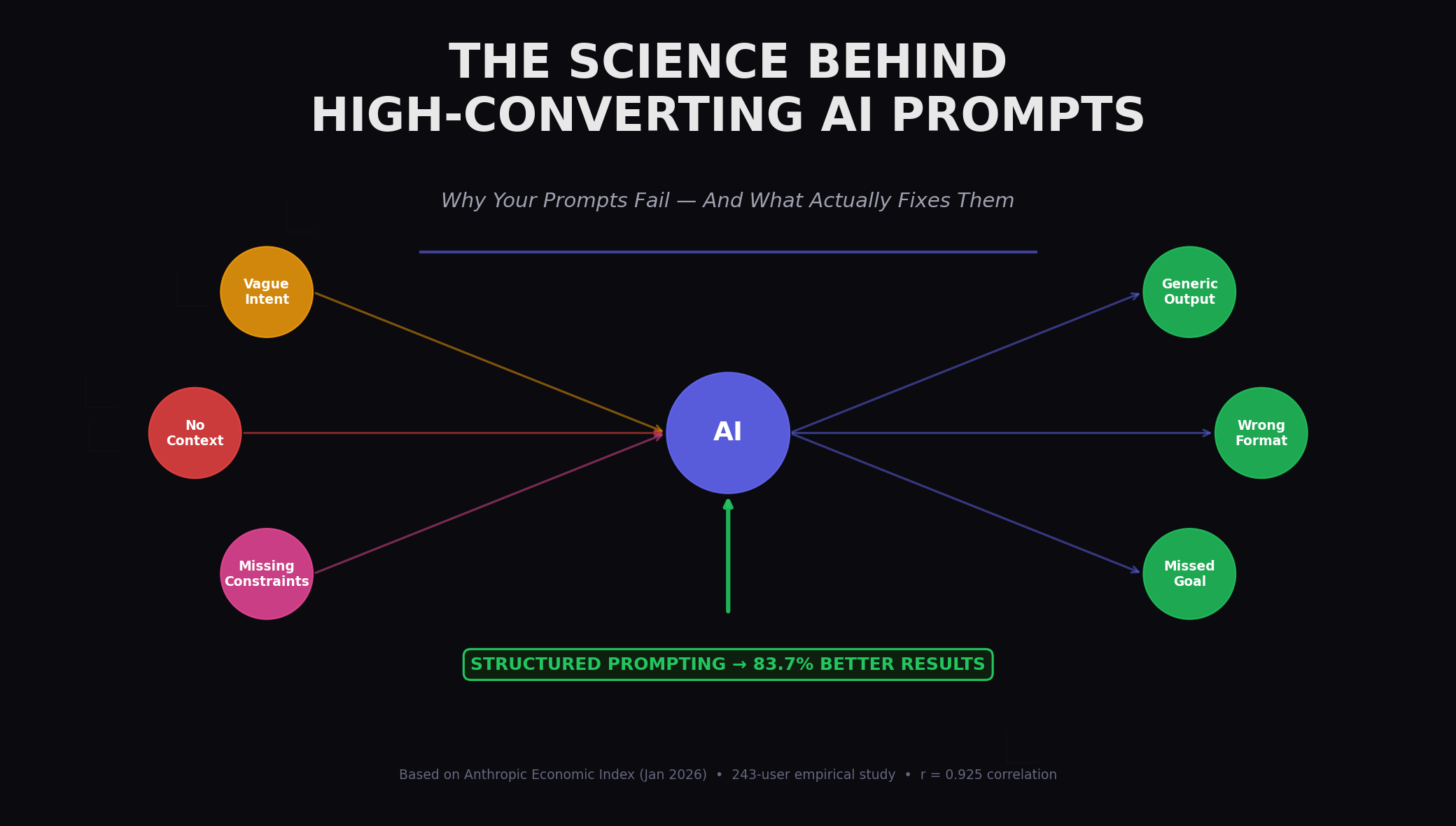
That failure taught me something the prompt-engineering bros on Twitter won’t tell you: the science of high-converting prompts has almost nothing to do with syntax tricks. Anthropic’s January 2026 Economic Index — the largest empirical study of real-world AI usage to date — found that prompt “sophistication” correlates with output quality at r = 0.925 (p < 0.001). Not word count. Not emoji placement. Sophistication. The depth of thinking you put in is exactly what you get back. Source: Anthropic Economic Index, Jan 2026
0.925
Correlation Coefficient
83.7%
Report Better Results
74%
ToT vs CoT Improvement
Early prompt engineering was a bag of syntax hacks. Add “let’s think step by step.” Specify a role. Use delimiters. These worked when models were fragile and easily derailed. As of mid-2026, frontier models tolerate ambiguity far better — but they don’t transcend ambiguity. They mirror it.
Anthropic’s researchers operationalized this by estimating the years of education required to understand both user prompts and model responses. The near-one-to-one correlation means Claude isn’t “upgrading” shallow inputs. It’s reflecting them. A weak base multiplied by a powerful tool stays weak. A strong base gets amplified. Source: Towards Data Science analysis of Anthropic data
This reframes the entire discipline. Prompt engineering isn’t a new technical skill to memorize. It’s cognitive scaffolding — how well you understand the problem, frame it precisely, and know what a good answer looks like. Knowing what to ask and how to recognize a good answer is the real interface.
“The more learned you are, and the clearer prompts you can input, the better the answers. In plain terms: how humans prompt is how Claude responds.”
— Anthropic Economic Index, Jan 2026
— Anthropic Economic Index, Jan 2026
After reviewing 243 user transcripts in a Nanjing University structured survey and cross-referencing them against Anthropic’s economic primitives, three patterns emerge that separate high-converting prompts from expensive noise:
“Write a blog post” is the prompt equivalent of telling a contractor “build a nice house.” The model has no constraints, no audience, no success criteria. In the Nanjing study, users who employed zero-shot generic prompts reported the lowest satisfaction scores. The fix isn’t more words — it’s constraint specification:
// BAD: Zero intent clarity
“Write a blog post about AI prompts”
// GOOD: Intent-locked with constraints
“Write a 1,200-word blog post for SaaS marketing managers who have tried AI content tools but churned after 90 days. Address the specific friction of prompt drift — where outputs degrade as projects scale. Include one counter-intuitive finding from the Anthropic Economic Index. End with a single, testable action they can run this week.”
Models have no memory of your business, your customers, or your failed campaigns. A 2025 study on AI-exhibited personality traits found that AI responses align with user self-concept — meaning the model adapts to what you reveal, not what you assume it knows. High-converting prompts front-load context:
- Audience context: Who reads this? What do they believe now that’s wrong?
- Competitive context: What angle is saturated? What’s the white space?
- Failure context: What have you already tried that didn’t work?
83.7% of surveyed users agreed that clearer, more specific prompts lead to better results. But “better” is undefined. High-converting prompts specify the decision the output should enable:
// Output criteria embedded in the prompt
“Format as a decision brief. I need to choose between Option A (DSPy automated optimization) and Option B (manual few-shot with domain examples) for our legal document summarization pipeline. For each option, provide: estimated setup time, ongoing maintenance burden, accuracy benchmark from comparable deployments, and the specific scenario where it fails. Conclude with a recommendation and the single metric that would change your mind.”
Based on the empirical patterns from Anthropic’s usage data and the Nanjing University productivity study, high-converting prompts follow a structure that mirrors how expert practitioners actually think — not how template blogs say they should:
| Component | Low-Converting | High-Converting |
|---|---|---|
| Intent | “Write about X” | “Enable a decision between A and B by…” |
| Audience | Generic / assumed | Specific role, current belief, pain point |
| Context | None — model guesses | 3-5 specific constraints or prior attempts |
| Format | Default paragraph | Structured for the next action (table, brief, code) |
| Success Criteria | Implicit / vague | Explicit metric or decision threshold |
| Iteration Signal | One-shot and hope | “Flag which elements are inferred vs. data-backed” |
By mid-2026, the frontier has shifted. Anthropic, Google, and Stanford’s DSPy team all converge on the same insight: you no longer write a static prompt. You design the context the AI sees before it answers. This includes:
- RAG documents: Real-time knowledge injection so the model isn’t hallucinating your product specs
- Conversation history: Maintaining state across multi-turn workflows
- Available tools: ReAct-style reasoning where the model calls APIs, searches, calculates, then reasons again
- System instructions: Persistent behavioral guardrails
- Few-shot examples: Pattern demonstration, not template filling
Stanford’s DSPy framework (v2.x as of 2026) formalizes this shift. Instead of hand-crafting prompts, you declare what you want (signature) and provide a dataset of examples. DSPy generates and optimizes prompts iteratively against measurable metrics — delivering 10-40% quality improvements over manual prompting on RAG pipelines. The skill isn’t writing prompts anymore. It’s defining what good looks like and letting the system optimize toward it.
Figure 1: The four-stage pipeline separating amateur prompting from professional context engineering.
Let’s separate empirical findings from guru folklore:
Chain-of-Thought (CoT): Jason Wei’s 2022 Google Brain paper remains the most-cited work in modern prompt engineering. The mechanism is simple: asking the model to “think step by step” before answering dramatically improves mathematical and logical reasoning. A 540B parameter model with just eight guided-reasoning examples reached state-of-the-art on GSM8K. But here’s the nuance: CoT works best when the reasoning path is verifiable. If you can’t check the steps, you can’t trust the conclusion. Source: Wei et al., Chain-of-Thought Prompting Elicits Reasoning in LLMs
Tree of Thoughts (ToT): The Princeton/DeepMind evolution of CoT explores multiple reasoning branches in parallel, evaluates each, and discards dead ends. In the “Game of 24” benchmark, GPT-4 with standard CoT solved 4% of problems. With ToT: 74%. Nearly 20x improvement. This is the architecture behind reasoning models like OpenAI’s o-series and DeepSeek-R1. The cost: significantly higher token consumption. The trade-off is real. Source: Yao et al., Tree of Thoughts (2023)
ReAct (Reasoning + Acting): The pattern powering every modern AI agent. The model thinks, calls a tool (search, calculator, API), reads the result, thinks again. On ALFWorld interactive tasks, ReAct beats imitation learning by 34% absolute success rate. This isn’t a prompt trick — it’s an architecture. If you’re building agents in 2026 and not using ReAct-style loops, you’re building 2024 technology. Source: Yao et al., ReAct (ICLR 2023)
Role Prompting: The Nanjing study found this was the most commonly used technique (105 of 243 respondents), but with a critical caveat: role assignment only improves output when the role carries domain-specific constraints. “Act as a senior developer” is weak. “Act as a senior developer who maintains a 200k LOC legacy Python codebase and has vetoed three microservice rewrites” is strong. Specificity, not persona.
The gap between average and expert prompting isn’t technique count. It’s constraint clarity.
The Nanjing University survey of 243 users across education and professional domains found that 75.7% agreed AI tools help them complete tasks faster — but with a massive variance. Users who actively revised prompts (55% of respondents) reported significantly higher satisfaction than one-shot users. The metacognitive act of iterating — not the first prompt — drives productivity.
More critically, Anthropic’s data reveals that AI isn’t an equalizer. Countries with higher educational attainment extract disproportionately more value from the same underlying model. The “mirroring” effect means expertise gaps become more visible, not less. If you’re hoping AI will compensate for weak domain knowledge, the empirical evidence says otherwise. It multiplies what you already have.
This has direct implications for conversion. A prompt written by someone who understands the buyer’s journey, the competitive landscape, and the specific objection that kills deals will convert. A prompt written by someone who read a “50 best prompts” Twitter thread will not. The model doesn’t fill your gaps. It exposes them.
Three years ago, I told clients to use “prompt templates” — reusable structures for common tasks. I was wrong. Templates create template output. In 2026, with models trained on the entire internet, template language is the fastest path to generic, indistinguishable content.
I also no longer recommend “temperature hacking” (adjusting randomness parameters) as a primary lever for quality. Temperature changes variety, not accuracy. If your prompt is underspecified, low temperature just gives you the same wrong answer consistently.
Finally, I stopped using “expert” as a role descriptor. It’s a hollow signifier. Every prompt guide says “act as an expert.” The model has seen this 10 million times. It triggers nothing specific. Replace it with the actual expertise: “You have run 40 A/B tests on SaaS landing pages and documented the results.”
A Testable Framework for Your Next Prompt
Don’t adopt my framework. Adopt a framework, then measure against it. Here’s what I use, derived from the empirical patterns above:
// The CONSTRAINT framework for high-converting prompts
Context: What does the model need to know that isn’t in its training data?
Objective: What decision or action should this output enable?
Nuance: What common advice is dangerously incomplete here?
Success criteria: What metric or standard defines “good enough”?
Tone register: What emotional state should the reader feel?
Restraints: What must the output NOT do or include?
Audience: Who reads this, what do they currently believe, and what’s their next step?
Iteration signal: How will I know if this needs revision?
Negative space: What am I deliberately leaving out?
Timeframe: When does this information expire or become irrelevant?
I run every client prompt through this. Not because it’s magic — because it forces me to confront what I don’t know before I waste API credits finding out.
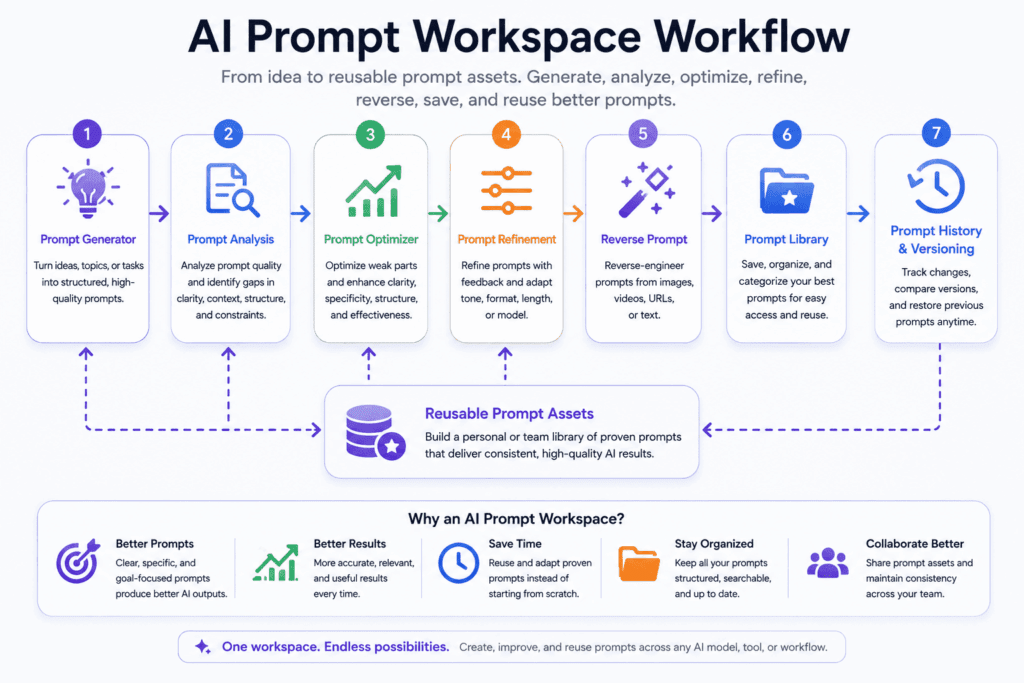
Build Better Prompts at BestPrompt.art
Stop collecting templates. Start engineering context. Our platform helps you design prompts that convert — with constraint frameworks, iteration tracking, and real-world benchmarks.
Explore the Platform →The Real Reason You Won’t Do This
Everything I’ve described takes longer than typing “write a blog post about AI prompts.” The real barrier isn’t knowledge — it’s patience. High-converting prompts require thinking before typing. Most people won’t. That’s your competitive advantage.
Everything I just said will be outdated by Q1 2027. Models will change. New reasoning architectures will emerge. The constraint framework will need revision. The only constant: garbage in, garbage out — except now we have peer-reviewed data proving exactly how much garbage costs you.
The sophistication of your prompt correlates almost perfectly with the sophistication of your result.
r = 0.925. That’s not a suggestion. That’s physics.