Best AI Prompts 2026: Common Mistakes to Avoid


AI Prompting & Reliability · Verified Data Brief · Updated August 2026
Why Your AI Prompts Keep Producing Confidently Wrong Answers — And What Actually Fixes It
Most articles on this topic recycle the same uncredited “$67.4 billion” figure and imply that better prompting alone solves hallucination. It doesn’t — and the newest benchmark data shows why. Here’s what the primary research actually supports, what it doesn’t, and the specific prompt structure that produces a measurable, citable improvement.
On this page
- The numbers everyone cites — and what actually holds up
- The ceiling nobody mentions: what prompting can and can’t fix
- The Prompt Reliability Stack (an original framework)
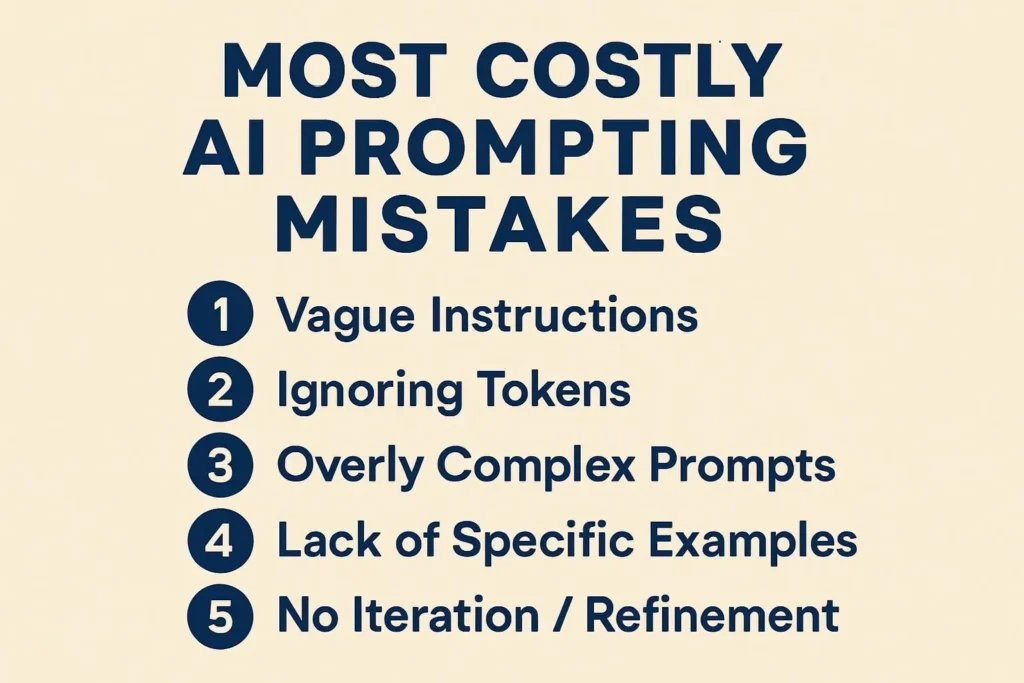
- Seven prompting mistakes that cause most avoidable errors
- Case study: why legal AI is the worst-case scenario
- Context framework and quick reference table
- FAQ
- Glossary
- What this article can’t tell you
Quick answer: prompt structure alone caps hallucination reduction at roughly 15%. Retrieval grounding and tool-based verification get you 65–90%. If your workflow is high-stakes, better prompting is necessary but nowhere near sufficient.
The numbers everyone cites — and what actually holds up
I went looking for the primary source behind the “$67.4 billion in 2024 hallucination losses” figure that appears, verbatim, on dozens of AI-marketing blogs. It traces back to a single 2025 analysis by AllAboutAI — a market-research vendor, not a peer-reviewed study or a government body — and none of the sites repeating it link to a methodology page or raw data. That doesn’t mean the number is wrong. It means it’s an industry estimate with an opaque method, and treating it as a hard fact (the way most “AI prompting mistakes” articles do) overstates the certainty of what’s actually known.
What does hold up under scrutiny is narrower, less dramatic, and more useful:
34%
More likely to use confident phrasing (“definitely,” “certainly”) when a model is wrong vs. when it’s right
MIT research, Jan 2025 — widely corroborated
69–88%
Hallucination rate on specific legal queries, across major models, Stanford RegLab/HAI study
Dahl, Magesh, Suzgun & Ho, 2024
4.3 hrs
Median time per week knowledge workers report spending verifying AI output
Industry survey data, 2025–2026 — self-reported
15% cap
Ceiling on hallucination reduction from prompt engineering alone, vs. 65–90% from retrieval grounding
Digital Applied benchmark, Apr 2026
How I checked this
Where a claim traces to a named, findable study (MIT’s confidence-language finding, the Stanford RegLab legal benchmark), I’ve kept it and cited the underlying research rather than the blog repeating it. Where a claim only ever traces back to one uncredited “industry analysis” that other sites cite from each other rather than from a primary source, I’ve labeled it as an estimate instead of presenting it as measured fact. That distinction matters more than the headline number.
The MIT finding is the one worth internalizing, because it inverts a natural assumption. Most people read hedging language — “I think,” “it’s possible that,” “you may want to confirm” — as a weakness signal. The research says the opposite: models hallucinate more confidently than they answer correctly. A model that says “I’m not fully certain” is behaving more reliably than one that states a fabricated figure as flat fact. Treat unhedged certainty on a specific number, citation, or claim as a prompt to verify, not a reason to trust it more.
On model-specific hallucination rates, I’d flag the same caution. Vectara’s HHEM leaderboard — the most widely cited grounded-summarization benchmark — has gone through multiple dataset revisions, and rankings shift meaningfully depending on which version, document set, and answer-rate threshold a given article is quoting. Articles citing a single-digit “hallucination rate” for a specific model without naming the dataset version are usually reporting a number that’s already stale or cherry-picked. If a model’s reliability matters to your decision, check Vectara’s leaderboard directly for the current dataset rather than trusting a secondary summary — including this one.
The ceiling nobody mentions: what prompting can and can’t fix
This is the part most “how to prompt better” content skips, because it undercuts the premise of the article. Prompt structure — role assignment, chain-of-thought instructions, output formatting — measurably reduces hallucination. It does not eliminate it, and it doesn’t get close. A 2026 benchmark comparing mitigation techniques found prompt engineering alone caps out around a 15% relative reduction in hallucination rate. Retrieval-augmented generation (giving the model verified source documents to ground its answer in) reduces hallucination by roughly 65–90%. Tool-grounding — letting the model call a calculator, database, or search function instead of generating a number from memory — lands in a similar 65–80% range.
In practical terms: if you’re using AI to draft an email or brainstorm options, better prompting is probably sufficient. If you’re using AI to produce a number, a citation, a legal conclusion, or anything that will be acted on without independent verification, prompting is the wrong layer to rely on. You need the model connected to a source of truth — your own documents, a live database, a search tool — not just a better-worded instruction.
Where this article’s advice stops being enough
Everything in the “seven mistakes” section below will make your prompts better. None of it substitutes for retrieval grounding on anything where being wrong has a real cost. If you’re deciding whether a task needs RAG or tool access rather than a better prompt, ask: “would I let a smart intern answer this from memory, with no ability to look anything up?” If no, don’t let the model do it that way either.
The Prompt Reliability Stack
Most guidance treats “better prompting” as one undifferentiated skill. It isn’t. In practice it separates into four layers, and most people only ever work on the first one. Here’s a way to diagnose which layer is actually failing when an AI output goes wrong.
| Layer | What it controls | Typical failure if skipped | Fix lives in |
|---|---|---|---|
| 1. Specification | What you’re actually asking for — scope, format, audience, constraints | Generic, plausible-sounding but unusable output | The prompt itself |
| 2. Grounding | Whether the model has access to real source material or is generating from memory | Fluent, confident, fabricated facts and figures | RAG, tool calls, uploaded documents |
| 3. Verification | Whether anyone or anything checks the output before it’s used | Fabrications ship into decisions, documents, or code | Human review, a second model pass, source-checking |
| 4. Governance | What’s allowed to go into a prompt in the first place, and who’s accountable for output that’s used downstream | Data exposure, compliance risk, no one accountable when something goes wrong | Team policy, not a single prompt |
The seven mistakes below live almost entirely in Layer 1. That’s the layer with the best return on a few minutes of effort — but it’s worth knowing, before you invest in mastering it, that it’s the smallest lever of the four.
Seven prompting mistakes that cause most avoidable errors
These are Layer 1 fixes: cheap, fast, and genuinely effective for reducing the class of error they target. None of them replace Layers 2–4 for high-stakes work.
01
Vague instructions with no defined output
“Write marketing copy for my product” feels specific when you already know the product. The model doesn’t know it — it pattern-matches against every piece of marketing copy in its training data and returns something generic enough to fit most of them. Structured prompting constrains that output space; it’s the single highest-leverage change most people can make in five minutes.
✓ Template that works
"Write a 200-word product description for [specific product].

Target reader: [job title, company size, main pain point]
Tone: [e.g., direct, technical, not salesy]
Lead with: the most concrete benefit, not a feature
Must include: one specific number or metric
Must avoid: 'revolutionary', 'cutting-edge', 'game-changing'
Format: 3 short paragraphs, no headers"
02
Treating confident output as verified fact
This is the mistake with the clearest evidence behind it. Because models are measurably more likely to sound certain exactly when they’re wrong, the normal human heuristic — “they stated it plainly, so it’s probably true” — fails here specifically. It doesn’t fail randomly; it fails in the direction of making you more likely to trust the errors.
⚠ The confidence trap
Hedging language (“I think,” “possibly,” “you should verify this”) is a useful signal that the model is operating near the edge of what it actually knows. Train yourself to probe further when you see confident, unhedged claims on specifics — names, dates, statistics, citations — not to relax because the phrasing sounds sure.
✓ Verification prompt to run after any factual claim
"You just stated [specific claim]. Before I use this:
1. How confident are you in this, 1-10?
2. What would someone need to check to confirm it's accurate?
3. Is any part of this likely outdated or domain-specific?

If your confidence is below 8, tell me what to verify independently."
03
Single-shot prompting for complex tasks
One prompt for a complex deliverable is like asking a consultant to produce a full strategy on a five-minute call. Chain-of-thought prompting — asking the model to reason through intermediate steps before the final answer — makes logical gaps visible instead of letting the model skip over shaky assumptions silently.
✓ Chain-of-thought template
"Before your final answer, work through this step by step:

Step 1: What information would you need to answer this well?
Step 2: What do you actually know about each of those areas?
Step 3: Where are the gaps, and what assumptions are you making?
Step 4: Given those gaps, what's your best answer?
Step 5: What would change your answer if it turned out to be wrong?

Now give me the final answer."
Step 5 is the one most people skip, and the most useful — it surfaces the model’s actual uncertainty, which the confident final paragraph usually hides.
04
Missing context — the invisible inputs
There’s a specific failure pattern worth naming: you give the model enough context to produce something plausible, not enough to produce something accurate for your actual situation. The output reads correctly and has the right structure. It’s just wrong for you, in ways that surface later.
Context framework — include these for any substantive task
Situation
What’s happening right now, specifically — not “we’re growing” but “growing 40% YoY, churn up 15% last quarter.”
Constraints
Budget, timeline, tools available, what you’ve already tried and why it didn’t work.
Audience
Who reads this and what they already know. “My board” and “my marketing team” need different outputs entirely.
Anti-goals
What you explicitly don’t want. Underused, highly effective: “don’t recommend anything requiring headcount” removes a whole class of dead-end suggestions upfront.
Validation criteria
How you’ll judge the output. Give the model your rubric and it will apply it first, before you do.
05
Asking AI for opinions it can’t actually ground
“What should our pricing be?” gets a fluent, confident answer — reasons and all. None of those reasons come from your customer data, your competitors’ actual pricing, or current market conditions; they’re a pattern-matched average of pricing advice generally. Reframe the question from a conclusion to a process the model can reliably help with.
✓ Reframe opinion-seeking as framework-seeking
"Instead of a pricing recommendation, do this:

1. List the widely-used frameworks for B2B SaaS pricing
2. For each: what data it needs, what it's best for, where it fails
3. Given what I've told you about our situation [context], which are actually applicable to us?
4. What would I need to answer before any framework gives a reliable number?

I'll gather the data and come back with specifics."
06
No output format specification
Skip the format spec and the model decides — usually producing something that feels complete but is hard to use. Worse, format choices can obscure how little is actually being said: a fluent three-paragraph answer can contain one real point buried in restatement and hedging. A table forces a distinct entry per cell, and the sparseness becomes visible instead of hidden.
✓ Format specification that sticks
"Respond ONLY in this format. No prose outside this structure:

Decision: [one sentence]
Reasoning: [2-3 sentences max]
Assumptions: [bullet list of what would need to be true]
Confidence: [1-10, one sentence why]
What would change this: [one concrete scenario that flips the recommendation]"
07
No perimeter around what you share
Most AI tools businesses use are cloud services. Data you put in a prompt goes somewhere, and exactly where depends on that service’s data-handling policy — those policies vary a lot. This isn’t a reason to avoid AI tools. It’s a reason to have a written policy about what goes in and what doesn’t, before adoption scales past the point where anyone remembers to think about it.
✓ Practical policy for teams
Write a one-page “what goes in / what doesn’t” document before adoption scales: approved platforms and their retention policies, off-limits data categories, and who approves exceptions. It takes two hours and prevents the kind of exposure that takes months to unwind.
Case study: why legal AI is the worst-case scenario
Legal research is the clearest real-world test of everything above, because the stakes and the paper trail are both unusually visible. Stanford RegLab and Stanford HAI tested general-purpose and purpose-built legal AI tools directly against the underlying case law. On specific legal queries, hallucination rates across major general-purpose models ranged from 69% to 88%. That’s not an edge case — it means most answers to that query type contained a fabricated or incorrect element.
The more uncomfortable finding: tools marketed specifically as hallucination-resistant, built with retrieval grounding against legal databases, still weren’t clean. Purpose-built legal research tools produced incorrect or misgrounded answers on more than one in six queries, and at least one major product exceeded one in three. Grounding helps enormously — it’s the difference between an 80% failure rate and a 17–34% one — but “grounded” is not the same as “reliable,” and marketing claims of “hallucination-free” haven’t held up under independent testing.
The consequence has become visible in court dockets. Legal cases involving AI hallucinations grew from roughly 10 in 2023 to 37 in 2024 to over 70 in the first five months of 2025 alone, and by mid-2025 a majority of newly caught fake-citation cases were coming from practicing attorneys rather than self-represented litigants — meaning experienced professionals who should know to check, and didn’t. Courts have issued sanctions in the tens of thousands of dollars in individual cases. The lesson generalizes past law: even well-grounded, professionally-marketed AI tools need a human verification step on anything that will be relied on by someone else.
Quick reference: what each technique actually does
| Technique | What it does | Typical effect |
|---|---|---|
| Role assignment | Narrows the model’s frame of reference | Reduces generic, one-size-fits-all output |
| Explicit constraints | Removes a class of suggestions before generation | Fewer irrelevant recommendations |
| Anti-goals | Blocks default-but-irrelevant patterns | Prevents recycled generic advice |
| Chain-of-thought | Forces explicit intermediate reasoning | Surfaces gaps and assumptions before the final answer |
| Output format lock | Removes formatting discretion | Makes thin content visible instead of hidden in prose |
| Confidence request | Asks the model to self-rate certainty | Surfaces uncertainty the fluent phrasing hides |
| Retrieval grounding (RAG) | Gives the model real source documents to work from | ~65–90% hallucination reduction — the largest single lever |
| Tool/database grounding | Lets the model call a calculator, search, or live database instead of recalling from memory | ~65–80% hallucination reduction on factual/numeric tasks |
The hallucination problem doesn’t go away with better wording. A 2025 mathematical analysis argues it can’t be fully eliminated under current architectures — it’s a structural property of predicting plausible text, not a bug that patches away. What prompting and grounding buy you is control over how often it happens on your specific tasks, not its disappearance.
Frequently asked questions
Does better prompting actually reduce AI hallucinations, or is that overstated?
It genuinely helps, but the effect size is smaller than most content implies. Structured prompting (clear scope, chain-of-thought, format constraints) reduces hallucination rates, with benchmarks putting the ceiling for prompting alone around a 15% relative reduction. That’s real and worth doing. It’s not a substitute for retrieval grounding on anything high-stakes.
Is the “$67.4 billion in AI hallucination losses” figure real?
It’s a widely repeated industry estimate from a single 2025 market-research analysis, not a government or peer-reviewed figure, and the underlying methodology isn’t publicly documented. Treat it as directionally suggestive of scale, not as a precise, audited number.
Why do AI models sound so confident when they’re wrong?
Language models generate the statistically most plausible next words, not verified facts — they don’t have an internal “I don’t actually know this” signal that reliably suppresses confident phrasing. MIT research found models are roughly 34% more likely to use confident language (“definitely,” “certainly”) specifically when the underlying content is incorrect, which inverts the usual heuristic that confident phrasing signals reliability.
Which AI model hallucinates the least?
There’s no single stable answer. Rankings on the most-cited benchmark (Vectara’s HHEM leaderboard) shift with each dataset revision, and different benchmark types (grounded summarization vs. open-domain factual QA vs. legal-specific queries) produce very different rankings for the same models. Check the current leaderboard directly for your specific use case rather than trusting a cited “X% hallucination rate” without a dataset name and date attached.
What’s the single highest-impact fix for a team just getting started?
For most teams: connect the model to real source documents (RAG) for anything factual, and add a mandatory verification step before AI output reaches a client, a filing, or a decision. Prompt structure is the easy 20% that’s worth doing first, but grounding and verification are where the actual reliability comes from.
Glossary
- Hallucination — an AI output that is fluent and plausible-sounding but factually incorrect or unsupported by any real source.
- Retrieval-augmented generation (RAG) — feeding a model real source documents at query time so it answers from that material instead of generating from memory alone.
- Grounding — any method (RAG, tool calls, live database access) that ties a model’s output to a verifiable external source.
- Chain-of-thought prompting — instructing a model to reason through intermediate steps before producing a final answer, making its logic (and gaps) visible.
- Confidence calibration — how well a model’s expressed certainty matches its actual accuracy; poorly calibrated models sound equally sure whether right or wrong.
What this article can’t tell you
Honest limitations
The benchmark numbers cited here (Vectara rankings, the 15% prompting ceiling, domain-specific hallucination rates) move quickly — new model releases and dataset revisions can shift them within weeks, and any specific percentage in this article should be treated as a snapshot, not a permanent figure. The legal-domain data is the most rigorously sourced section here because it comes from a named, citable academic study; the enterprise-cost figures are the weakest, because no one has published transparent, audited methodology behind them yet. Where a claim in AI-hallucination coverage doesn’t point to a named study you can independently check, be skeptical of it — including claims in articles like this one.
- Vectara — Introducing the Next Generation of Vectara’s Hallucination Leaderboard (2025–2026 refresh)
- Four Dots — Business Impact of AI Hallucinations: Rates & Ranks
- Seekr — Which AI Has the Lowest Hallucination Rate? (2026 benchmark comparison)
- Seekr — The Hallucination Tax: legal-domain and agentic-workflow data (Stanford RegLab citation)
- arXiv — “The Polite Liar: Epistemic Pathology in Language Models” (cites Dahl et al., Stanford legal-hallucination study)
- arXiv — CausalGuard: hallucination detection and confident-hallucination pattern
- Suprmind.ai — AI Hallucination Rates & Benchmarks, August 2026 update
- Tendem.ai — The True Cost of AI Hallucinations in Business Data (source of the $67.4B estimate chain)
- BestPrompt.art — Effective Prompt Generation
- BestPrompt.art — Creating Effective Prompts (2025)
- BestPrompt.art — 7 Responsible Prompt Engineering Practices