AI Prompts for Legal Professionals: The Verification Playbook

By Tom Morgan · Citations independently verified against primary court records · Last verified: September 2026
AI prompts can accelerate contract drafting, legal research, and client communications for lawyers — but only when every output passes through a human verification loop before it reaches a client or a court. The prompt text matters less than the evidence architecture wrapped around it.
TL;DR
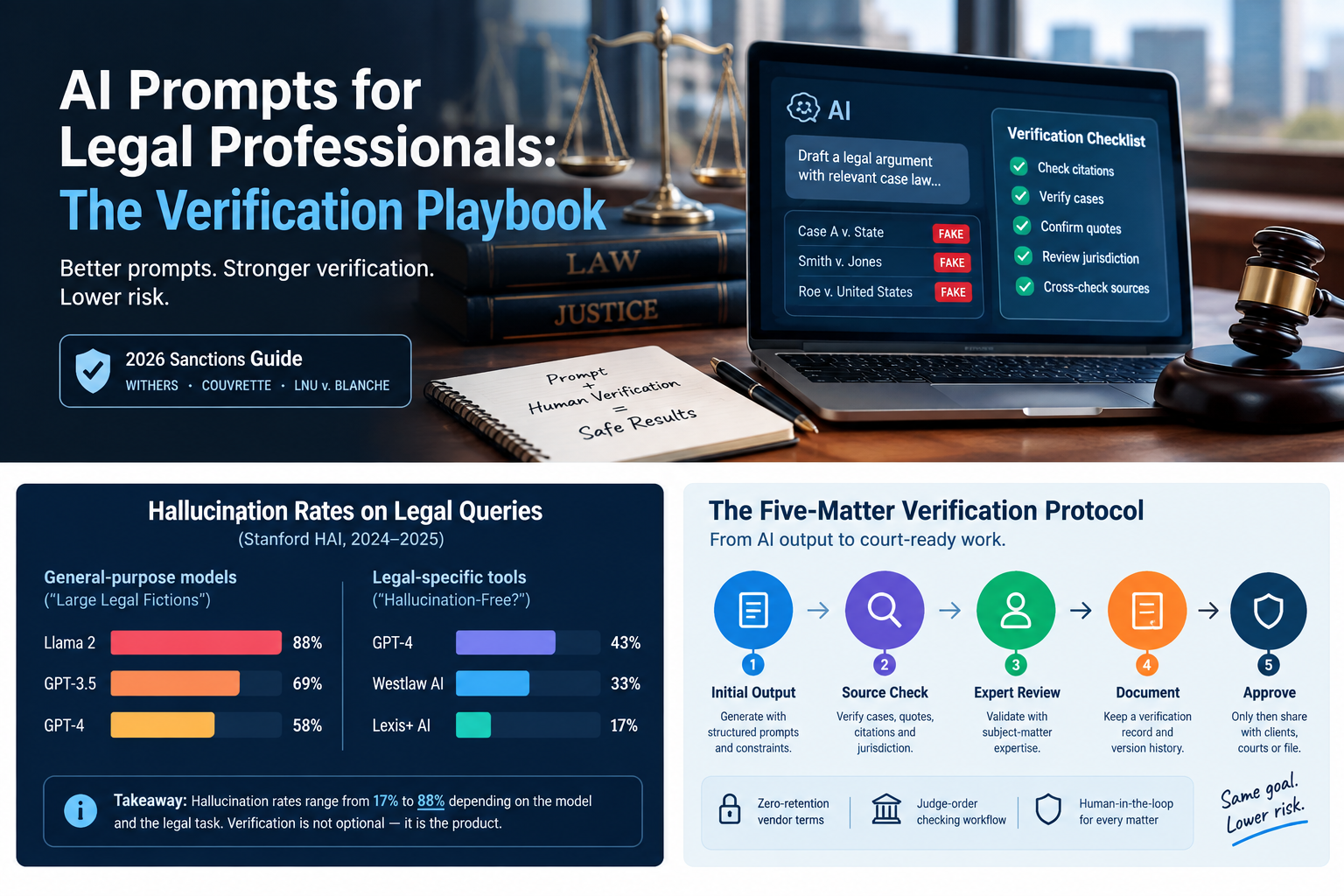
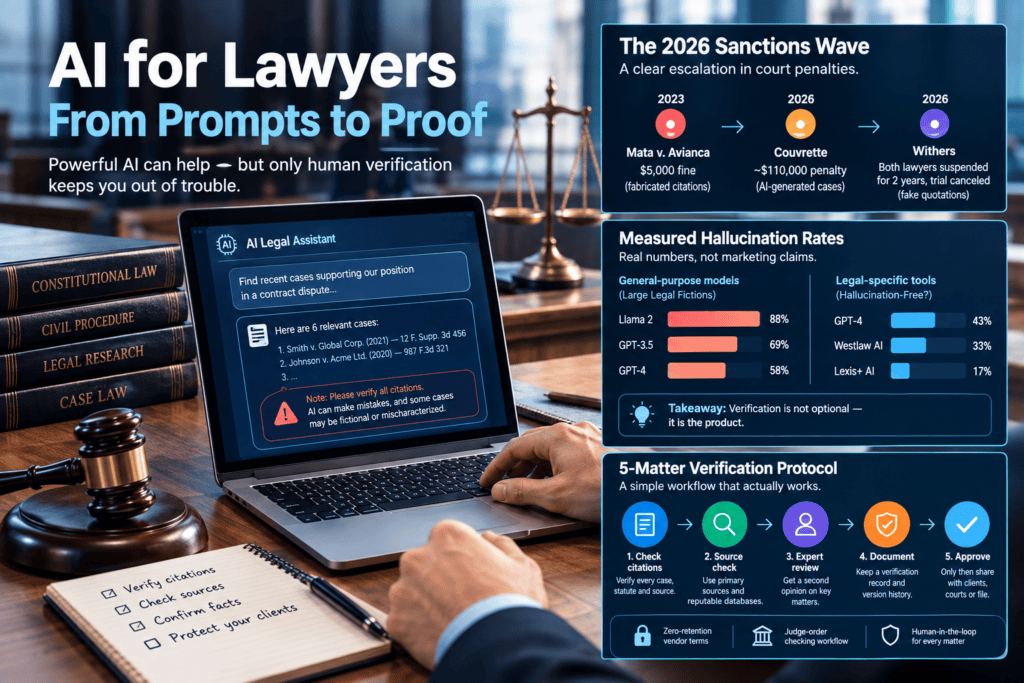
- Measured hallucination rates run 17–43% for legal-specific AI tools and 58–88% for general-purpose models on verifiable legal questions. Verification is not optional; it is the product.
- “Act as an expert lawyer” prompts produce no consistent accuracy gain. Constraint-based prompting with forced uncertainty outperforms role-play.
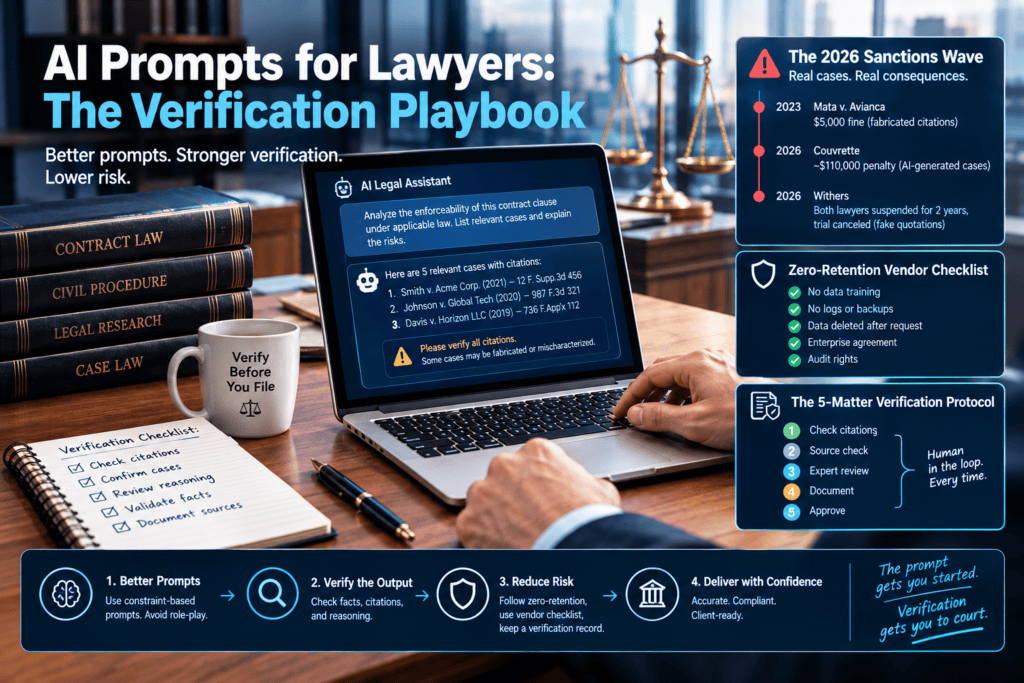
- The sanction arc now runs from Mata‘s $5,000 fine (2023) to Couvrette‘s ~$110,000 combined penalty (2026) to Withers, where both sides’ lawyers were suspended for two years and the trial was canceled.
- The prompts below ship with the missing operational layer: zero-retention contract terms, a judge-order checking workflow, and a five-matter verification protocol.
On June 8, 2023, two lawyers stood in Courtroom 11D of the Southern District of New York and explained to Judge P. Kevin Castel how six federal court decisions cited in their brief came to be fabricated. Steven Schwartz had asked ChatGPT to find cases supporting his client’s position against Avianca. ChatGPT delivered — with reporter citations, page numbers, and convincing quotations. When Schwartz grew suspicious and asked whether the cases were real, the chatbot assured him they were “real” and could be found in reputable legal databases.
They could not. On June 22, 2023, Judge Castel sanctioned both attorneys and their firm $5,000, ordered them to notify their own client, and ordered letters sent to each judge falsely named as the author of a fake opinion.
Coverage of Mata v. Avianca consistently gets one thing wrong. Castel did not punish the lawyers for using AI — his opinion states there is nothing inherently improper about using a reliable AI tool for assistance. He punished them for abandoning the gatekeeping role: filing citations no human had verified.
That distinction is the entire subject of this playbook, because the stakes have moved well past 2023. In April 2026, the Sixth Circuit removed a court-appointed attorney from a criminal appeal, denied him all compensation, and referred him for discipline after an AI legal-research platform generated fake quotations and inverted case holdings in his briefs. The pattern has now spread across dozens of jurisdictions, and the courts’ patience has a price schedule. Most “AI prompts for lawyers” content ignores all of this and sells incantations. Below are prompts built around a single principle: the unit of value is not the prompt. It is the verification loop.
What the Measured Error Rates Actually Look Like
Two Stanford studies, testing different market layers, provide the most reliable numbers available.
Large Legal Fictions (Dahl et al., Journal of Legal Analysis) tested 2023-era general-purpose models on over 800,000 verifiable legal questions. Hallucination rates ran 58% to 88%: GPT-4 at 58%, GPT-3.5 at 69%, Llama 2 at 88%.
Hallucination-Free? (Magesh et al., Journal of Empirical Legal Studies) tested commercial products against realistic research queries: Lexis+ AI hallucinated 17% of the time, Westlaw AI-Assisted Research 33%, and general-purpose GPT-4 43% — errors including outright fabrications, mischaracterized real cases, and inapposite authority. Hallucination Rates on Legal Queries (Stanford HAI, 2024–2025) General-purpose models (“Large Legal Fictions”) Llama 2 88% GPT-3.5 69% GPT-4 58% Commercial legal tools, May 2024 versions (“Hallucination-Free?”) GPT-4 (general) 43% Westlaw AI-AR 33% Lexis+ AI 17% Retrieval-grounded legal tools cut error rates by roughly half versus general models — none eliminated them. Tested versions are from May 2024; treat as a diligence floor, not a current product benchmark.
Chart data, for reference: general-purpose models — Llama 2 88%, GPT-3.5 69%, GPT-4 58%. Commercial legal tools (May 2024 versions) — general GPT-4 43%, Westlaw AI-Assisted Research 33%, Lexis+ AI 17%.
A dated caveat matters. The Hallucination-Free? team tested product versions from May 2024; vendors have shipped substantially updated models since, and legal-tech commentators have cautioned against treating those figures as current benchmarks. What has not changed is the failure mode: in United States v. Farris (6th Cir. Apr. 3, 2026), a retrieval-grounded, lawyer-branded tool produced fabricated quotations and inverted the holdings of real cases — an affirmance reported as a reversal. The pattern persists in the UK, where tribunals flagged AI-sourced authorities again in Zzaman (2025) and Elden (2026).
The strongest controlled evidence on what works comes from a randomized trial by Schwarcz et al. (University of Minnesota, 2025). They assigned 127 law students to complete legal tasks with Vincent AI (a RAG-based legal tool), OpenAI’s o1-preview reasoning model, or no AI. Vincent AI boosted productivity roughly 38–115% with no statistically significant increase in hallucinations over baseline; o1-preview boosted productivity 34–140% and produced deeper analysis — but introduced hallucinations. Architecture matters. Verification still decides everything.
The Sanction Wave of 2026
Ignore the trend line and you are drafting against last year’s rulebook.
| Case | Court | Date | Penalty |
|---|---|---|---|
| Mata v. Avianca | S.D.N.Y. | Jun 2023 | $5,000 + apology letters to fake cases’ “judges” |
| Johnson v. Dunn | N.D. Ala. | 2025 | Disqualification + bar referral |
| U.S. v. Farris | 6th Cir. | Apr 2026 | Removal from case; all CJA compensation denied; bar referrals |
| Couvrette v. Wisnovsky | D. Or. | Dec 2025–Mar 2026 | ~$110,204 combined; claims dismissed with prejudice; order sent to state bar |
| LNU v. Blanche | 9th Cir. | Jun 2026 | Suspensions; “typo” defense rejected |
| Withers v. City of Aberdeen | N.D. Miss. | Jun 2026 | Trial canceled; all four lawyers removed; two-year bans for two of them; fines; bar referrals |
Four shifts in this table matter for how you build a workflow:
1. Sanctions became arithmetic. In Couvrette v. Wisnovsky, the court fined lead counsel per fabricated case and per fabricated quotation, then added roughly $94,700 in opposing fees split between the pro hac vice lawyer and local counsel. Total exposure: roughly $110,204. The per-infraction formula, which originated in Oregon appellate practice, has migrated into federal district practice — hallucinated authority now has a predictable market price.
2. The lawyers who sign now pay too. Withers v. City of Aberdeen is the clearest illustration: Senior U.S. District Judge Sharion Aycock found that filings from both sides of a routine Mississippi fee dispute contained hallucinated citations. Two out-of-state attorneys admitted using AI without verifying the output and drew two-year bans from the district; the two Mississippi local counsel who signed or authorized those filings without checking them were disqualified and fined under the rule making resident counsel responsible for pro hac vice conduct. The trial was canceled outright. Singapore’s High Court applied the same logic to supervision in Tan Hai Peng Micheal v Tan Cheong Joo [2026] SGHC 49: the court found it “plainly evident” that an AI tool had produced fictitious authorities in the closing submissions, called the failure to catch them “a lax system of control and supervision,” and imposed personal costs on both the solicitor who prepared the submissions and counsel of record who signed them — rejecting the explanations each offered for not catching the fabrications.
3. The correction is graded. In Couvrette, the “corrective” filings only stripped quotation marks from fabricated propositions of law while leaving the false statements in place. Courts are now scrutinizing the 72 hours after a fake citation surfaces — a superficial errata is itself aggravating conduct.
4. The “typo” defense is dead. In LNU v. Blanche (9th Cir., June 3, 2026), the panel — reviewing briefs from attorneys Mike Singh Sethi and William Rounds that cited nonexistent cases and misattributed quotations — rejected the typographical-error explanation outright, finding the fabricated citations “not plausibly typographical” given how far they departed from any real case name, reporter number, or year. Both lawyers had also repeatedly denied AI involvement before eventually admitting it; the court treated that denial as a separate, aggravating violation. The published order was explicit that AI use itself isn’t the offense — signing and filing unverified output is — and warned the circuit’s bar to “read everything cited in a court filing,” regardless of who or what drafted it.
One more data point for the skeptics in your firm: public incident trackers listed roughly 1,600 AI-hallucination legal incidents worldwide as of June 2026, adding several per day. The dominant profile is a solo or small-firm lawyer, on a personal device, using a general-purpose chatbot, on a litigation motion. That is precisely the audience the prompt listicles target.
Personas Don’t Add Knowledge
Open almost any prompt guide and you’ll find the same advice: begin with “You are a senior contracts attorney with 20 years of experience.” Stop.
A Wharton Generative AI Lab report (Playing Pretend: Expert Personas Don’t Improve Factual Accuracy, December 2025) tested matching expert personas, mismatched personas, and low-knowledge personas across six models. Expert personas produced no consistent accuracy gain. Low-knowledge personas actively hurt performance, and mismatched personas caused some models to refuse to answer entirely. A 2026 analysis of why this happens calls it the “Penthouse Fallacy”: a persona cannot lift a model beyond what its system-level framing already claims, and conflicting identity instructions can degrade output below baseline.
The mechanism is simple. A persona adds no knowledge the model lacks. If training data is thin on a circuit split, calling the model “experienced appellate counsel” just dresses the same guess in more confident prose.
Use constraint-based prompting instead — task decomposition, defined terms, output format, and forced uncertainty:
List every indemnification clause in the attached agreement. For each:(a) quote the exact sentence,(b) restate it in plain English,(c) flag any deviation from this standard language: [paste].If you are uncertain about a clause's meaning, write "UNCERTAIN" and explain why.Every element has a job: the quote creates an audit trail, the restatement exposes misreadings, the deviation flag routes judgment to you, and the uncertainty rule gives the model permission to say “I don’t know” — the single most valuable sentence in legal AI.
Route the Work: Tier, Tool, Verification
Not all legal work carries the same failure cost. Classify before you prompt.
| Task tier | Primary risk | Tool rule | Verification method |
|---|---|---|---|
| Contract drafting / review | Silent legal drift; phantom clauses | General model OK with hard constraints | Diff against playbook; read every redline |
| Legal research | Fabricated authority; inverted holdings | RAG legal tools only — never a general chatbot | Shepardize every cite; read original passages |
| Client communications | Privilege waiver; overpromising tone | Zero-retention agreement verified first | Attorney sign-off; confidentiality audit |
Pre-Prompt Decision Flow New AI-assisted task Contains client-confidential information? YES Zero-retention DPA verified? If no → anonymize or stop NO Proceed to citation check below Contains legal citations? YES RAG legal tool only + Shepardize every citation NO Constraint-based prompt (no citation risk) Court-facing filing? YES Check judge’s standing order (Ropes & Gray tracker) + Rule 11 NO Standard verification + attorney sign-off Attorney sign-off → send / file
Flow, in words: any confidential input first requires a verified zero-retention agreement (anonymize or stop if none exists). Any task involving legal citations goes only through a RAG-based legal tool with every citation Shepardized; tasks with no citation risk can use a general model under constraint-based prompting. Any court-facing filing additionally requires checking the assigned judge’s standing order against a tracker and confirming Rule 11 obligations — and in practice, check that order before locking in which AI tool you’ll use, since some standing orders prohibit specific tools or AI use outright. Everything ends at attorney sign-off before it is sent or filed.
Contract Drafting and Review: Prompts That Contain the Damage
Contract work is the safest tier because errors are localized and checkable. The model cannot invent a clause that isn’t in the document — unless your prompt invites it to.
Pattern 1 — Clause extraction and risk flagging:
Task: Review the attached vendor agreement against the checklist below.Output: Markdown table — Clause | Present? | Exact Quote | Risk (Low/Med/High) | Notes.Checklist:1. Limitation of liability cap2. IP indemnification by vendor3. Data security standards reference4. Termination for convenience5. Assignment without consentRules:- Missing items: write "MISSING" in the Present? column.- Do not paraphrase; quote exact language.- Do not invent clauses that are not in the document.- If uncertain whether a provision satisfies an item, flag "UNCERTAIN" and explain.Pattern 2 — Playbook alignment redline:
Task: Compare the attached draft NDA to our standard language below. Output aredline of every deviation.Standard language: [insert firm standard]Rules:- Insertions underlined, deletions struck through.- Do not add obligations present in neither document.- Flag deviations that increase risk to [Company] as [RISK: HIGH].Failure modes to expect: phantom clauses pulled from training data and inserted as “standard”; clauses labeled “mutual” that are one-sided; confident mischaracterization of carve-outs. Add a defined-terms consistency pass (plural/singular drift, capitalization drift) as a second run on any agreement over 20 pages.
Verification: diff every redline against your playbook and read the diff yourself. Fifteen minutes of paralegal time against a phantom-obligation disaster.
Legal Research: The RAG-First Rule
Research is the most dangerous tier, because the failure mode is a non-existent case filed with a court. The rule: citation-bearing work goes only through retrieval-augmented tools built for law — Lexis+ AI, Westlaw AI-Assisted Research, Vincent AI, or equivalent. Never let a general chatbot near a citation: the Stanford head-to-head found general-purpose GPT-4 hallucinated 43% of the time on realistic research queries versus 17% for the best legal tool.
Pattern 3 — Research memo with forced citations:
Task: Prepare a short research memo on [specific issue] under [statute] in [jurisdiction].Requirements:- Cite primary authority only (statutes, regulations, binding cases).- For each case: full citation, year, and the exact holding sentence.- If a cited case has been overruled, limited, or distinguished, say so immediately after the citation.- If no directly on-point binding authority exists, state that explicitly, then cite the closest persuasive authority and explain why it is not binding.Uncertainty rule: If you cannot locate authority for a proposition, write"NO AUTHORITY LOCATED" — do not infer one.Verification, non-negotiable: Shepardize or KeyCite every case. Open the original and read the passage the tool quoted — snippet summaries lie. Check docket numbers. Verify statutory codification against the current code, because training data has cutoffs. This is the “read everything cited” step the Ninth Circuit now demands by name.
Client Emails: Confidentiality Before Cleverness
Client communications carry moderate risk: the output won’t be filed, but one careless paste into a consumer chatbot can waive privilege. ABA Formal Opinion 512 (July 29, 2024) confirms Model Rule 1.6 applies: inputting client information into tools that retain data for training, or that lack adequate safeguards, can breach confidentiality — and boilerplate consent language in engagement letters is insufficient for self-learning tools.
Pattern 4 — Client update (procedural):
Task: Draft a client update email from these milestones: [dates and events].Requirements:- Tone: professional, reassuring, no outcome guarantees.- Reading level: plain English (8th grade).- Include a "What happens next" section with realistic timelines.- Preserve all caveats (e.g., "the court has not yet ruled on...").- No language that could be read as a promise of result.Output: subject line + body. No signature block.Pattern 5 — Tone de-escalation:
Task: Rewrite this reply to a demanding client requesting an unrealisticturnaround: [paste draft].Requirements:- Acknowledge urgency without admitting fault.- Explain required steps factually; propose a realistic timeline with justification.- Firm but respectful; no apologizing for standard processes.- Do not reveal internal staffing or resource constraints.Verification: the responsible attorney reads every AI-drafted email before it goes out. The name in the signature line is the certification.
The Zero-Retention Checklist
“Don’t paste client data into ChatGPT” is useless advice without a definition of safe. Here is what “verified zero-retention terms” actually look like — items to demand in the enterprise agreement, not read on a marketing page:
- Training exclusion — a contractual clause stating inputs and outputs are never used to train models. Verify it is in the MSA/DPA, not just the help center.
- Retention and deletion — zero retention or a fixed short window, with a deletion SLA and written certification available on request.
- Security attestations — a current SOC 2 Type II report (review it; do not accept the badge), ISO 27001, encryption at rest and in transit.
- Access controls — SSO/SAML, SCIM provisioning, role-based permissions, and DLP integration so a paralegal cannot exfiltrate a workspace.
- Model-improvement toggles — account-level opt-outs configured by your IT team and verified by screenshot, not assumed.
- Subprocessor transparency — a named list with advance notice of changes, and flow-down of the same terms.
- Breach notice and indemnity — a defined notification window and vendor liability for misuse of your data.
Red flags: consumer tiers, “may use data to improve services” defaults, no admin console, or no DPA offered. In those cases, anonymize before pasting — strip names, dates, dollar figures, and docket numbers — or don’t paste.
Governance, Billing, and Court Orders in 2026
Formal Opinion 512 maps existing Model Rules onto AI use. The load-bearing obligations: competence means understanding the specific tool’s limits (Rule 1.1, cmt. 8); candor means you own every citation regardless of who drafted it (Rules 3.1, 3.3); supervision means partners who delegate AI workflows without verification protocols are themselves exposed — Withers sanctioned local counsel who never touched the AI tool, and Farris sanctioned the delegation itself. On fees (Rule 1.5): bill actual time — if AI helps you draft a pleading in 15 minutes, you bill those 15 minutes plus review time, not the hours it would have taken manually.
Checking judge-specific rules — the three-step workflow:
- Search the assigned judge. Ropes & Gray’s AI Court Order Tracker catalogs 550+ standing orders, local rules, and decisions and adds new rulings weekly; filter by judge, court, and jurisdiction.
- Check the district’s own rules even if the judge has no order. Three models coexist: mandatory disclosure-and-certification (most common), outright prohibition in some individual courtrooms, and responsibility-based standards that fold AI into Rule 11 with no separate certificate. “No AI order” does not mean “no obligation.”
- Calendar a re-check before every filing and set alerts. Requirements shift as judges revise their own standing orders; trackers offer email alerts for exactly this reason.
Adoption pressure is rising in parallel: the ABA’s 2024 Legal Technology Survey found 30% of attorneys’ offices using AI tools, up from 11% the year before, with 75% naming accuracy as the top concern.
The Economics: A Break-Even Model
Vendor time-saving claims are marketing. Here is an independent calculation with every assumption visible — and one assumption that is genuinely a placeholder: the AI seat cost. Treat that single figure as illustrative and swap in your own vendor’s actual quote before using this table for a real budget decision.
Inputs: paralegal median wage $30.24/hr (BLS, May 2025); loaded at 1.4× = $42.34/hr. Associate loaded rate ≈ $107/hr, derived from the BLS lawyer median of $159,670/year at the same multiplier. Legal-specific AI seat: $250/month — an illustrative mid-market placeholder, not a quoted price from any specific vendor.
| Task | Manual time | AI-assisted time | Time saved | Cost saved/task | Break-even |
|---|---|---|---|---|---|
| Contract first-pass review | 1.5 hrs (paralegal) | 0.67 hrs | 0.83 hrs | $35 | ~8 reviews/mo |
| Research memo | 4.0 hrs (associate) | 1.5 hrs | 2.5 hrs | $269 | ~1 memo/mo |
| Blended: 10 contracts + 2 memos | — | — | — | $888/mo gross (10 × $35 + 2 × $269) | ~$638/mo net (at the $250 placeholder seat cost) |
The RCT evidence supports the direction of these savings (productivity gains of 34–140% depending on tool and task), though it measured law students, not practicing attorneys. The savings are real only if verification time is counted and nothing slips through — and one fabricated citation now prices at $500 to over $100,000, plus your signature.
The Five-Matter Protocol
Do not overhaul your practice. Pick one low-stakes workflow — contract clause extraction is the best candidate — and run five matters through this loop:
- Run the decision flow (confidential? → citations? → court-facing?) before every task, not after.
- Prompt with constraints, never personas: exact quotes, explicit uncertainty rules, “do not invent” clauses.
- Verify against originals: Shepardize, read the passage, diff the redline, audit the tone.
- Respond properly if something slips. The Couvrette lesson: a superficial errata made things worse. If you find a fake citation after filing, disclose fully, correct substantively, and explain — immediately.
- Sign your name. The AI is a research assistant with no law license. The filing, the email, and the advice are yours.
Next step: choose one workflow this week, run five documents through the protocol, and record actual time against your old process. The only metric that matters is whether the final work is faster and still right.
Sources: primary court opinions and orders (Mata v. Avianca, S.D.N.Y.; United States v. Farris, 6th Cir.; Couvrette v. Wisnovsky, D. Or.; LNU v. Blanche, 9th Cir.; Withers v. City of Aberdeen, N.D. Miss.; Tan Hai Peng Micheal v Tan Cheong Joo, SGHC), Stanford HAI research (Dahl et al.; Magesh et al.), the Schwarcz et al. RCT (University of Minnesota), the Wharton Generative AI Lab persona study, ABA Formal Opinion 512 and the 2024 Legal Technology Survey, BLS wage data, and the Ropes & Gray AI Court Order Tracker. Figures on the pace of sanctions (case counts, weekly new orders) change quickly; recheck the sanction table and tracker links before republishing after a gap of more than a few months.