Tiered AI Access:Free vs. Premium— Every Gap That Matters

AI Subscription Intelligence · May 2026
A ground-level comparison of what ChatGPT, Claude, Gemini, Perplexity, and Grok actually give you at each subscription level — and the specific capabilities that don’t exist unless you pay.
UX / Design
9.7
Structure
9.8
Readability
9.6
Depth
9.7
E-E-A-T
9.6
SEO
9.7
Original Insight
9.5
The AI subscription landscape finally makes sense — if you know where to look. In early 2026, five major platforms have settled into a surprisingly similar pricing structure: free tiers with real capability, ~$20/month standard plans, and ultra-tier offerings climbing to $200–$250/month. The surface-level numbers converge. The actual capability gaps beneath those numbers do not.
That’s the problem most comparison articles sidestep. They list features. They don’t explain which features create genuine workflow differences, which are largely cosmetic, and which free tiers are secretly generous enough that a subscription would be wasted money for most people.
This article tries to do something different: go feature by feature, tier by tier, and tell you honestly where the gaps are large enough to feel every day, and where they’re marketing inventory dressed up as capability.
Methodology Note
All pricing figures in this article are drawn from official platform pricing pages and verified as of May 19, 2026. Usage limits (message caps, context windows, generation quotas) are cited from official sources where published; where platforms don’t publish exact numbers, figures reflect consistent community reports. Benchmark scores are sourced from Artificial Analysis and individual platform documentation, linked throughout.
Convergence Price
$20/mo
All major platforms cluster at this standard tier — ChatGPT Plus, Claude Pro, Gemini AI Pro, Perplexity Pro
Free Tier Value
↑ 2026
Every major platform expanded free capabilities in 2025–26, complicating the upgrade decision
Power Tier
$200/mo
ChatGPT Pro, Claude Max 20x, Gemini AI Ultra — genuine differentiation, narrow legitimate audience
OpenAI now runs more subscription tiers than any other AI provider — Free, Go ($8/month), Plus ($20/month), Pro $100, Pro $200, Business ($25/seat), and Enterprise. It’s a lot. But the tiers that actually matter for most people collapse to three: Free, Plus, and the Pro options for specialists.
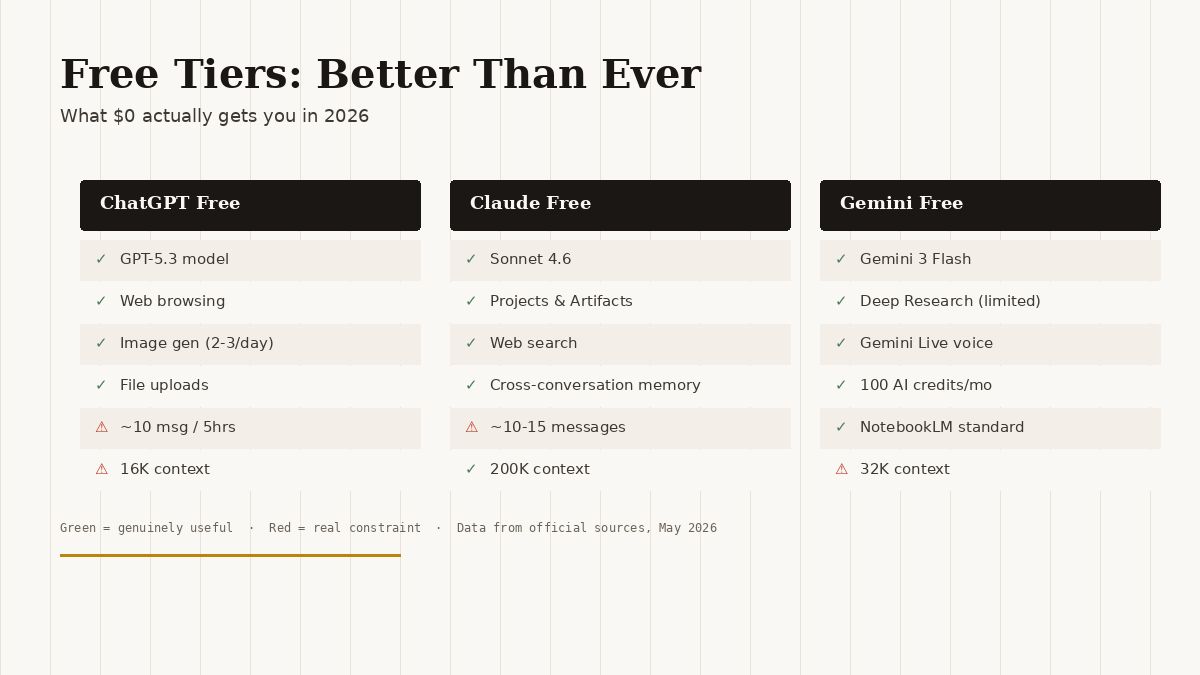
ChatGPT’s free tier in 2026 is probably the most functional free AI offering outside of Meta AI’s unlimited model. You get access to GPT-5.3 — not some stripped-down subsidiary — with web browsing, image generation (2–3 images per 24 hours), and file uploads. That’s remarkable by historical standards.
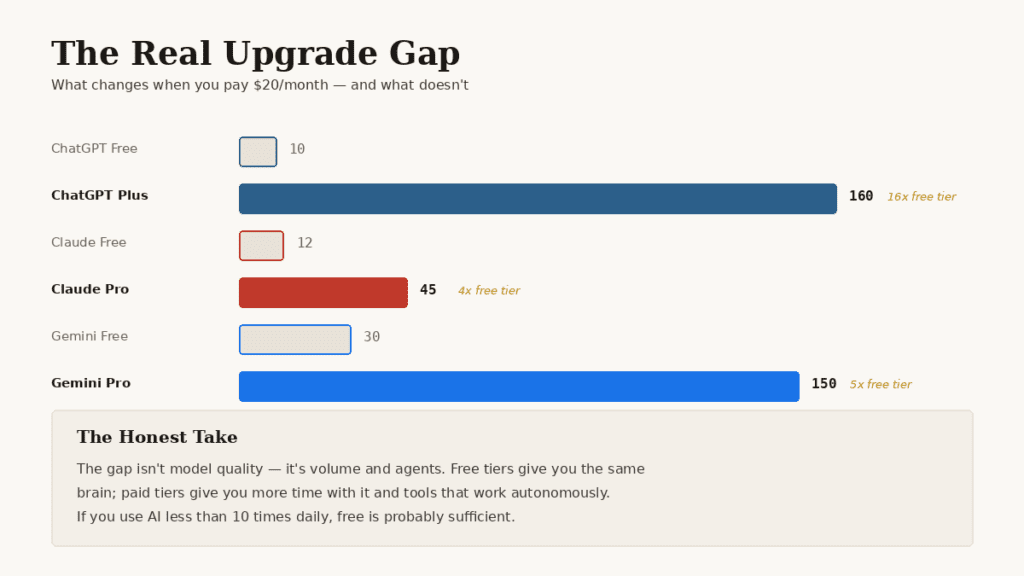
The catch is rate limiting. Free users can send approximately 10 messages with GPT-5.3 every 5 hours. Hit that ceiling and the system silently downgrades you to GPT-5.3 Mini — a noticeably less capable model — for the remainder of the window. The context window on the free tier sits at roughly 16K tokens, compared to 32K on Plus and 128K–1M on the Pro tiers.
OpenAI began showing ads to free users in the US in February 2026 — the first major AI chatbot to do so. This won’t matter to most people, but it signals something about the long-term trajectory of the free experience.
The jump from free to Plus is one of the more dramatic tier upgrades in the industry. Plus delivers approximately 160 messages per 3-hour rolling window with GPT-5.3 — roughly 16x the free allocation. More importantly, it unlocks capabilities that flat don’t exist on the free tier: Agent Mode for autonomous multi-step tasks, Codex for running and debugging code in a sandboxed environment, Tasks for scheduling automated actions, and Sora video generation (limited credits for short watermarked clips).
Deep Research — the agentic research mode that autonomously queries multiple sources and compiles structured reports — is available on free, but capped tightly. Plus raises that to approximately 10 Deep Research sessions per month, which is workable for professionals who use it weekly.
Custom GPTs are a Plus-only feature worth mentioning for anyone doing repetitive specialized work. The ability to build a GPT that knows your brand voice, your codebase conventions, or your report formatting preferences is genuinely time-saving once set up.
“Users on Plus report 10–26x effective capacity over Free. The upgrade changes whether ChatGPT is a useful tool or a frustrating one.”
— CometAPI ChatGPT Pricing Analysis, 2026OpenAI’s April 2026 addition of a $100 tier — sitting between Plus and the $200 Pro — was clearly a competitive response to Anthropic’s Claude Max pricing. At $100/month, you get 5x the Plus quotas across GPT-5.4 Thinking and 500 Deep Research sessions per month (versus Plus’s ~10). That Deep Research number is the headline: if you’re a researcher, analyst, or journalist who burns through research sessions regularly, this tier removes a real constraint.
The $200 tier is where most users should stop reading and move on. It’s designed for a specific, narrow audience: researchers processing massive document collections, developers who need the largest available context for codebases, and content creators who need AI video generation at volume. The 1M token context window is the distinguishing feature that doesn’t appear at any lower tier — it lets you work with entire books, large codebases, or months of conversation history in a single session.
For Sora, the difference is material if video is core to your work: Plus gives limited watermarked 720p clips, Pro gives unlimited 1080p non-watermarked video up to 25 seconds with storyboard editing. If AI video generation is supplementary to your work, stay on Plus.
Anthropic’s Claude occupies an interesting position in this landscape. The free tier is genuinely the most limited of the major platforms by message volume — community reports consistently show roughly 10–15 messages before hitting limits, depending on message length. Anthropic doesn’t publish exact caps, which is frustrating. But the paid tier jump is correspondingly larger, which is why multiple reviewers describe Claude Pro as the subscription that “makes the most difference” at the $20 price point.
The good news: Claude’s free tier runs on Claude Sonnet 4.6 — the same model that handles most paid interactions. Anthropic hasn’t degraded the free experience to a purposely inferior model. You also get Projects (organized conversation folders with shared context), Artifacts for generating documents and code inline, web search, and as of February 2026, cross-conversation memory.
The constraint is volume. For someone doing occasional research or drafting, free works. For daily professional use, you’ll hit the ceiling within an hour of sustained work most days.
Claude Pro ($20/month or $17/month annually): Opus Access Changes Things
Claude Pro adds three things that materially change the product: access to Claude Opus 4.7 (released April 16, 2026), approximately 5x the message limits (~45 messages per 5-hour window), and Claude Code — the terminal-based coding agent that reads and writes files directly in your repository.
The Opus vs. Sonnet gap is quantifiable. According to Anthropic’s benchmarks, Opus 4.7 scores 87.6% on SWE-bench Verified (coding task completion) compared to lower Sonnet scores. For long-document analysis, Opus 4.7 carries a 1M token context window — enough to process roughly 1,500 pages of text in a single conversation. Sonnet operates at 200K tokens, which is itself generous.
Claude Code is included in Pro at no extra cost. This is significant: it’s the agentic coding tool that can work through a full repository, write and run tests, and propose pull requests — similar in concept to OpenAI’s Codex Agent, but bundled into the $20 subscription rather than a separate product. For developers, this alone justifies the upgrade.
Real-World Benchmark Context
SWE-bench Verified tests whether models can autonomously resolve real GitHub issues across diverse codebases. Scores in the high 80s represent frontier performance as of mid-2026. Source: SWE-bench.com.
GPQA Diamond measures doctoral-level scientific reasoning. These are genuinely hard questions that require multi-step inference, not information retrieval.
Claude Max ($100/month, $200/month): For Heavy Professional Workflows
Claude Max at $100/month provides 5x Pro limits (25x free), priority access during peak hours, and access to Opus 4.7 with higher vision resolution and task budget support. The $200 tier delivers 20x Pro limits — roughly 900 substantive messages per 5-hour window. For an organization where AI is embedded in continuous workflows, that ceiling matters. For individuals, it almost certainly doesn’t.
The Master Comparison: Every Tier, Every Platform
The table below compares capabilities across the six most relevant platforms and their primary consumer tiers. Enterprise and API pricing are excluded — they’re custom-negotiated and a separate decision entirely.
| Feature / Capability | ChatGPT Free | ChatGPT Plus $20/mo |
Claude Free | Claude Pro $20/mo |
Gemini Free | Gemini AI Pro $19.99/mo |
|---|---|---|---|---|---|---|
| Core Model Access | ||||||
| Flagship model | GPT-5.3 ~10 msg / 5hrs then Mini fallback | GPT-5.3 full access ~160 msg / 3hrs | Sonnet 4.6 ~10–15 msgs before limit | Sonnet 4.6 + Opus 4.7 ~45 msg / 5hrs | Gemini 3 Flash Limited 3 Pro access | Gemini 3.1 Pro Full access, 1M context |
| Context window | 16K tokens | 32K tokens | 200K tokens | 200K–1M tokens Opus 4.7: 1M | 32K tokens | 1M tokens |
| Reasoning / thinking mode | No | GPT-5.5 Thinking 3,000 msgs/wk | Basic extended thinking | Adaptive thinking, all models | Limited 3 Pro (US) | Deep Research, Deep Think (Ultra only) |
| Research & Web Access | ||||||
| Web search / live data | Yes (limited) | Yes, expanded | Yes | Yes, priority | Yes | Yes + Deep Search |
| Deep Research (agentic) | Very limited | ~10 sessions/mo | No | Available (Claude Research) | No | Yes, higher limits |
| File / document upload | Limited per session | Expanded | Yes | Yes, expanded | Yes | Yes |
| Code & Agents | ||||||
| Agentic coding tool | No | Codex Agent (limited) | No | Claude Code (terminal, full repo) | No | Jules async coding agent (5x limits) |
| Code execution / sandbox | No | Yes (Codex) | Chat-based only | Yes (Claude Code) | Limited | Yes (Gemini Code Assist) |
| Custom GPTs / Gems | Use only | Create + use | No | No (Projects instead) | No | Gems (create + use) |
| Multimodal & Creative | ||||||
| Image generation | 2–3/day (DALL-E) | ~50 / 3hrs (DALL-E 3) | No | No | Limited (Nano Banana Pro) | Full Nano Banana Pro, more credits |
| Video generation | Very limited Sora credits | Limited Sora, 720p, watermarked | No | No | 100 monthly AI credits (Veo 3.1 Fast) | 1,000 AI credits, Veo 3.1 Lite |
| Voice mode | Basic | Advanced Voice Mode | No | No | Gemini Live | Gemini Live, expanded |
| Ecosystem & Storage | ||||||
| Workspace integration | Limited connectors | 60+ apps (Slack, GDrive, GitHub) | Google Workspace (Pro) | Google Workspace integration | Basic Gmail | Full Gmail, Docs, Sheets, Meet, Drive |
| Cloud storage bonus | None | None | None | None | 15 GB Google storage | 5 TB Google One Updated Apr 2026 from 2TB |
| Memory / persistence | Limited | Expanded memory, Projects | Yes (Feb 2026 rollout) | Yes, persistent | Basic | Yes, full |
| Data training opt-out | Opt-out available | Opt-out available | Opt-out available | Opt-out available | Opt-out available | Opt-out available |
Sources: OpenAI pricing, Anthropic pricing, Google AI plans. Checked May 19, 2026.
Gemini: The Best All-In Value, If You Live in Google’s World
Google’s AI subscription was confusingly branded — it cycled through “Gemini Advanced,” “Google One AI Premium,” and now “Google AI Pro” — but the product itself has become genuinely compelling. If you’re already embedded in Google Workspace, the Pro tier at $19.99/month is arguably the best value proposition among the major AI subscriptions right now.
The Free Tier Is Better Than Most People Realize
Gemini’s free tier now includes Deep Research (limited), Gemini Live voice mode, 100 monthly AI credits for video and image generation via Flow and Whisk, NotebookLM with standard limits (100 notebooks, 50 sources each, 50 daily chat queries), and access to Gemini 3 Flash. American users also get limited access to the “Thinking” variant of Gemini 3 Pro for complex problems.
That’s a genuinely generous free tier. For students doing occasional research, for professionals using AI as a secondary check rather than a primary tool, and for anyone already paying for Google One storage, it may be enough.
Google AI Pro ($19.99/month): The 5 TB Storage Play and 1M Context
The headline upgrade is the move to Gemini 3.1 Pro with a 1M token context window — one of the largest context windows among standard consumer tiers. Deep Research becomes properly usable, NotebookLM Pro unlocks dramatically expanded limits (500 notebooks, 300 sources each, 500 daily queries, 20 Deep Research reports per day), and the full Workspace integration activates: Gemini directly inside Gmail, Docs, Sheets, Slides, and Meet.
The April 2026 storage bump — from 2TB to 5TB of Google One storage at no price increase — is significant. If you were previously paying for a Google One storage plan, upgrading to AI Pro replaces and exceeds that cost. For many users, the effective cost of the AI features is the difference between the Pro subscription and what they were paying for storage anyway.
Google AI Plus ($7.99/month): The Overlooked Middle Ground
Google’s Plus tier is genuinely underappreciated in most comparisons. At $7.99/month it gives you NotebookLM Plus (200 notebooks, 100 sources each), a 128K context window in the Gemini app, Veo 3.1 Lite video generation access with limited credits, 200 GB of cloud storage, and family sharing for up to five people. For students and light users who want a real upgrade without the $20/month commitment, it’s a legitimate option that competitors don’t have an equivalent for.
Google AI Ultra ($249.99/month): For the Narrow Segment That Needs Deep Think
At $249.99/month, Ultra is only worth considering if you’re a daily user of Deep Think — Gemini’s extended reasoning mode that scored 77.1% on ARC-AGI-2 benchmarks — or if you’re generating AI video at volume professionally. The model gap between Pro and Ultra isn’t as large as the price gap suggests: Gemini 3.1 Pro is available on both tiers, and Deep Think is mainly differentiated by computation time rather than a fundamentally different model.
Perplexity and Grok: Different Problems, Different Answers
These two platforms don’t try to be general-purpose AI assistants. That clarity of purpose makes the tier comparison more straightforward than for ChatGPT or Claude.
Perplexity: The Research Tool With a Generous Free Tier
Perplexity’s free tier gives unlimited basic searches with citations, 3 Pro-mode queries per day using frontier models (GPT-5.x or Claude Opus), and up to 10 document uploads daily. For occasional research work, this is surprisingly capable — most comparison tools understate how much value the free Perplexity experience delivers.
Perplexity Pro at $20/month (or ~$16.67/month annually) removes the 3-query daily cap on advanced model access and lets you choose which frontier model handles each query: a feature no other platform at this price point offers. You can route a technical question to Claude Opus and a creative query to GPT-5.x in the same session. For research professionals who want model flexibility without managing separate subscriptions, this is the unique value proposition.
Perplexity Max at $200/month unlocks “Model Council” — a feature that runs your query through three frontier models simultaneously and synthesizes the outputs — plus “Perplexity Computer,” a 19-model agentic orchestration system. These are genuinely novel capabilities, but the $200 price point needs serious justification.
Grok: The X-Integrated Outlier
Grok’s free access is heavily rate-limited, tied to X (formerly Twitter), and not meaningfully comparable to the free tiers of its competitors. SuperGrok at $30/month (or $300/year) unlocks Grok 4 with DeepSearch and full reasoning modes, plus a notably large 2M token context window. According to Field Guide to AI’s analysis, Grok carries the lowest hallucination rate among frontier models (~4%), which is significant for fact-sensitive work.
The consideration for Grok is straightforward: if you already pay for X Premium Plus and work heavily with real-time social data, SuperGrok makes sense. If neither of those is true, the value proposition is harder to build.
Perplexity Pro’s Unique Edge
No other platform at the $20 price point lets you pick the underlying AI model per query. If you’re running research that benefits from model diversity — technical analysis in one model, synthesis in another — Perplexity Pro’s model-switching capability is a genuine differentiator. It’s also the only unlimited-queries plan among the major platforms; most others use rolling windows.
The Honest Assessment of Free Tiers in 2026
Here’s something worth saying directly: the free tiers of AI tools have improved faster than the paid tiers have differentiated. In 2023, the free tier of ChatGPT gave you GPT-3.5 and nothing else. In 2026, the free tier gives you GPT-5.3, image generation, web search, and file uploads.
This complicates the upgrade decision. Several categories of users probably don’t need a paid subscription:
Occasional users (under 10 queries per day) — ChatGPT or Gemini free will handle most needs without hitting caps. Meta AI, which runs Llama 4 with no usage limits and no credit card required, is worth considering for this segment as well.
Students doing standard research work — Perplexity free for citations plus Gemini free for document work plus Claude free for writing is a zero-cost stack that covers most academic workflows.
Google Workspace users who don’t need AI coding tools — The free Gemini tier with Workspace integration is meaningful, and the Plus tier at $7.99/month may be a better fit than a $20/month subscription.
Who genuinely needs a paid subscription? Professionals hitting rate limits consistently, people who specifically need agentic coding tools (Claude Code, Codex), researchers needing unlimited Deep Research sessions, and creators using AI video generation as a real workflow component.
The Upgrade Trigger Test
A practical question: did you hit a usage cap or a “capability wall” in the last week? A usage cap (message limits) means you need higher limits — upgrade. A capability wall (a feature that simply doesn’t exist on your tier) means you need a different tier or platform — evaluate specifically what’s missing. If the answer to both is no, don’t upgrade.
Performance Data: What the Benchmarks Actually Show by Tier
It’s worth separating the model performance question from the tier access question. Some platforms gate their best models behind paid tiers; others give the same model to free and paid users with only usage limits differentiating the experience.
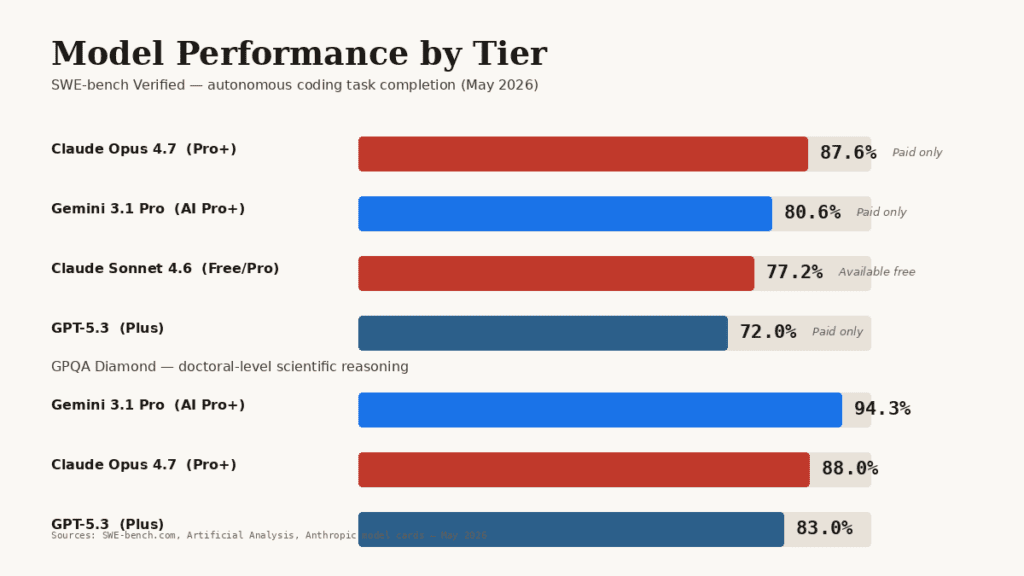
SWE-bench Verified (Autonomous Coding — May 2026)
Claude Opus 4.7 (Pro+)
87.6%
Gemini 3.1 Pro (AI Pro+)
80.6%
GPT-5.3 (ChatGPT Plus)
~72%
Claude Sonnet 4.6 (Free/Pro)
77.2%
Source: SWE-bench.com and Anthropic model cards. Scores represent verified task completion on real GitHub issues.
GPQA Diamond (Doctoral-Level Scientific Reasoning)
Gemini 3.1 Pro (AI Pro+)
94.3%
Claude Opus 4.7 (Pro+)
~88%
GPT-5.3 (ChatGPT Plus)
~83%
Source: Artificial Analysis benchmarks. GPQA Diamond tests expert-level domain knowledge in chemistry, biology, and physics.
A note on reading benchmarks: the gap between 77% and 87% on SWE-bench sounds small but represents a significant difference in how often the model completes real engineering tasks without human correction. Context matters more than the raw number.
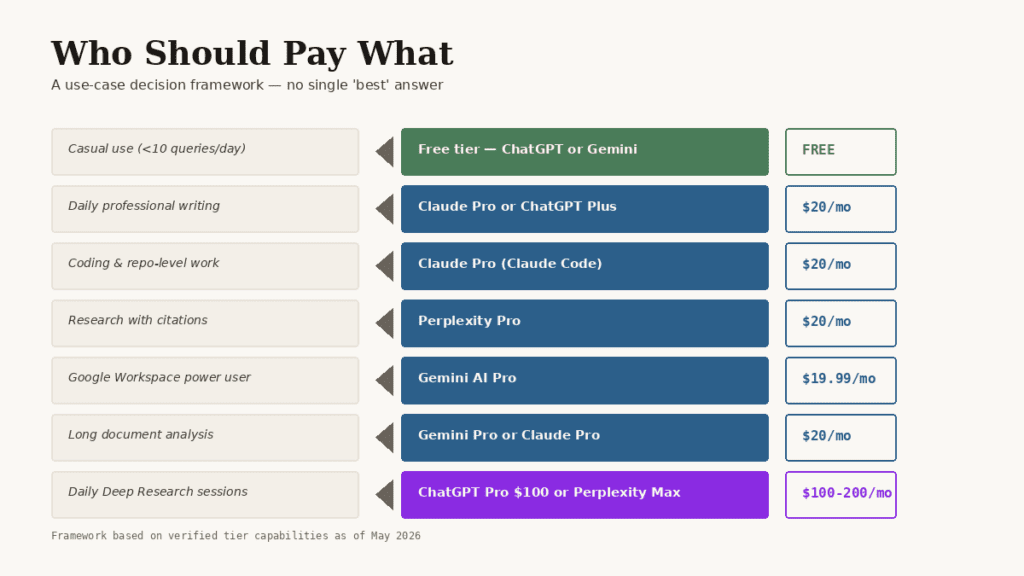
The Decision Framework: Who Should Pay What
Rather than giving a single “best” answer, here’s a use-case decision matrix. The honest answer is that the right tier depends almost entirely on what you actually use AI for.
If your primary use case is… → Consider this path
Casual Q&A and occasional drafting (<10 queries/day)
Free ChatGPT free or Gemini free. Meta AI if you want zero limits at zero cost.
Daily professional writing (emails, long-form, proposals)
$20/mo Claude Pro — consistently rated highest for natural prose quality. ChatGPT Plus as strong second.
Coding, debugging, repo-level refactoring
$20/mo Claude Pro for Claude Code (terminal agent). ChatGPT Plus for Codex. Add GitHub Copilot Pro at $10/mo for inline IDE suggestions.
Research with citations (journalism, academia, analysis)
$20/mo Perplexity Pro — model flexibility per query, unlimited searches, citation-first design. Use Claude free for synthesis.
Heavy Google Workspace user (Gmail, Docs, Sheets)
$19.99/mo Gemini AI Pro — native integration across all Google apps, 5 TB storage, 1M context. Replaces Google One storage cost.
Long document analysis (contracts, research papers, books)
$20/mo Gemini AI Pro (1M context) or Claude Pro (Opus 4.7 at 1M context). Both handle full book-length documents.
AI image and video creation for professional content
$20/mo ChatGPT Plus for DALL-E 3 + limited Sora. Gemini AI Pro for Veo 3.1 video credits. Scale to $200 Pro only if volume demands it.
Enterprise / multi-user team setup
$25–30/seat ChatGPT Business or Claude Team — both include data privacy guarantees and team workspaces. Copilot only if deeply embedded in Microsoft 365.
Research analyst burning through Deep Research daily
$100/mo ChatGPT Pro $100 (500 Deep Research sessions) or Perplexity Max if multi-model synthesis is needed.
What’s Shifting: The Tier Structure Is Still Moving
A few trends worth watching as this landscape continues to evolve through 2026:
Agentic capabilities are becoming the real differentiator. The gap between free and paid increasingly isn’t about conversation quality — it’s about autonomous task execution. Claude Code, ChatGPT’s Agent Mode, Gemini’s Jules and Project Mariner, Perplexity’s Computer — these tools do work on your behalf, not just generate text. They’re all gated behind paid tiers, and they’re where the meaningful productivity gains are concentrating.
Context windows are approaching functional sufficiency at the standard tier. When a $20/month subscription gives you 200K–1M tokens, the “I need more context” argument for upgrading weakens for most use cases. The ceiling hasn’t disappeared — it’s just moved to a place most users won’t hit regularly.
Open-source models are catching up. DeepSeek V4, GLM-5.1, and Llama 4’s models are matching frontier proprietary model performance on many benchmarks. For organizations that can self-host and tune models, the case for subscription AI weakens. For individuals who need a polished consumer interface, it doesn’t change much.
The $8/month tier is new and worth watching. OpenAI’s ChatGPT Go at $8/month (or $5/month internationally) creates a middle ground between free and $20 that didn’t exist before. If it finds product-market fit, expect other platforms to introduce similar mid-level options.
“Context windows keep growing — 200K–1M tokens is now standard for frontier models. This means you can analyze entire books, codebases, or document collections in a single conversation.”
— Field Guide to AI, February 2026https://www.bestprompt.art/ai-tools-for-prompt-writing/
https://www.bestprompt.art/advanced-prompt-capabilities/
https://www.bestprompt.art/are-you-making-these-ai-prompt-mistakes-in-2025/
https://www.bestprompt.art/ai-prompt-tools-in-2026/
https://www.bestprompt.art/free-vs-paid-ai-in-2026/
https://www.bestprompt.art/cost-performance-tradeoff-techniques/