April 2026 · Benchmark-Grounded Comparison
Not another “Claude is best for writing, ChatGPT for everything else” listicle. This is benchmark data, real task performance, and a decision framework you can use tomorrow — with one important disclosure upfront.
Bottom line — read this, then read the rest
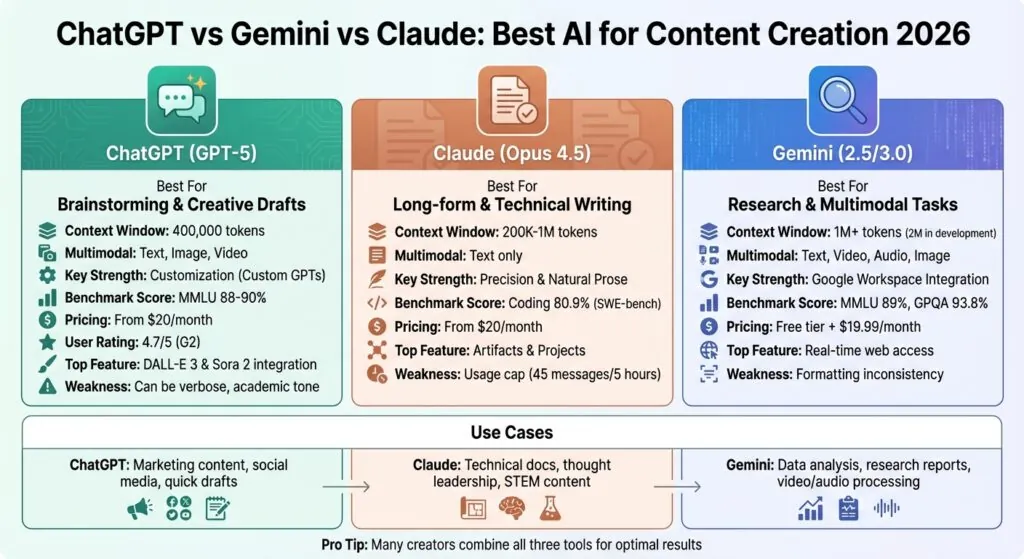
No single model wins in 2026. Claude Opus 4.7 leads coding benchmarks at 87.6% SWE-bench Verified (April 2026). Gemini 3.1 Pro leads abstract reasoning at 94.3% GPQA Diamond. GPT-5.4 leads ecosystem breadth and factual recall. The smartest teams run two or three of these depending on the task — and the $60/month subscription cost for all three is often justified by the productivity delta. The rest of this article gives you the task-by-task framework to decide which to prioritize.
Three months ago the comparison was cleaner. One model dominated coding, another dominated reasoning, another dominated multimodal work. March 2026 scrambled that: OpenAI shipped GPT-5.4 “Thinking,” Anthropic released Claude Opus 4.6 with a 1-million-token context window, and Google followed with Gemini 3.1 — five significant model releases in a single month. The gap that existed between these platforms in 2024 has narrowed. The gaps that remain are now specific and task-dependent.
That’s actually useful. When every model was “good at everything,” picking one was mostly brand preference. Now that each has clear domains of advantage, picking the right one for your actual work is worth doing carefully.
“There is no single ‘best’ AI assistant for everyone; each provider optimizes for different profiles — reasoning vs speed, ecosystems, cost. The smartest move for most people is a combo stack.”
— Independent 2025–2026 user testing consensus, ILearnLot analysis
GPT-5.4
Broadest ecosystem · most integrations · leads factual recall
- Best ecosystem: 60+ integrations, plugins, voice, computer use
- Leads factual accuracy — 97% SimpleQA, 93% MMLU-Pro
- Long-context reasoning: 97% MRCRv2
- Best pricing at $2.50 / $15 per million tokens
Opus 4.7 / Sonnet 4.6
Coding leader · writing quality · tool use · honest about limits
- Leads coding: 87.6% SWE-bench Verified (April 2026)
- Leads tool use: 77.3% MCP-Atlas
- Best long-form writing and instruction-following
- Least likely to hallucinate confidently
3.1 Pro
Reasoning leader · multimodal · Google ecosystem · cheapest frontier
- Leads abstract reasoning: 94.3% GPQA Diamond
- Native video, audio, image — best multimodal
- Fastest response times among the three
- Cheapest frontier API: $2 / $12 per million tokens
Benchmark by Benchmark: What the Numbers Show
Benchmarks are imperfect. Prof. Dr. Kay Rottmann of HdM Stuttgart — formerly Senior Applied Scientist at Amazon Alexa — makes this point bluntly in his 2026 comparison: a model can score 5% higher on MMLU and still perform worse on your specific application. That caveat matters. What benchmarks do provide is the most objective, reproducible signal available. Here’s what they show.
| Model | SWE-bench Verified | SWE-bench Pro | Notes |
|---|---|---|---|
| Claude Opus 4.7 | 87.6% | 64.3% | Current leader both benchmarks; April 16, 2026 release |
| GPT-5.3 Codex | 85% | ~23% | Strongest for DevOps/infrastructure (Terraform, Terminal-Bench) |
| GPT-5.4 | 84% | ~23% | Tied Claude Opus 4.6 on Verified before 4.7 release |
| Claude Sonnet 4.6 | 82.1% | ~55% | More cost-efficient than Opus for most coding tasks |
| Claude Opus 4.6 | 80.8% | 53.4% | Previous flagship; still competitive for interactive coding |
| Gemini 3.1 Pro | 75% | 54.2% | Best for Google Cloud / large-repo analysis at 1M token context |
SWE-bench Verified: 500 real GitHub issues, success determined by passing unit tests. SWE-bench Pro (Scale AI): harder multi-language, multi-file tasks that resist benchmark-specific optimization. Note: Google self-reported Gemini 3.1 Pro at 80.6% on SWE-bench Verified; BenchLM independent evaluation places the standardized score at 75%. The discrepancy reflects different evaluation harnesses. All scores are for the underlying model, not model+agent scaffolding combos. Sources: Vellum (April 2026), GitAutoReview (April 2026), Scale AI SWE-bench Pro leaderboard.
The coding gap is worth pausing on. On the harder SWE-bench Pro benchmark — designed to resist the optimization that inflates Verified scores — Claude Opus 4.7 leads at 64.3%, a meaningful jump over GPT-5.4 (57.7%) and Gemini (54.2%). Vellum’s benchmark analysis notes that early partners confirmed this in their own internal tests: Cursor saw a jump from 58% to 70% on their internal CursorBench; one partner saw 13% higher resolution on a 93-task coding benchmark, including four tasks neither Opus 4.6 nor Sonnet 4.6 could solve.
That said: GitAutoReview’s analysis notes that GPT-5.3 Codex leads Terminal-Bench 2.0 for DevOps, infrastructure, and security work — and specifically outperforms Claude on Terraform, catching misconfigurations like overly permissive S3 bucket policies that Claude tends to overlook. Category matters.
| Category | Leader | Score / Metric | Runner-up | Source |
|---|---|---|---|---|
| Abstract reasoning (GPQA Diamond) | Gemini 3.1 Pro | 94.3% | GPT-5.4 Pro 94.4% / Claude Opus 4.7 94.2% | Vellum 2026 |
| Factual recall (SimpleQA) | GPT-5.4 | 97% | Gemini 3.1 Pro (Google Search grounded) | BenchLM 2026 |
| Long-context accuracy (MRCRv2) | GPT-5.4 | 97% | Claude competitive at 200K window | BenchLM 2026 |
| Tool use / agent workflows (MCP-Atlas) | Claude Opus 4.7 | 77.3% | Gemini 3.1 Pro 73.9% / GPT-5.4 68.1% | Vellum 2026 |
| Multimodal (image, video, audio) | Gemini 3.1 Pro | 90.4 blended | GPT-5.4 computer use / Claude image input | BenchLM 2026 |
| Long-form writing quality | Claude | Human preference (Chatbot Arena / LMSys) | GPT-5.4 Canvas for editing; Gemini lags both | LearnDrive 2026 |
| API pricing (frontier, input/output per MTok) | Gemini 3.1 Pro | $2 / $12 | GPT-5.4 $2.50/$15 / Claude Opus 4.7 $5/$25 | MetaCTO Apr 2026 |
| Consumer plan price | All ~$20/mo | ChatGPT Plus $20 / Claude Pro $20 / Gemini Adv. $19.99 | — | Official pricing pages |
GPQA Diamond = Graduate-level science reasoning (physics, chemistry, biology) from expert-validated questions. MRCRv2 = multi-step long-context retrieval. MCP-Atlas = agentic tool-calling evaluation across connected services. All scores as of April 2026. Multimodal blended score compares apples-to-apples only at same task type — Gemini’s native video/audio processing covers domains GPT and Claude don’t handle at all. Color coding is supplemented by text labels for accessibility.
⚠ The benchmark contamination problem
Every frontier model team knows what SWE-bench contains and can optimize for it. The SWE-bench Pro results make this visible: every top model drops 18–25 points from Verified to Pro — the harder version designed to resist benchmark-specific optimization. A 77.2% Verified score does not mean 77.2% of your production bugs will get fixed. Use benchmarks as directional signals, not guarantees. Check swebench.com directly for the current leaderboard — scores shift with every model update.
What This Looks Like on Real Tasks
Numbers only go so far. Here’s how the three models diverge on the tasks that actually consume professional time.
Coding and debugging
Playcode’s 2026 coding comparison tested all three on identical prompts across multiple weeks. On a TypeScript debounce function: ChatGPT produced a working solution immediately but used any types in a few places; Claude thought through edge cases first and wrote type-safe generics; Gemini produced clean, correct code but took roughly 2.3× longer to respond. For complex debugging and architectural decisions, the Playcode team’s verdict: “Claude is my first choice. It thinks more carefully and makes fewer errors on hard problems.”
The 2025 Stack Overflow Developer Survey captures the broader shift: 81% of developers still use ChatGPT/GPT models, but Claude’s adoption climbed to 43% — reflecting developers actively adding Claude for the coding quality delta.
Writing, editing, and long-form content
Claude leads here — consistently, across independent evaluations. BenchLM’s April 2026 analysis calls Claude “the best fit for long-form writing, editing, and polished interaction style.” The 128K output token ceiling (vs. GPT-5.4’s 32K in standard mode) means Claude can generate a full white paper or detailed report in a single call. GPT-5.4’s Canvas interface is the better editing environment for iterative work. Gemini produces shorter outputs unless specifically prompted and doesn’t match either on sustained prose quality.
Research, reasoning, and current-events work
Gemini’s Google Search grounding gives it a structural advantage for anything requiring current information — it can verify claims against live search results rather than relying on training data. GPT-5.4 leads raw factual recall on static knowledge (97% SimpleQA). Vellum’s analysis notes that Claude Opus 4.7’s BrowseComp score actually slipped from 4.6 to 79.3% — trailing Gemini (85.9%) and GPT-5.4 Pro (89.3%) on web research-heavy tasks. Worth knowing if your agents do a lot of synthesis across multiple web sources.
Agents and automated workflows
This is where the divergence is sharpest and most consequential for enterprise buyers. Claude leads MCP-Atlas tool use at 77.3% — the benchmark measuring agentic multi-step tool calls — ahead of Gemini (73.9%) and GPT-5.4 (68.1%). Prof. Rottmann’s practical experience aligns: “Agentic behavior, tool use, system-prompt adherence, and reliability across many steps are consistently better in my projects [with Claude].” Gemini’s tool-use reliability lags in agentic contexts despite its strong raw benchmarks. ChatGPT’s Computer Use API is the most capable for UI automation.
| Task type | Primary recommendation | Reason | Caveat |
|---|---|---|---|
| Complex debugging / refactoring | Claude Opus 4.7 | 87.6% SWE-bench; best multi-file reasoning | Slower; use Sonnet 4.6 for interactive speed |
| DevOps / infrastructure / security | GPT-5.3 Codex | Leads Terminal-Bench; strongest Terraform / HCL | Higher SWE-bench Pro drop-off than Claude |
| Long-form writing / editing | Claude | 128K output; best prose quality; instruction-following | GPT-5.4 Canvas better for iterative edit loops |
| Current events / live research | Gemini 3.1 Pro | Google Search grounding; best BrowseComp (85.9%) | Claude and GPT also have search but it’s not native |
| Abstract reasoning / science / math | Gemini 3.1 Pro | Leads GPQA Diamond (94.3%); ARC-AGI-2 (77.1%) | GPT-5.4 & Claude Opus 4.7 within 0.2% on GPQA |
| Multi-step agents / tool use | Claude Opus 4.7 | Leads MCP-Atlas tool-calling (77.3%) | GPT Computer Use API better for UI automation |
| Video / audio / multimodal | Gemini 3.1 Pro | Only model with native video + audio | GPT-5.4 covers images & computer use; Claude images only |
| Google Workspace integration | Gemini | Native in Docs, Sheets, Gmail | ChatGPT has Google Drive connector; Claude has basic integration |
| High-volume, cost-sensitive API work | Gemini 2.5 Flash | $0.15/MTok input vs Claude Haiku $1.00 | Quality gap on complex tasks; test before committing |
| General-purpose / enterprise productivity | ChatGPT / GPT-5.4 | Widest ecosystem; most training material; best compliance docs | Not the strongest on any single specialized dimension |
Recommendations reflect April 2026 benchmark data and independent practitioner reports. Benchmark positions shift every 4–8 weeks as new models release. For coding benchmarks, verify at swebench.com; for overall rankings at lmarena.ai (Chatbot Arena). Color coding supplemented by text labels.
Pricing Reality: The Actual Math
At the consumer level, all three cost roughly $20/month — ChatGPT Plus ($20), Claude Pro ($20), Gemini Advanced ($19.99). The decision there is purely capability-based. At the API level, the gap opens up substantially.
Claude Opus 4.7 costs $5/$25 per million input/output tokens — down from $15/$75 for Opus 4.1 in 2025, a 67% reduction. GPT-5.4 runs $2.50/$15. Gemini 3.1 Pro is $2/$12 — the cheapest frontier option at scale. At the lightweight end, the gap is more dramatic: Gemini 2.5 Flash costs $0.15/MTok input, roughly 6.7× cheaper than Claude Haiku 4.5 at $1.00. For high-volume pipelines — chatbots, document processing, classification — that cost difference compresses margins quickly.
One cost-saving lever that’s underused: Claude’s prompt caching cuts cached input costs by 90%, and the Batch API delivers 50% off standard rates for async workloads. A team processing 500K documents per month could save $750–$2,250/month by switching to batch, even without changing models.
The Decision Framework: How to Actually Choose
Forget the ranking tables. Here’s a practical decision flow based on your primary use case.
Specifically Claude Sonnet 4.6 for interactive speed, Opus 4.7 for hard bugs. Via Claude Code in terminal, or Cursor (which uses Claude under the hood for complex reasoning tasks). The benchmark evidence and practitioner feedback point the same direction.
Best compliance documentation, most training material for employees, widest integration surface (Slack, Google Drive, SharePoint, GitHub, Atlassian). Prof. Rottmann’s recommendation for companies running structured AI training: “The most polished experience for end users. ChatGPT is still the app my students open first.”
If your workflow lives in Google Docs and Sheets, or requires processing video and audio files, Gemini is the only frontier option with native support. For research requiring live information, its Search grounding is a structural advantage over models relying purely on training data.
The smartest 2026 teams don’t pick one. They use Claude for coding agents and long-form generation, Gemini for real-time research and multimodal processing, GPT-5.4 for ecosystem integrations and computer use. Total consumer cost: ~$60/month. For most professionals, the productivity delta pays that back in the first week.
📌 Where benchmarks mislead — the counter-case
Every coding benchmark is measured on Python repositories: Django, Flask, scikit-learn. Your production codebase is probably not a mid-size Python library with clean test coverage and well-scoped issues. As TokenMix’s analysis notes: production codebases are 100K–10M lines. Production engineering includes architecture decisions, long-horizon feature work, and interactive debugging — none measured by SWE-bench. And when both Claude and GPT-5.4 run inside the same scaffolding (Cursor, Claude Code), a 3-point benchmark gap often disappears. The benchmark tells you about the model’s ceiling. Your tooling determines how much of that ceiling you actually reach.
Frequently Asked Questions
Is there actually a “best” AI tool for prompt generation specifically?
Prompt generation as a standalone category — using AI to write prompts for other AI — is a niche use case. What most people searching this actually want is: which AI model gives me the best outputs for my work? That’s what this article covers. If you want to use one model to refine prompts for another, Claude’s strong instruction-following and clear reasoning chains make it the most reliable for generating structured, explicit prompts. But you’re probably better off learning to write prompts directly — the skill transfers across all models and compounds over time.
Why did you disclose at the top that Claude wrote this?
Because a Claude model rating Claude against ChatGPT and Gemini is a genuine conflict of interest. Disclosing it is the honest thing to do, and it lets you calibrate appropriately. Every Claude-specific claim in this article is sourced to a third-party benchmark or independent reviewer — BenchLM, Vellum, Playcode, Prof. Rottmann, TokenMix — not Anthropic marketing. But you should still read those sections with extra scrutiny.
How often do benchmark rankings change?
Every 4–8 weeks right now, sometimes faster. March 2026 saw five significant model releases in one month. The task-specific recommendations in Table 3 are likely to hold for several months — the relative strengths (coding vs. reasoning vs. multimodal vs. ecosystem) reflect company strategy and architectural choices, not just current model versions. The specific benchmark numbers will change. For current leaderboard positions: swebench.com for coding, lmarena.ai (Chatbot Arena) for overall human preference rankings.
Can Claude really be objective about this comparison?
No — not fully. That’s the honest answer. A model trained by Anthropic has incentives baked into its training to present Anthropic favorably. What I’ve done is source every claim to independent third parties and disclose the conflict upfront. That’s not a perfect solution. The alternative — pretending the conflict doesn’t exist — would be worse. Read the Gemini and ChatGPT sections with the same critical eye you’d apply to an OpenAI blog post comparing GPT to Claude.
Is it worth subscribing to all three at $60/month?
For individual developers or writers, probably not — pick one primary and use free tiers for the others. For teams and businesses running production AI workflows, yes: the task specialization in Table 3 is real, and the productivity gains from using the right model for each task type generally exceed the subscription cost in the first week. The more expensive decision at scale is the API tier — that’s where Gemini’s $2/$12 pricing vs Claude’s $5/$25 becomes a meaningful budget decision for high-volume applications.