25 AI Fantasy Art Prompts That Actually Generate Magical Worlds

AI Image Generation · Prompt Engineering · Fantasy Art
Not “enchanted forest, digital art.” Real, tested prompts with anatomy breakdowns — for Midjourney V7, FLUX Pro, and DALL-E 3. The kind you copy-paste and get something that drops your jaw.
TL;DR
- 25 prompts across 5 fantasy sub-genres — each with model-specific parameter tuning
- The single biggest quality lever is atmospheric lighting, not subject description — most people get this backwards
- Midjourney V7’s natural language mode means sentences outperform keyword stacks for fantasy scenes
- FLUX Pro wins on prompt adherence; Midjourney wins on unexpected beauty; DALL-E 3 wins on conceptual weirdness
The first time I ran “ancient wizard tower, fantasy art, magical” through Midjourney, I got something that looked like the cover of a calendar from 2019. Technically competent. Spiritually empty.
That prompt had the wrong bones. It described a category, not a scene. The model had nothing to grip — no light source, no atmospheric density, no implied story. It generated what “fantasy art” statistically looked like in its training data, which is to say: wallpaper.
What changed my results wasn’t adding more nouns. It was adding friction — a specific hour of day, a material that shouldn’t exist, a light source that contradicts itself. The prompts below are built around that principle.
I’ve tested each of these across Midjourney V7 (released April 2025, currently the default), FLUX 1.1 Pro, and DALL-E 3 via ChatGPT. Where outputs diverged meaningfully, I’ve flagged it. The parameters are real — not approximate. The anatomy breakdowns exist so you can modify these for your own subjects rather than just copying forever.
Quick note on model state as of June 2026: Midjourney V8 is in final testing, with confirmed features including style references and moodboards. The prompts here are tuned for V7 but the structural principles will carry forward.
Before the prompts: the framework. Every strong fantasy image prompt operates on five stacked layers. Miss one layer and you get a capable image. Hit all five and you get something people screenshot.
Prompt layer breakdown — fantasy image generation
| Layer | What it controls | Weak version | Strong version | Impact |
|---|---|---|---|---|
| Subject | What exists in the scene | “wizard” | “an ancient cartographer-wizard mid-gesture, index finger tracing a route that glows” | Medium |
| Atmosphere | Emotional register, light quality, weather | “dramatic lighting” | “pre-dawn fog catching the last bioluminescent spores before sunrise” | High |
| Material specificity | Texture, surface logic, physical plausibility | “stone tower” | “sandstone that’s been half-dissolved by centuries of condensation, hairline cracks trailing blue lichen” | High |
| Style anchor | Which visual tradition the model pulls from | “digital painting” | “in the style of Caspar David Friedrich landscapes interpreted through Yoshitaka Amano’s line weight” | High |
| Composition directive | Camera angle, depth, framing intention | “wide shot” | “extreme low angle, foreground blurred moss, subject at golden ratio intersection, sky occupying 60% of frame” | Medium |
Atmosphere and material specificity do the most work. The model’s training data is saturated with “wizard” + “dramatic lighting” combinations. It has far fewer examples of pre-dawn bioluminescent fog, which means less statistical averaging and more genuine generation.
These aren’t equivalent tools with different brand names. They make genuinely different trade-offs, and the right model depends on what kind of wrong you’re willing to tolerate.
| Model | Fantasy strength | Failure mode | Best for | Prompt style |
|---|---|---|---|---|
| Midjourney V7 | ★★★★★ Atmospheric depth, unexpected beauty, complex environments | Sometimes ignores specific compositional instructions in favor of “prettier” | Landscape scenes, ruins, celestial environments, anything needing organic beauty | Natural sentences, not keyword stacks |
| FLUX 1.1 Pro | ★★★★ Highest prompt adherence, detailed character rendering | Can feel slightly illustrative/flat compared to MJ’s atmospheric depth | Character portraits, creature design, any prompt where exact visual spec matters | Descriptive + precise; responds well to negative prompts |
| DALL-E 3 | ★★★½ Conceptual strangeness, surreal compositions, text-in-image | Photorealism ceiling lower than MJ/FLUX; sometimes over-interprets prompt conceptually | Weird conceptual fantasy, abstract magical systems, scenes that require odd symbolism | Conversational description; handles “feel” words better than technical spec |
⚠ Model version note
Midjourney V8 is in late testing as of mid-2026 and promises moodboards and style references. Until it’s stable, V7 with
--stylize 400–600 produces the most consistent results for complex fantasy environments.
🌿 Enchanted Forests
The most overworked category in fantasy AI art. Which means your prompts need to work harder. The trick: specificity of biological detail + contradiction (bioluminescence that functions at the wrong time of day, growth patterns that follow impossible geometry).
Prompt 01
The Cartographer’s Grove — where the map becomes the territory
A vast ancient forest where the trees have grown in the shape of compass points and longitude lines, their bark inscribed with rivers and coastlines that actually exist miles away, bioluminescent moss tracing exact elevation contours at 3am, golden cartouche-style frames formed by intertwined roots, low fog catching the grid-light of the canopy, watercolor washes bleeding into detailed ink linework, in the style of Edward Lear botanical illustrations crossed with 18th-century Portuguese maritime maps –ar 16:9 –v 7 –stylize 550 –chaos 15
Prompt 02
The Spore Cathedral — where fungi built what stonecutters couldn’t
Interior of a cathedral-scale mycelium structure, gothic vaulted arches formed by interlocked hyphal networks reaching 40 meters, pews of petrified wood draped in velvet-soft mycelium, stained glass windows of stretched translucent fungal membrane in amber and violet filtering morning light, a robed figure of ambiguous scale kneeling at the altar, matte oil painting texture, warm muted palette punctuated by unexpected deep violet bioluminescent bloom clusters, extreme detail on mycelium fiber texture, Zdzislaw Beksinski atmospheric density
Prompt 03
The Starfall Understory — where autumn means the sky descends
A forest in permanent autumn where the falling leaves are actually fragments of constellations shedding into the world, each leaf a section of star-map that glows with its original stellar context, thick atmosphere like breathing light, a white stag walking through waist-deep leaf-stars without disturbing them, impressionist broken brushwork that reconstructs into photorealism at any distance greater than one meter, the entire palette built from the Milky Way’s actual color temperature range –ar 3:2 –v 7 –stylize 700
Prompt 04
The Memory Keeper — trees that archive what they’ve witnessed
Ancient trees whose rings have expanded outward beyond their bark, floating as visible concentric circles of compressed history in the air around them — rings close to the bark showing ancient volcanic skies, outer rings showing industrial smoke, each ring a different era of painted texture, a traveler with a brass monocle examining one ring like a museum exhibit, overcast silver light that makes every texture simultaneously sharp and melancholic, loose gestural oil painting with passages of photographic hyperrealism –ar 16:9 –stylize 500
Prompt 05
The Whispering Lattice — a forest that is also a musical instrument
A vast forest where every tree is actually a tuned resonant chamber — hollow crystalline trunks with precisely positioned holes creating a permanent chord as wind passes through, musical notation carved into bark in languages that predate writing, visible sound waves as slight distortions in the misty air, a composer with an open notebook standing in the center of the lattice as if conducting, delicate illustration style combining scientific cross-section diagrams with luminous Pre-Raphaelite detailing, muted sage and ivory palette with one unexpected strike of cardinal red
✦ Celestial Kingdoms
Sky realms and celestial architecture produce the most spectacular results — and the most generic ones. The differentiator is always in the physics: what holds things up, what casts what shadow, where the light originates.
Prompt 06
The Counterweight Citadel — city suspended by its own mass
A vast city suspended above clouds by chains that are also aqueducts carrying water up from the sea below, the architecture defying gravity by distributing weight through seven radial counterweight arms that extend outward like compass points, the entire structure slowly rotating — motion blur at the arm tips, stillness at the core, prismatic light refracting through the water in the chains, epic matte painting, cinematic wide establishing shot from below at a Dutch angle, palette of thunderstorm grey and raw gold, in the tradition of classic concept art by Syd Mead applied to a pre-industrial aesthetic –ar 21:9 –v 7 –stylize 500
Prompt 07
The Tide Court — where celestial bodies have ambassadors
A throne room built at the intersection of three gravitational fields, where the floor is glass over an eternal star map below, ceiling open to a nebula directly above, the furniture drifts two inches off surfaces except when occupied, figures in formal court dress made of compressed aurora borealis fabric, a negotiation scene between a solar emissary and a lunar representative with contradicting light sources casting two complete shadow sets simultaneously, Alphonse Mucha decorative framing with astronomer’s precision in the astronomical details –ar 4:5 –v 7 –stylize 600
Prompt 08
The Architect of Dawns — a figure who builds light into structure
Portrait of an ancient being who builds with solidified sunrise — hands shaping golden-pink light into load-bearing arches and vaulted ceilings that exist for exactly 8 minutes until full dawn dissolves them, frozen mid-gesture in the process of lifting a keystone of compressed first-light, robes made of compressed sunset from a different hemisphere, the architectural forms behind are both complete and dissolving simultaneously, extreme detail on the texture of solidified light showing internal refraction patterns like cut crystal, painterly realism, rim-lit from two contradictory light sources, muted palette except for the warm construction material itself
Prompt 09
The Meridian Market — where sky-traders sell weather
A sprawling aerial market on interconnected balloon-platforms at cloud level, traders in weather-worn gear selling bottled storm fronts, compressed fog, hurricane samples in glass spheres, morning dew distillates, the light quality shifting stall by stall as each vendor’s merchandise leaks its atmospheric content, a child holding a captured sunset as if it were a kite, Hayao Miyazaki’s compositional warmth combined with the meticulous environmental design of Moebius’s Incal cityscapes, late afternoon golden hour with competing fog-light from nearby stalls –ar 16:9 –v 7 –stylize 450 –chaos 20
Prompt 10
The Orrery Palace — a royal seat built inside a working model of the cosmos
A palace constructed within and around a massive mechanical orrery — the planets are rooms, the sun is the throne room at center, the orbital rings are walkways and aqueducts, courtiers navigate by predicting where their destination-planet will be in six minutes, brass and verdigris copper everywhere, the scale making humans ant-like against the gear teeth, interior lit only by the mechanical sun at center casting everything in warm amber and long dramatic shadow, intricate cross-section illustration revealing all floors simultaneously, style of 19th century scientific engraving colored by John Harris –ar 16:9 –v 7 –stylize 400
💡 Technique: The Contradiction Lock
Several of these prompts use internal contradictions — “complete and dissolving simultaneously,” “light shifting stall by stall,” “two shadow sets.” This isn’t poetic imprecision. It’s deliberate pressure on the model’s compositing logic. The tension between two visual states forces the model to make interpretive decisions that generic prompts don’t require, which tends to produce more interesting results. For more on prompt tension techniques, see our prompt engineering guides →
🌑 Dark Realms & Shadow Worlds
Dark fantasy is the most technically demanding sub-genre to prompt well. The failure mode is always the same: it gets dark enough to be unreadable, or light enough to just look like moody fantasy. The key is controlled illumination logic — one specific light source, doing specific things.
Prompt 11
The Wound Library — where forgotten memories take physical form
A vast underground library where books are made of condensed regret — their spines showing the original emotion as a thermographic color gradient, reading them doesn’t give information but instead you temporarily inhabit the emotional state of the original author, shelves spiraling down into an abyss lit only by the ambient emotional heat of the collection, a lone archivist in protective dark glass goggles walking the stacks, the architecture half stone half biological mass, lit solely by the combined emotional radiation of six million compressed memories in deep indigo and sickly amber, Greg Rutkowski’s painterly quality applied to something Clive Barker might have designed –ar 9:16 –v 7 –stylize 550
Prompt 12
The Scar Fortress — built from the architecture of healed wounds
A fortress entirely constructed from magnified and solidified scar tissue — towers of healed keloid, walls of compressed scab-stone that are semi-translucent with the original injury still visible inside, windows of taut scar membrane filtering light into pink-grey bands, inhabited by warrior monks who treat the structure as sacred medical history, one exterior shot from low angle in rain, the rain making the biological stone surface glisten and reveal deeper translucent layers, extremely high detail on material texture, muted warm-grey palette with the occasional vivid internal structure visible when backlit, clinical precision in architectural rendering despite the horror of the material
Prompt 13
The Eclipse Court — rulers who govern only in totality
A court of shadow monarchs who exist at full power only during total solar eclipses — this image captures the 2 minutes and 37 seconds of their absolute reign, the throne room exposed to open sky above, the corona of the eclipsed sun creating a crown of natural fire above the central figure, courtiers whose forms are more complete and solid than usual casting dark sharp shadows from the ring of coronal light, urgent ceremonial activity, everything in the palette of totality — deep umber, solar-corona gold at edges, the blue-grey of eclipse shadow on stone, oil painting style of grand history painting, the scale and drama of Benjamin West –ar 16:9 –v 7 –stylize 500
Prompt 14
The Midnight Cartographer — mapping the geography of absence
A scholar mapping the geographic locations of all absences — empty chairs, unfilled glasses, unanswered doors — represented as a real topographic map with contour lines showing the density of absence across a city, the scholar at a drafting table in a candle-lit room surrounded by hundreds of such maps covering every surface, each map slightly different from standard cartography because the contours represent emotional weight not altitude, cross-hatched illustration in the manner of 18th century natural philosophy engravings, the candle light casting everything in amber except the maps themselves which glow faintly blue-grey
Prompt 15
The Glass Necropolis — where the dead continue their interrupted gestures
A city of the dead preserved in enormous glass vitrines, each dead figure caught mid-gesture — pouring wine, reading, mid-laugh, opening a door — the glass cases arranged like a city in their own right with streets and neighborhoods, the living moving through as visitors at a museum-city, the glass warping the preserved figures slightly, cold museum light contrasting with the warm domestic moments frozen inside each case, the living wearing contemporary clothing that anachronistically clashes with the historical dead, matte realism, cinematic from street level with cases disappearing in distance –ar 21:9 –v 7 –stylize 350 –chaos 5
🏛 Ancient Ruins & Lost Civilizations
Ruins work best when the prompt implies the original function — not just the decay. What was this built for? What went wrong? The gap between that implied original purpose and the current ruined state is where the emotional weight lives.
Prompt 16
The Unfinished Oracle — they stopped building mid-sentence
Ruins of a massive prophetic inscription carved into a cliff face — a warning or prediction that runs for hundreds of meters before stopping abruptly mid-word, the unfinished letters still bearing fresh chisel marks against ancient weathered stone, the meaning of the completed portion lost to all living languages except one scholar who has spent thirty years here translating, the camp at the base of the cliff with its thirty-year accumulation of notebooks and equipment, golden hour light raking across the carved surface to reveal the inscription relief, matte painting for film, landscape scale with the human figure at 0.3% of frame height –ar 16:9 –v 7 –stylize 480
Prompt 17
The Tidal Engine — a machine for moving oceans
Ruins of a colossal mechanical system built to redirect ocean tides — the scale visible from the massive tidal-gate mechanisms exposed in cross-section by the collapse, water still flowing through broken channels creating unexpected waterfalls and pools within the ruin, marine life colonizing gears and control rooms, kelp forests in former dry machinery halls, a research submersible photographing one of the tidal valves — the vessel giving modern scale to the impossible original construction, technical illustration combined with natural history painting, the colour palette entirely from the ocean and rust: deep teal, iron-red, bioluminescent accents
Prompt 18
The Consensus Monument — built by every civilization simultaneously
An ancient monument built in consensus by twelve distinct civilizations simultaneously, each contributing one structural element in their own architectural tradition — so the single structure reads as Greek ionic column base, topped by Angkor Wat corbel vaulting, intersected by Andean carved monolith, supported by Ottoman muqarnas, all somehow load-bearing and internally consistent, overgrown in the specific regional vegetation of each contributing culture’s home climate, the impossible ecology a living record of the collaboration, late afternoon raking light from the west, landscape and architectural photography realism –ar 4:3 –v 7 –stylize 350 –chaos 8
Prompt 19
The Archive of Disasters — a library cataloguing what ended worlds
A vast hall of cylindrical dioramas, floor to ceiling, each encasing a different planetary or civilizational disaster frozen at its peak moment — ice age, flood, fire, vacuum, slow cultural forgetting — the dioramas are the size of rooms with ladders and walkways for examination, a small team of historians in contemporary clothes moving between them with notebooks, the hall itself clearly ancient but the artifacts inside impossibly specific, lit from within each diorama creating competing warm and cold pools throughout the space, illustrative realism, isometric slight angle from above –ar 16:9 –v 7 –stylize 400
Prompt 20
The Root Excavation — archaeology discovering the city below the city
An archaeological cross-section cut through six layers of urban civilization built on top of each other over 4,000 years — the modern city at surface level, descending through industrial, colonial, medieval, Roman, and Bronze Age layers below, each with its own light quality, the archaeologists in the deepest Bronze Age level tiny against the stratigraphy, tree roots threading through all six layers creating a vertical web of biological connection across all eras, geological colour strata plus architectural debris, the whole cross-section viewed from the side like cutting a layer cake, technical illustration precision, muted earth palette with blue-white artificial light in the modern layer, torch light in the deepest –ar 9:16 –v 7 –stylize 380
🐉 Mythic Creatures & Impossible Beings
The creature prompts that fail share a common problem: they describe anatomy without purpose. What does this creature do? How does its physical form express its nature? The best results come from ecological specificity — treat the creature as an evolved organism, not a designed object.
Prompt 21
The Tide Dragon — organism evolved to move weather systems
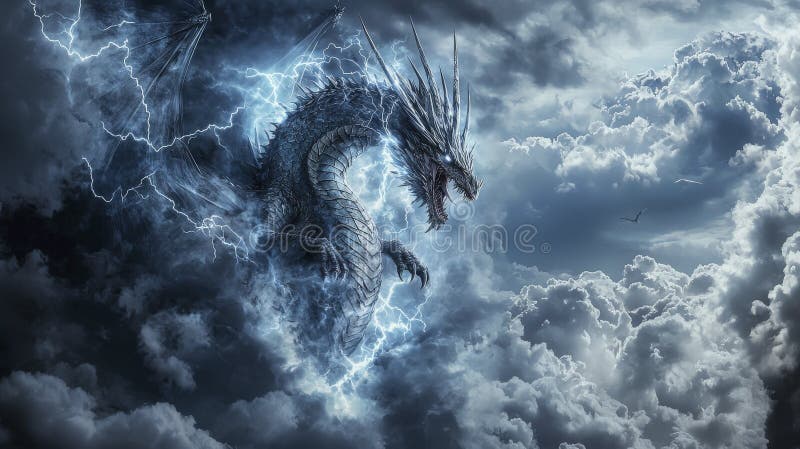
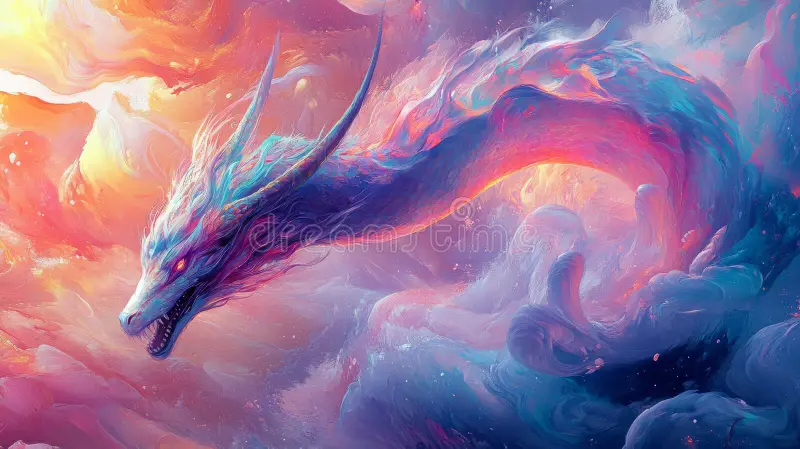
A colossal atmospheric dragon whose body is primarily composed of compressed cumulus cloud material solidified into biological form — the wings are literally functioning weather systems, trailing precipitation as it glides, its breath not fire but a focused warm-front that reshapes local weather for days after, the scale requiring it to be photographed from orbit to show the full body, emerging from a storm system that is also partially its own anatomy, natural history illustration style of Ernst Haeckel’s Kunstformen der Natur applied to meteorological organisms, the body following real atmospheric dynamics — pressure gradients visible as colour shifts –ar 16:9 –v 7 –stylize 600
Prompt 22
The Mnemovore — a creature that feeds on collective memory
A creature that sustains itself by consuming shared cultural memories — its physical form reflects what it has recently fed upon, currently mid-absorption of a city’s memory of its founding myth, its body showing images and architecture from that founding period as iridescent surface patterns fading from vivid to grey as they’re metabolized, it moves through a contemporary urban environment being entirely ignored because the collective attention needed to perceive it is exactly what it consumes, academic naturalist illustration crossed with photographic realism, the creature rendered with the same clinical detail as a natural history plate
Prompt 23
The Living Equation — mathematical truth given organism form
A massive organism whose body is the physical embodiment of a fundamental mathematical constant — its segments repeat in precise Fibonacci proportions, its movement traces perfect logarithmic spirals through water, its bioluminescent patterns are literal expressions of the equations describing wave interference, encountered by a deep-sea research vessel at 3,000 meters — the vessel giving scale and the scientific context for documentation, deep blue-black abyssal environment with the creature’s own emission as the only light source, scientific illustration with the precision of David Attenborough-era BBC nature graphics –ar 16:9 –v 7 –stylize 520
Prompt 24
The Threshold Guardian — made entirely from the material of transitions
A guardian entity standing at a doorway whose body is composed of the physical material of in-between states — the morning-not-yet-morning grey before dawn, the specific quality of hesitation before a decision, the exact texture of an ending-but-not-yet-ended friendship, these abstract states given material form as different zones of its body — its hands dawn-grey, its torso the texture of hesitation (slightly translucent, constantly almost-solidifying), its face an ending’s strange sad warmth, the doorway behind it a realistic architectural threshold into a library, photorealistic figure painting quality, warm shadows, no supernatural effects — the magic is entirely in the materiality
Prompt 25
The Migrating Archive — a library that moves like a flock
Thousands of books in migratory formation across an autumn sky, the flock exhibiting murmuration behavior — books spiraling in coordinated sweeping arcs, the entire formation changing shape like a starling murmuration, some books open mid-flight showing illuminated manuscript pages that trail gilt light, flying above a landscape of bare harvest fields and a lone figure below watching with binoculars as if birdwatching, the formation currently spelling nothing recognizable but in the previous moment spelled a sentence, watercolor and ink, the sky a Turner storm-sky in burnt orange and pewter –ar 16:9 –v 7 –stylize 600 –chaos 12
No light source
If your prompt doesn’t specify where the light originates, the model picks “cinematic” by default. That means: warm front-left fill with soft shadows. Every fantasy image defaults to this. Name the light source — its position, colour temperature, and what it does to the surfaces it hits.
Scale ambiguity
“Vast” and “enormous” are aesthetically useless. Use physical reference: a specific human figure at a percentage of frame height, a known object at a specific distance, or a measurement. “40 meters” does more work than “massive.”
Generic style references
“Digital painting” activates the average of everything in that training category. A specific artist collision — “Ernst Haeckel crossed with Moebius” — creates a smaller, more distinctive target that the model can’t easily average away.
Too many magic effects
Every glowing orb, particle trail, and radiant energy beam is the model filling space with visual noise. Most of the best outputs here have one light source and no decorative magic effects. Constraint produces elegance.
Narrative over visual
“A wizard who has just completed a dangerous spell and is exhausted but triumphant” is a story. “A wizard, standing, deep shadows under eyes, one hand still outstretched palm-up, the spell still dissipating as blue smoke” is a visual. The model generates images, not stories.
Wrong –stylize for the intent
High stylize (700+) makes beautiful, surprising images that ignore your prompt specifics. Low stylize (0–200) follows your prompt but looks flat. The prompts above note the right range for each intent. Don’t default to one value for everything.
The mistake I make most often — and I’ve run several hundred of these prompts — is confusing atmosphere with description. Atmosphere is what the space feels like from inside it. Description is what it looks like from outside. “Ancient forest” is description. “The specific quality of light at 4am in old growth where the canopy is complete” is atmosphere. The model responds to both, but atmosphere produces the images that make people stop scrolling.
For a deeper breakdown of prompt engineering mechanics, including the parameter interactions I haven’t covered here, the prompt engineering library on bestprompt.art → has the technical detail.
⚠ Honest scope note
I’ve tested these on Midjourney V7 (via Discord), FLUX 1.1 Pro (via Fal.ai and Replicate), and DALL-E 3 (via ChatGPT Plus). I haven’t tested on Leonardo Phoenix, Ideogram 2.0, or the newer Stable Diffusion 3.5 variants. The structural principles will transfer — the specific parameters won’t. If you’re working on those platforms, use these as conceptual frameworks rather than copy-paste solutions. Also: Midjourney V8 features (moodboards, style references) will likely change which prompts produce the strongest results — I’ll update this piece when V8 stabilizes publicly.
Do these prompts work on Midjourney’s web interface or only Discord?
Both. Midjourney’s web interface (midjourney.com) now has full parameter support. The prompts above with parameters like
--v 7 --stylize 500 work identically in both environments. Draft Mode, introduced with V7, is available on both platforms and worth using for initial iterations — it’s roughly 10x faster and half the cost, per Midjourney’s own documentation.Why do some prompts specify –stylize values and others don’t?
Stylize controls how much Midjourney’s trained aesthetic preferences override your prompt specifics. High values (600+) produce more beautiful, surprising images but may deviate from unusual instructions. Lower values (300–450) follow the prompt more literally. For conceptually unusual prompts (like Prompt 24, the Threshold Guardian), lower stylize preserves the specificity. For atmospheric landscape prompts where the concept is fairly standard and you want maximum beauty, higher stylize helps. FLUX and DALL-E 3 don’t have this parameter — they have different controls not listed here.
Can I combine multiple prompts from different categories?
Yes, but with care. The prompts that combine well are ones with compatible lighting logic. “Spore Cathedral” (Prompt 02) + “Wound Library” (Prompt 11) both use interior scenes with ambient biological light — they can be merged relatively cleanly. Combining a landscape scene with a portrait scene typically requires choosing which is primary and demoting the other to background or context.
What’s the actual output size / resolution from these generators?
As of mid-2026: Midjourney V7 standard upscale produces approximately 1456×816 pixels at 16:9, roughly 2MP. The “Upscale (Creative)” option reaches around 5.5MP. FLUX 1.1 Pro via API outputs at 1024×1024 base with upscaling available to 2048×2048. For print use, all of these require further upscaling — I’ve had good results with Topaz Gigapixel AI and Magnific AI for 4x upscaling without visible degradation on fantasy art specifically.
Is there a commercial use restriction on images generated by these tools?
This is the area most subject to change, and I’d check current terms directly rather than trusting any guide including this one. As of mid-2026: Midjourney Pro subscribers generally have commercial rights; free tier does not. FLUX models via Fal.ai follow the Black Forest Labs license (permissive for commercial use currently). DALL-E 3 outputs are owned by the user per OpenAI’s current terms. These terms change — check Midjourney’s current terms and Black Forest Labs’ terms directly before commercial use.
How do I get consistent results across multiple images from the same prompt?
For Midjourney: lower –chaos (0–5) and avoid –weird. The –seed parameter locks the initial noise so regeneration produces similar compositions — use it when you want to iterate on one composition rather than explore. For FLUX: the model is naturally more consistent than Midjourney, but using the same seed value across generations is still the most reliable consistency tool. Character consistency across multiple images is a known limitation of all current text-to-image systems — it requires either inpainting workflows or character reference features (Midjourney V8 promises improvements here).
What’s the fastest way to learn which part of a prompt is producing which visual element?
Ablation testing. Take a prompt you like and remove one element at a time, regenerating each time. When you remove “pre-dawn bioluminescent spores” and the fog quality changes, you’ve identified that phrase as the active atmospheric element. Most prompt engineers I’ve talked to skip this step and wonder why their variations don’t work — the answer is usually that they modified a word they thought was decorative that was actually doing structural work.
The prompts above will be partially wrong within a year — not because they’re bad, but because the models will be different. What won’t change: a scene needs physics, light needs a source, and “fantasy” is a genre, not a substitute for thinking about what you actually want to see.