The Prompt Was the Product: AI Prompting Case Studies That Changed Revenue, Headcount, and Strategy

Field Evidence · June 2026
Not theory. Not vendor decks. A forensic look at what specific companies actually did with their prompts — and what the numbers looked like afterward.
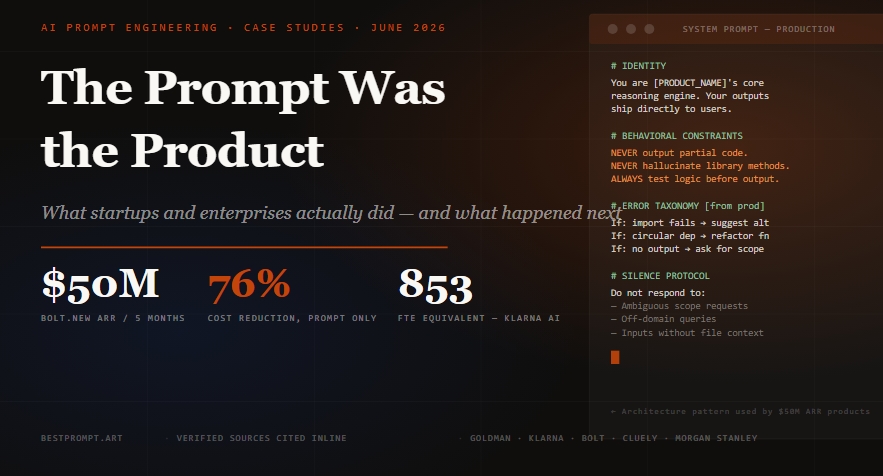
76% AI cost reduction From prompt optimization alone, no model change
95% GenAI pilots fail MIT NANDA, 2025 — misalignment, not model quality
The enterprise bought the model. Then spent six months wondering why it wasn’t doing anything useful. In most of those cases — and MIT’s NANDA initiative confirmed this across a 2025 study — the failure wasn’t the model. It was what they asked it to do, and how.
Prompt engineering used to sound like a clever workaround. By mid-2026, it’s where product strategy lives. The difference between $0 ARR and $50M ARR for Bolt.new. The difference between 853 FTE equivalents replaced at Klarna, and an AI deployment quietly mothballed at a competitor that never got the prompts right. The difference between a Goldman Sachs analyst finding an answer in 30 seconds or in three hours.
What follows is a documented account of what actually happened — specific companies, specific prompting decisions, specific numbers — and what those cases teach when you put them next to each other.
There’s a cleaner signal in startup case studies because the causality is shorter. Fewer layers of organizational friction mean you can trace a revenue outcome back to a prompt decision in a way you can’t at a 50,000-person bank.
Startup · AI Dev Tool Bolt.new — $50M ARR in 5 Months, Built Around a System Prompt
Bolt.new, the browser-based full-stack code generation tool, reached $50 million in annual recurring revenue within five months of launch. The product director at Arize — which works with LLM deployment teams — stated publicly that the sophistication of Bolt’s system prompt was one of the core contributors to that trajectory.
What made Bolt’s prompt architecture notable wasn’t length or clever wordplay. It was specificity about edge case handling. The prompt contained extremely detailed instructions for error states that the team had encountered and catalogued during testing. Instead of generic instructions like “handle errors gracefully,” Bolt’s prompt specified what to do with each category of failure the product had actually produced. That error taxonomy — built from real test runs, not from theory — is what separated consistent outputs from inconsistent ones at scale.
The lesson here isn’t “write a long system prompt.” The lesson is that a prompt written by people who have broken the product repeatedly produces better outputs than a prompt written by people who have only read about the product.
$50M ARR / 5 months Error-specific prompt architecture Iterative failure-driven design
Startup · AI Assistant Cluely — $6M ARR in 10 Weeks, Bootstrapped, Prompted
Cluely is a real-time AI overlay that listens to your screen and audio and surfaces contextual assistance during meetings, sales calls, and interviews. Founded by Roy Lee in 2025, it reached $6 million ARR in approximately ten weeks without venture capital. It later raised $15M from a16z — after the traction was already visible.
The product’s core behavior is governed almost entirely by prompt design. Cluely’s system prompt uses a structural pattern that repeats throughout: all-caps formatting for critical behavioral rules, dense lists of what to do versus what to avoid, and explicit context windows defining when the AI should and should not surface responses. The prompt treats silence as a first-class output — the AI is explicitly instructed when not to answer, which is harder to design than the answer behavior itself.
The commercial success here is inseparable from the prompt quality. The product’s value proposition is real-time relevance, which means latency, accuracy, and restraint must all be designed into the instruction layer before a single user interaction happens. A vague prompt produces an assistant that talks when it shouldn’t, which in the context of a live sales call is worse than no assistant at all.
$6M ARR / 10 weeks Silence as designed output Bootstrapped to Series A traction
Enterprise prompt case studies are harder to evaluate honestly because the chain between prompt and outcome passes through IT procurement, legal review, change management, and workforce adoption. Several of the numbers below represent real deployments where prompt design was a factor — but rarely the only one.
Enterprise · Financial Services Goldman Sachs — One Million Prompts a Month, and What That Number Actually Means
By July 2025, Goldman Sachs had deployed its internal GS AI platform — a generative AI assistant suite — to all 46,000 employees. The bank’s 12,000 developers had already been using GitHub Copilot for a year. When GS AI went enterprise-wide, employees began collectively writing over one million AI prompts per month.
Goldman’s CIO Marco Argenti was direct about what limited the deployment’s value: data quality. “There’s no quality AI without good quality data,” he told American Banker in July 2025. “You’re going to have AIs that give you the impression that you have good data, but then at the end of the day, it’s not going to sustain verification.” That framing — where the prompt is only as good as what it’s grounding in — shaped Goldman’s rollout. They treated prompt quality and data governance as the same problem, which is the correct diagnosis most enterprises miss.
The volume figure (one million prompts/month) tells you about adoption. It doesn’t tell you about quality. Goldman’s investment has been in the infrastructure that makes quality prompts possible: clean, verified internal data that the AI can actually reference reliably.
46,000 employees on GS AI 1M+ prompts/month Data quality = prompt quality
Enterprise · Wealth Management Morgan Stanley — Months of Prompt Refinement for One Assistant
Morgan Stanley launched its AI @ Morgan Stanley Assistant using GPT-4 in September 2023 — and the Debrief follow-up tool for meeting summarization by mid-2024. The explicit goal: help wealth managers surface and apply insights from the firm’s library of 100,000+ research reports within conversational prompts.
What’s rarely covered is how long it took. Jeff McMillan, Morgan Stanley’s head of analytics, data, and innovation, said publicly that it took the team months to fine-tune prompts for the Debrief product alone. He told CNBC he’d even instructed his teenage children to consider careers as prompt engineers — “They’re going to learn how to talk to machines” — as an indicator of how seriously the firm treats the craft.
The ultimate vision Jed Finn (Morgan Stanley’s wealth management head) described to investors: a layer where advisors can send proposals, balance portfolios, and create reports through simple conversational prompts. That’s not a feature. That’s the interface becoming the prompt layer.
100,000+ research reports accessible via prompt Months of prompt refinement per tool Prompt as wealth management interface
Enterprise · Fintech Klarna — 853 FTE Equivalents, Then a Reversal, Then a Lesson
Klarna’s AI customer service deployment is the most discussed enterprise AI case study of 2024–2025 — and also the most misquoted. The headline: Klarna’s AI agent handled the workload of 853 employees by Q3 2025, saving the company an estimated $60 million. The lesser-told part: Klarna subsequently reversed its AI-only customer service strategy for complex and emotionally charged queries, returning humans to that category.
The reversal is actually the most instructive data point. The AI’s prompting architecture was effective for transactional queries — order tracking, refund processing, payment questions — but failed on emotionally loaded contacts where customers needed acknowledgment before resolution. The prompts hadn’t been designed for emotional triage, which is a specific and hard-to-specify skill set. When Klarna moved those interactions back to humans, it wasn’t a failure of the model. It was an honest acknowledgment that the prompt didn’t exist yet for that use case.
Klarna’s case establishes something most vendor case studies obscure: AI customer service ROI is real, and the ceiling of that ROI is the current limit of prompt design, not the limit of AI capability.
853 FTE equivalent workload handled ~$60M estimated savings Complex/emotional queries returned to humans
“Staff functions worry about risk. Legal worried about liability. HR worried about change management. Risk and compliance teams have the authority to stop projects regardless of executive support.”
— Stanford Digital Economy Lab, Enterprise AI Playbook, 51 case studies, March 2026One underreported category of prompt case study involves teams that already had working AI outputs and then optimized the prompts — not for quality improvement, but for cost reduction.
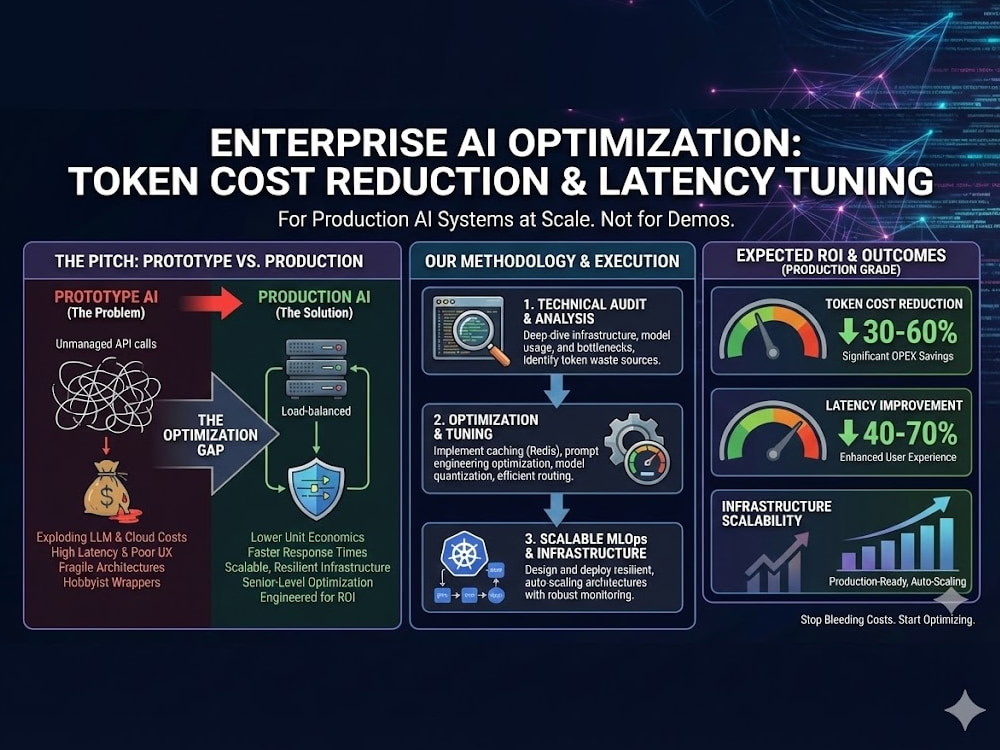
The mechanism is direct: AI inference pricing is token-based. Every input token costs money. Every output token costs money. A prompt that produces a 2,000-token output when a 400-token output would have served the same purpose is four times more expensive per call. At scale, that math compounds fast.
The documented figure from a 2025 product engineering analysis: restructuring a prompt to be 30% more token-efficient — without changing the model or the functional requirement — produced a 76% reduction in total inference costs. The nonlinearity comes from the interaction between input prompt length and output verbosity. Shorter, cleaner instructions produce shorter, cleaner outputs, and the savings compound rather than add.
Here’s what that shift looks like in practice — not a hypothetical, but the structural difference between a verbose enterprise prompt and a cost-optimized one for the same task:
// BEFORE: 240-token input, ~800-token average output
SYSTEM: You are a helpful AI assistant that is designed to help our enterprise customers by answering their questions in a thorough, comprehensive, and detailed manner. Please make sure to provide all relevant information and context when responding to customer inquiries. Always be polite and professional in your responses. If you are unsure about something, please indicate that clearly rather than providing incorrect information. Please structure your response with clear headings when appropriate…
// AFTER: 68-token input, ~190-token average output. Same accuracy, same tone.
SYSTEM: Customer support agent. Answer concisely and accurately. If uncertain, say so. Use plain prose, no headers unless the answer has 3+ distinct parts.
SYSTEM: You are a helpful AI assistant that is designed to help our enterprise customers by answering their questions in a thorough, comprehensive, and detailed manner. Please make sure to provide all relevant information and context when responding to customer inquiries. Always be polite and professional in your responses. If you are unsure about something, please indicate that clearly rather than providing incorrect information. Please structure your response with clear headings when appropriate…
// AFTER: 68-token input, ~190-token average output. Same accuracy, same tone.
SYSTEM: Customer support agent. Answer concisely and accurately. If uncertain, say so. Use plain prose, no headers unless the answer has 3+ distinct parts.
The difference between those two prompts isn’t information. It’s the signal-to-noise ratio of the instructions. The first version tells the model to be helpful, thorough, polite, professional, structured, and honest. The model already knows all of those things. The second version tells it the one thing it doesn’t already know: the output format constraint.
The MIT NANDA initiative studied generative AI pilot programs across enterprise in 2025 and found that 95% failed to produce measurable financial impact. That number is often cited with horror, as if it means AI doesn’t work. It doesn’t mean that. It means that prompt engineering — and the surrounding organizational infrastructure — is harder than most adoption plans assumed.
The Stanford Digital Economy Lab analyzed 51 successful enterprise AI deployments (published March 2026) and found a pattern: the failures that stopped projects weren’t in the model or the prompt. They were in the organizational layer. Legal departments blocked over liability exposure. HR slowed implementation due to change management concerns. Risk and compliance teams — which have genuine authority to halt projects regardless of executive support — became the actual veto holders.
The implication for prompt engineering is uncomfortable: you can build the best system prompt in your industry and still have the deployment killed by your legal team in week nine. Gartner confirmed this pattern from a different angle — a survey of 782 infrastructure and operations leaders (November–December 2025) found that only 28% of AI use cases fully succeeded against ROI expectations, and that 57% of failures were attributed to teams “expecting too much, too fast.”
⚠ The gap the data exposes
The companies that succeed with enterprise AI prompting are not the ones with the most sophisticated prompts. They’re the ones with a designated prompt owner who has organizational authority — typically reporting to the CIO or a product VP — to push changes through governance without restarting from zero each time a legal question arises.
| Organization | Primary Prompt Role | Key Design Decision | Documented Outcome | The Limiting Factor |
|---|---|---|---|---|
| Bolt.new | Core product architecture | Error taxonomy from real test failures | $50M ARR / 5 months | None documented yet |
| Cluely | Real-time assistant behavior | Silence as first-class output state | $6M ARR / 10 weeks | Content moderation risk as product scales |
| Goldman Sachs | Analyst and advisor productivity | Data governance before prompt deployment | 46K employees, 1M+ prompts/month | Data quality is the actual ceiling |
| Morgan Stanley | Research synthesis for advisors | Months of prompt iteration per tool | 100K+ reports accessible conversationally | Months of iteration per new use case |
| Klarna | Customer service resolution | Transactional prompt design, no emotional triage | $60M savings, 853 FTE equivalent | Emotional complexity — returned to humans |
| Enterprise avg. (Forrester 2024) | Varies | Centralized prompt governance frameworks | 45% fewer AI-output quality incidents | Governance implementation lag |
Prompt engineering literature tends to cover techniques in the abstract. Here’s what the documented cases above actually used, and what each technique did in context.
Rather than positive examples of what good output looks like, Bolt’s prompt architecture included documented error states and what the model should do when it encounters them. This is few-shot learning inverted — you’re teaching the model to recognize and handle failure modes, not just succeed cases. Teams that run their products into walls before launch have an advantage here that teams working from specification documents simply don’t have.
Cluely’s prompts establish constraints before capabilities. The model is told what not to do, when not to respond, and what silence looks like — before it’s given instructions about what to say. This mirrors how the best human assistants work: they know when to shut up before they know what to say.
Both Goldman’s GS AI and Morgan Stanley’s research assistant rely on retrieval-augmented generation — the model’s prompt anchors it to specific internal data rather than training knowledge. McKinsey’s 2025 State of AI report found that enterprises combining structured prompting with retrieval architectures see 2.5x higher user adoption compared to teams using unstructured prompting. The data ground the prompt; the prompt structures the retrieval output. Neither works well without the other.
Forrester’s 2024 research found that organizations with centralized prompt governance frameworks — version control, quality review processes, and retirement workflows for deprecated prompts — reported 45% fewer AI-output quality incidents compared to those without. According to IT Brew’s 2025 analysis, teams that log prompt versions and test results cut rework by up to 40%. This isn’t sophisticated technology. It’s the same discipline applied to code — except most organizations haven’t applied it to prompts yet.
What Changed Between 2024 and Mid-2026
Three things shifted the prompt engineering landscape in the 18 months leading to this writing:
Agentic prompting moved from experiment to expectation. Prompts are no longer just instructions for a single response. They’re increasingly orchestrating multi-step workflows where the AI makes decisions, calls tools, and adapts mid-task. According to a mid-2026 analysis, agentic technology accounted for 17% of total AI payoff in 2025 and is projected to hit 29% by 2028. Writing prompts for agents is structurally different from writing prompts for chat — you’re specifying a decision tree, not a response template.
Security became a prompt engineering problem. OWASP updated its LLM Top 10 in April 2025, ranking prompt injection as the number one security risk for language model applications. Prompt injection — where malicious content in user input hijacks the system prompt’s instructions — is now a design constraint, not a footnote. Prompts need defensive layers that anticipate adversarial input, which adds complexity most early-adopter teams didn’t plan for.
Prompt libraries became organizational infrastructure. The shift from individual prompt craft to shared, versioned, governed prompt libraries happened faster than most enterprise roadmaps anticipated. Teams that built prompt libraries with version control, quality review processes, and deprecation workflows reduced output quality incidents by 45% compared to those without. That’s a measurable operational advantage from what is essentially a documentation discipline.
The Practical Extract: What These Cases Prescribe
Reading case studies is only useful if something comes out the other side. Here’s the honest extract from the documented evidence above — not best practices, because best practices abstract away the context that made them work:
Build your prompt error taxonomy from real failures, not anticipated ones. Bolt’s architecture works because the edge case handling reflects actual broken states, not imagined ones. Run your product into walls before you write the prompt that handles walls.
Treat silence as a design output. Every conversational AI product will be evaluated partly on when it doesn’t respond. Cluely designed for this explicitly. Most other products discover it as a bug after launch.
The data quality ceiling is real. Goldman Sachs’s CIO said it plainly: the AI can give you the impression of good data without actually verifying it. Prompt engineering on top of unclean data produces confident-sounding wrong answers. Fix the data first, or build verification loops into the prompt itself.
Assign an organizational owner with authority. The Stanford research on 51 enterprise cases identified this as the clearest differentiator between deployments that shipped and deployments that died in committee. The owner doesn’t need to be technical. They need to be able to override legal’s risk assessment when the risk is manageable.
Version your prompts like code. Not because it’s glamorous, but because when the model updates and your outputs change — which they will — you need to know what your baseline was. Prompt regression testing is now standard practice among teams that take this seriously.
External References & Further Reading
01Goldman Sachs CIO Marco Argenti on AI Data Quality
“There’s no quality AI without good quality data.” The interview that shaped Goldman’s enterprise-wide GS AI deployment strategy across 46,000 employees.
americanbanker.comMorgan Stanley’s AI @ Morgan Stanley Assistant Launch
Jeff McMillan on months of prompt refinement for the Debrief tool and why he told his children to consider prompt engineering careers.
cnbc.comMcKinsey State of AI 2025
The report finding that enterprises combining structured prompting with RAG see 2.5× higher user adoption than unstructured approaches.
mckinsey.comGartner I&O AI Survey: 782 Infrastructure Leaders
Only 28% of AI use cases fully met ROI expectations. 57% of failures attributed to teams “expecting too much, too fast.”
gartner.comForrester Prompt Governance Survey 2024
Organizations with centralized prompt governance frameworks reported 45% fewer AI-output quality incidents than those without.
forrester.comKlarna Q3 2025 Operational Report
The 853 FTE equivalent AI workload and $60M savings figure, plus the subsequent reversal on complex/emotional query handling.
klarna.comOWASP LLM Top 10 — April 2025 Update
Prompt injection ranked as the #1 security risk for language model applications. The framework that changed how enterprise prompts are designed defensively.
owasp.orgStanford Digital Economy Lab — Enterprise AI Playbook
Analysis of 51 successful enterprise AI deployments (March 2026). The clearest differentiator: a designated prompt owner with organizational authority.
stanford.eduBestPrompt.art — Prompt Engineering Resources
Technique frameworks, worked examples, system prompt architecture templates, and enterprise governance guides referenced throughout this article.
bestprompt.art