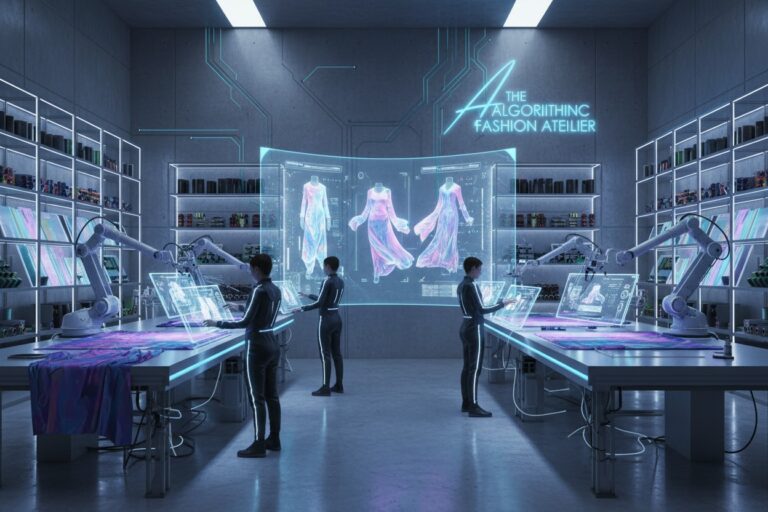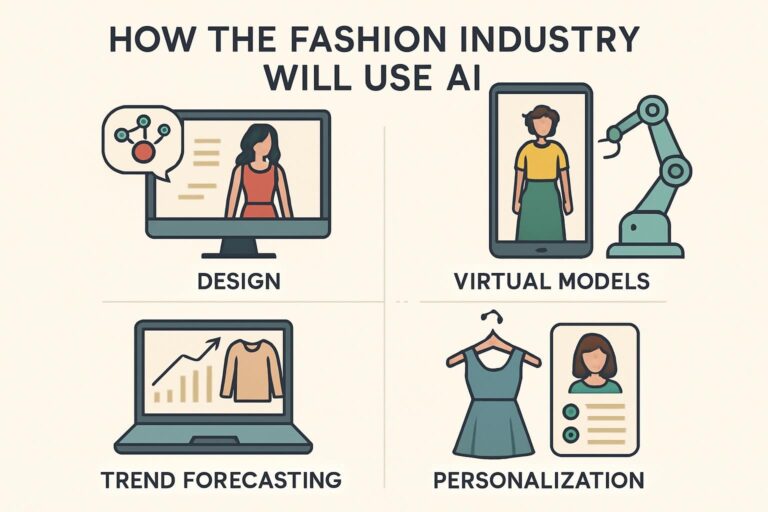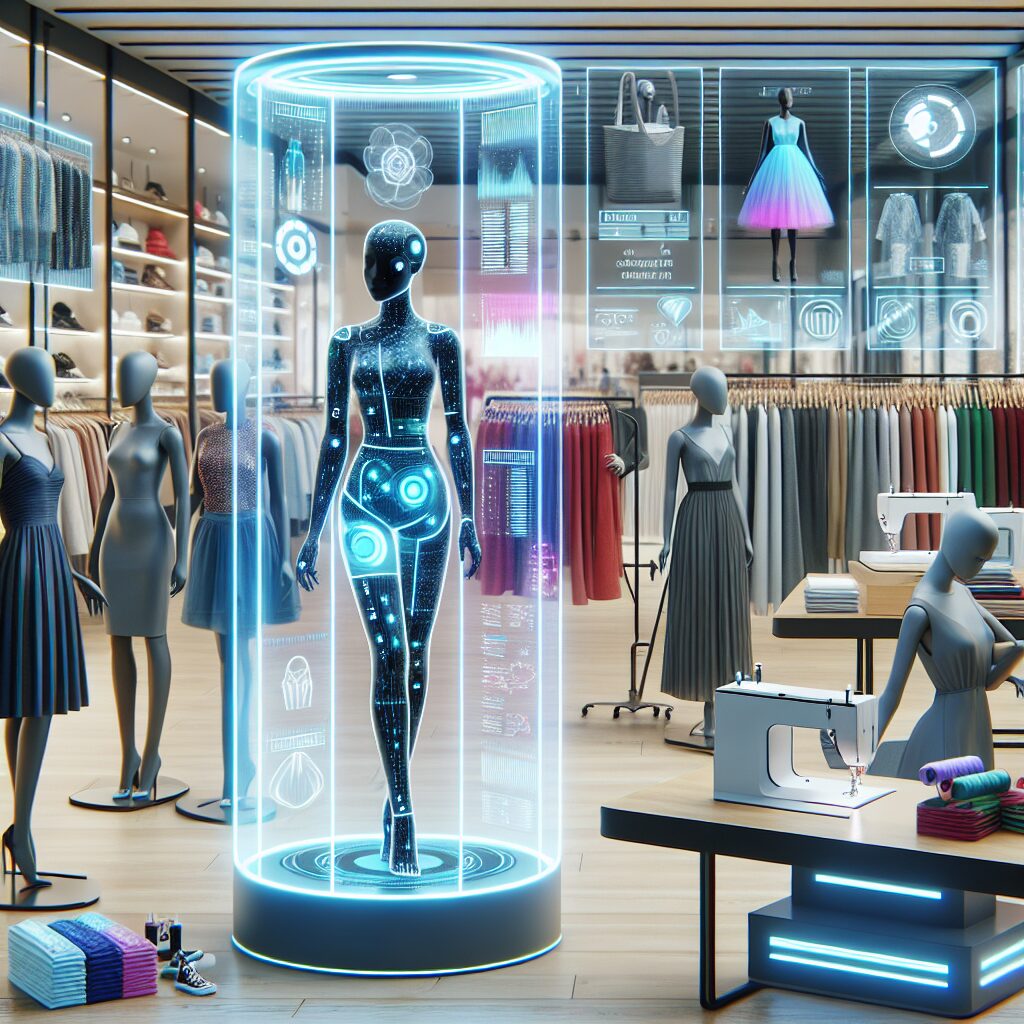
From generative design to zero-waste supply chains — the complete, data-backed guide to artificial intelligence in the fashion industry.
- AI is projected to add $275 billion in value to the fashion industry by 2030
- Brands using AI-driven trend forecasting reduce overstock by up to 40%
- Generative design tools have cut concept-to-sample time from weeks to hours
- AI personalization lifts conversion rates by 20–30% for early adopters
- The sustainability impact is real: AI-optimized supply chains cut fabric waste by 15–20%
I’ll be honest — when I first started tracking AI’s role in fashion a few years ago, I expected mostly hype. A few chatbot stylists. Some auto-generated mood boards. The usual tech-meets-culture theater.
What’s actually happening is weirder, more significant, and — in places — genuinely beautiful. AI isn’t just speeding up processes that already existed. It’s changing what gets made, who decides, and what reaches the waste bin.
This guide covers the full picture: the mechanics, the real numbers, the tools, the hype vs. reality, and where the industry is actually headed. Let’s get into it.
1. What AI Actually Does in Fashion (and What It Doesn’t)
There’s a persistent fantasy that AI is designing clothes autonomously — that some server farm somewhere is dreaming up next season’s silhouettes. That’s mostly fiction, at least for now.
What AI actually does is less cinematic but more immediately useful. Think of it as an extraordinarily fast pattern-recognition engine that can process signals no human team could handle at scale. Social media sentiment, historical sales data, satellite imagery of retail car parks, even weather forecasting — all of it gets fed in, and out comes analysis that helps designers and buyers make better decisions faster.
Related: Prompting AI for Creative WorkThe pipeline looks something like this:
Social, sales, trends
Pattern recognition
Generative concepts
Optimized production
Right product, right person
Each node in that pipeline is where real AI applications are being deployed right now. Let’s walk through them one by one.
2. Trend Forecasting: The Crystal Ball Gets a Processor
Traditional trend forecasting relied on a small number of expert consultants, trade shows, and an almost mystical sense of cultural timing. Firms like WGSN built entire empires on this. Good at it? Yes. Scalable? Not really. And when COVID hit, most of those forecasts became landfill-worthy overnight.
AI-driven forecasting is a different beast entirely. Platforms like Trendalytics and Heuritech ingest millions of social media images per day, tagging visual attributes — collar styles, fabric textures, hemline lengths — and tracking their frequency over time. The system doesn’t have taste. But it has something arguably more valuable: it’s watching everything, simultaneously, without getting tired or distracted.
“Brands that adopted AI forecasting in 2023 reported up to 40% less deadstock by the following season. That’s not a marginal improvement — that’s a structural shift.”
Heuritech, for example, works with LVMH and other luxury houses to predict micro-trend trajectories 12–18 months in advance. They claim accuracy rates that exceed traditional methods — and the data backs them up. Louis Vuitton reportedly used trend AI to inform its SS24 buying decisions, resulting in significantly reduced markdowns.
The catch — and there’s always a catch — is that AI forecasting mirrors existing preferences rather than inventing new ones. It’s reactive by nature. You still need the creative director with the weird idea that breaks the mold. The AI is better understood as a risk-reduction tool rather than a creativity engine. Use it to know when to take a swing, not what to swing at.
See also: AI Tools for Creative Professionals3. Generative Design: The Part That Actually Surprised Me
I’ll admit — I was skeptical about AI-generated fashion design. Most early examples looked like midjourney hallucinations wearing clothes. Technically impressive, commercially useless.
The serious applications are more nuanced. Designers at Stitch Fix, Zalando, and a handful of independent studios are now using generative models not to replace their sketching process but to compress it. You describe a concept, the model generates 50 rough visual interpretations, you pick the two that resonate, you iterate. What used to take a week of mood boarding takes an afternoon.
How Generative Design Actually Works in Practice
- Brief input: Designer describes the brief — mood, season, target demographic, key garment
- Concept generation: The AI produces dozens of visual concepts based on the brief
- Curation: Designer selects promising directions (this part is still 100% human)
- Iteration: Selected concepts are refined with additional AI passes or manual sketching
- Handoff: Final concepts go to pattern makers and sample rooms as they always did
Tommy Hilfiger ran a highly publicized experiment in 2023 where AI-generated concepts were included in a design competition alongside human submissions. Judges couldn’t reliably distinguish them. That’s not to say AI designs are better — it’s to say the tool has reached a threshold of competence that makes it genuinely useful.
The materials optimization angle is where it gets particularly interesting. Researchers at MIT’s Media Lab have developed AI systems that can generate pattern pieces optimized to minimize fabric waste before a single physical sample is cut. Early tests suggest 15–20% waste reduction. For an industry that generates an estimated 92 million tons of textile waste per year, that’s not trivial.
4. Personalization at Scale — Finally Actually Working
Here’s something I’ve said for years: personalization in e-commerce was mostly a lie. “Customers who bought X also bought Y” is correlation, not understanding. It’s useful but it’s not personal.
What’s changed is the depth of the models. Companies like Stitch Fix have published detailed technical papers on how they use a combination of explicit preference data, implicit behavioral signals, and multi-armed bandit algorithms to serve genuinely personalized recommendations — not just “similar items” but predictions of what an individual customer will want next, accounting for their style evolution over time.
Virtual try-on technology has quietly matured too. The early versions were cartoonish. Current implementations — Snap’s AR tools, Amazon’s virtual fitting room, Zara’s own AR experience — are genuinely useful. Zalando published research showing that AR try-on reduced return rates by 36% in their test group. Returns are fashion’s dirty secret: they cost the industry an estimated €30 billion per year in Europe alone. Anything that dents that number matters enormously.
5. Supply Chain: The Least Glamorous, Most Important Application
Nobody photographs a supply chain. It doesn’t make it onto mood boards. But if you want to understand where AI is creating the most concrete, measurable value in fashion right now, it’s here.
The core problem is inventory. Fashion supply chains operate on absurdly long lead times — 6 to 18 months from concept to shelf for many brands — and incredibly uncertain demand. The result is a chronic cycle of overproduction and clearance sales that destroys margins and creates mountains of waste.
| Metric | Traditional Supply Chain | AI-Optimized Supply Chain | Improvement |
|---|---|---|---|
| Forecast accuracy (6-month) | ~60–65% | ~80–85% | +20–25 pts |
| Overstock rate | ~20–30% of production | ~10–18% of production | –40% avg |
| Markdown depth | 40–60% off average | 25–40% off average | Shallower |
| Lead time reduction | Baseline | 15–25% faster | Faster to market |
| Fabric waste per unit | Baseline | 15–20% reduction | Significant |
H&M, for all its sustainability controversies, has made real investments in AI demand forecasting. The company partnered with Google Cloud to build models that integrate store-level sales data with local weather, events, and demographic signals. Early results showed meaningful reductions in end-of-season clearance volumes in pilot markets.
Explore: AI Prompting for Data Analysis6. The Timeline: How We Got Here
Basic collaborative filtering drives “customers also bought” features. Limited personalization. Data infrastructure begins to mature.
Image recognition enables visual search and auto-tagging. Stitch Fix publishes landmark papers on hybrid human-AI styling. Brands begin serious AI investment.
Supply chain disruption forces brands to invest in better forecasting. Virtual try-on becomes commercially viable. AI design tools emerge from research labs.
Midjourney, DALL-E, and purpose-built fashion tools let designers generate visual concepts at unprecedented speed. Debate ignites about authorship and creativity.
Leading brands run end-to-end AI optimization across design, production, logistics, and retail. New roles emerge: AI stylist, prompt director, algorithmic buyer.
7. Myths vs. Reality: Let’s Clear Some Things Up
There’s a lot of noise around AI in fashion — from breathless hype to reflexive dismissal. Here’s what the data and industry reporting actually support:
8. Sustainability: Where the Stakes Are Highest
Fashion is one of the world’s most polluting industries. Estimates vary widely, but a commonly cited figure puts fashion’s share of global carbon emissions at around 10% — more than aviation and shipping combined. The textile waste figure is staggering: 92 million tons per year globally, much of it preventable overproduction.
This is where AI’s impact could be most significant — and where the gap between potential and current reality is also widest.
AI’s Proven Sustainability Applications (with data)
- Demand forecasting accuracy improvements directly reduce overproduction. McKinsey estimates AI forecasting could prevent 10–15% of all fashion waste generated by overproduction annually.
- AI pattern optimization (companies like Browzwear) can reduce fabric waste per unit by 15–20% by calculating more efficient cut layouts.
- Virtual sampling eliminates physical samples in early design stages. Adidas estimates it has eliminated thousands of physical samples by adopting 3D digital prototyping tools.
- Resale and circularity AI (ThredUp, The RealReal) uses computer vision to authenticate, grade, and categorize secondhand garments at a scale impossible with human labor alone — making circular fashion viable at mass market scale.
The honest caveat: AI itself is not free of environmental cost. Training large models requires significant compute energy. Data centers consume water. The net benefit calculation requires actually measuring both sides. For now, the evidence suggests the efficiency gains outweigh the compute costs for most applications — but that requires scrutiny, not assumptions.
9. Frequently Asked Questions
How does AI predict fashion trends?
Is AI replacing fashion designers?
Can small fashion brands use AI tools?
What are the risks of AI in fashion?
Which luxury fashion brands are using AI?
Where Does This Leave Us?
If you’ve made it this far, you probably came in with some skepticism — or maybe some anxiety — about what AI means for an industry built on craft, taste, and human creativity. I hope what I’ve laid out is neither a utopian sales pitch nor a dystopian warning.
The honest picture is: AI is a genuinely powerful tool that’s already changing how clothes get designed, made, and sold. The brands using it intelligently — as an augmentation layer on top of real expertise, not a replacement for it — are seeing real results. The brands treating it as a silver bullet are finding it falls short.
The sustainability question is the one I’m watching most carefully. Fashion’s environmental footprint is a genuine crisis, and the waste-reduction math on AI adoption is compelling. But tools don’t fix systems. AI won’t save fashion if the underlying business model — built on volume, velocity, and disposability — doesn’t change alongside it.
That’s the work that still needs doing. And that part is still on us.
More on AI for Creative Industries →Want to Use AI Better in Your Creative Work?
Explore our curated guides, prompt libraries, and tool reviews — built for designers, founders, and creative professionals who want to actually use AI, not just read about it.
Explore bestprompt.art →Sources & Further Reading
- McKinsey & Company — The State of Fashion 2025
- Vogue Business — AI in Fashion Coverage
- Heuritech — Trend AI Research & Case Studies
- Stitch Fix — Algorithms Tour (Technical Overview)
- WGSN — AI-Powered Trend Forecasting
- MIT Media Lab — Sustainable Textile & Pattern Research
- Zalando Research — AR Try-On Impact Study
- Business of Fashion — Technology Section