The Words You Choose When Prompting: Determine Whether the Answer Is Correct


Prompt Engineering · AI Accuracy · 2026
Not the style. Not the tone. The correctness. Most teams treating keyword selection as a search-optimization problem are solving the wrong thing entirely — and the $4,000 prompt engineering course they bought last quarter is making it worse.
A colleague ran a SQL migration script in November after Claude confirmed it was safe. It was — syntactically. He’d asked: “Is this script okay?” The model replied that the script was well-formed. True. Not the question he needed answered. Three hours of production data, one emergency rollback, two very bad phone calls.
That’s not an AI failure. That’s a keyword failure. The word “okay” has no operational definition in a production database context. The model answered the question he wrote, not the question he meant. The gap between those two things cost $11,000 in engineering time and customer credits that week.
The standard advice — be specific, give context, be clear — doesn’t explain why that happened. Here’s what does.
76pp
maximum output swing from structural framing changes alone — same semantic content, different presentation (Sclar et al., 2024)
4.5pp
accuracy drop from fear/urgency framing vs. neutral — across 5 instruction-tuned models on SuperGLUE benchmark (MDPI, March 2026)
Two numbers. Both sourced. The 76-point swing is the one that should unsettle you — because it comes from research isolating framing alone, with no change to the underlying question or the facts the model has access to. The prompt is the variable. The prompt is always the variable.
When a search engine processes a keyword, it retrieves documents. When a language model processes a word, it does something structurally different: it shifts the probability distribution over every token that follows. Your prompt doesn’t “tell” the model what you want. It shapes the statistical neighborhood where the response gets generated.
“Analyze” and “list” and “diagnose” are not synonyms to a transformer architecture. They carry different inferential signatures — they activate different regions of the training distribution, pull from different genres of text, produce different levels of qualification and hedging. A casual phrase like “what do you think about our churn rate” draws from conversational training data. “Diagnose the primary driver of Q3 churn with reference to cohort retention curves” draws from analytical and domain-specific training data. The information available to the model is identical. The output is not.
This is what most prompt engineering guides never say: the words you choose are not a communication layer. They are input data the model reasons against. Change the words, you change the reasoning.
“Single-prompt evaluations of LLM behavior are unreliable. Formatting changes can swing outputs by up to 76 percentage points. Answer reordering shifts results by 13–75%.”
— Preprint, arXiv:2603.22730 (June 2026) — replications of OpenAI model behavior across prompt variationsMost prompt guides treat keyword quality as a single dial labeled “specificity.” There are at least three separate variables, and they interact in ways that aren’t linear.
Register is the domain-specificity gradient of your vocabulary. “What causes inflation?” and “What are the primary mechanisms of demand-pull versus cost-push inflationary pressure in open economies?” are both valid questions. They don’t produce the same response even when you want the same information — because the second signals domain expertise, which pulls from a more technically grounded distributional region. The casual prompt doesn’t fail. It succeeds at a shallower level. That’s the problem.
HOW REGISTER SHIFTS OUTPUT — SAME TOPIC, TWO REGISTERS
What changes
Casual register
Domain-signaling register
hedging behavior
model over-hedges: “it depends,” “many factors to consider”
model commits to specific claims with qualified precision
example quality
textbook examples, popular analogies
practitioner-level edge cases and failure modes
what gets omitted
exceptions, contested claims, implementation constraints
basic definitions the reader demonstrably already knows
There’s a class of words that don’t describe what you want — they describe how the model should process what you want. Summarize, analyze, compare, diagnose, refute, steelman, audit, enumerate exceptions to. These route the generation process through structurally different inferential chains. They’re not decorative. They’re the actual task specification.
Most enterprise prompts are missing them entirely. “Tell me about our Q3 churn rate” has no operator. It uses the content noun as both subject and implicit request. The model fills the gap with whatever mode felt most probable given the phrasing — usually descriptive, usually shallow, usually correct in a way that’s useless for the decision you’re making.
No operator — description mode
“Tell me about our Q3 churn rate.”
Model produces a description. Accurate. Definitionally unhelpful for the decision you’re facing.
Operator + constraint — diagnostic mode
“Diagnose the Q3 churn rate. Identify the most probable causal factor, not the most visible one.”
“Diagnose” + “not the most visible” forces a structured reasoning path away from the obvious surface answer.
A March 2026 paper in MDPI ran five instruction-tuned models across the SuperGLUE benchmark varying only the emotional tone of prompts — joy, apathy, anger, fear — while keeping semantic content identical. Fear and urgency framing produced the lowest accuracy, trailing neutral/positive framing by up to 4.5 percentage points.
The model doesn’t “feel” pressure. But phrases like “this is critical,” “I need this to be perfect,” and “don’t get this wrong” embed statistical signals that correlate with hedged, over-qualified completions — the model’s equivalent of a doctor ordering every test to avoid liability. The output gets longer, vaguer, and less committed precisely when you needed it to be precise.
⚠ The urgency trap
Enterprise prompts written under deadline pressure tend to include the most urgency language and produce the least reliable output. “I need this by EOD,” “this is for the board,” “make sure it’s right” — all of these degrade accuracy. Write the prompt as if you have time. The model doesn’t know you don’t.
The Kubernetes example is worth spending a paragraph on because it breaks the “just be more specific” rule in a way that’s easy to miss.
Prompt: “List the 7 most important steps for securing a Kubernetes cluster, in order of priority.”
Specific. Clear. Wrong. The constraint to exactly 7 ordered steps forces the model into a list structure that has no basis in actual security architecture — Kubernetes hardening doesn’t have 7 canonical ranked steps that any practitioner would agree on. The model complies with the structure because you demanded the structure. The specificity created false authority. You get a confident, well-formatted answer that reflects the shape of your question more than the shape of the problem.
The 2025 AAAI ICWSM study on prompt design put it precisely: minor prompt changes like requesting a specific output format “can cause large changes in the distribution of LLM-generated labels.” The structural demand colonizes the content. When you specify the container before you specify the task, the container wins.
👉 Reframe without the false structure
“What are the highest-leverage security controls for a Kubernetes cluster? Flag the ones that fast-moving engineering teams consistently skip, and explain why they skip them.”
No count. The “consistently skip” constraint surfaces non-obvious information. The “explain why” operator forces causal reasoning, not a checklist. Same topic, structurally more honest.
1
Domain Signal
One or two field-specific terms that place the model in the right distributional region. Not jargon for its own sake — the vocabulary a competent practitioner in this domain would actually use.
2
Operator Keyword
The cognitive task. Diagnose, refute, compare, audit, steelman, enumerate exceptions to. Not “explain” or “tell me about” — a real task verb that specifies how the model should process the content, not just what content to address.
3
Constraint Phrase
The frame that blocks the most obvious — and usually least useful — response path. “Not the textbook answer.” “For teams that can’t change vendor contracts.” “Assume budget isn’t the constraint.” One constraint phrase does more work than three additional sentences of context.
4
Failure Mode Probe
The most underused layer: append “Where is this analysis most likely to be wrong?” to any analytical prompt. Forces the model to surface its own assumptions. The answer to that question is often more valuable than the analysis itself.
Output structure specification — “give me a JSON object,” “in three bullet points” — is deliberately absent from this list. Specify the output format only after you’ve specified the task. Format decisions made before the task is defined tend to constrain the reasoning rather than organize the result.
| Use case | Common weak pattern | Higher-accuracy version | Variable changed |
|---|---|---|---|
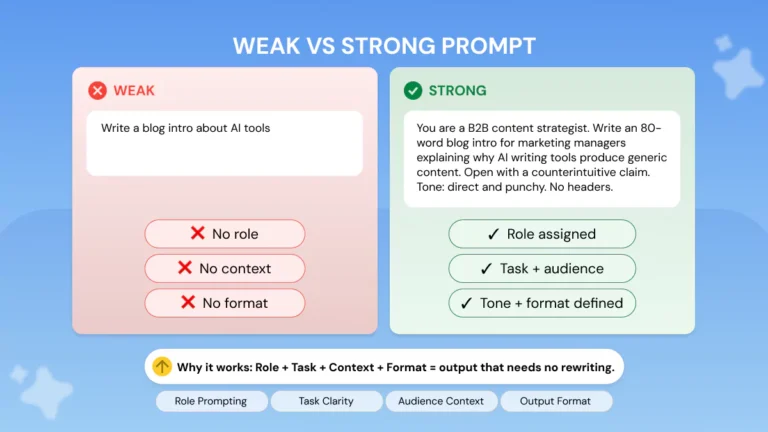
| Code review | “Is this code okay?” | “Audit this for production readiness. Flag data loss risks specifically, not style issues.” | Operator + constraint |
| Strategic decision | “What should we do about X?” | “Steelman the case for doing nothing about X. Then identify the weakest point of that case.” | Operator pair |
| Research question | “Summarize what you know about Y.” | “What is genuinely contested about Y among practitioners? Where is consensus weakest and why?” | Framing + register |
| Root cause analysis | “Why isn’t this working?” | “Diagnose the most probable root cause. Assume the obvious answer has already been ruled out.” | Operator + constraint |
| Vendor evaluation | “Compare these two tools.” | “Compare these two tools specifically for a team of 40 that can’t afford a 6-month migration. Flag where the conventional wisdom about each gets us wrong.” | Constraint + register |
The research on prompt sensitivity almost entirely tests isolated variables — one framing change, one format change — against standardized benchmark tasks. Real enterprise prompting is compound: you’re changing register, operator, emotional valence, and output format simultaneously, and the interaction effects aren’t published anywhere because they depend on your specific model, your task domain, and your team’s writing patterns.
I don’t have reliable data on compound prompt variable interactions at scale, and neither does anyone else yet. What’s described above is directionally supported by published research, but the precise effect sizes in your environment are something only your own systematic comparison can establish. Take your five most common prompt types. Write three variants. Compare outputs. That exercise costs nothing and will surface more signal than any framework, including this one.
The broader keyword strategy question — how these same principles apply to how AI search engines retrieve and cite content — is covered in more depth at bestprompt.art. The short version: the same variables that make a prompt produce a useful response are the same variables that make content worth citing. Intent architecture beats keyword density in both directions.
The prompt engineering industry has spent three years telling you that better outputs require more elaborate prompts. The research says otherwise. The 76-point accuracy swing comes from structural framing — something you can change in ten seconds. The problem was never that you didn’t know enough about AI. The problem is that the feedback loop is invisible: bad prompts produce confident answers, and the damage shows up somewhere else, hours later, with a different person’s name on it.