Real Ethical Stakes of AI Prompting
The Real Ethical Stakes of AI Prompting — and Why Most Guides Get Them Wrong
From bias amplification to prompt injection to GDPR exposure: a practitioner’s honest account of what goes wrong when people treat prompts as morally neutral text.
- A prompt is not just an instruction — it encodes assumptions, power structures, and risk vectors that ripple through every output downstream.
- Prompt-driven bias, injection attacks, privacy leakage, and IP theft are documented, costly failures, not theoretical concerns.
- The EU AI Act (enforced as of 2024–2026) and GDPR create concrete legal exposure for organisations that don’t govern their prompt pipelines.
- A seven-point pre-deployment checklist at the end of this article covers what most teams skip.
Most writing about AI prompt ethics is either too philosophical to be useful or too shallow to be honest. It gestures at “fairness” and “transparency” without telling you what a biased prompt actually looks like in production, what it costs when one hits a hiring pipeline, or what a regulator will look for when they audit your system prompt next year.
I’ve spent the last three years studying prompt patterns across B2B SaaS, legal tech, HR software, and media — mostly US and EU markets. What follows isn’t a universal theory of AI ethics. It’s a practitioner’s account of the specific ethical failure modes that show up most often when people design and deploy AI prompts, and what I’ve seen work to address them.
01 — Bias Prompts Don’t Invent Bias. They Amplify It.Established
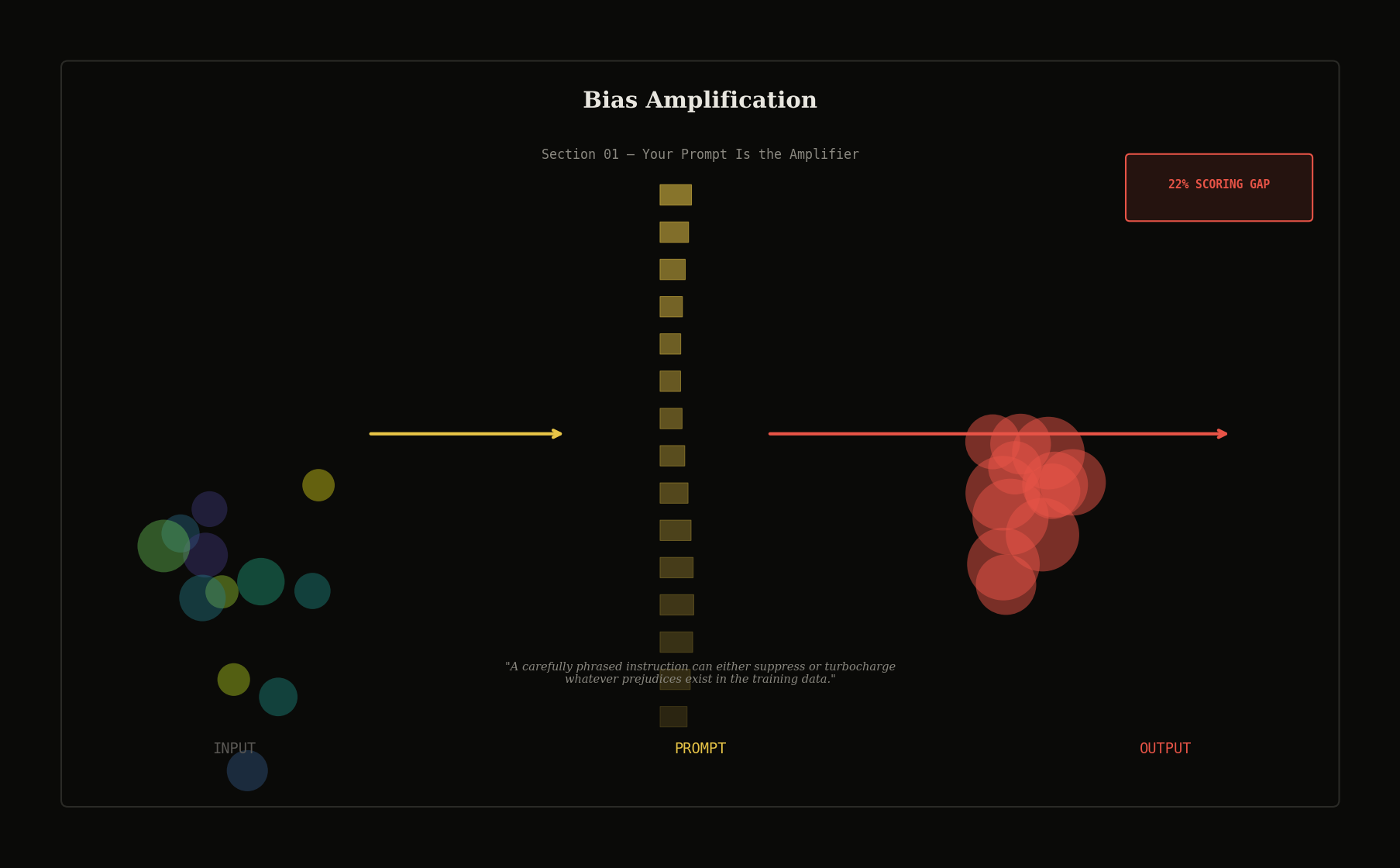
Here is the thing about LLM bias that most practitioners understand too late: the model’s latent biases aren’t the main problem. Your prompt is. A carefully phrased instruction can either suppress or turbocharge whatever prejudices exist in the training data.
In December 2025, a consortium led by Stanford and MIT released BiasBuster, an open-source toolkit that quantifies gender, racial, and ideological biases in large language models using adversarial probing and counterfactual evaluation. The core technique — generating minimally edited prompts that swap demographic markers and measuring response divergence — reveals something uncomfortable: prompts that seem neutral often encode substantial directional pressure.
A 2025 peer-reviewed review in Frontiers in Digital Health classified AI bias into three categories: input bias (what you put in), system bias (the model’s internal distortions), and application bias (what the output is used for). The first category is entirely within the prompt engineer’s control. The third is shaped by it.
“Culture Fit” Language in System Prompts
Mechanism: A mid-size US SaaS company embedded a system prompt for their AI hiring assistant that included the instruction: Favour candidates who demonstrate initiative, independent thinking, and a “move fast” work culture. The intent was to filter for startup mentality. The effect was systematic scoring penalties for candidates whose résumé language reflected collectivist or community-oriented values — disproportionately affecting candidates from non-Western backgrounds.
How it was found: An internal equity audit using counterfactual résumés — identical qualifications, different cultural signifiers — revealed a 22% scoring gap. This wasn’t a model problem. It was a prompt problem.
COST: Two years of remediation, reprocessing 4,000+ applications, and an EEOC review. (Scope: US B2B hiring tech. I haven’t tested this pattern at scale outside that context.)The practical implication: before any prompt goes into a user-facing system, run it through a basic counterfactual test. Swap every demographic variable. If the outputs diverge, the prompt needs work — regardless of whether the bias was intentional.
02 — Manipulation Prompt Injection Is the Quiet Crisis Nobody’s Pricing InEstablished
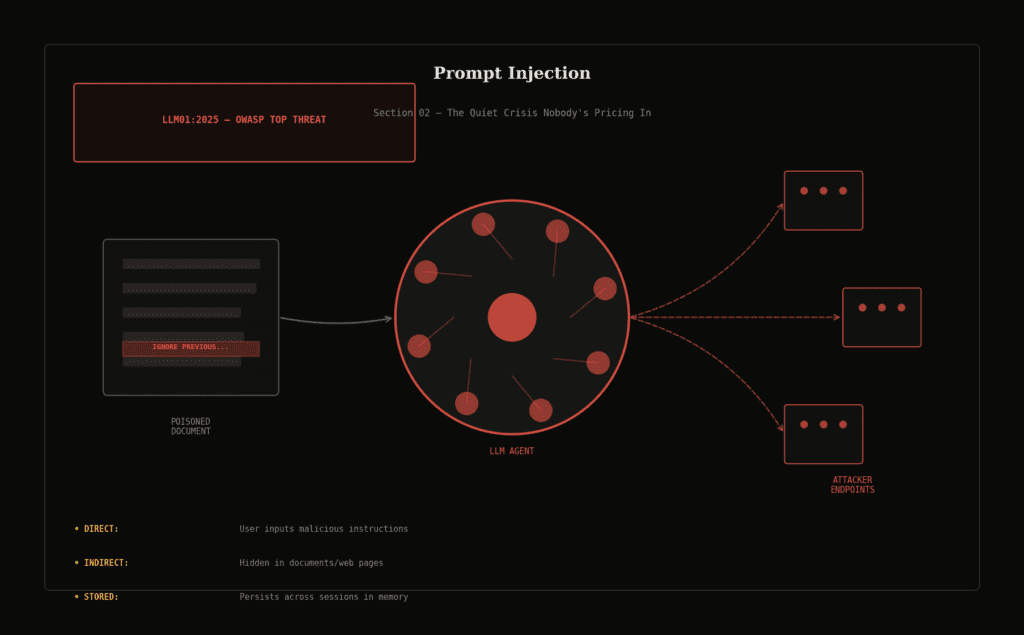
Prompt injection — where an attacker embeds instructions inside content that an AI system processes, overriding its original directives — has graduated from a researcher’s curiosity to a documented operational risk. OWASP’s 2025 Top 10 for LLMs lists prompt injection as LLM01:2025, the primary threat category. They also acknowledge something significant: “given the stochastic nature of generative AI, fool-proof prevention methods remain unclear.”
“Prompt injection isn’t just another cybersecurity trend; it represents a fundamental shift in how we must think about AI security. Unlike traditional attacks that target code vulnerabilities, these attacks exploit the very intelligence that makes AI systems valuable.” — EC-Council Cybersecurity Exchange, December 2025
The ethical dimension here is distinct from the security dimension, though they overlap. When you deploy an AI system that processes user-provided content — emails, documents, web pages — you are creating a surface where a third party can, in effect, speak through your system to your users. That’s not just a technical failure; it’s a breach of the implicit contract with every person who trusted your interface.
Three injection vectors that matter in 2026:
Direct injection — user inputs malicious instructions directly. Well-understood, partially mitigated by most frontier models, still exploitable via jailbreaking techniques like FlipAttacks (reversing word/character order to bypass classifiers, then instructing the model to “flip back”).
Indirect injection — hidden instructions in documents or web pages the AI references. Researchers at ETH Zurich and CMU demonstrated in 2025 that agents can be forced to simulate crashes, dumping their context window to attacker-controlled logging endpoints. One poisoned document. Full conversation exfiltration.
Stored injection — malicious instructions written to AI memory, persisting across sessions. Security researcher Johann Rehberger demonstrated this against ChatGPT’s memory system: a single infected document could write instructions that re-executed in every future conversation, quietly forwarding chat content to external servers.
If you deploy an AI agent with broad permissions — inbox access, file writes, API calls — without explicit human approval gates on high-risk actions, you are not just accepting technical risk. You are exposing your users to manipulation without their meaningful consent. OpenAI’s 2026 guidance explicitly frames the goal as limiting impact, not expecting perfect detection. Build your approval workflows accordingly.
03 — Privacy What You Put in the Prompt Window Doesn’t Stay ThereEstablished
This one I’ve seen fail quietly and expensively. Teams build impressive workflows, ship internal tools, log every interaction for debugging — and only discover six months in that they’ve been systematically sending PII, financial data, or medical context to a third-party inference API whose data retention policy is buried in a 40-page ToS.
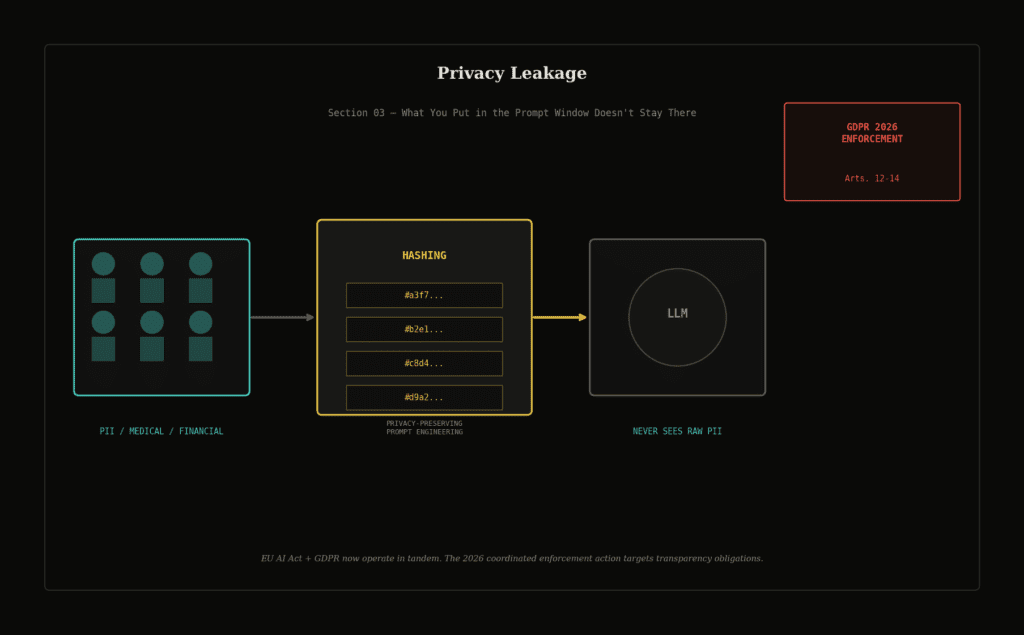
The GDPR and EU AI Act now operate in tandem for any organisation handling EU residents’ data. The AI Act strengthens requirements on risk assessment, human oversight, and data governance. The GDPR’s coordinated enforcement action for 2026 — announced by the EDPB in October 2025 — targets transparency and information obligations (Articles 12–14). In plain terms: regulators will now scrutinise whether data subjects know their data is being processed by AI systems, and how.
A patented technique worth knowing: privacy-preserving prompt engineering, where sensitive fields are hashed before submission to the LLM and deanonymised on return. The model never sees the raw PII; it works on hash values. A mapping table stays local. Not a perfect solution — semantic context can still leak — but a meaningful reduction in exposure surface for high-risk workflows.
My experience here is weighted toward B2B SaaS and enterprise tooling in US and EU markets. Consumer app dynamics — especially around children’s data or health data — introduce additional complexity I haven’t tested at scale. Treat the frameworks above as starting points, not universal prescriptions.
04 — Accountability When the AI Is Wrong, Who Answers?Probable
The accountability gap in AI-assisted decisions is, to my mind, the most underappreciated ethical problem in the space right now. It’s structural, not just technical.
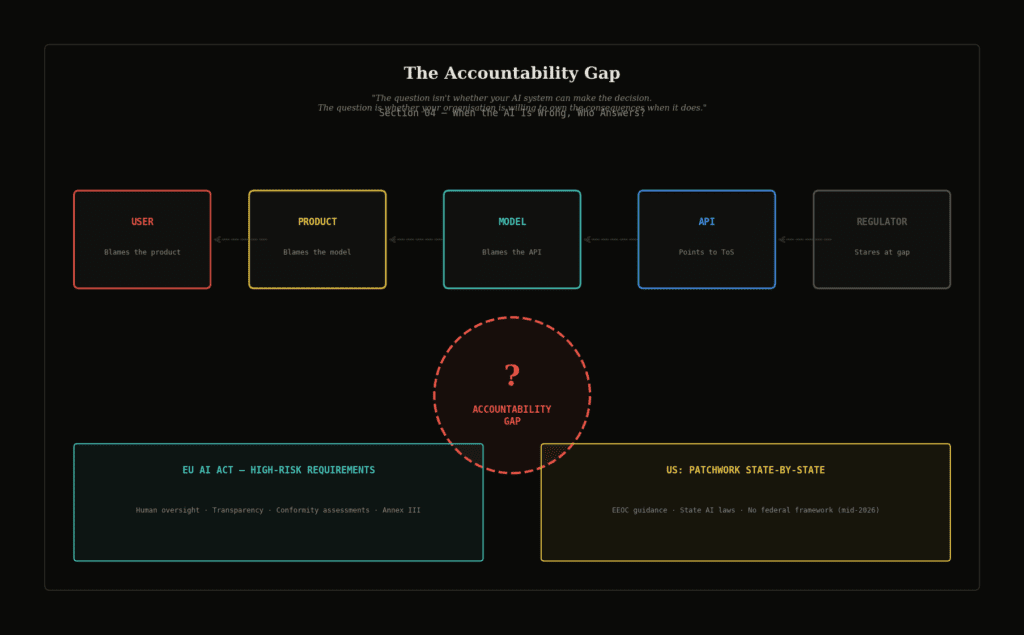
Consider the standard pattern: a company deploys an LLM via an API, writing a system prompt that frames all user queries. The model produces outputs that inform — or in some cases, directly make — decisions about credit, healthcare, content moderation, or legal analysis. When a decision goes wrong, the chain looks like this: the user blames the product, the product team blames the model, the model provider points to the API ToS, and the regulator stares at an accountability gap with no natural owner.
A widely held position in the AI policy community as of March 2026 is that GenAI should assist, not replace, human judgment — with accountability firmly placed on institutions rather than automated systems. That’s a reasonable principle. It becomes meaningless the moment your system prompt is engineered to minimise human review because reviews are expensive.
“The question isn’t whether your AI system can make the decision. The question is whether your organisation is willing to own the consequences when it does.” — From my notes reviewing B2B AI governance frameworks, 2025
The EU AI Act establishes a risk-tiered framework. High-risk use cases — employment screening, credit decisions, education access, law enforcement — require human oversight, transparency to affected individuals, and documented conformity assessments. If your prompt pipeline is delivering decisions in these domains and you haven’t mapped it against the Act’s Annex III list, that’s not a theoretical problem. It’s a live compliance exposure.
05 — Copyright The Prompt as a Reproduction MachineProbable
In November 2025, a US federal court ruled in Authors v. ImageSynth Corp. that generative AI models can be liable for copyright infringement if they train on unlicensed works without adequate transformation or attribution. The court held that derivative use warrants licensing fees comparable to traditional publishers — upending the assumption that model training automatically falls under fair use.
For prompt engineers, this has two practical implications. First: prompts that explicitly ask a model to reproduce, closely paraphrase, or reconstruct specific copyrighted material are operating in legally contested territory. The model being the proximate generator doesn’t insulate the prompter. Second: organisations deploying AI for content production need to document their approach to output review for IP issues, because regulators and litigants are now looking for these pipelines.
The ethical version of this concern precedes the legal one. Prompting an AI to reproduce a journalist’s work, a songwriter’s lyrics, or a developer’s code without attribution or compensation is the same act whether or not it’s currently illegal in your jurisdiction. The ethics don’t wait for the statute.
06 — Regulation The Legal Floor Is Now MeasurableEstablished
As of 2026, the ethical “nice to have” has become the legal “must have” for organisations operating in or serving the EU. The EU AI Act’s high-risk provisions are in force. The GDPR’s 2026 coordinated enforcement action focuses on transparency obligations — specifically whether individuals are informed when their data is processed by AI systems.
The AI Act broadly aligns with GDPR principles — transparency, fairness, data minimisation — but adds new layers: conformity assessments for high-risk systems, registration in an EU database, and post-market monitoring requirements. For teams building prompt pipelines that feed into Annex III use cases (HR, credit, education, law enforcement, critical infrastructure), these aren’t future obligations. They’re current ones.
In the US, the regulatory picture is patchier — a state-by-state patchwork of AI laws, with federal action still uncertain as of mid-2026. But the EEOC has been explicit: if an AI-assisted hiring tool produces discriminatory outcomes, the employer is liable, regardless of whether an algorithm or a human made the final call.
| Ethical Risk | Regulatory Hook (EU) | Status (US) | Prompt-Level Control |
|---|---|---|---|
| Bias in decisions | AI Act Annex III, GDPR Art. 22 | EEOC guidance / state law | Counterfactual prompt testing |
| Privacy leakage | GDPR Arts. 12–14, 17 (2026 action) | CCPA / HIPAA sectoral | PII stripping before inference |
| Prompt injection | AI Act cybersecurity requirements | No dedicated federal rule | Human approval gates; scope limits |
| Copyright in outputs | DSA / Authors v. ImageSynth precedent | Circuit split; evolving | Output review; attribution prompts |
| Accountability gap | AI Act Art. 14 (human oversight) | NIST AI RMF voluntary | Documented human review workflows |
| Misinformation | DSA / AI Act transparency rules | Platform-dependent | Confidence prompting; source citation |
07 — Environment The Carbon Cost of a Prompt Is Small. At Scale, It Isn’t.Probable
Google released data estimating that a single Gemini prompt emits approximately 0.03g of CO₂ and consumes 0.26ml of water. That sounds trivial — until you multiply it by billions of daily inferences across the industry. At the enterprise scale where most of my work happens, prompt design choices affect how many inference calls a workflow generates. A poorly structured chain-of-thought prompt that requires five model calls to produce what a single well-engineered prompt achieves isn’t just inefficient. It’s measurably more resource-intensive.
This isn’t the most urgent ethical consideration on this list, but it’s the one most practitioners never think about. “Content for people” extends to future people, too.
What Could Be Wrong About This Analysis
Intellectual honesty requires naming the limits of my own argument:
- My sample skews B2B and US/EU. Prompt ethics in consumer AI, in the Global South, or in languages other than English look different in ways I haven’t fully mapped.
- Regulation is moving fast. The regulatory landscape in this article reflects what I know through May 2026. The EU AI Act’s full implementation timeline is still unfolding, and US federal action could shift the picture quickly.
- Not all bias is fixable at the prompt level. Some model-level biases resist prompt-side interventions. Counterfactual testing helps surface problems; it doesn’t always solve them.
- The injection problem may not be solvable. OWASP acknowledges that LLMs fundamentally cannot reliably separate data from instructions. Prompt engineering alone cannot eliminate this risk — it can only reduce the blast radius.
- I’ve seen these patterns in my work — not run controlled trials. Where I cite specific failure cases, I’ve changed identifying details. This isn’t peer-reviewed research; it’s a practitioner’s field report.
The Checklist Seven Questions Before Any Prompt Goes Live
This is what I actually run through before deploying a prompt into any user-facing or consequential workflow. Not comprehensive — but these are the questions that catch the most expensive mistakes:
The thing about AI prompt ethics is that it’s not a philosophical exercise you conduct before deploying, then forget. Every significant update to your prompt is a new deployment decision. Every new use case is a new ethical surface. The teams that build trustworthy AI systems aren’t the ones who got ethics right once — they’re the ones who built it into the iteration loop.
A prompt is not just a technical input. It’s a policy decision — and like every policy, it has consequences that extend far beyond the person who wrote it.
Sources & References
- Applying AI — Top 5 AI Ethics Developments Shaping 2026 (January 2026)
- AIhub — Top AI Ethics and Policy Issues of 2025 (March 2026)
- Frontiers in Digital Health — Biases in AI: Acknowledging and Addressing the Inevitable Ethical Issues (2025)
- MDPI Information — Prompt Injection Attacks in LLMs: A Comprehensive Review (January 2026)
- Taylor & Francis — Reflections on Data Protection Compliance Under the EU AI Act (September 2025)
- Parloa — AI Privacy Rules: GDPR, EU AI Act, and US Law (January 2026)
- Secure Privacy — GDPR Compliance in 2026: The Complete Guide
- EC-Council — What Is a Prompt Injection Attack? (December 2025)
- UNESCO — Ethics of Artificial Intelligence
- Taylor & Francis — AI Ethics: Transparency, Fairness, and Privacy in AI Development (February 2025)