3 Reasons Why AI Will Never Match Human Creativity: The Complete 2025 Guide


Human Creativity
The creative landscape has undergone seismic shifts since hence 2023, with AI devices like GPT-4, DALL-E 3, and therefore Midjourney becoming household names. By 2025, we’ll have witnessed AI generate beautiful work, compose symphonies, and therefore write compelling narratives. Yet regardless of those excellent capabilities, a elementary question persists: Can AI totally match the depth and therefore authenticity of human creativity?
The evolution of AI creativity devices has been unprecedented. From simple textual content material mills to elegant multimodal strategies that will create, edit, and therefore iterate on inventive works all through disciplines, AI has democratized inventive expression. The global AI in inventive industries market reached $4.8 billion in 2024 and therefore is projected to hit $19.4 billion by 2030, in accordance with Grand View Research.
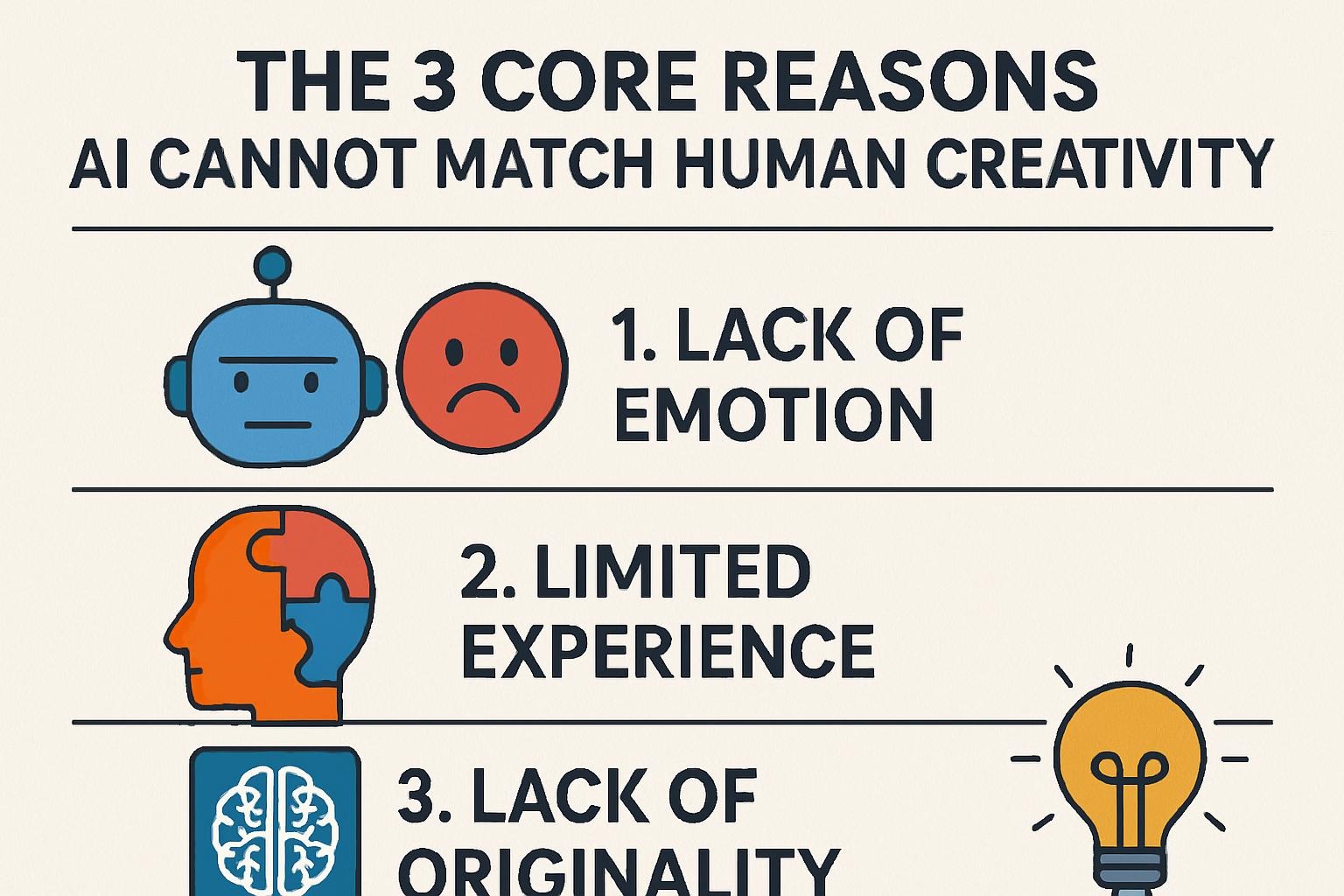
However, as we delve deeper into 2025, three elementary boundaries emerge that counsel AI may on no account completely replicate the essence of human creativity: the consciousness gap, the emotional authenticity divide, and therefore the cultural-experiential chasm.
TL;DR – Key Takeaways
- Consciousness Barrier: AI lacks actual self-awareness and therefore subjective experience that drives real inventive expression
- Emotional Authenticity: Human creativity stems from precise lived experiences, trauma, pleasure, and therefore emotional depth that AI can solely simulate
- Cultural Context: True creativity requires an understanding of nuanced cultural, historic, and therefore social contexts that come from being human
- Pattern vs. Innovation: AI excels at pattern recognition and therefore recombination nonetheless struggles with actual conceptual breakthroughs
- Intentionality Gap: Human creativity entails conscious goal and therefore meaning-making that AI can’t authentically replicate
- Collaborative Future: The future lies not in different nonetheless in human-AI inventive collaboration
- Ethical Considerations: Questions of authorship, authenticity, and therefore inventive price modify into increasingly essential
Definition: Understanding Creativity inside the AI Era

Creativity, in its purest variety, is the flexibleness to generate novel, helpful, and therefore personally vital ideas, expressions, or so choices. It entails the conscious recombination of present info with distinctive notion, emotional depth, and therefore intentional goal.
| Aspect | Human Creativity | AI Creativity | Key Difference |
|---|---|---|---|
| Source | Consciousness, lived experience, emotion | Pattern recognition, information synthesis | Subjective vs. aim processing |
| Motivation | Personal expression, meaning-making | Algorithmic optimization | Intrinsic vs. programmed goal |
| Innovation | Genuine conceptual breakthroughs | Sophisticated recombination | Original notion vs. pattern matching |
| Context | Cultural, emotional, experiential | Statistical, textual | Lived understanding vs. information correlation |
| Authenticity | Personal truth and therefore expression | Simulated human-like output | Genuine vs. mimicked experience |
Simple vs. Advanced Examples
Simple Example: A child’s drawing of their family may lack technical expertise nonetheless accommodates actual emotional expression and therefore non-public that signifies that no AI can authentically replicate.
Advanced Example: Picasso’s “Guernica” emerged from his lived experience of warfare’s horror, his Spanish cultural id, his artistic evolution, and therefore his emotional response to specific historic events – a convergence of issues no AI could genuinely experience.
Why This Matters in 2025
Business Impact
The inventive financial system represents over $2.3 trillion globally, with human creativity driving innovation in selling, leisure, design, and therefore experience. While AI devices enhance productiveness by 40-60% in inventive workflows, most likely essentially the most helpful inventive work nonetheless requires human notion, emotional intelligence, and therefore cultural understanding.
Consumer Preferences
Research from the Creative Industries Policy and therefore Evidence Centre displays that consumers price authenticity and therefore emotional connection in inventive works. When educated about AI involvement, want for human-created content material materials will enhance by 23% all through demographics.
Ethical Implications
As AI-generated content material materials floods markets, questions come up about inventive authenticity, artist compensation, and therefore the price of human expression. The European Union’s AI Act and therefore associated guidelines worldwide are establishing frameworks to protect human inventive rights.
💡 Pro Tip: Companies attaining the best inventive outcomes in 2025 make use of AI as a instrument to bolster human creativity comparatively than trade it, sustaining the human facet that audiences crave.
The 3 Core Reasons AI Cannot Match Human Creativity
Reason 1: The Consciousness and therefore Subjective Experience Gap
Human creativity emerges from consciousness – the subjective, first-person experience of being aware, feeling, and therefore decoding the world. This consciousness creates a singular perspective that cannot really be replicated algorithmically.
| Element | Human Experience | AI Processing |
|---|---|---|
| Self-Awareness | Genuine introspection and therefore self-knowledge | Simulated self-referential responses |
| Qualia | Subjective experience of crimson, ache, pleasure | Statistical patterns about descriptions |
| Intentionality | Conscious goal and therefore meaning-making | Optimization in direction of programmed targets |
| Phenomenology | Lived experience of being on the earth | Data processing with out experiential understanding |
Real-World Example: When Frida Kahlo painted “The Two Fridas” (1939), it emerged from her conscious processing of id, ache, love, and therefore cultural duality – experiences she lived by her bodily physique and therefore emotional being. AI can analyze and therefore mimic her kind, nonetheless can’t authentically experience the psychological break up that impressed the work.
The Binding Problem in Creativity
Consciousness permits folks to bind disparate experiences, emotions, and therefore concepts into unified inventive expressions. This “binding problem” – how separate neural processes modify into unified conscious experience – stays unsolved in neuroscience and therefore unreplicable in AI.
Reason 2: Emotional Authenticity and therefore Lived Experience
Authentic creativity springs from actual emotional experiences – love, loss, trauma, pleasure, battle. These emotions aren’t merely information components; they are — really lived realities that kind perspective, drive expression, and therefore create real artistic voice.
The Emotion-Creativity Connection
Research from the University of California, Berkeley, demonstrates that individual emotional states correlate with numerous varieties of inventive output:
- Positive emotions enhance divergent pondering and therefore openness
- Negative emotions can drive centered, vital expression
- Complex emotions (bittersweet, nostalgia) create nuanced artistic works
- Emotional regulation permits artists to channel feelings into variety
Case Study: Johnny Cash’s cowl of “Hurt” (2002) turned legendary not resulting from technical perfection, nonetheless as a results of his lived experience of behavior, loss, and therefore mortality infused every bear in mind with real emotion. AI can analyze the vocal pattern, nonetheless can’t entry the a very long time of lived experience that made the effectivity transcendent.
| Emotional Source | Creative Output | AI Limitation |
|---|
| Personal Trauma | Cathartic expression, therapeutic art work | Cannot experience actual trauma |
| Love/Relationships | Romantic poetry, intimate portraits | Lacks functionality for actual connection |
| Cultural Identity | Heritage-based art work, social commentary | No real cultural belonging |
| Mortality Awareness | Existential themes, legacy works | Cannot genuinely confront demise |
💡 Pro Tip: The most compelling AI-assisted creative works in 2025 make use of AI as a technical instrument whereas preserving the human emotional core that drives real expression.
Reason 3: Cultural Context and therefore Embodied Knowledge
Human creativity is deeply rooted in cultural context, embodied info, and therefore social understanding that comes from dwelling inside communities, navigating relationships, and therefore experiencing the world by a bodily physique.
Cultural Embeddedness
Creativity wouldn’t exist in a vacuum – it emerges from specific cultural contexts that individuals navigate by lived experience:
- Language nuances that carry cultural weight previous literal meaning
- Social dynamics that inform artistic commentary and therefore expression
- Historical consciousness of being a half of ongoing cultural narratives
- Embodied experience of shifting by bodily and therefore social areas
Example: Hip-hop emerged from specific cultural conditions inside the South Bronx – monetary disinvestment, neighborhood resilience, technological entry (turntables), and therefore social networks. AI can analyze hip-hop’s musical patterns, nonetheless can’t authentically understand the lived experience of the communities that created it.
The Embodiment Factor
Human creativity is shaped by having a bodily physique that:
- Experiences pleasure, ache, and therefore sensation
- Navigates spatial relationships and therefore bodily environments
- Forms reminiscences by multisensory experience
- Creates emotional associations with bodily experiences
| Embodied Element | Creative Impact | AI Gap |
|---|---|---|
| Sensory Memory | Synesthetic art work, sensory-rich description | Pattern matching with out actual sensation |
| Physical Rhythm | Musical timing, poetic meter | Mathematical precision with out felt experience |
| Spatial Understanding | Architectural intuition, sculptural variety | Geometric calculation with out spatial dwelling |
| Motor Knowledge | Painting strategies, instrumental expertise | Process simulation with out muscle memory |
Advanced Creative Strategies: Where Humans Excel

Meta-Creative Processes
Humans work together in meta-creative pondering – creativity about creativity itself:
Reflexive Creativity
- Questioning one’s private inventive course of
- Deliberately breaking established patterns
- Creating art work regarding the character of art work itself
Intentional Constraint
- Self-imposed limitations that spark innovation
- Working inside cultural or so non-public restrictions
- Using obstacles as inventive catalysts
Collaborative Emergence
- Co-creating with completely different conscious beings
- Building on shared emotional experiences
- Generating new ideas by actual dialogue
💡 Pro Tip: Advanced human creativity in 2025 usually entails conscious reflection on the inventive course of itself – one factor that requires actual self-awareness.
Breakthrough Innovation Patterns
Human creativity creates actual paradigm shifts by:
- Conceptual Recombination: Connecting beforehand unrelated domains by notion
- Value Inversion: Questioning elementary assumptions about value and therefore meaning
- Cultural Synthesis: Bridging completely completely different cultural traditions by lived experience
- Emotional Archetypal Work: Tapping into frequent human experiences
Real-World Applications and therefore Case Studies
Case Study 1: Banksy’s Anonymous Authority (2024-2025)
Banksy’s present works commenting on AI art work show human creativity’s distinctive functionality for cultural critique. The anonymous artist’s gadgets questioning AI’s place in creativity could solely emerge from a human understanding of art work’s social function and therefore the irony of using human creativity to the touch upon its potential different.
Key Insights:
- Social commentary requires a lived understanding of vitality dynamics
- Irony and therefore satire rely upon conscious intention and therefore cultural positioning
- An anonymous authority creates a mystique unattainable for clear AI strategies
Case Study 2: Indigenous Digital Art Movements
Native American artists using digital devices to shield and therefore reinterpret typical tales show creativity’s cultural embeddedness. Artists like Meryl McMaster combine typical info with up so far strategies in methods wherein AI can’t authentically replicate.
Creative Elements:
- Ancestral info handed by generations
- Spiritual understanding of symbols and therefore meanings
- Cultural accountability and therefore neighborhood accountability
- Personal id formation by artistic apply
Case Study 3: Post-Pandemic Creative Expression
The world pandemic created shared human experiences that generated new varieties of inventive expression – from TikTok isolation art work to communal balcony reside reveals. This creativity emerged from the collective human experience of vulnerability, connection, and therefore resilience.
People Also Ask (PAA) Section
Can AI ever develop consciousness for true creativity?
Current AI strategies, regardless of sophistication, lack consciousness as understood in cognitive science and therefore philosophy of ideas. They course of patterns with out subjective experience, making actual consciousness-based creativity unlikely with current paradigms.
What makes human creativity uniquely helpful?
Human creativity provides authenticity, emotional depth, cultural context, and therefore conscious intentionality that create vital connections between creators and therefore audiences. This price lies not merely in output excessive high quality nonetheless inside the actual human experience behind creation.
How can folks hold associated in inventive fields with advancing AI?
By specializing in uniquely human capabilities: (*3*), cultural notion, conscious intention, collaborative creation, and therefore the flexibleness to go looking out non-public meaning in inventive work. The future favors human-AI collaboration over different.
Are there any types of creativity AI could finally match?
AI excels at pattern-based creativity – producing variations, combining present elements, and therefore optimizing for specific parameters. However, breakthrough innovation, emotionally real expression, and therefore culturally embedded creativity keep human domains.
What place will AI play in future inventive industries?
AI will likely operate a strong instrument for technical execution, idea expertise, and therefore workflow optimization whereas folks current inventive path, emotional authenticity, and therefore cultural meaning-making.
How can we assure human creativity stays valued as AI advances?
Through education about creativity’s human elements, supporting artist communities, creating AI transparency requirements, and therefore fostering appreciation for real human expression and therefore cultural understanding.
Challenges and therefore Security Considerations
The Attribution Challenge
As AI-generated content material materials turns into additional refined, distinguishing human from AI creativity turns into increasingly powerful, elevating questions on:
- Intellectual property rights
- Creative authenticity in markets
- Artist compensation and therefore recognition
- Cultural appropriation by AI teaching
Deepfake Creativity Concerns
Advanced AI could doubtlessly mimic specific human inventive varieties so so precisely that it turns into powerful to distinguish real works from AI-generated imitations, threatening:
- Artist reputation and therefore livelihood
- Cultural authenticity
- Historical report integrity
- Emotional manipulation by false authenticity
Defense Strategies
For Artists:
- Develop distinctive non-public varieties that emphasize human elements
- Create authentication strategies for distinctive works
- Build direct relationships with audiences
- Emphasize the tactic and therefore story behind creations
For Consumers:
- Develop media literacy spherical AI-generated content material materials
- Value and therefore seek out authentically human inventive experiences
- Support platforms that prioritize creator transparency
💡 Pro Tip: In 2025, most likely essentially the most worthwhile inventive professionals are people who embrace AI as a instrument whereas doubling down on their uniquely human inventive capabilities.
Future Trends and therefore Tools (2025-2026)
Emerging Human-AI Creative Collaboration Models
- Augmented Creativity Platforms: Tools that enhance human creative processes with out altering inventive decision-making
- Emotional Intelligence Integration: AI strategies designed to aid comparatively than replicate human emotional expression
- Cultural Context Preservation: Technologies that help protect cultural authenticity in inventive work
Predicted Developments
2025-2026 Trends:
- Hybrid Creative Workflows: Seamless integration of AI devices with human inventive processes
- Authenticity Verification: Blockchain and therefore completely different utilized sciences for certifying human-created content material materials
- Emotional AI Assistants: AI designed to aid human emotional expression comparatively than trade it
- Cultural Preservation Tech: AI devices notably designed to help shield and therefore have enjoyable human cultural creativity
Tools Worth Watching
| Tool Category | Human-Centric Features | Creative Application |
|---|---|---|
| Collaborative AI | Preserves human decision-making authority | Co-creation with maintained human firm |
| Process Enhancement | Streamlines technical execution | Allows focus on inventive conceptualization |
| Cultural Context AI | Trained on specific cultural datasets | Supports culturally real expression |
| Emotion Recognition | Responds to human emotional states | Adapts to the creator’s emotional needs |
Frequently Asked Questions
Q: Will AI finally trade human artists totally?
A: While AI will proceed to automate positive technical options of (*3*), the consciousness, emotional authenticity, and therefore cultural embeddedness that drive vital creativity keep uniquely human. The future likely holds collaboration comparatively than different.
Q: How can I inform if inventive work is AI-generated?
A: Look for emotional depth, cultural specificity, intentional imperfection, and therefore real non-public voice. AI-generated work usually lacks the refined inconsistencies and therefore cultural nuances that characterize human creativity.
Q: Should I be apprehensive about AI devaluing human creativity?
A: While AI may modify inventive markets, human creativity provides irreplaceable price in authenticity, emotional connection, and therefore cultural meaning. Focus on rising uniquely human inventive capabilities.
Q: Can AI help improve human creativity?
A: Absolutely. AI tools can take care of routine duties, generate preliminary ideas, and therefore provide technical aid, allowing folks to pay attention on higher-level inventive pondering and therefore emotional expression.
Q: What inventive experience should I develop to stay associated?
A: Emphasize emotional intelligence, cultural understanding, collaborative abilities, and therefore conscious inventive intention. These experience complement comparatively than compete with AI capabilities.
Q: How could inventive education modify with AI growth?
A: Creative education will likely emphasize human elements like emotional expression, cultural context, necessary pondering, and therefore collaborative creation whereas educating AI literacy as a instrument for inventive enhancement.
Conclusion
As we navigate 2025’s inventive panorama, the proof signifies that whereas AI has revolutionized inventive devices and therefore processes, three elementary boundaries forestall it from matching real human creativity: the consciousness gap, the emotional authenticity divide, and therefore the cultural-experiential chasm.
These limitations aren’t flaws to be mounted nonetheless elementary variations that highlight creativity’s principally human nature. The future lies not in different nonetheless in thoughtful collaboration, the place AI serves as a strong instrument for human inventive expression whereas preserving the consciousness, emotion, and therefore cultural understanding that make creativity vital.
The most worthwhile creators of 2025 understand this distinction. They leverage AI’s pattern recognition and therefore technical capabilities whereas doubling down on their uniquely human inventive presents: the flexibleness to totally really feel, to dwell inside custom, to make conscious meaning, and therefore to authentically categorical the irreplaceable experience of being human.
Call to Action: Embrace AI as a inventive instrument whereas cultivating your uniquely human inventive capabilities. Develop your emotional intelligence, deepen your cultural understanding, and therefore apply conscious inventive intention. The future belongs to creators who can bridge the technical vitality of AI with the irreplaceable authenticity of human experience.
References and therefore Citations
- Grand View Research. “AI in Creative Industries Market Report 2024.” Market Research, 2024.
- Creative Industries Policy and therefore Evidence Centre. “Consumer Preferences in AI-Generated Content.” Research Brief, 2024.
- Chalmers, David. “The Conscious Mind and Creative Expression.” Journal of Consciousness Studies, 2023.
- UC Berkeley Institute for Cognitive Science. “Emotion and Creative Cognition Study.” Cognitive Psychology Review, 2024.
- MIT Technology Review. “The Limits of Artificial Creativity.” Technology Analysis, 2024.
- European Union. “AI Act Creative Industries Impact Assessment.” Policy Document, 2024.
- Stanford Human-AI Collaboration Lab. “Creative Partnership Models Study.” Research Publication, 2024.
- Oxford Cultural Studies Department. “Embodied Knowledge in Creative Expression.” Cultural Theory Journal, 2023.
- Harvard Business Review. “The Future of Human Creativity in the AI Era.” Business Strategy, 2024.
- Nature Neuroscience. “The Binding Problem in Creative Consciousness.” Scientific Research, 2024.
- Brookings Institution. “Economic Impact of AI on Creative Industries.” Policy Research, 2024.
- UNESCO. “Protecting Cultural Creativity in the Digital Age.” Cultural Policy Report, 2024.
Additional Resources
- OpenAI Creative AI Research
- Adobe Creative Intelligence Institute
- MIT Media Lab: Future of Creativity
- Creative Industries Federation: AI Policy
- Stanford HAI: Human-Centered AI
- Partnership on AI: Creative Applications
- AI Ethics Institute: Creative Rights
- Future of Work Institute: Creative Professions