Your “Unique” Creative Team Is Costing You $2M a Year


https://www.bestprompt.art/ai-creativity-vs-human-creativity-2025/
https://www.bestprompt.art/the-dark-side-of-ai-prompts-7-shocking-2025-dangers/
https://www.bestprompt.art/top-10-ai-writing-tools/


WordPress-ready format. Paste into Posts → Add New → Code Editor. Fill SEO metadata into Yoast or RankMath before publishing.
Here is the most clarifying result in the current research on AI and creativity. Wharton researchers Lennart Meincke, Gideon Nave, and Christian Terwiesch asked participants to invent a toy using a fan and a brick. Among those using ChatGPT, 94% of the ideas clustered around the same concept — and nine participants, independently, named their toy “Build-a-Breeze Castle.” The human-only group produced entirely unique ideas. Across five experiments, AI-assisted sessions consistently produced narrower idea sets. As Terwiesch put it: “The ideas are great, but not as diverse as human-generated ideas. That points to a trade-off to be aware of: if you rely on ChatGPT as your only creative advisor, you’ll soon run out of ideas, because they’re too similar to each other.”
That finding is devastating. Not in the sense of “AI bad” — but in the sense of naming a real structural risk that most AI adoption conversations skip past entirely. Nine people independently arriving at the same product name is not individual failure. It is a systemic property of what happens when a large group funnels creative work through the same model. The model’s training distribution shapes the output distribution. That’s not a bug that gets patched in the next release. It’s how the technology works.
The business question this creates is specific: does it matter for your work? The honest answer is: it depends entirely on the competitive structure you operate in. And most people on both sides of this debate — the “fire the human creatives” camp and the “protect diversity at all costs” camp — are answering a simpler version of that question than reality requires.
“If you rely on ChatGPT as your only creative advisor, you’ll soon run out of ideas, because they’re too similar to each other.”
Christian Terwiesch, co-director, Wharton Mack Institute — Knowledge@Wharton, 2025
The Wharton result needs to be read alongside the UCL/Exeter finding it complements. In Doshi and Hauser’s 2024 paper in Science Advances — a controlled experiment with 293 writers — AI access caused stories to be rated as more creative, better written, and more enjoyable, especially among less creative writers. But AI-assisted stories were more similar to each other than human-only stories. The paper frames this as a social dilemma: individually better off, collectively producing a narrower scope.
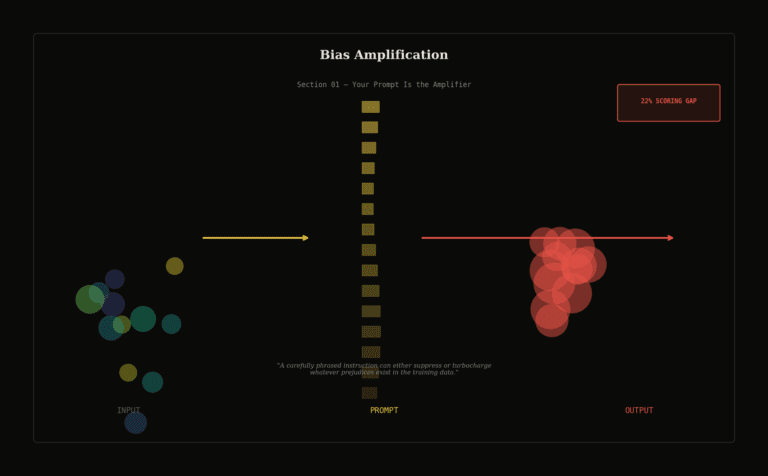
Put the two findings together and you get something more precise than either “AI is great for creativity” or “AI kills creativity.” What you get is: AI raises the floor and lowers the ceiling of the collective output. The weakest individual outputs improve substantially. The distance between the best and worst outputs shrinks. The total variety of ideas in circulation decreases. Whether that’s good or bad for a specific business depends on what that business actually competes on.
One more crucial detail from the Doshi and Hauser paper: AI particularly benefited less creative writers. It essentially equalized evaluations, removing inherent creativity as an advantage. That’s remarkable — and it cuts in two directions. If you’re a strong creative, AI assistance may not help you much and may actually homogenize your output. If you’re a weaker creative, AI significantly closes the gap. This has direct implications for team composition that most discussions ignore entirely.
There’s a version of the “embrace AI homogenization” argument that is correct. In markets where creative work is a cost center rather than a competitive moat — where the client needs competent execution on time and on budget, not a novel angle — AI-assisted throughput wins. A team producing 12 solid projects a year beats a team producing 4 brilliant ones, all else being equal. This is true. It’s also not a universal truth; it’s a market-structure-specific truth.
The argument gets into trouble when it’s presented as the default case rather than one scenario among several. Specifically, it fails in three situations that are more common than the “embrace homogenization” advocates tend to acknowledge.
Markets where brand distinctiveness is the product. In these markets — luxury goods, independent creative agencies, boutique consulting, any space where the client is buying “not like everyone else” — homogenization is not a cost-efficiency trade-off. It’s a category exit. If your work starts looking like everyone else’s AI-assisted work, you’ve left the market you were in. The Wharton finding applies directly here: if everyone is using the same tools, the idea space gets exhausted, and the work converges. You don’t just lose clients. You lose the reason the clients came to you.
Category creation and genuine innovation work. The Wharton research found that in AI-assisted brainstorming, just 6% of ideas were unique. If you are trying to find the genuinely novel angle — the product positioning nobody has named, the campaign concept that doesn’t yet exist — the model that exhausts the idea space quickly is exactly the wrong tool for the generation phase. It’s potentially excellent for the execution phase once you’ve found the angle. Using it for both collapses the distinction.
Competitive markets where your competitors are also using AI. This is the one that the “embrace homogenization” case misses most badly. If your competitors standardize on the same AI tools and workflows, and you do too, you haven’t gained an advantage. You’ve participated in a race to the same creative output. The teams that emerge differentiated from that environment will be the ones that use AI for throughput on execution work while maintaining human-driven divergent thinking for positioning and concept development. That’s a more sophisticated operating model — but it’s the one the evidence supports.
Before deciding how your creative team should be structured, answer this: in your specific market, does your revenue depend on being perceived as better or as different? These are not the same thing, and they require different resource allocations.
“Better” means higher quality, faster delivery, lower error rate, more reliable output. AI tools win here, clearly and consistently. The Doshi/Hauser finding that AI raised quality scores across the board supports this. If your clients are buying quality and reliability — and most B2B clients are — AI-assisted workflows are the correct answer and human resistance to them is misguided.
“Different” means occupying a creative position that competitors don’t occupy, producing work that clients recognize as distinctively yours, building the kind of brand association that attracts clients before they’ve seen your pricing. AI tools create measurable headwinds here. Not insurmountable ones — the Wharton team’s subsequent research found that specific prompting techniques can increase idea variance substantially, even within AI-generated output. But the default mode of AI-assisted brainstorming trends toward convergence, and using it without deliberate counter-pressure will homogenize your creative positioning over time.
Most creative teams are not purely in one camp or the other. They do execution work (better-oriented) and concept work (different-oriented) in the same week, sometimes in the same project. The mistake is applying the same tool and the same workflow to both. AI as execution engine for production work is almost always right. AI as your sole source of creative direction is, per the research, the reliable path to nine teams independently producing “Build-a-Breeze Castle” and not understanding why clients stopped finding you interesting.
AI raises the floor and lowers the ceiling of collective output. Whether that’s good or bad depends entirely on what your business competes on.
Synthesis: Doshi & Hauser (Science Advances, 2024), Meincke, Nave & Terwiesch (Wharton, 2025)
The practical answer depends on which problem you’re actually trying to solve.
If throughput is your primary problem — if you’re consistently late, over-budget, or producing work at a pace that can’t scale — AI-assisted execution is the correct fix, and resistance to it from creative team members is a business problem, not a creative philosophy question. Standardize the workflows for production work. Measure output velocity. The research supports this: quality goes up on average, delivery improves, and clients at this end of the market largely don’t notice the diversity reduction because they weren’t buying diversity in the first place.
If creative positioning is your problem — if your work is looking generic, if clients are describing you as “fine,” if you’re losing pitches on concept rather than price — the answer is not more AI in the concept phase. It’s protecting the divergent-thinking stage from premature AI involvement. Use human-only brainstorming for concept development, with AI introduced later for refinement, execution, and production. The Wharton team’s finding that prompting techniques can be used to artificially increase idea variance is worth exploring — but it requires deliberate effort against the model’s default tendencies, not passive reliance on it.
If you’re trying to do both — which is most creative businesses — the operating model is a sequenced one. Human-led divergence in the concept phase, with explicit protection against AI’s homogenizing tendencies at that stage. AI-assisted convergence and execution once the direction is set, extracting every efficiency available. The organizations that will look back at 2025 as a competitive advantage moment are the ones that made that distinction clearly rather than collapsing it into “we use AI” or “we protect human creativity.”
The research doesn’t resolve this debate in favor of either camp. It makes the debate more specific. Nine people naming their toy the same thing is a real problem in some competitive environments and irrelevant in others. Figuring out which one you’re in is the actual work — and no AI tool is going to do that for you.
- Doshi, A. R. & Hauser, O. P. (2024). “Generative AI enhances individual creativity but reduces the collective diversity of novel content.” Science Advances, 10(28), eadn5290.
- Meincke, L., Nave, G. & Terwiesch, C. (2025). “ChatGPT decreases idea diversity in brainstorming.” Nature Human Behaviour, 9(6), 1107–1109. (via Penn Today summary)
- Knowledge@Wharton: “Does AI Limit Our Creativity?” — extended discussion with Terwiesch and Meincke, 2025
- Meincke, L., Mollick, E. R. & Terwiesch, C. (2024). “Prompting Diverse Ideas: Increasing AI Idea Variance.” Wharton School Research Paper / SSRN
If AI is affecting your creative output, the next step is not theory — it’s how you structure prompts, workflows, and teams to avoid homogenization.
-
Complete Prompt Engineering Guide
Learn how prompt structure influences output diversity and control. -
Prompt Engineering Mistakes Beginners Make
Why most prompts lead to generic outputs — and how to fix it. -
Prompt Templates for Developers
Use structured prompts that push models toward more varied outputs. -
Best AI Prompts (Real Examples)
See how high-performing prompts avoid generic, repetitive results. -
Prompt Engineering Tools 2025
Scale creative workflows with evaluation, versioning, and observability.
👉 Practical takeaway: Use AI for execution and refinement — not as your only source of ideas. The difference is what separates high-output teams from indistinguishable ones.