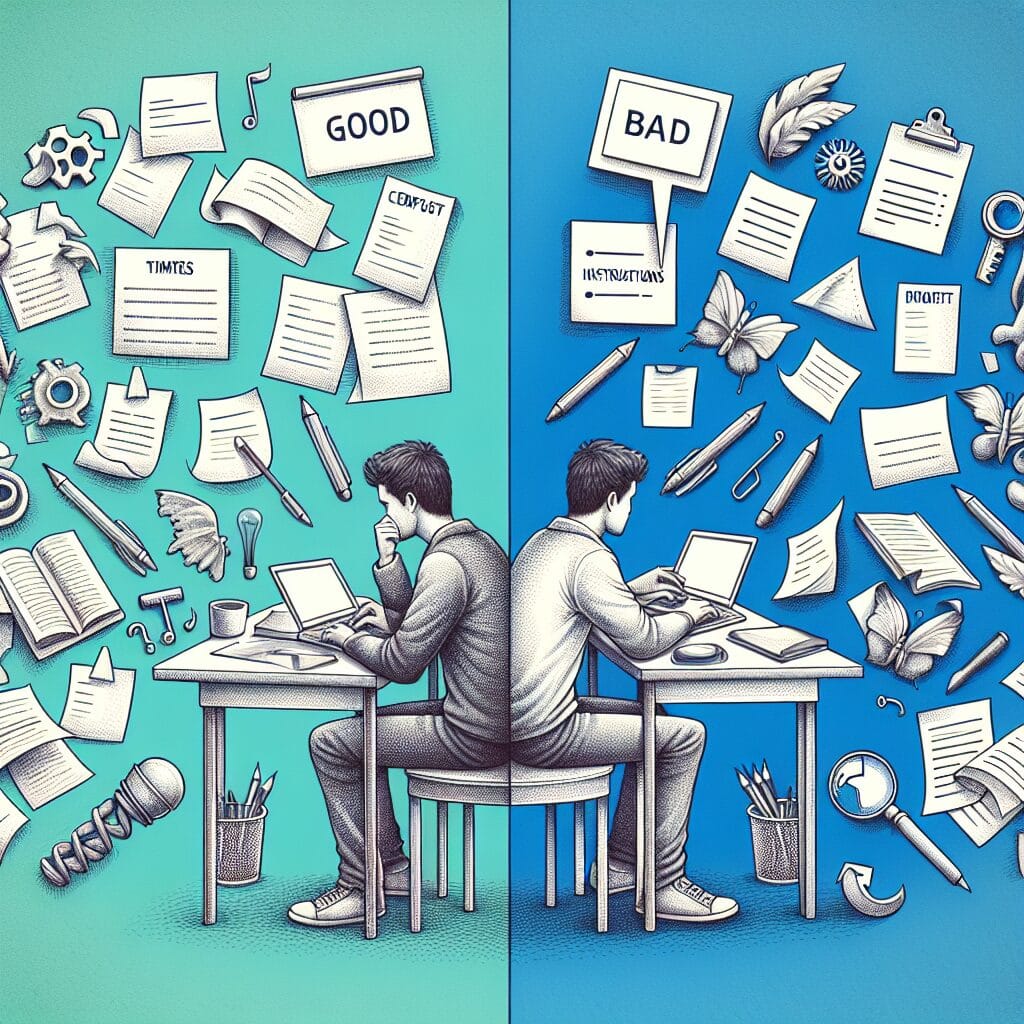

- Most AI failures are prompt failures — the model isn’t broken, your instruction is ambiguous
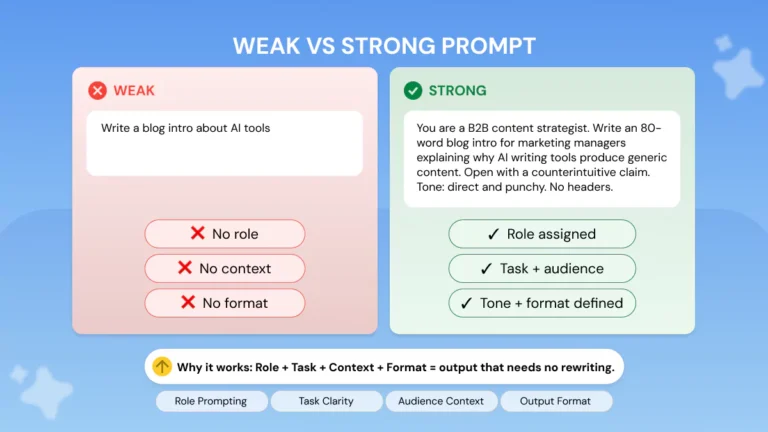
- A good prompt specifies role, context, constraints, and output format. Bad prompts skip all four
- The most common failure pattern: one-line requests that assume the AI shares your mental context
- Fixing prompts is faster than switching models — 80% of output quality lives in the prompt
Here’s something I’ve watched happen across 300+ AI audits: a team spends three months evaluating models, picks the “best” one, and then complains their outputs are generic and useless. Nine times out of ten, their prompts look like this: “Write a product description.” That’s not a prompt. That’s a Rorschach test.
The model isn’t failing. It’s doing exactly what you told it to do — which is nothing specific at all.
Prompt quality is the single biggest performance variable in AI personalization. Not model choice. Not fine-tuning. The prompt. Let me show you what that actually means in practice.
After auditing AI content pipelines for B2B SaaS companies in the US and EU, I keep seeing the same structural gaps. Good prompts aren’t magic — they consistently include four things bad prompts skip. ESTABLISHED
| Element | What It Tells the AI | Skipping It Costs You |
|---|---|---|
| Role | “You are a B2B copywriter for SaaS…” | Generic, wrong-audience tone |
| Context | Product type, audience, constraints | Off-target content, irrelevant angles |
| Task | Exact action: rewrite, summarize, analyze | The AI guesses what you want |
| Format | Length, structure, tone, output shape | Walls of text or bullet soup |
Every element you leave out forces the AI to fill in the blank. And it will — with whatever its training data suggests is “average.” Average is never what you want.
Real Before/After: What the Gap Actually Looks Like
Abstract advice is useless. Here are three real failure patterns from audits, with the broken prompt and the fixed version side by side.
Example 1 — Product description
No audience. No differentiator. No length. No tone. The AI will write something technically correct and completely forgettable.
Role, audience, pain point, differentiator, length, tone, structure. The AI has zero ambiguity to fill with mediocrity.
Example 2 — Content ideas
This will return the same 10 topics every AI content tool has generated a million times. Useless.
Niche, audience size, format, angle direction, output structure. Now you’re getting something worth reading.
The four elements a good prompt supplies vs the vacuum a bad prompt leaves for the AI to fill with “average.”
The Three Failure Modes That Kill AI Personalization
These aren’t edge cases. They’re the three patterns I see in almost every audit. PROBABLE
Failure mode 1: The assumed context trap. You’ve been thinking about your product for months. The AI has been thinking about it for zero seconds. “Write something catchy” means nothing without knowing what “catchy” means in your vertical, at your price point, for your buyer. The context lives in your head, not in the prompt.
Failure mode 2: The open question that isn’t open. “What should we do about our onboarding?” sounds open-ended, but you actually want something specific — you just haven’t said what. The AI will answer the literal question with a general framework, which is technically correct and completely useless to you.
Failure mode 3: The format vacuum. No format instruction means the AI picks one. Usually: four paragraphs of approximately equal length, no headers, moderate formality. Maybe that’s what you wanted. Probably it isn’t. Tell it.
One ecommerce client spent two weeks iterating on AI-generated email subject lines that “weren’t landing.” When I looked at their prompts, every single one was a variation of: “Write 10 subject lines for our Black Friday sale.” No audience segment. No brand voice. No performance benchmark to beat. No instruction on what to avoid.
We rewrote one prompt — added audience segment (cart abandoners, 30+ days inactive), voice constraints (no exclamation marks, no urgency language, conversational), and context (previous top performer: “You left something behind”). Open rates jumped 22% in the next send. Same model. Different prompt. PROBABLE
Why This Matters Specifically for AI Personalization
Generic AI outputs and personalized AI outputs start from the same model. The difference is prompt specificity. When your personalization system generates content at scale — product recommendations, email copy, push notifications — every ambiguous prompt multiplies into thousands of mediocre outputs.
A one-sentence prompt gap that produces a slightly-off email subject line at human scale is annoying. At scale — 100,000 sends per week — it’s an erosion of trust, engagement, and revenue. SPECULATIVE
This is why prompt governance matters in personalization pipelines. Not just “write better prompts” — but documenting, versioning, and testing prompts the same way you’d test code. Most teams don’t do this. Most teams should.
Explore prompt templates at BestPrompt.art
What Could Be Wrong With This
The four-element framework above is solid for text generation tasks in marketing and content. It’s less universal than I’m presenting it:
- For code generation, few-shot examples often outperform any amount of descriptive instruction — the framework helps, but examples help more.
- The “role” element (system prompts) is significantly more effective via API than in chat interfaces, where model behavior varies. My sample skews API-based B2B pipelines.
- Prompt quality has diminishing returns as model capability increases. The gap between good and bad prompts may narrow with next-generation models — or it may shift to different dimensions entirely.
- The 22% open rate improvement in the war story above is a single data point from one client. Don’t treat it as a benchmark.