$1.5 billion settlements, training data scraped without consent, and a legal landscape that changes monthly. Here’s the complete picture — for creators, developers, and everyone in between.
Let me be direct about something: the legal situation around AI and copyright is genuinely a mess, and anyone who tells you otherwise is either selling something or hasn’t been paying close enough attention.
Courts are issuing contradictory rulings. Fair use arguments that worked in one case failed in the next. The U.S. Copyright Office keeps releasing guidance, then revising it. And meanwhile, generative AI companies are training on datasets that include millions of protected works — betting that the legal landscape will shake out in their favor before the bills come due.
For creators, the question is: what do you actually do? For developers, it’s: what liability are you actually carrying? This guide answers both — with real case data, not speculation.
Here’s the thing that trips most people up: copyright infringement isn’t about intent. It doesn’t matter whether an AI company meant to infringe. What matters is whether a protected work was reproduced without authorization, and whether that reproduction harms the original market.
For AI systems, this creates a specific legal problem in two distinct places: during training and at the output stage. They’re legally separate — and both can get you into trouble.
Courts weigh all four factors — no single one is decisive. The catch is that AI training typically looks terrible on Factor 4. When a model trained on your novels can generate fiction in your style that competes with your novels on the same market, it’s very hard to argue no market harm.
Related: How AI Companies Handle IP ComplianceThe training stage is where the legal question is still genuinely unsettled. Output infringement — where the AI reproduces substantial portions of a specific protected work — is legally cleaner: that’s infringement. Full stop.
2. The Major Cases — What Courts Have Actually Decided
I’ve tracked every significant AI copyright ruling since 2023. Here are the ones that actually matter for understanding where things stand.
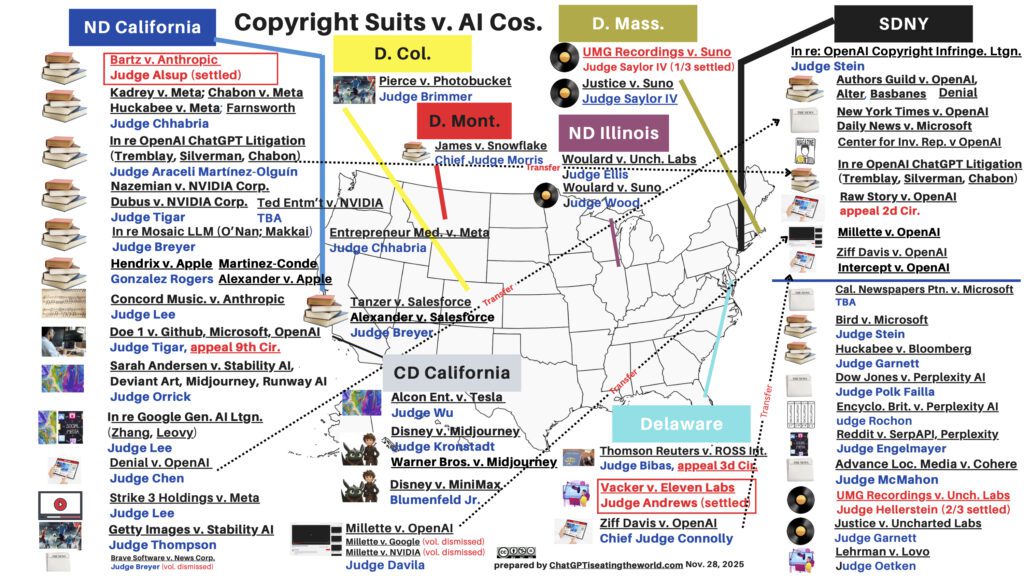
A class action brought by authors including Jodi Picoult and other major writers, alleging that Anthropic trained Claude on over 500,000 books scraped from piracy sites including LibGen — without consent, license, or compensation. Filed in the Northern District of California.
The September 2025 settlement: $1.5 billion total, approximately $3,000 per infringed work. Anthropic also agreed to a certified data destruction process for the pirated training corpus. This is the number everyone will be citing for the next few years when calculating AI copyright liability.
ROSS built a competing legal AI using Westlaw’s copyrighted headnotes — editorial summaries of case law — as training data. The Delaware court rejected fair use on all four factors. The decisive factor: ROSS was building a direct commercial competitor to Westlaw, making market harm obvious.
ROSS argued the training process was transformative. The court disagreed — transformativeness doesn’t save you when you’re using someone’s content to build a product that replaces their product.
A Munich court ruled that OpenAI infringed GEMA-managed song rights by training ChatGPT on lyrics without a license. This is significant because it extends infringement to the training process itself — not just the output — under German copyright law, which has no fair use equivalent. Damages undisclosed pending final assessment.
Two cases worth watching but not yet resolved: NYT v. OpenAI (New York, focuses on near-verbatim output reproduction of articles) and Getty Images v. Stability AI (alleges mass scraping of 12 million images including metadata). Both are likely to produce significant rulings in 2026.
See also: AI Legal Compliance Strategies3. The U.S. vs. EU vs. Everyone Else — A Jurisdiction Map
One of the most frustrating parts of this area is that the rules are genuinely different depending on where you operate. This isn’t nitpicking — it’s the difference between legal and illegal.
| Jurisdiction | Training Data Rule | Output Copyrightability | Risk Level |
|---|---|---|---|
| United States | Fair use possible — but declining in competitive cases | No copyright for pure AI output; human edits may qualify | MEDIUM |
| European Union | Must license or use public domain; opt-out registries apply | No EU-wide AI copyright; member state variation | HIGH |
| United Kingdom | Text & data mining exception applies to non-commercial research | Computer-generated works can be copyrighted (unusual globally) | MEDIUM |
| China | Evolving — court-by-court; some AI outputs granted protection | Beijing courts have granted copyright to AI-assisted images | MEDIUM |
| Japan | Broadest TDM exception globally — training largely permitted | AI-only outputs not copyrightable; human contribution required | LOW |
Japan is the outlier most AI researchers know about but don’t publicize loudly: Japanese copyright law has the most permissive text and data mining exception in the world, explicitly allowing AI training on copyrighted materials for non-expressive purposes. Several AI labs have established data processing operations there specifically because of this.
4. What AI Developers Actually Need to Do
Not a checklist. Real decisions, with real trade-offs, in the order that matters.
First: Audit what’s in your training data
This sounds obvious but most teams either haven’t done it or did it once and stopped. The Anthropic case turned on LibGen — a source that wasn’t ambiguous. If you’ve used Common Crawl, Books1, Books2, or any web-scraped dataset without auditing its provenance, you may be carrying liability you haven’t quantified.
Training data sources that create legal exposure
- LibGen, Sci-Hub, Z-Library — piracy sites explicitly cited in Bartz v. Anthropic
- Unfiltered Common Crawl — contains copyrighted text at scale; needs filtering
- Social media scrapes — user content subject to platform ToS and copyright claims
- News archives scraped without license — NYT, AP, and others have sued specifically over this
- Image datasets without metadata audit — LAION-5B, specifically flagged in Getty case
Then: Decide your legal strategy — honestly
There are three real positions you can take. Fair use argument (risky, case-dependent), licensed datasets only (expensive, but clean), or synthetic data generation (emerging, still uncertain). Most serious companies are moving toward a combination of licensed data plus synthetic generation. The “just train on everything and see” era is ending — the Anthropic settlement made that financially untenable.
Monitor your outputs
Output-level infringement is the more immediately actionable risk for most businesses. Tools like Copyleaks can detect when model outputs substantially reproduce protected text. If your production model is regurgitating copyrighted articles verbatim, that’s direct infringement regardless of your training data story.
Related: AI Prompt Engineering Best Practices5. What Creators & Rights Holders Need to Do
The power dynamic here is genuinely asymmetric. An AI company can train on your work at scale, and you may not know for months or years. That said, you have more levers than you might think.
Registration first — everything else is secondary
If you haven’t registered your copyrights with the U.S. Copyright Office, do it before anything else. Registration within three months of publication unlocks statutory damages ($750–$150,000 per work) and attorney’s fees. Without it, you’re limited to actual damages — which are very hard to prove against an AI company. The filing fee is $65. The difference in potential recovery is measured in tens of thousands of dollars per work.
What actually works for rights holders
- Register with U.S. Copyright Office — unlocks statutory damages. Do this first.
- Opt out of AI training — add
User-agent: GPTBotand equivalent directives to robots.txt for major crawlers. Not legally binding but documents your objection. - Join Spawning.ai’s opt-out registry — covers Stable Diffusion and several other models directly.
- Embed C2PA metadata via Adobe Content Authenticity Initiative — creates a provenance record that follows your work across platforms.
- Monitor with reverse image search / Copyleaks — evidence gathering is essential before any legal action.
- License proactively — if your work is going to be trained on anyway, getting paid for it is better than not. Getty’s licensing program with AI companies is the model here.
Style infringement is a separate frustrating issue. Copyright doesn’t protect style — only specific expression. If an AI produces work “in the style of” an artist, that’s not legally actionable regardless of how obvious the mimicry is. This is a gap in the law that WIPO and several national legislators are actively debating, but it won’t be resolved quickly.
6. Tools That Are Actually Worth Using
7. The Honest Risk Scenarios — What Might Happen Next
Three scenarios. One is wishful thinking, one is where I think things are actually heading, and one is the bad version.
Congress acts; the market self-organizes
A legislative fix clarifies fair use for AI training with mandatory licensing compensation — similar to how music streaming was resolved via compulsory licensing in the 1970s. A robust licensing market emerges, creators earn royalties, AI companies get legal certainty, and everyone moves on. This is the scenario that IP scholars are advocating. It’s also been two years in the making with no serious Congressional movement.
Years of litigation → patchwork settlements
The Anthropic settlement becomes a template. Major AI companies settle with the largest plaintiffs, negotiate licensing deals with media and publishing groups (the way Spotify eventually negotiated with labels), and absorb the cost as a business expense. Small creators continue to have limited recourse. The EU implements stricter rules that diverge significantly from U.S. practice, creating compliance complexity for companies operating in both markets. This process takes 5–8 years.
Strict judicial rulings halt unlicensed training
A Supreme Court ruling definitively rejects fair use for commercial AI training. Dataset destruction orders become common. Training costs skyrocket as every model requires fully licensed datasets. The compliance burden ($500B estimated by Gartner for full-scope compliance) concentrates AI development among companies with the resources to absorb it, and destroys most AI startups. Possible. Not probable.
My honest read: we’re in the middle scenario. The litigation will continue, settlements will accumulate, and the market will eventually produce licensing norms similar to how digital music rights evolved. The timeline is 5–10 years. Plan accordingly.
8. How We Got Here — A Timeline That Actually Explains Things
OpenAI’s ChatGPT reaches 1M users in 5 days. The scale of web-trained language models becomes visible to the public. Legal experts immediately flag training data concerns — but litigation takes time to organize.
Getty sues Stability AI for allegedly using 12 million Getty images, complete with watermarks, to train Stable Diffusion. The visible Getty watermarks in some outputs made this case uniquely damaging for the defendant.
The New York Times sues OpenAI and Microsoft, alleging millions of articles were used to train GPT models. The lawsuit includes exhibits showing ChatGPT reproducing NYT articles near-verbatim — the output infringement argument at its most concrete.
Delaware court rules in favor of Thomson Reuters against ROSS Intelligence. Fair use defense rejected. Training on copyrighted materials to build a competing product is infringement. First significant judicial precedent established.
Class action settlement sets the per-work benchmark at ~$3,000. Dataset destruction agreed. Every AI company’s legal team recalculates their exposure overnight. The era of “train on everything and fight later” effectively ends.
Munich court finds training on song lyrics without license constitutes infringement under German law. No fair use equivalent means no defense. EU operations now carry explicit training-stage infringement risk.
9. Frequently Asked Questions
Can AI-generated content be copyrighted?
Is training AI on copyrighted data always infringement?
What if an AI replicates my style?
How do I prove an AI was trained on my work?
What does the EU AI Act actually require?
Does adding watermarks to my work actually help?
10. Your Actual Action List
Split by who you are. Do the ones relevant to you, in order.
If you’re a creator / rights holder:
If you’re an AI developer / company:
Stay Ahead of the AI Legal Landscape
We track AI copyright cases, tool updates, and compliance strategies so you don’t have to dig through court filings.
Visit bestprompt.art →Primary Sources & Further Reading
- U.S. Copyright Office — AI & Copyright Reports (2025)
- PACER — Court Filings: Bartz v. Anthropic, Thomson Reuters v. ROSS
- WIPO — AI and Intellectual Property: Policy Discussion
- Copyright Alliance — 2025 AI Litigation Tracker
- Ropes & Gray — Analysis of Bartz v. Anthropic Settlement
- European Commission — EU AI Act (Official Text)
- McKinsey — State of AI Report 2025
- Adobe Content Authenticity Initiative — Technical Documentation