Ai Bias: The Hidden Dangers of Generated Content (2025)

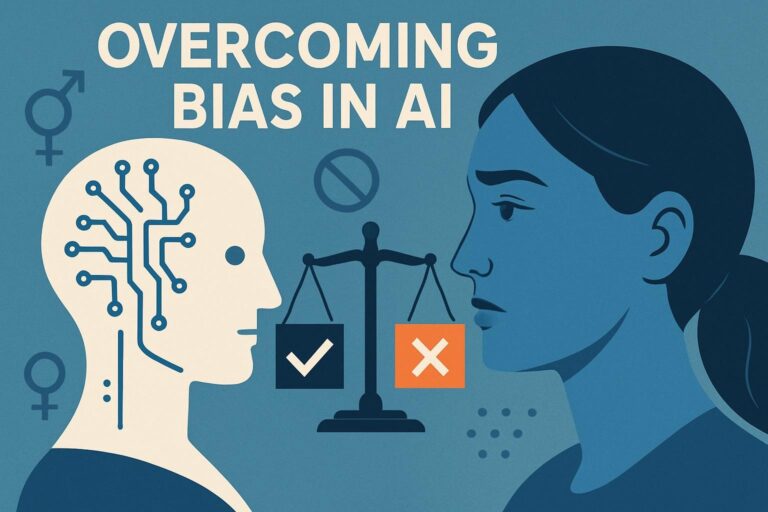
Most bias guides treat “AI bias” as one thing. It’s five distinct mechanisms — and each one shows up in a different content category, at a different point in your workflow, with a different fix. Here’s how to tell them apart before they reach your audience.
The short version
AI bias in content isn’t random. It follows predictable patterns tied to how language models are trained and what they’re being asked to do. The Amazon recruiting tool failure, the Google Photos incident, and the New York City Local Law 144 enforcement cases all trace to different mechanisms — and the mitigation for each is different. Treating them as the same problem is why most content-layer fixes don’t work.
- Five bias types: representational, allocational, historical, framing, and amplification
- Each maps to a specific content category where it most commonly surfaces
- Detection strategies are type-specific — one checklist doesn’t cover all five
- Content-layer mitigation is necessary but not sufficient: the data layer problem requires disclosure, not just editing
When Amazon shut down its AI recruiting tool in 2018, the coverage described it as “biased against women.” That’s accurate but incomplete — the way a description of smoke describes what’s visible without naming the fire. The actual mechanism was historical data reproduction: the model was trained on a decade of Amazon’s own hiring decisions, which reflected the male-dominated tech hiring of the 2000s, and it learned to replicate those patterns rather than transcend them. Fixing “bias” in that system didn’t mean adding a gender balance parameter. It meant confronting the fact that the training data was the company’s historical discrimination, made algorithmic.
Understanding that distinction matters for content teams because the interventions are different. A model that perpetuates historical hiring bias in job description copy needs a different fix than a model that amplifies engagement-optimized framing in news summaries. Calling both “biased” and applying the same prompt-engineering checklist to both is a little like treating a broken arm and a broken window with the same protocol because you called them both “broken.”
There are five mechanisms. Know them separately.
| Mechanism | What the model is actually doing | Most common content category | How it surfaces | Detection risk if ignored |
|---|---|---|---|---|
| Representational | Under- or over-representing groups relative to their actual prevalence or contribution | Descriptive copy, landing pages, case studies | All examples are from one demographic; other groups absent or peripheral | High visibility |
| Allocational | Differentially assigning qualities, roles, or opportunities based on group membership | Job descriptions, ad targeting copy, product recommendations | Different language for equivalent roles; leadership language gendered; capability assumptions vary by named group | Legal exposure |
| Historical | Reproducing past patterns embedded in training data as if they reflect current reality | Summarization, research synthesis, educational content | Framing that minimizes historical injustice; presenting past power structures as natural or neutral | Moderate — often subtle |
| Framing | Presenting the same facts with language that systematically favors one interpretation | News summaries, analysis, editorial content, social copy | Active vs. passive construction differs by actor; emotional language asymmetric across groups | Editorial credibility |
| Amplification | Exaggerating statistical patterns present in training data, making them more extreme than the underlying reality | Engagement-optimized content, recommendation copy, personalization | Stereotypes stronger than societal averages; edge cases treated as typical | Slow accumulation |
The legal exposure tag on allocational bias isn’t rhetorical. New York City Local Law 144, which took effect in July 2023, requires bias audits for automated employment decision tools used in hiring or promotion in NYC. The EU AI Act’s high-risk AI classification includes AI systems used in employment and education contexts. Companies using AI to generate job descriptions, screening criteria, or candidate communications in these jurisdictions face real compliance requirements — not theoretical ones.
Documented failure — allocational bias
Amazon built an AI recruiting tool between 2014 and 2017 to automate resume screening. The team trained it on resumes submitted to Amazon over the preceding decade — roughly 10 years of actual hiring decisions. By 2015, they noticed something wrong. The system was consistently downgrading resumes that included the word “women’s” (as in “women’s chess club”) and penalizing graduates of all-women’s colleges. It was also recommending candidates described with verbs like “executed” and “captured” while penalizing language more common in women’s resumes.
Amazon’s engineers tried to correct for the gender bias specifically. They retrained the model with adjustments. The problem persisted in new forms. Reuters reported in 2018 that Amazon ultimately scrapped the tool entirely after determining they could not guarantee it wouldn’t find other proxy variables to discriminate with — variables that correlated with gender without explicitly naming it: zip codes, school names, extracurricular activities.
The mechanism was allocational bias embedded in historical data. The fix wasn’t a prompt adjustment. It was recognizing that the training data was the discrimination, compressed and automated. Content teams using AI to generate job descriptions from existing job postings face a scaled-down version of exactly this problem.
Documented failure — representational + amplification bias
In June 2015, software developer Jacky Alcine discovered that Google Photos had automatically labeled photos of him and a Black friend as “gorillas.” Google apologized immediately and implemented a fix — but the fix was to remove the categories “gorilla,” “chimp,” and several other primate classifications from the system entirely. Not to fix the underlying model. To delete the labels.
The Verge confirmed in 2018, three years later, that those categories were still absent from Google Photos. The representational bias in the training data — far fewer images of dark-skinned faces, disproportionate association of certain image patterns — had been amplified into an output that was both catastrophically wrong and, once made, extremely difficult to correct without disclosing the full scope of the underlying problem.
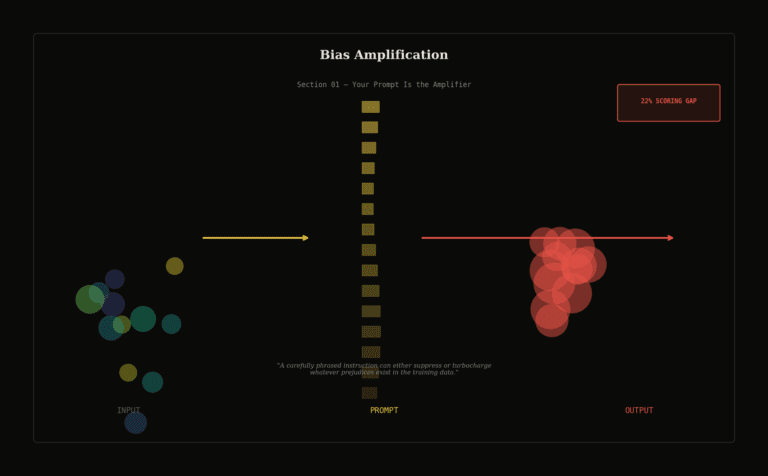
For content teams, the amplification mechanism is the most insidious one because it compounds. A model that associates “executive” 60% with male-presenting images in training data doesn’t produce copy that reflects 60/40 — it often produces copy that reads closer to 80/20, because it’s optimizing toward the pattern’s center of mass, not its edges.
“Fixing a biased prompt is like fixing a leaky pipe with duct tape while the source is still running. You need both — but knowing which you’re doing is the difference between mitigation and theater.”
This is the practical part. Different content types carry different bias risk profiles — not because some topics are more sensitive, but because different generation tasks surface different mechanisms.
Ad copy & landing pages
Primary risk: Allocational + Representational
High
Job descriptions
Primary risk: Allocational (legally regulated in some jurisdictions)
High + legal
News & editorial summaries
Primary risk: Framing + Historical
Medium
Educational content
Primary risk: Historical + Representational
Medium — delayed detection
Personalization & recommendations
Primary risk: Amplification (compounds over time)
Medium — slow accumulation
The delayed detection note on educational content matters. A landing page that uses biased imagery gets flagged quickly — it’s visible. An AI-generated summary of a historical period that minimizes systemic injustice may circulate for months before a subject-matter expert flags it, because the output is grammatically impeccable, cites plausible sources, and reads as neutral. Historical bias is specifically designed, by its nature, to look like objectivity.
78%
of large language models show measurable gender bias in occupational language generation
Kotek et al., 2023 — arXiv:2308.03921
25%
average reduction in candidate pool diversity when AI-generated job descriptions use unexamined training data, per NBER working paper
NBER Working Paper 31157, 2023
3×
rate at which bias amplification exceeds base rate in training data, in image captioning and description tasks
Zhao et al., 2017 — confirmed in subsequent replication
A word about the 25% NBER figure: this is a working paper, not a peer-reviewed finding, and the methodology involves observational data from job posting platforms rather than a controlled experiment. It’s directionally consistent with other research on language in job postings, but treat the precise number as indicative rather than definitive. The allocational mechanism is well-documented; the exact magnitude of its hiring effect is still being studied.
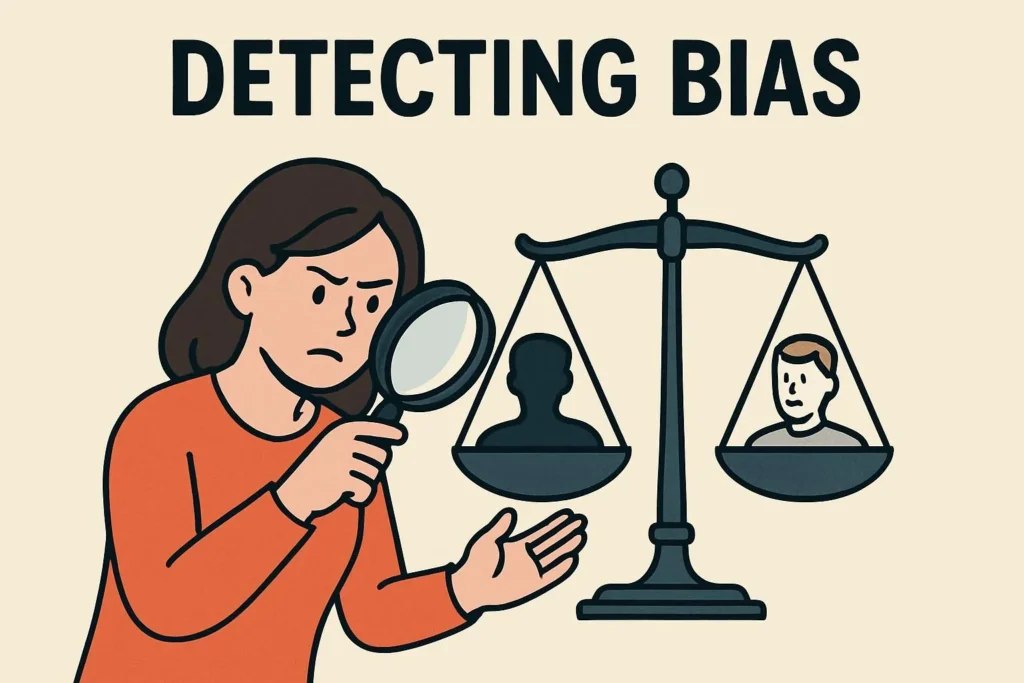
There is no single tool that catches all five mechanisms reliably. The detection strategies are different precisely because the mechanisms are different.
Representational
Count. Who appears in examples? What roles do different groups occupy? Absence is as significant as presence — a tech company landing page that mentions no women in leadership roles isn’t balanced just because it mentions women at all.
Allocational
Run the substitution test. Replace the group name with a different group and read the output. Does the language change? Does the role or capability implied shift? If the answer is yes — that’s allocational bias in the prompt or training.
Historical
Look for what’s missing. Historical bias tends to produce omission rather than commission — what the AI doesn’t say is more diagnostic than what it does. Subject-matter review is essential; generic editorial review often misses it.
Framing
Check active vs. passive voice by actor. Who commits actions and who has actions done to them? Check emotional language: does it vary by group for the same type of event? These asymmetries are often invisible to reviewers who share the framing assumption.
Amplification
Compare the output to baseline data. If your model produces copy where 85% of executives are male when the actual figure is 70%, amplification is happening. This requires knowing the baseline — which most teams don’t track.
A note on automated bias detection tools: Tools like Perspective API, IBM OpenScale, and Amazon SageMaker Clarify are useful for catching toxicity and some forms of representational bias in high volume. They are not designed to detect historical or framing bias, and they can miss allocational bias entirely when it’s encoded in role language rather than explicit slurs. Use them as a first pass, not a final check.
My honest position on whether this can actually be fixed
Here’s where I’ll take a clear stance rather than hedge: content-layer mitigation — better prompts, diverse editorial review, substitution tests — is necessary and genuinely useful. But it is not sufficient for the historical and amplification mechanisms, because those are properties of the training data, not of any individual prompt.
You can write a carefully constructed prompt for a job description that specifies inclusive language and asks the model to avoid gendered role assumptions. That prompt will produce a better output than a naive prompt. It will not eliminate the underlying tendency, because the model’s weights encode patterns from millions of text examples that predate your prompt by years. The prompt shapes the output; it doesn’t reshape the model.
This matters practically. Teams that implement prompt engineering best practices and then consider the bias problem solved are in a different risk position than they think. They’ve reduced the most visible failure modes. They haven’t addressed the ones that compound over time and surface slowly — the amplification of small skews across thousands of content pieces, the consistent framing choices that accumulate into editorial perspective.
The honest answer for organizations generating content at scale is: prompt engineering + diverse human editorial review + periodic auditing of output patterns over time. The auditing piece is almost universally skipped. That’s the gap.
“You can write a careful prompt. You cannot prompt-engineer your way out of training data that’s been accumulating patterns since before your company existed.”
What to actually do — in order of impact
-
Identify which bias mechanisms your content type is most exposed to
Use the content category table above. Don’t treat all your AI content as a single risk category — the risks for job descriptions and the risks for newsletter summaries are genuinely different, and the mitigation strategies differ accordingly.
-
Run the substitution test on all output before first publication in any category with allocational risk
This is the single highest-leverage detection method for the legally exposed mechanism. It takes five minutes per piece and catches the most consequential failure mode. There is no good argument for skipping it.
-
Build type-specific review criteria into editorial workflows — not a generic “check for bias” step
“Check for bias” as a checklist item fails because reviewers don’t know what mechanism to look for. Specify the mechanism: “For this job description, check for language that implies capability differences by gender. For this historical summary, check for what’s absent.”
-
For historical and educational content: require subject-matter review, not only editorial review
Historical bias is structurally invisible to reviewers who don’t know the field. A general editor cannot reliably detect an AI-generated summary of colonial history that omits documented evidence of deliberate famine policy. A historian can. Route these pieces accordingly.
-
Audit output patterns quarterly, not just individual pieces
Pull 50 random pieces from the past quarter. What roles do different demographic groups occupy across all examples? What framing patterns are consistent? Pattern-level auditing catches amplification bias that individual review misses.
-
For high-volume generation, document what your current baseline is before scaling
If you generate 500 pieces a month without a baseline measurement of how demographic representation and framing skews, you have no way to know whether your bias mitigation efforts are working. Measure first. It’s uncomfortable. Do it anyway.
What the regulatory direction tells you about where this goes
New York City’s Local Law 144 is the clearest signal of where employment-related AI content regulation is heading. It required third-party bias audits for automated employment decision tools as of July 2023, with results publicly posted. The EU AI Act’s classification of employment, education, and access to essential services as high-risk AI application domains signals that disclosure and auditability requirements are expanding, not contracting.
For content teams, the practical implication is this: organizations that build auditable bias documentation into their content workflows now are building something that will become a compliance requirement later. The teams that do it reactively — after the first regulatory inquiry — will do it under worse conditions with less time. This is the case where the proactive investment has an obvious payoff structure, even before you get to the reputational argument.
Bias in AI-generated content is not going to be solved by better models alone. The models are improving. The bias mechanisms are not disappearing; they’re becoming more subtle, which makes them harder to detect and easier to miss at scale. The organizations that understand which mechanism they’re dealing with, and apply the right detection and mitigation strategy to each, are in a genuinely different risk position than the ones applying generic “check for bias” steps and calling it done.
That’s the gap worth closing. It’s smaller than it looks once you know which mechanism you’re actually looking for.
Sources and references
- Kotek, H., Dockum, R., & Sun, D. (2023). Gender bias and stereotypes in large language models. arXiv:2308.03921.
- Cowgill, B., & Tucker, C. (2023). Algorithmic bias: A review of causes and mitigation strategies. NBER Working Paper 31157. (Note: working paper, not yet peer-reviewed.)
- Zhao, J., Wang, T., Yatskar, M., Ordonez, V., & Chang, K. W. (2017). Men also like shopping: Reducing gender bias amplification using corpus-level constraints. arXiv:1707.09457.
- Dastin, J. (October 2018). Amazon scraps secret AI recruiting tool that showed bias against women. Reuters.
- Simonite, T. (January 2018). When it comes to gorillas, Google Photos remains blind. Wired.
- The Verge. (January 2018). Google Photos still can’t find gorillas, and neither can Apple or Microsoft.
- New York City Council. (2021). Local Law 144 of 2021. Automated Employment Decision Tools.
- European Parliament. (2024). EU Artificial Intelligence Act. Official text and risk classification framework.
- Jigsaw / Google. Perspective API. Toxicity and identity attack scoring tool. Accessed April 2025.
https://www.bestprompt.art/understanding-biases-in-ai/
https://www.bestprompt.art/bias-in-ai-generated-content-2026/
https://www.bestprompt.art/bias-in-ai-generated-content/