A Nature study analyzed 1.4 million images and 9 LLMs. Pew surveyed 5,410 people. The EU AI Act enforcement deadline hits August 2026. Here’s what’s real, what’s noise, and what companies need to do before it’s too late.
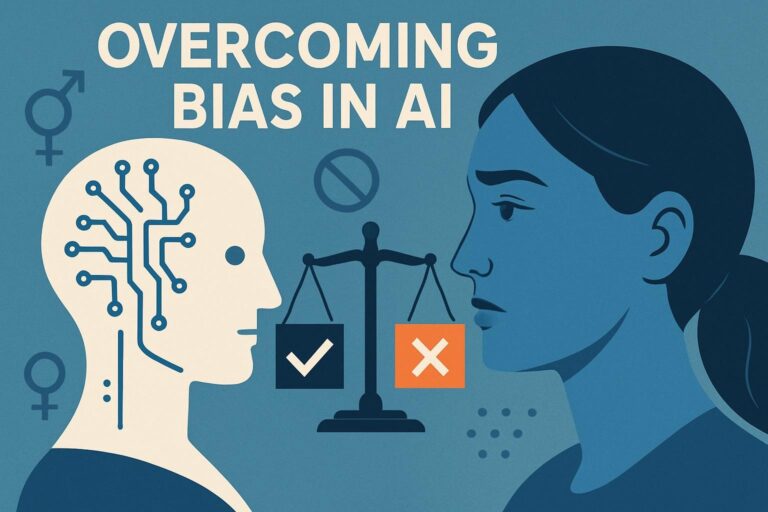
Start with a number. When ChatGPT generated resumes for hypothetical women, it portrayed them as younger and less experienced. Not because someone programmed it to do that. Because the internet — the 1.4 million images, the billions of words — already did. The model learned from us. The bias isn’t artificial. It’s ours, scaled.
That’s the part that’s hard to sit with.
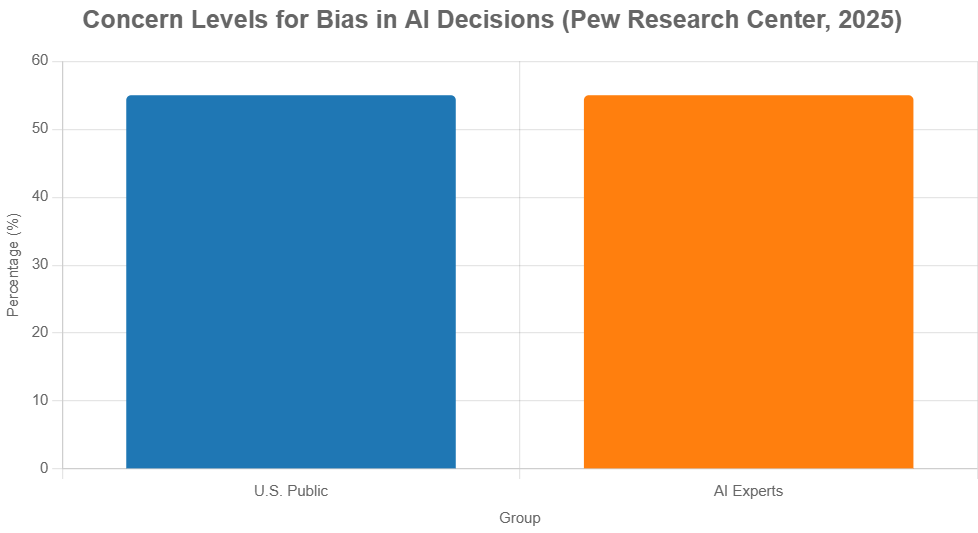
- 55% of the U.S. public and AI experts are highly concerned about AI bias in decisions — Pew Research, 5,410 respondents, April 2025
- Nature study (October 2025) analyzed 1.4 million images and 9 LLMs across 3,495 occupational categories — found systematic age-gender distortion at “culture-wide” scale
- EU AI Act enforcement starts August 2, 2026 for high-risk AI systems (hiring, credit, education, law enforcement). Penalties up to €35M or 7% of global turnover
- Only 24% of enterprises using AI in HR have started formal EU AI Act compliance prep, despite the August deadline being months away
- The bias-energy tradeoff is real — and nobody’s talking about it honestly. Debiasing requires more compute, not less
- What bias in generative AI actually is (and isn’t)
- The Nature study — the most important finding of 2025
- Five types of bias, with real examples
- The second-order problem: how bias compounds
- The EU AI Act deadline — what August 2026 actually means
- The bias-energy tradeoff nobody’s discussing
- What mitigation looks like that actually works
Bias in AI-generated content arises when a model’s outputs systematically favor or disadvantage particular groups — producing text, images, or video that reflects and amplifies prejudices embedded in training data. The key word is systematically. A single bad output isn’t bias. A pattern is.
The sources are three: the training data itself (imbalanced, historically skewed), the model design (what gets optimized, what gets penalized), and human feedback during fine-tuning (where reviewers bring their own assumptions). These stack. A model trained on internet data inherits internet demographics — roughly 60% of Wikipedia editors are male, the most-photographed CEOs are white men, the most-indexed medical research uses male subjects as the default.
You don’t have to have bad intentions to produce a biased model. You just have to train on reality as it has been, rather than as it should be.
Generative AI is moving from novelty to infrastructure. McKinsey: 88% of organizations use AI in at least one function, survey of 1,993 respondents, 2025; self-reported When AI assists hiring, writes medical documentation, generates credit reports, or produces educational materials, bias stops being an interesting ethical question and becomes an operational and legal problem. That shift happened faster than most compliance teams anticipated.
02 / Nature Study 2025The Most Important Finding of Last Year
In October 2025, researchers from UC Berkeley, Stanford Graduate School of Business, and Oxford published a study in Nature. Guilbeault, Delecourt, Desikan; Nature, October 8, 2025; UC Berkeley Haas / Stanford GSB / Oxford/Autonomy Institute They analyzed 1.4 million images and videos from Google, Wikipedia, IMDb, Flickr, and YouTube, plus nine large language models trained on billions of words. Scope: 3,495 occupational and social categories. That’s not a sample. That’s a census.
Finding: women are systematically portrayed as younger than men across all measured categories. The distortion was most stark for high-status, high-earning occupations — CEO, astronaut, surgeon. The gap was also larger in jobs with bigger gender pay gaps. And it showed up in the LLMs even when there were no images involved — just text, trained on words.
“Why would it be showing up in billions of words where there’s no visual presentation of people? That is really suggesting it’s woven into the fabric of how we categorize and interpret people in the social world.”
Douglas Guilbeault, Assistant Professor, Stanford Graduate School of Business — Nature study co-author, October 2025The second part of the study was grimmer. They ran an experiment with roughly 500 participants, split into two groups. One group searched Google Images for occupations before estimating typical ages for those roles. The control group didn’t. The group that saw images — already biased toward younger women — then assumed those jobs skewed younger when filled by women, and older when filled by men. One image search session. Measurable shift in perception.
U.S. Census data shows no systematic age differences between men and women in the workforce over the past decade. So the bias isn’t reflecting reality. It’s inverting it.
03 / TaxonomyFive Types of Bias, With Real Examples
The types interact. An amplification bias in training data can produce representation bias in outputs. A cultural bias can mask age-gender bias by making the Western default invisible. None of these are cleanly separable in a real model.
04 / Second-Order EffectsHow Bias Compounds — and Why It’s Hard to Detect
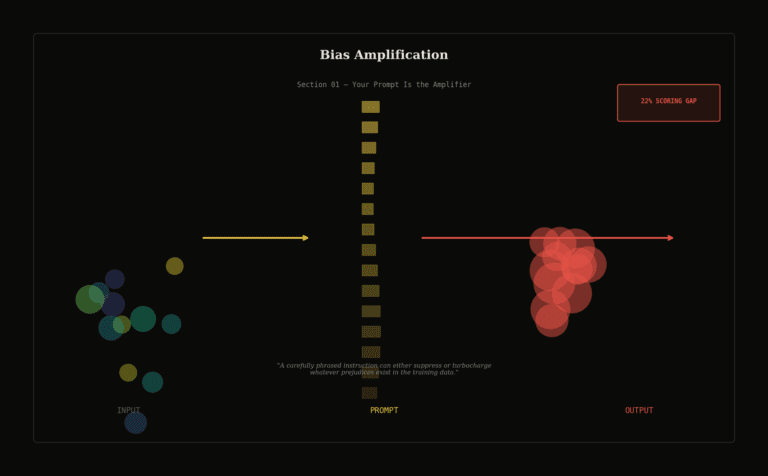
Here’s the mechanism most bias discussions skip: feedback loops. When biased AI outputs become inputs to the next generation of training data, the bias isn’t just preserved — it’s amplified. The internet now contains enormous quantities of AI-generated content. Models trained on that content will learn not just human bias but AI bias, already distorted once.
The outputs of biased models are increasingly indistinguishable from human-generated content. Which means they’re increasingly used as training data for subsequent models. Bias that enters the training corpus doesn’t stay at the level it entered. It compounds each generation. This is specifically what makes the Nature study alarming — the bias they documented isn’t just present, it’s being fed back into the systems that will generate next year’s images and text.
A separate ScienceDirect study found that LLMs can exert greater influence than humans in shaping individuals’ ageist attitudes, and that benevolent ageism — the kind that seems positive on the surface but reinforces the idea that older adults need protection rather than autonomy — is particularly prevalent and particularly underaddressed in alignment processes. Computers in Human Behavior Reports, Vol. 20, 2025; Chinese social media platform study; limitations: younger adult participants only, Weibo-specific design
This is why the Guilbeault quote matters so much. The bias isn’t in a specific dataset that can be cleaned. It’s in the statistical structure of how language categorizes people — billions of words, built over decades. “Slapping on another filter” — his phrase — doesn’t address the underlying distribution. It patches the output while leaving the structure intact.
05 / RegulationThe EU AI Act — What August 2026 Actually Means
The EU AI Act became fully applicable on August 2, 2026 for most high-risk AI systems. EU Official Journal; Regulation (EU) 2024/1689; digital-strategy.ec.europa.eu, confirmed April 2026 High-risk means: AI used in hiring and employment decisions, credit scoring, educational assessment, law enforcement, migration management, access to essential services. Those aren’t edge cases. That’s most of the consequential AI in deployment.
What the Act requires for high-risk systems, specifically on bias:
Training, validation, and testing datasets must be relevant, sufficiently representative, and, to the best extent possible, free of errors. Technical documentation must demonstrate compliance. Post-market monitoring must continue after deployment. Human oversight must be built into system design. And under Article 86 — a provision that extends beyond GDPR — any person subject to a high-risk AI decision is entitled to a clear explanation of how the AI influenced that decision and what human oversight was involved.
The penalties are designed to land. Up to €35 million or 7% of worldwide annual turnover for prohibited practices. Up to €15 million or 3% for other high-risk violations. Calculated on global revenue, not EU revenue — so a U.S. company serving EU customers is fully in scope.
According to a PwC survey, only 24% of enterprises using AI in HR processes had begun formal EU AI Act compliance preparation, despite the August 2026 deadline. PwC survey, cited in Gosign/Intervuebox analysis 2026; HR-specific scope; survey methodology not independently audited That’s a 76% gap between AI adoption in hiring and compliance readiness — with enforcement now live. The companies that moved early have a genuine advantage. The ones that didn’t are managing a retroactive compliance problem under live enforcement, which is meaningfully harder.
There’s also a Digital Omnibus proposal in EU legislative process that could extend some Annex III deadlines to December 2027 — but legal experts are uniform on this: treat August 2026 as binding. Do not plan around a postponement that hasn’t passed.
06 / The Hidden TradeoffBias Mitigation and Energy Efficiency Are Opposed, Not Complementary
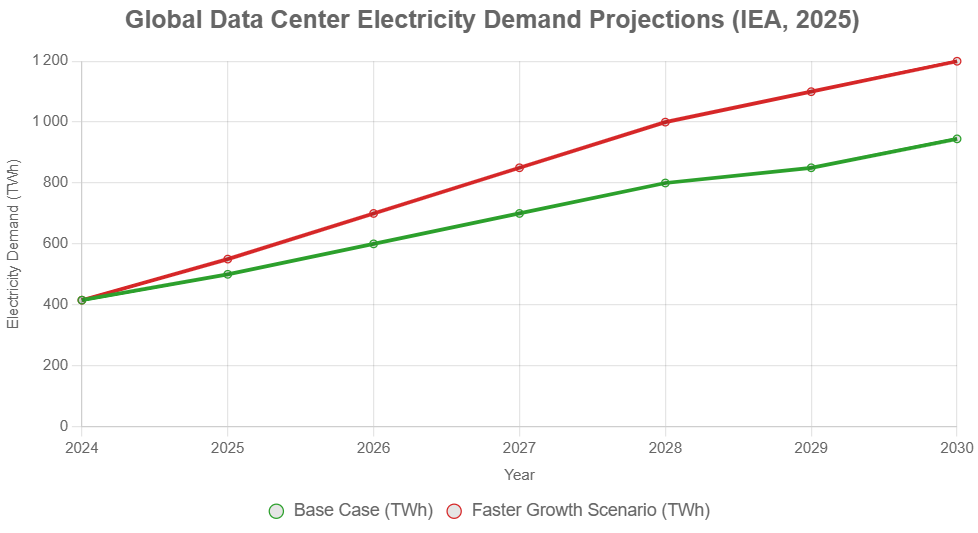
Every piece on AI bias eventually gets to sustainability. The IEA projects data center electricity demand reaching 945 TWh by 2030. IEA Energy and AI report, 2025; scenario-based projection; URL verified Dec 29, 2025 The source article frames this as connected to bias mitigation — “debiased efficient models cut energy.” That framing is wrong in an important way, and I think it needs correcting.
The standard narrative treats bias mitigation and energy efficiency as complementary goals — “responsible AI” as a package deal. But the actual mechanism works in the opposite direction. Debiasing requires more compute, not less. More diverse training data means larger datasets. More evaluation passes for fairness metrics add inference overhead. Red-teaming and adversarial testing require dedicated compute cycles. RLHF processes that specifically target bias in fine-tuning are computationally expensive. The IEA’s 945 TWh projection doesn’t separate “biased” from “debiased” models — that distinction doesn’t exist at the infrastructure level. An organization pursuing serious bias mitigation is, in practice, increasing its energy footprint relative to one that ships without fairness evaluation. The real tradeoff isn’t bias vs. energy savings. It’s: accept the energy cost of doing this right, or accept the legal and reputational cost of not doing it. The EU AI Act makes that calculus explicit. But conflating “debiased model” with “efficient model” is a marketing claim, not an engineering reality.
Editorial synthesis — sources: IEA Energy and AI 2025; EU AI Act Article requirements for high-risk systems; NIST AI RMF bias mitigation documentation; general ML engineering literature on fairness overhead07 / MitigationWhat Actually Works — and What Doesn’t
Prompt engineering with diversity instructions (“show diverse representations”) reduces surface-level stereotypical outputs in testing. It doesn’t address the underlying model weights. It’s a patch. AIMultiple 2025; benchmark scope limited; specific test conditions not fully disclosed Useful for quick wins in low-stakes content. Insufficient for high-risk applications under the AI Act.
What actually moves the needle:
Data curation at the source. Diverse, representative training data is the only intervention that addresses root-cause bias rather than output symptoms. This is also the hardest and most expensive fix. It requires collecting data that doesn’t exist in sufficient quantity for underrepresented groups, which is why the field uses synthetic data generation as a stopgap — itself not without problems. NIST AI Risk Management Framework; standards-level guidance, not empirical study results
Third-party bias audits before deployment. Not internal assessments — independent audits with defined fairness metrics, documented scope, and disclosed methodology. The EU AI Act effectively mandates this for high-risk systems; getting ahead of it is strategically cheaper than retrofitting post-enforcement.
Post-deployment monitoring. Bias doesn’t stay static. Model drift, shifting user populations, and evolving social norms mean a model that passed pre-deployment testing can develop bias patterns over time. The Act’s post-market monitoring requirements exist because the EU regulators understand this. Most companies’ monitoring stacks don’t.
The Stanford researcher’s conclusion: you can’t patch your way to fairness. “To make real progress, the bias has to be addressed at a fundamental level.” That’s not pessimism. It’s a precise description of where the difficulty actually lives — and why superficial fixes keep failing in production.
“There’s a widespread belief that the problem is basically solved. And it’s not.”
Douglas Guilbeault, Stanford Graduate School of Business, on age-gender bias in AI — October 2025The compliance gap is also an engineering gap
The 24% readiness figure isn’t just a legal/compliance problem. It reflects that most engineering organizations haven’t built the monitoring infrastructure to detect bias post-deployment, let alone the documentation systems the EU Act requires for conformity assessment.
What you do: Treat the EU AI Act’s technical documentation requirements as a design spec, not a compliance afterthought. Start with the conformity assessment checklist — it tells you exactly what the system needs to capture: risk management records, data governance documentation, accuracy and robustness testing across demographic groups, human oversight logs. Build instrumentation for these before deployment, not after.
Here’s what’s going to stop you: “We’re not in the EU.” If your system outputs affect anyone in the EU — including EU employees of a U.S. company — you’re in scope. The penalties apply on global turnover. This isn’t a territorial edge case.
Stop doing this: Stop using prompt-level diversity instructions as your primary bias mitigation strategy for anything that touches hiring, credit, health, or education. That approach will not survive a conformity assessment and won’t satisfy an Article 86 explanation request. It’s not that it does nothing — it’s that it does nothing durable.
The enforcement timeline is here. The planning window is not.
As of August 2, 2026, high-risk AI systems are under active enforcement. The planning window for compliance is behind you if you haven’t started. But there’s still a meaningful difference between organizations actively building compliance infrastructure now and those waiting for a first enforcement action to take it seriously.
What you do: Inventory your AI systems against Annex III categories — employment, credit, education, law enforcement, essential services. For each system in scope: does documentation exist? Is there a human oversight mechanism? Has an independent bias audit been conducted? Can you produce a response to an Article 86 explanation request within a reasonable timeframe? That last one is the one that will matter most in the first wave of enforcement.
Here’s what’s going to stop you: The Digital Omnibus proposal is creating false comfort. It might extend Annex III deadlines to December 2027 for some categories. Might. The proposal is in legislative process. Treat August 2026 as binding until you have enacted law saying otherwise.
Stop doing this: Stop treating AI governance as a standalone ethics initiative. Under the AI Act, it’s a risk management and legal compliance function with documented penalties. It belongs in the risk register, not in a corporate responsibility deck. The EU didn’t write €35 million penalties to make a point — they wrote them to create sufficient deterrence that companies actually change behavior.
| Bias type | Key finding / evidence | Mitigation approach | ⚠ Limitation |
|---|---|---|---|
| Age-gender | Nature 2025: 1.4M images + 9 LLMs; women systematically younger across 3,495 categories | Training data diversification; age-controlled synthetic data | Root cause is in the structure of internet data itself — not any one dataset. Patches don’t hold at scale. |
| Representation | Image generators depict 75–100% male scientists (AIMultiple benchmarks 2025; scope: test conditions) | Curated diverse datasets; balanced class representation | Data curation can’t fully compensate for historically underrepresented groups with limited source material. |
| Amplification | Known ML finding: models amplify statistical patterns in training data beyond actual proportions | Fairness-constrained training objectives; calibration | Fairness constraints create accuracy tradeoffs; different fairness metrics can conflict with each other. |
| Ageist attitudes | ScienceDirect 2025: LLMs exert greater influence than humans on ageist attitude formation | Explicit value alignment; benevolent ageism red-teaming | Benevolent bias is structurally harder to detect than hostile bias; often survives standard alignment processes. |
| Political | Multiple studies suggest ideological lean in LLM outputs; results vary by model and methodology | Viewpoint diversity in RLHF annotation; political neutrality guidelines | No consensus on what political neutrality means or how to measure it; highly contested finding across studies. |
The bias problem in generative AI is not a problem that will be solved by any single technical intervention. The Nature study’s scale — 1.4 million images, nine language models, 3,495 categories — is probably the most comprehensive look we have, and what it shows is a pervasive, structural distortion that runs through both image and language models simultaneously. That’s not a bug in a dataset. It’s a reflection of what human culture has produced and published online.
Which means addressing it requires changing what we put into models, not just filtering what comes out. Slow, expensive, unglamorous work. The EU AI Act’s August 2026 enforcement makes it unavoidable for any company deploying high-risk AI in the European market. For everyone else, the timeline is self-selected.
This article is for informational purposes only and does not constitute legal advice. EU AI Act compliance requirements described reflect the law as of April 2026; consult qualified legal counsel for jurisdiction-specific guidance. Research findings represent the author’s interpretation of cited sources; for direct conclusions, consult original papers via the URLs and identifiers provided. Internal links to BestPrompt.art are navigational.