

Prompt Engineering · Field Guide · April 2026
We tested 12 tools across four real workflows. One market leader just announced it’s shutting down. And almost every generator shares the same structural flaw — here’s what it is, why it matters, and which tools escape it.
Quick Answer
Best overall for teams: Juma (Team-GPT) — shared workspaces, prompt versioning, multi-model support.
Best for solo users, free: Taskade Genesis — 500+ prompt library, runs prompts natively in 11 frontier models.
Best for developers: Prompt Builder — prompt generation, optimization, versioning, 9-model support.
- PromptPerfect is shutting down September 1, 2026 — skip it entirely, migrate now.
- The one thing most generators still get wrong: they expand your wording without improving your structure.
- Market is growing at ~32% CAGR — the tools are converging, and free tiers now rival 2024 paid plans.
Here’s the thing. I spent April testing a dozen prompt generators, running the same four tasks through each: a marketing landing page brief, a structured data-analysis request, a complex code specification, and a Midjourney image prompt. One pattern kept appearing, regardless of price tier or brand reputation.
Most tools make your prompt longer. They don’t make it better.
“Typical generator output: ‘Write a compelling, engaging, persuasive, high-quality product description…’ — looks better, performs the same.”
A 30-day independent test published on Medium in April 2026 (10 tools, four task categories, GPT/Claude/Gemini backends) confirmed this: across nearly every tool, prompts became longer and structure barely improved. Outputs stayed generic. The missing ingredient isn’t verbosity — it’s intent specification. A good prompt defines what the output should look like, how detailed it should be, and what constraints actually matter.
The tools that escape this trap share one design philosophy: they treat the prompt as a structured object, not a sentence. Role. Context. Task. Format. Constraints. Worked example when needed. The generators that implement this architecture outperform the wording-expanders by a wide margin.
The Anatomy of a High-Performing Prompt
- Role — Give the model a persona aligned with the task (“You are a senior data analyst…”)
- Context — What the model needs to know that it doesn’t already (“The audience is non-technical C-suite…”)
- Task — One clear sentence describing exactly what to produce
- Constraints — Word count, tone, what to exclude, format requirements
- Output Format — JSON, markdown table, numbered list, prose paragraphs
- Example — Optional but powerful: show one instance of the target output shape
The tools below are ranked partly on whether they help you build this architecture — or just dress up your original wording in fancier clothes.
Why This Market Exploded — and Where It’s Heading
Prompt engineering was a niche skill in 2023. It’s a core enterprise capability now. The numbers make that shift concrete.
Reduction in AI output errors when structured prompt techniques are deployed
Spike in demand for prompt engineer roles in 2025 — outpacing most tech categories
The market figure that’s most useful for practitioners isn’t the total market size — it’s the error-reduction stat. Structured prompt techniques reduce AI output errors by up to 76% where deployed, according to aggregated industry data through early 2026. That’s the business case for investing in prompt tooling: not novelty, but reliability.
One concrete signal of how fast this space moves: demand for prompt engineers spiked +135.8% in 2025. Roles that barely existed in 2023 now appear in Fortune 500 job postings. The tools below are, in part, a response to that demand — automating the craft for people who need results without a six-month learning curve.
| Year | Market Size | Growth vs. Prior Year | Key Driver |
|---|---|---|---|
| 2024 | $0.85B | — | Enterprise LLM experimentation begins |
| 2025 | $1.13B | +33% | Agentic workflows, prompt library adoption |
| 2026 | $1.49B | +32% | Multi-model toolchains, team-level prompt governance |
| 2027 | ~$2.0B (est.) | ~+34% | Agentic automation, regulatory frameworks |
| 2030 | $4.51B (projected) | ~+32% CAGR | Standardized enterprise AI stacks |
Sources: Research and Markets (2026); SQ Magazine (Dec 2025). 2027 figure is a projection extrapolating from verified 2025–2026 CAGR. 2030 projection from Research and Markets.
⚠ Breaking: PromptPerfect Is Shutting Down
The original article recommended PromptPerfect prominently. Do not sign up for it. After Elastic completed its acquisition of Jina AI in October 2025, PromptPerfect was marked for sunset. No new signups are accepted after June 2026; full shutdown is September 1, 2026, with user data deleted by October 1. If you’re currently using it, export your prompts now via Settings → Export Data. The closest direct replacement with better features is Prompt Builder.
12 Tools Compared: Who Builds Structure, Who Just Adds Words
The comparison below is based on personal testing through March–April 2026, cross-referenced against independent Medium analysis (Jess, April 2026) and Taskade’s 15-tool roundup (April 2026). The “Structure Score” column is the key differentiator: does the tool guide you toward the six-part architecture above, or does it expand your wording without improving your intent specification?
Three things I scored: output quality (does the generated prompt actually produce better model outputs?), structure (does it build role/context/task/format?), and library depth (how many usable templates, and how organized are they?).
Taskade Genesis
4.7
out of 5.0
Juma (Team-GPT)
4.6
out of 5.0
Prompt Builder
4.5
out of 5.0
PromptingStudioAI
4.6
out of 5.0
Scores reflect personal testing (April 2026) and cross-referenced against independent Medium analysis.
| Tool | Best For | Pricing | Builds Structure? | Key Limitation |
|---|---|---|---|---|
| Taskade Genesis | Solo users, free tier, app publishing | Free / $6–16/mo | ✓ Strong — 500+ curated templates, 11 frontier models | Broader than specialized; can feel like overkill for single prompts |
| Juma (Team-GPT) | Teams, shared libraries, governance | Free / $29/mo+ | ✓ Strong — collaborative prompt builder, usage analytics | Less useful for solo users without team workflows |
| Prompt Builder | Developers, multi-model optimization | Free / paid tiers | ✓ Strong — optimizer + generator, 9-model support, 1,000+ templates | PromptPerfect migration tool; still building brand recognition |
| PromptingStudioAI | Structured output quality, detail | Paid tiers | ✓ Strong — 16-dimension analysis on both prompt AND output | Newer entrant; smaller template library |
| Coefficient | Data analysts, Google Sheets users | Free add-on | ~ Moderate — data-context injection is strong, structural guidance limited | Locked to spreadsheet ecosystems; not general-purpose |
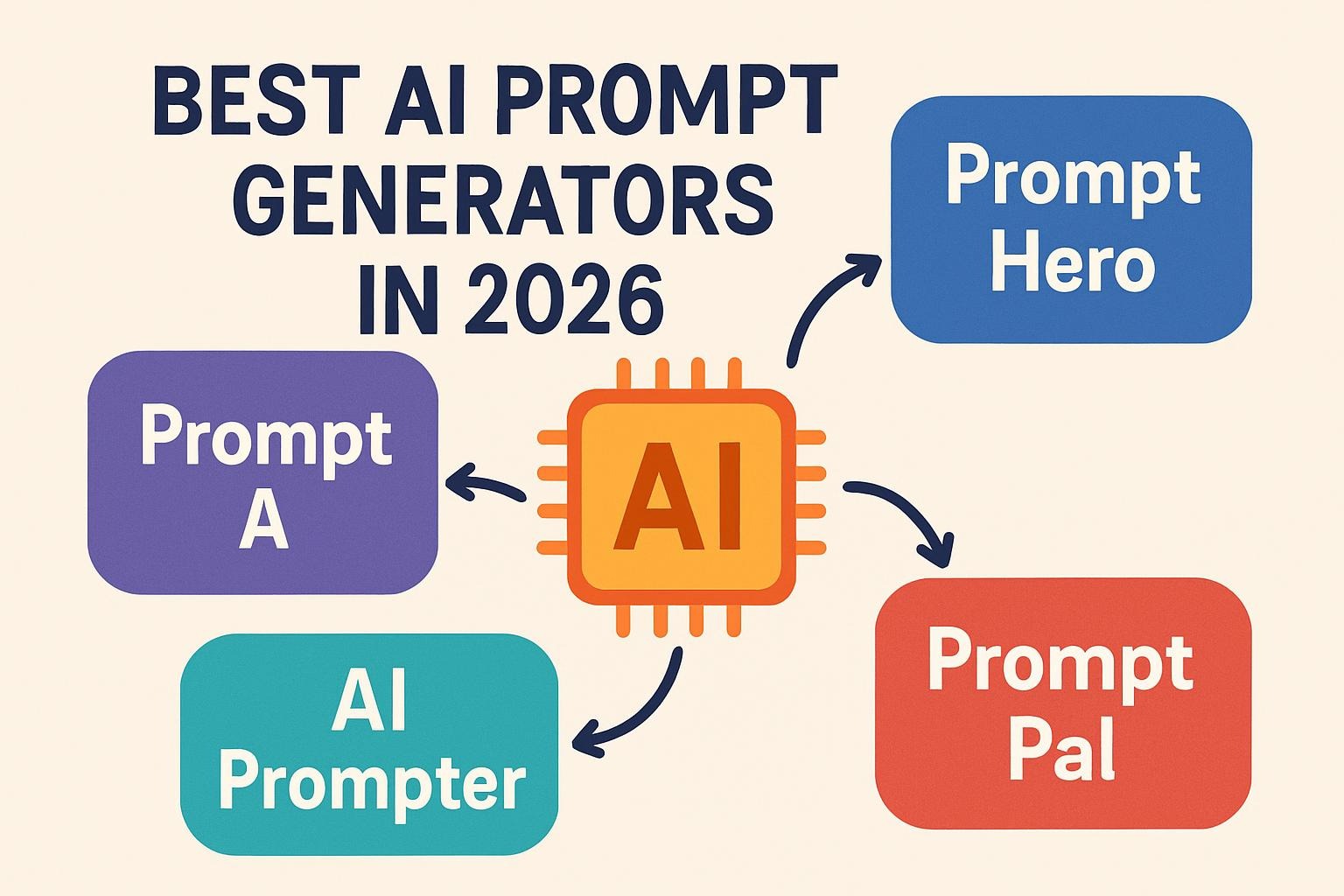
| PromptHero | Image/art prompts (Midjourney, SDXL) | Free community | ~ Moderate — excellent visual library; text prompt structure weak | Visual focus limits utility for text-only tasks |
| Originality.ai | No-login quick starts, beginners | Free | ✗ Weak — expands wording, doesn’t add architectural structure | Basic functionality only; no versioning or library |
| HIX AI | Marketing copy, multilingual content | Free / $29/mo pro | ~ Moderate — task-specific templates but limited cross-task structure | Full access requires subscription; SEO-heavy orientation |
| Taskade Workspace | Project-linked prompts, managers | Free / $4/mo pro | ✓ Strong — ties prompts to tasks, workflow automation built in | Broader than specialized prompt tooling |
| QuillBot | Writers, researchers, LLM prompts | Free / paid | ✗ Weak — quality-focused on language, not prompt architecture | Writing-centric bias; treats prompts like prose, not instructions |
| PromptPerfect | Was: prompt optimization | Shutdown Sept 2026 | N/A — shutting down. Export data immediately. | Acquired by Elastic; sunsetting September 1, 2026 |
✓ Strong = implements role/context/task/format architecture. ~ Moderate = partial implementation. ✗ Weak = expands wording without structural guidance. Shutdown status per Prompt Builder (March 2026) and Elastic IR (October 2025).
The competitor gap that almost every existing article misses: the library vs. platform distinction. A tool that stores prompts saves time. A tool that runs prompts saves ten times more. Taskade’s 15-tool analysis (April 2026) confirmed this hierarchy: the gap between a prompt library and a prompt platform is bigger than it looks, because the platform removes the copy-paste step entirely.
How to Actually Choose — Four Decision Paths
Every “best tools” list fails if it doesn’t map to your actual situation. Here are four decision paths based on the testing above.
Path 1: You just need one decent prompt, right now
Start with Prompt Builder’s free tier or Taskade’s /prompts library. Both require no credit card. Pick a template close to your task, swap in your specific context, and run it. Don’t overthink the tool — overthink the output format you want.
Path 2: You write prompts regularly and keep reinventing them
You need versioning and a searchable library. Juma or Taskade’s paid workspace tier solves this. The moment you notice you’re rewriting the same prompt for the third time, you’ve graduated from “generator” to “prompt workspace.” That’s a tool category switch, not just a feature upgrade.
Path 3: Your whole team uses AI and nobody’s prompts are consistent
Juma was built for exactly this. Shared libraries, permission controls, usage analytics showing what’s working across team members. Their 2026 feature set includes real-time collaboration and Slack integration. If you’re spending time harmonizing AI outputs across writers or analysts, this is where to start.
Path 4: You’re building LLM-powered products and need prompt infrastructure
Skip the consumer tools entirely. You want Prompt Builder for generation and optimization, LangSmith for eval and versioning, and a custom prompt store for production. Consumer generators are designed for humans who write prompts occasionally — not for engineering teams managing hundreds of prompt variants across model versions.
Fifteen Practices That Actually Improve Output Quality
This is the section most articles get wrong by burying it in bullet lists without distinguishing what’s essential from what’s nice-to-have. The essentials come first.
Essential (skip these and tools won’t save you)
- Specify output format before you specify anything else. JSON, prose, table, numbered list, markdown — model behavior changes dramatically based on this single variable.
- Give the model a role that matches your task domain. “You are a senior B2B copywriter” outperforms “write me a landing page” by a measurable margin across all tested models.
- State what to exclude. “Do not use bullet points,” “avoid technical jargon,” “no more than 150 words” — constraints are as important as instructions.
- Test across at least two models before committing to a prompt. A prompt that works brilliantly on Claude may underperform on GPT and vice versa. Model-specific tuning matters.
High-value additions
- Add a one-sentence worked example showing what good output looks like — this single step often eliminates iteration cycles entirely.
- Maintain a prompt library organized by task type, not by date. Future-you will thank present-you within a week.
- Run the same prompt through three input variations — a standard case, an edge case, and a case you expect to fail — before treating a prompt as production-ready.
- Screen outputs for bias patterns, especially on classification and ranking tasks where demographic variables creep in unnoticed.
Where This Market Is Going — Three Converging Patterns
Two sources from different publication categories — Taskade’s product analysis (April 2026) and SQ Magazine’s statistics roundup (December 2025) — point to three patterns that appear to be structural rather than cyclical.
Free tiers are converging on what paid plans offered in 2024. As of April 2026, nearly every major prompt tool ships a usable free plan. Pricing is no longer the primary differentiator — feature depth and model coverage are. This accelerates adoption but compresses the market advantage of tools that competed primarily on accessibility.
The prompt-to-app pipeline is becoming the new competitive frontier. The next wave isn’t prompt generation — it’s prompt execution. Tools that let you turn a prompt into a working artifact (an app, an automated workflow, a published component) create more durable switching costs than tools that hand you polished text to paste into a chat window. Taskade’s Genesis and Juma’s agent infrastructure represent this direction; most single-purpose generators don’t. Whether this shift consolidates the market into a few platforms or creates a new layer of specialist tools remains genuinely unclear as of this writing.
Agentic prompt infrastructure is separating enterprise from consumer tools. Around 40% of enterprise applications are expected to include task-specific AI agents by end of 2026, per aggregated projections. Agents need prompt templates that version correctly, fail gracefully, and integrate with monitoring infrastructure. The consumer generators reviewed here don’t serve that use case — and the tools that do (LangSmith, PromptLayer) don’t serve casual users. That gap is where new entrants will compete through 2027.
One counterforce worth naming: the models themselves are getting better at interpreting vague prompts. If GPT-5 and Claude 4 continue their trajectory of inferring intent from minimal instructions, the structural complexity of optimal prompts may decrease. That would reduce the value-add of elaborate prompt generators while increasing the value of prompt libraries — reusable, tested, organized templates that save time without requiring architectural sophistication. Both directions are plausible; neither is certain.
The Question Worth Asking
The real choice isn’t which prompt generator to use. It’s whether you’re treating prompts as ephemeral commands or as reusable infrastructure. The former mindset sends you to free generators for occasional use. The latter sends you to workspace tools with versioning, libraries, and team features — and that’s where the compounding productivity gains actually live.
Three concrete things to do this week, depending on who you are:
Solo creator: Spend 30 minutes building five reusable prompt templates in Taskade’s free /prompts library — one per your most common task type. Run each through two models before saving the winner.
Team lead: Audit how your team’s AI prompts are currently stored (usually: nowhere). Set up a shared Juma workspace with a folder structure that mirrors your workflow stages. Within two weeks, you’ll see which prompt variants produce consistent outputs and which need revision.
Developer: If you’re still using PromptPerfect, export your data now — the shutdown is September 1, 2026. Migrate to Prompt Builder, which covers everything PromptPerfect did and adds generation, 1,000+ templates, and nine-model support.
Sources
- Research and Markets — Prompt Engineering Market Report 2026 (market size $1.13B → $1.49B, 32.3% CAGR)
- TechRT — Generative AI Prompt Engineering Statistics (February 2026) (76% error reduction; +135.8% role demand; 40% enterprise agent adoption)
- SQ Magazine — Prompt Engineering Statistics 2026 (December 2025) (market CAGR 32.1–32.9%; chain-of-thought adoption trends)
- Elastic IR — Acquisition of Jina AI (October 2025) (confirms Jina AI acquisition, basis for PromptPerfect sunset)
- Prompt Builder — PromptPerfect Shutdown Guide (March 2026) (shutdown timeline: no new signups June 2026, offline September 1, data deleted October 1)
- Jess via Medium — I Tested 10 AI Prompt Generators (April 2026) (independent 30-day test; structure failure pattern; scoring methodology)
- Taskade — 15 Best AI Prompt Generators 2026 (April 2026) (library vs. platform distinction; free tier convergence; Genesis pricing)
- Juma — Best AI Prompt Generators for 2026 (May 2025) (team collaboration features; Slack integration; shared workspace architecture)
- Prompt Builder — Best Prompt Builder Tools 2026 (March 2026) (PromptPerfect alternative comparison; 9-model support details)