
AI Coding Tools 2026: What the Controlled Data Actually Shows
Vendors say 55% faster. A randomized controlled trial says 19% slower. Both can be true — but only one should drive your tooling decisions.
- A July 2025 RCT found experienced developers were 19% slower with AI tools — while believing they were 20% faster.
- AI delivers clear value in four task categories: boilerplate, unit test scaffolding, onboarding/explanation, and documentation generation.
- It creates measurable costs in complex, context-dependent work — especially for senior engineers on large codebases.
- Vendor adoption figures are near-universal; vendor trust figures are collapsing. That gap is the story.
- The correct response is not to abandon these tools. It’s to measure your own results instead of inheriting someone else’s.
By February 2026, roughly 84% of developers use or plan to use AI coding tools. The widely cited figure that 41% of production code is now AI-generated aggregates self-reported estimates from GitHub, Google, and Microsoft about their own internal codebases — no independent methodology audits that figure across the industry, so treat it as directional. Both numbers tell you about adoption. Neither tells you whether the tools work.
The gap between those two questions is where the most important decisions in software engineering currently live. And it turns out that gap is enormous.
The productivity story vendors tell is internally consistent and largely wrong for experienced practitioners. Early studies from GitHub, Google, and Microsoft — all vendors with AI tools to sell — found developers completing tasks 20% to 55% faster. A randomized controlled trial published by METR in July 2025 found the opposite: when experienced open-source developers used AI tools on their own well-understood codebases, they took 19% longer than without. The same developers, when asked to estimate their own speedup, guessed they were 20% faster.
The self-perception was wrong by 39 percentage points. Understanding why that gap exists — and why it’s structured the way it is — is the most useful thing a developer can do before making tooling decisions in 2026.
This is not an argument against AI coding tools. It’s an argument against using them blindly. AI provides measurable benefits in specific task categories and measurable costs in others. The developers extracting real value are the ones who’ve mapped that boundary for their own work. The ones losing ground are the ones who haven’t.
Why Self-Assessment Fails Every Time
Three independent lines of evidence converge on the same problem: developer self-assessment is a poor instrument for measuring AI tool value, and controlled data looks worse than survey data every time the two are compared directly.
The METR study’s methodology matters here — because a lot of people read the headline and miss what made it credible. Its 16 participants were experienced contributors to large open-source repositories, averaging more than 22,000 GitHub stars and over one million lines of code, working on projects they’d contributed to for years. These are not junior developers encountering unfamiliar territory. They are exactly the people whose AI productivity claims are most frequently cited at engineering all-hands presentations. The study randomly assigned 246 real issues to either allow or disallow AI assistance, then measured actual elapsed time. The 19% slowdown is not a survey result. It’s a controlled measurement, on real work, by experienced practitioners, in their own domain.
“Experienced developers believed AI made them 20% faster. Objective measurement showed they were 19% slower. The self-perception was wrong by 39 percentage points.”
METR Randomized Controlled Trial, July 2025The code quality data compounds the picture. GitClear’s analysis of production code found that developers are producing roughly 10% more durable code since 2022 — a gain plausibly attributable to AI assistance. But that gain arrived alongside sharp declines in several other quality measures GitClear tracks: copy-paste code rates climbing, move operations falling (a proxy for deliberate refactoring), and churn rates in AI-assisted code running higher than the overall baseline. More code survives in the short term; the structural and architectural properties of that code are deteriorating. The net is ambiguous, not positive. Any article citing only the durability gain without the quality decline is reporting one half of a split result.
Then there’s Mike Judge, principal developer at Substantial, whose six-week self-experiment provides the third line of evidence and the closest individually replicable analog to the METR study’s design — with an important caveat. Where METR randomly assigned 246 tasks across 16 developers, Judge selected his own tasks, which introduces the possibility that he unconsciously weighted toward work where he suspected AI might underperform. That limitation doesn’t invalidate the finding; it means the experiment is directionally informative rather than controlled. He estimated he was 25% faster with AI tools before running the test. After assigning tasks by coin flip and tracking actual elapsed time for six weeks, his conclusion aligned with the METR finding closely enough that he then spent hours analyzing publicly available data on GitHub projects, new app registrations, and website launches to see whether the claimed industry-wide productivity boom was visible anywhere in the output. It wasn’t. The graphs were flat where he expected hockey sticks. That absence isn’t proof — but it’s the correct question to ask, and most articles on AI coding tools in 2026 are not asking it.
The mechanism behind the self-assessment gap is not a mystery. Developers using AI tools experience immediate relief on the tasks AI handles well — boilerplate, test scaffolding, explaining unfamiliar code — and attribute that relief to a general productivity uplift. The costs arrive later: in review time, in debugging AI-generated code that looks correct and isn’t, in the overhead of clarifying context for a system that doesn’t understand architectural intent. Those costs are distributed across time and harder to attribute. The self-report captures the benefit in the moment; the controlled measurement captures the full cost at the end.
Where AI Coding Tools Actually Deliver Value
The METR result should not be read as a blanket indictment. The study explicitly acknowledges that its setting — experienced developers on familiar, complex codebases — is one of the worst-case scenarios for AI assistance. The authors note that less experienced developers working in unfamiliar codebases may see different results, since the context-retention cost that slowed their participants is lower when the developer doesn’t have deep context to begin with. That hypothesis is plausible and widely repeated. As of this writing, no published RCT has tested it directly. It’s the most important gap in the current evidence base.
Practitioners and research literature agree on four categories where AI tools provide consistent, reproducible value: boilerplate generation, unit test scaffolding for functions with clear inputs and outputs, onboarding/unfamiliar code explanation, and documentation for well-structured functions.
Failure cases cluster around complexity and context: large codebases where the correct action depends on architectural decisions made months earlier, and multi-file refactors where the model lacks the state to reason about component interactions across the repository.
MIT CSAIL’s July 2025 paper, “Challenges and Paths Towards AI for Software Engineering,” presented at ICML 2025 by lead author Alex Gu and senior author Armando Solar-Lezama, documents this failure mode precisely: AI-generated code that calls non-existent functions, violates internal style rules, or passes superficial unit tests while embedding logic that collapses in production. Gu describes it this way: without a confidence channel — a way for the model to flag “this part, maybe double-check” — developers risk trusting hallucinated logic that compiles but fails under real conditions. That failure mode is difficult to detect at review without running code against edge cases the AI didn’t consider. It’s the primary cost that controlled studies measure when experienced developers come out slower.
Distrust rose from 31% in 2024 to 46% in 2025. Adoption continues rising while confidence falls — the hallmark of a tool category where switching costs sustain use even among skeptics.
Task-by-task performance: what the evidence actually supports
| Task Category | AI Performance | Evidence Base | Review Overhead |
|---|---|---|---|
| Boilerplate / repeated patterns | Strong | Practitioner consensus; vendor studies | Low |
| Unit test generation (clear I/O) | Strong | Practitioner consensus | Low–Medium |
| Unfamiliar code explanation / onboarding | Strong | Practitioner consensus; team velocity data | Low |
| Documentation generation | Strong | Practitioner consensus | Low |
| Bug fixing in self-contained functions | Moderate | Vendor studies (GitHub, Google) — unaudited by independent benchmarks; treat as directional | Medium |
| Complex multi-file refactors | Weak / Negative | METR RCT; MIT CSAIL; GitClear quality data | High |
| Experienced devs on familiar large codebases | Negative | METR RCT (19% slowdown); Judge self-experiment | High |
The trust data confirms the gap between adoption and confidence. Stack Overflow’s 2025 Developer Survey — 49,009 respondents across 166 countries — found that 46% of developers actively distrust the accuracy of AI tool outputs, while only 33% trust them; just 3% report “highly trusting” what AI produces. Senior practitioners are the most skeptical: only 2.6% report high trust, and 20% report actively distrusting outputs. Distrust rose sharply from 31% the prior year. Adoption continues rising while confidence falls. That combination describes a tool category where switching costs are high enough to sustain use even among skeptics — not a category where the value proposition has been demonstrated.
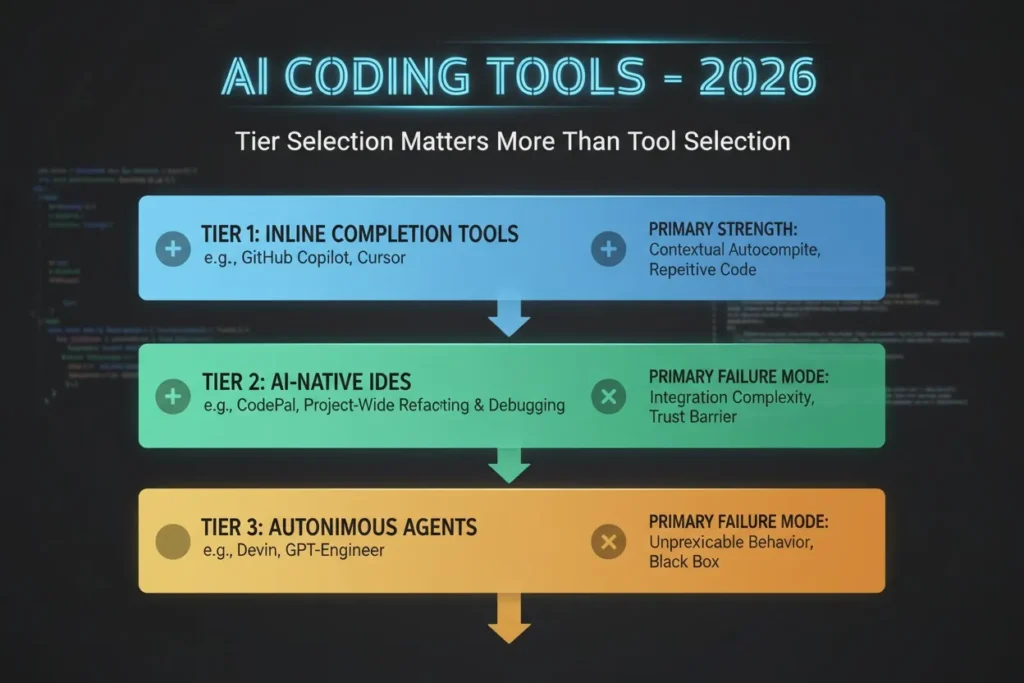
How to Evaluate the Three Tool Tiers
Inline Completion
Real-time suggestions inside existing IDEs. Strongest on boilerplate and test scaffolding. Weakest where correctness depends on repository-wide context.
AI-Native IDE
Codebase-wide context awareness. Architecturally correct response to the METR failure mode. No published RCT has tested whether it changes outcomes.
Autonomous Agents
Most aggressive claims, most variable results. Controlled evidence for complex production tasks doesn’t yet exist. Scope matters enormously.
The inline-completion tier — GitHub Copilot above all — integrates into VS Code and JetBrains without workflow disruption and handles the boilerplate and test generation categories where AI value is clearest. GitHub Copilot reports 81% of users complete tasks faster, with self-reported productivity gains of 55%. No independent audit of those figures was found; treat them as directional estimates subject to the same self-assessment bias documented in the METR study. What is not in dispute is Copilot’s market position. Its failure mode — confident suggestions that are syntactically correct and semantically wrong — is precisely what MIT CSAIL documented. Copilot is strongest where review overhead is lowest and weakest where code correctness depends on context the tool cannot access.
A senior engineer at a mid-size fintech team documented the following pattern in a February 2026 InfoWorld analysis: Copilot-assisted PRs for an authentication refactor passed all existing unit tests and code review by two senior engineers. The issue surfaced six days after merge, in production, when an edge case involving token refresh under concurrent session load triggered a race condition the AI-generated code had introduced. The logic was locally plausible — every function looked right in isolation — and globally incoherent across the session management boundary.
The review overhead to find and fix it: roughly 14 engineering hours across two engineers. The original refactor had taken 90 minutes with Copilot assistance, compared to an estimated 3–4 hours without. Net: the “saved” 2 hours cost 14 in remediation.
The AI-native IDE tier — Cursor above all, with Windsurf as a close second — attempts to solve the context problem by building awareness of the entire repository rather than the current file. This is the correct architectural response to the failure mode identified in the controlled studies. Whether it solves the problem empirically — whether Cursor users in controlled conditions show different results than the METR cohort — has not been tested in published independent research as of this writing. The tool is popular among developers working on complex projects. That is consistent with the tool working and with developers underestimating their review overhead on a tool they prefer using. Both explanations fit the available evidence.
Pragmatic Coders’ structured evaluation tested MetaGPT and GPT Pilot on a TODO application requiring JWT authentication and serialization — deliberately chosen to require multi-component reasoning across authentication state, token lifecycle, and data serialization boundaries. Neither system produced a complete, functional result.
The failure wasn’t at the edges. Both tools generated syntactically valid code for whichever component they were currently processing, then lost coherence when the implementation required reasoning about how that component interacted with what was already written. The evaluators had to manually recover the partial outputs, identify where state assumptions had diverged, and complete the authentication logic by hand — work that took longer than building the feature without AI would have.
The autonomous agent tier makes the most aggressive capability claims and produces the most variable results. Cyfrin documented a Claude Code agent consuming over 21,000 input tokens — roughly equivalent to reading a short novel — to fix a one-line typo in a README: it opened an issue, posted a checklist comment, created a branch, committed the change, and opened a pull request before the human engineer could intervene. That’s an extreme case. But it illustrates the asymmetry that Rock Lambros, CEO of RockCyber, identified as the core structural problem with agent-tier tooling in production: “A contributor can generate a 500-line pull request in 90 seconds. Yet a maintainer still needs 2 hours to determine whether it’s sound. That asymmetry is what’s crushing open source teams right now.”
AI-made code is cheap to produce. Reviewing it costs exactly what it always did. Anthropic’s own rate-limiting decisions — introducing caps on Claude Code’s continuous background operation — signal that even the tool’s creator is managing the boundary between constrained utility and unconstrained operation.
What Is the Evidence Pointing Toward That Nobody’s Naming?
The METR slowdown, the GitClear quality-metrics decline, and the flat macro output indicators may be pointing toward a quality-debt overhang phase. The industry may be paying for productivity gains now with maintenance drag later — and quarterly OKRs won’t catch it until it compounds.
Read together, the three datasets point toward a dynamic that none of them alone makes visible. AI tools are producing code faster than before — the durability gain is real, adoption is near-universal. But the architectural and structural properties of that code are deteriorating at a rate that won’t manifest as system failures or engineering slowdowns in quarterly metrics until the maintenance drag compounds. The productivity gains are front-loaded and visible; the costs are distributed across future sprint cycles and are structurally difficult to attribute back to the tooling decisions that created them.
If this framing is correct, the organizations best positioned in 2027 will not be the ones who adopted AI coding tools earliest. They will be the ones who adopted measurement frameworks that tracked code quality alongside velocity — and caught the overhang before it became a refactor emergency.
“AI coding tools are already load-bearing infrastructure for software development at scale. The question of whether to adopt is closed for most organizations. The question of how to adopt is where the decisions with real economic consequences still live.”
Analysis based on Microsoft and Google leadership statements, 2025AI coding tools are already load-bearing infrastructure. AI writes more than 30% of Microsoft’s code and over a quarter of Google’s, according to statements from those companies’ leadership. The question of whether to adopt is closed for most organizations. The question of how to adopt — which tasks, which tools, which developers, with what measurement framework — is where the decisions with real economic consequences still live in 2026.
The foundational assumption in most enterprise AI coding adoption strategies is that deployment is better than restraint, that tools provide net value across the development workflow if used broadly enough. That assumption is defensible but not automatic. The METR evidence suggests it is false for experienced developers on complex familiar codebases, true for less experienced developers and unfamiliar codebases, and untested at a controlled level for most of the work that falls between those poles. An organization that deploys broadly without measuring is making a bet whose expected value is genuinely ambiguous.
How to Measure Your Own Results — Not Someone Else’s
The four-week measurement framework
- For individual developers: Run the Judge experiment. Assign tasks by method (AI-assisted vs. manual), track actual elapsed time including review, and measure over 4–6 weeks. Your self-assessment is almost certainly biased in the direction the METR data predicts. The measurement will be more useful than the intuition.
- For engineering leaders: Pick one team, one “Strong” task category from the table above — boilerplate, test scaffolding, or onboarding. Instrument it with actual cycle time tracking (not self-report), tracking review overhead separately from generation time. Engineering intelligence tooling (Cortex, LinearB, Jellyfish) can instrument cycle time without requiring developers to self-log. If the sprint does not show measurable cycle time improvement after four weeks, stop expanding. If it does, expand one task category at a time with the same instrumentation.
- For teams evaluating autonomous agents: The controlled evidence for autonomous coding agents in production-complexity tasks does not yet exist. That’s a research gap, not a verdict. The correct posture is constrained deployment with a defined scope — not avoidance, but also not the unconstrained background operation that Anthropic’s own rate limits were introduced to curtail.
- For everyone: Before trusting any vendor productivity claim — including the ones in this article — ask: “Was this measured by the vendor, or by someone with no stake in the outcome?” If the former, apply the 39-percentage-point correction factor the METR study documented, and treat the figure as directional.
Most experienced developers now use more than one tool, selecting each based on the task. The real advantage is not speed alone — it’s reduced mental load on the tasks where AI handles context, repetition, and scaffolding reliably, leaving cognitive resources for the work that actually requires judgment. That task-level selection is the discipline that separates the developers extracting real value from the ones just running up review overhead.
The developers who’ll navigate this correctly aren’t the ones who believe the vendor data or the ones who reject AI tools entirely. They’re the ones who treat the METR result the way it was designed to be treated: as a snapshot of one setting in early 2025, valuable not as a verdict but as a calibration instrument. The tools are improving. The evidence base will improve with them.
What cannot wait for better evidence: the discipline of measuring your own results rather than inheriting someone else’s. An engineering team that reaches Q4 2026 still relying on vendor surveys to understand whether its AI tools are working hasn’t made a neutral choice. It’s made an expensive one — and it just doesn’t know the price yet.
“The developers who will be right about this aren’t the believers or the skeptics. They’re the ones who kept score.”
Analysis, BestPrompt.art, April 2026Sources
- 1.METR, “Measuring the Impact of Early-2025 AI on Experienced Open-Source Developer Productivity,” July 2025
- 2.Stack Overflow, “2025 Developer Survey — AI,” July 2025 (49,009 respondents, 166 countries)
- 3.MIT CSAIL / MIT News, “Can AI really code? Study maps the roadblocks to autonomous software engineering,” July 2025
- 4.GitClear, “Coding on Copilot: 2023 Data Suggests Downward Pressure on Code Quality,” ongoing analysis
- 5.MIT Technology Review, “AI coding is now everywhere. But not everyone is convinced,” December 2025
- 6.MIT Technology Review, “Generative coding: 10 Breakthrough Technologies 2026,” January 2026
- 7.Cyfrin, “The Hidden Cost of AI Coding Agents,” 2025
- 8.Pragmatic Coders, “Best AI Tools for Coding in 2026,” January 2026
- 9.InfoWorld, “Enterprise use of open source AI coding is changing the ROI calculation,” February 2026
- 10.Dev.to, “Best AI Tools for Coding in 2026: A Practical Guide,” January 2026
- 11.Cortex, “AI Tools for Developers 2026: More Than Just Coding Assistants”
- 12.BestPrompt.art, “AI Coding Tools Guide — Prompting for Better Code Output,” 2026