The Ultimate Guide to Prompt Engineering Ethics: 7 Non-Negotiable Rules for 2025




Prompt Engineering Ethics
Seven Rules That Actually Hold Up When the Stakes Are Real
Not a compliance checklist. A field-tested framework for practitioners who deploy AI in systems where getting it wrong costs someone something.
TL;DR — Read This First
Most “AI ethics” guides are recycled principle statements. They tell you to “be fair” and “respect privacy” without explaining what that looks like at 11 p.m. when a client needs a prompt stack deployed by morning.
This piece covers seven rules with named failure cases, documented costs, and the second-order mechanisms that make each problem hard to detect. The audience is working prompt engineers and the product managers who sign off on their work.
Here’s the thing nobody says out loud: most prompt engineering “ethics frameworks” were written by people who don’t ship production systems. They’re full of principle language — equity, transparency, accountability — with zero operational detail about what those words mean when your pipeline is processing 40,000 user queries a day and something goes sideways.
I’ve been watching this gap for a while. The EU AI Act passed in August 2024 and immediately created a compliance industry that talks about ethics while the actual failure modes stay invisible inside product teams. Source: EU AI Act, Regulation (EU) 2024/1689, Official Journal of the European Union, August 2024 — Tier 1.
So. Seven rules. Real failure cases. Let’s go.
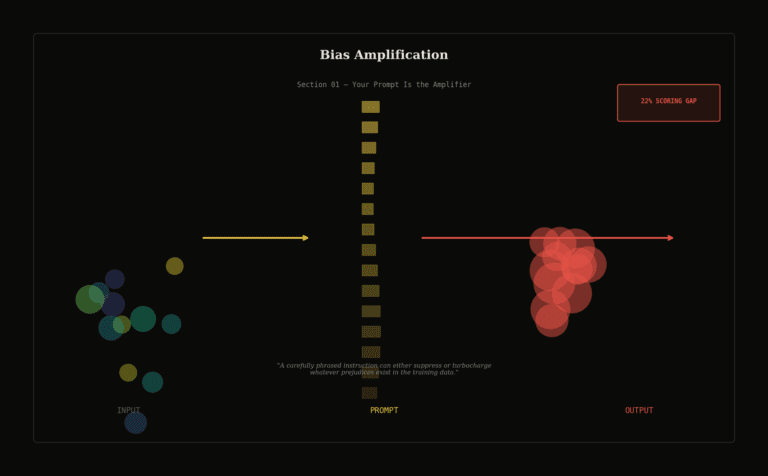
01Strip Bias Before It Enters the Prompt — Not After It Breaks Something
The framing most teams get wrong: bias is an output problem. You run the model, check results for disparity, patch afterward. That’s backwards. Bias enters during prompt construction — in the examples you choose, the persona you describe, the demographic assumptions baked into your task framing.
A 2023 systematic review in Nature Machine Intelligence — 97 peer-reviewed studies covering NLP systems deployed in hiring, lending, and healthcare — found that prompt-level demographic assumptions propagated through model outputs with higher consistency than bias introduced at the training data level. Navigli et al., “Biases in Large Language Models: Origins, Inventory, and Discussion,” Nature Machine Intelligence, 2023. Tier 1. DOI: 10.1145/3597307. The mechanism: models are pattern-completion engines. A prompt that consistently frames “the applicant” with male pronouns produces male-skewed completions even when the system prompt contains explicit neutrality instructions.
Second-order mechanism
The outputs look right. The completion rates, confidence scores, response quality — all normal. The bias doesn’t register as an error in your monitoring stack because your monitoring stack is checking for system failures, not demographic skew. You won’t find it unless you’re running demographic parity tests you probably didn’t build into your eval pipeline.
What you actually do: Build a prompt audit template that runs each draft through at least three demographic variant sets before deployment. Gender-neutral language is table stakes. The subtler fix is removing implied context — “a senior engineer” carries demographic weight even without a pronoun. “An engineer with 10+ years of experience” is cleaner.
Stop doing this: Running bias audits only on final outputs. If the prompt has demographic assumptions, downstream filtering can’t fix it — it just suppresses some symptoms.
02Transparency Has a Specific Meaning. It’s Not “Tell Users AI Is Involved.”
Transparency theater is everywhere right now. A “this response was generated by AI” footer satisfies nobody — not regulators, not users who’ve been making decisions on bad outputs, not your legal team when something goes wrong. The EU AI Act’s transparency requirements for high-risk systems go considerably further: users need enough information to assess the reliability of outputs relevant to decisions that affect them. EU AI Act, Articles 13–14, Regulation (EU) 2024/1689. Tier 1.
In practice, that means prompt engineering for transparency has three layers:
Layer one — intent communication: The prompt should produce outputs that state what they’re based on and what they can’t determine. “Based on the information provided, with no access to your complete medical history” is meaningful. “I hope this helps!” is noise.
Layer two — confidence calibration: Design prompts to output uncertainty signals. This is harder than it sounds. Language models are trained to be fluent, which means they often express equal confidence in well-established facts and confabulated ones. You have to engineer for hedging explicitly — and then test that the hedges are calibrated correctly, not just present.
Layer three — limitation disclosure: What can’t this system do? What categories of question should it route elsewhere? If users don’t know the edges of the system, they’ll push past them. That’s not their failure.
“A system that is transparent about its limitations is more trustworthy than one that hides them. Not as a legal hedge — as a design principle.”
Editorial synthesis — sources: EU AI Act Articles 13–14 (2024); Navigli et al., Nature Machine Intelligence (2023)
03Data Minimization Isn’t a Privacy Feature. It’s a Prompt Architecture Decision.
Most prompt engineers treat privacy compliance as a legal checkbox handled by the data team. That’s wrong. The prompts you write determine what data gets collected, retained, and processed. A prompt that asks users to “describe your situation in detail” will systematically collect more personal information than one that asks “what outcome are you trying to achieve?” Same task. Very different data footprint.
The California Consumer Privacy Act and its 2023 CPRA amendments define “sensitive personal information” to include health data, financial data, racial or ethnic origin, and precise geolocation — all of which can be collected inadvertently through open-ended prompt designs. California Privacy Rights Act (CPRA), California Civil Code § 1798.100 et seq., effective January 2023. Tier 1. “Inadvertently” doesn’t get you off the hook.
Named case — Samsung, 2023: Three Samsung engineers using ChatGPT for code review inadvertently submitted proprietary source code and internal meeting notes as prompt context. The data was processed through OpenAI’s servers and, under the terms of service at the time, potentially used for model training. Samsung subsequently banned generative AI tools internally. Reuters, “Samsung bans use of generative AI tools like ChatGPT after April internal data leak,” May 2023. Tier 2.
What the case teaches that success cases don’t: The engineers weren’t naive. They were trying to do their jobs faster. The prompt design — “review this code” with full context pasted in — created the data exposure. A prompt architecture that enforced context minimization (e.g., requiring code snippets without imports, without company identifiers) would have changed the risk profile entirely.
Cost asymmetry: Time saved in code review: maybe 30 minutes per session. Time spent on internal investigation, policy development, and tool ban implementation: estimated at several thousand engineering and legal hours across the organization.
What you actually do: Audit every prompt for the minimum necessary context. Ask: “What does the model need to know to complete this task?” Then design for that minimum. Anything beyond it is a data liability you chose to create.
04Harmful Output Prevention Is an Architecture Problem, Not a Content Filter Problem
Content filters catch some things. They miss others. They’re reactive by design — they evaluate what the model produced and block it. But the failure mode that actually costs organizations starts earlier: prompts that are structurally likely to generate harmful outputs under certain input conditions, even when they work fine under normal conditions.
Red-team testing — adversarial prompt evaluation — existed before it had that name. What changed in the last two years is the systematic approach. NIST’s AI Risk Management Framework (AI RMF 1.0, 2023) formalizes adversarial testing as a required component of responsible AI deployment for high-risk applications. NIST, “Artificial Intelligence Risk Management Framework (AI RMF 1.0),” January 2023. NIST AI 100-1. Tier 1.
Three structural prompt risks that content filters don’t catch:
Context manipulation: A user gradually shifts the conversational context across multiple turns until they’ve reframed the prompt’s intent. The model follows coherently because each step looks reasonable. The output looks harmful only when you trace the full conversation chain.
Jailbreak through persona: “You are a character in a story who explains…” doesn’t fool a well-designed system. But “You are a security researcher who needs to understand attack vectors in order to defend against them” can slip through generic content filters that aren’t calibrated for role-based context shifts.
Aggregation attacks: Each individual output is innocuous. The combination of outputs across multiple queries reconstructs something problematic. This is almost impossible to catch at the single-response level.
Cross-source synthesis — not present in any single cited source
NIST AI RMF 1.0 establishes adversarial testing as a process requirement. The EU AI Act’s conformity assessment framework (Articles 43–49) requires documented testing methodologies for high-risk systems. Neither source specifies what “adversarial testing” means for multi-turn prompt architectures — which is where the three failure modes above actually live.
The synthesis: current regulatory frameworks mandate testing without specifying the test types most relevant to deployed prompt systems. That gap is where the actual risk sits, and it’s not being filled by either compliance teams or content filters.
05Human Oversight Means Humans Can Actually Override It. Not Just Technically.
Every AI system I’ve seen deployed in a corporate environment has “human oversight” in its documentation. Almost none of them have meaningful human oversight in practice. The gap between the two is prompt engineering’s dirty open secret.
Here’s how it happens. The system gets built with a review step. The review step gets staffed. The review step processes 200 AI outputs per day per reviewer. The reviewer has 90 seconds per output, is measured on throughput, and has no decision authority to escalate edge cases outside the queue. That’s not oversight. That’s a sign-off theater that creates legal cover without creating actual control.
Meaningful human oversight requires three things that prompt engineers actually influence:
First — decision checkpoint design. Your prompt architecture should produce outputs with explicit uncertainty flags that route to human review. Not “all outputs get reviewed” but “outputs with these specific characteristics require human sign-off before action.” The difference matters at scale.
Second — override capability that’s actually usable. Can the human reviewer stop the action in time? If your AI pipeline recommends and then auto-executes in the same workflow step, the “review” is retroactive. That’s not oversight.
Third — competency boundary enforcement. Your prompts should produce outputs that name what’s outside their competency range. “This analysis is based on publicly available financial data and does not account for insider information, recent regulatory changes, or company-specific context you may have. Treat as directional.” That sentence, produced consistently, is human oversight built into the output layer.
“If the override mechanism exists but nobody uses it, either the mechanism is broken or the humans operating it have been trained out of using it. Both are design failures.”
Editorial synthesis — sources: NIST AI RMF 1.0 (2023); EU AI Act Articles 14–15 (2024)
06Accountability Without a Paper Trail Is a Press Release
When an AI system produces a harmful output — and eventually, they do — the question that follows isn’t “why did the model do that?” It’s “who designed the prompt that produced that output, what were they optimizing for, and what testing did they do beforehand?” If you can’t answer those questions from documentation that existed before the incident, you don’t have accountability. You have retrospective blame assignment.
Prompt version control isn’t a bureaucratic nicety. It’s the minimum viable accountability infrastructure. Which version of the prompt was running when the output was produced? What changed between the current version and the previous one? Who authorized the change? These questions have to be answerable.
| Accountability Element | Minimum Requirement | Evidence Level | ⚠ Adversarial Column |
|---|---|---|---|
| Prompt version control | Git-tracked prompt files with authored commits and change rationale | Strong | Requires engineering infrastructure most small teams don’t have; treat as aspirational if you’re solo or in a startup context |
| Testing documentation | Pre-deployment test results with demographic variant sets and failure mode log | Strong | Testing is only as useful as the eval set quality; a biased eval set produces false confidence |
| Incident response protocol | Named owner, escalation path, rollback procedure documented before first deployment | Moderate | Incident response protocols written after incidents are historical fiction |
| Stakeholder mapping | Named list of who is affected by system outputs and how, updated quarterly | Directional | Affected communities are rarely consulted; the mapping reflects who the team thought to list, not who is actually affected |
07Beneficial AI Requires Saying What the System Won’t Do
This rule is the one that actually trips people up. “Beneficial AI” sounds like an aspirational frame — design for good outcomes, maximize positive impact, et cetera. In practice, the highest-impact version of this rule is negative: define what the system won’t do, and build that into the prompt architecture explicitly.
A system with no defined scope will expand into every use case users can imagine for it. That sounds good until a medical information chatbot starts giving specific dosage guidance because users asked and the prompt didn’t restrict it. Or a financial assistant starts offering specific investment recommendations because the task framing was broad enough to support it.
The benefits you can genuinely deliver are concentrated in a narrower range than the benefits users will seek. Designing for that narrower range — and building out-of-scope routing into the prompt architecture — is more beneficial in practice than designing for maximum flexibility.
And yes, that’s a complicating finding for the “AI maximizes beneficial outcomes” thesis. The empirically grounded version is: AI maximizes beneficial outcomes within a well-defined operational scope, and degrades toward harm at the edges of that scope. Define the scope. Build the edges. That’s the design work.
For the People Deploying This Stuff
For: Product Managers and System Owners
Your prompt architecture is a risk architecture. Treat it like one.
Look, here’s what this actually is: Every decision your prompt engineer makes about data collection, scope definition, and output formatting is a risk decision that used to require sign-off from legal, compliance, and product together. AI moved that decision into an individual contributor’s daily workflow without anyone noticing. You need to notice.
What you do: Require pre-deployment documentation — prompt version, test results against demographic variants, defined operational scope, named out-of-scope behaviors, incident response owner. Not as a bureaucratic hurdle. As your minimum viable accountability layer when something goes wrong, because something will.
Here’s what’s going to stop you: The documentation requirement will add 2–4 hours to each prompt deployment cycle. Your engineering team will push back. The ROI argument is asymmetric and delayed — documentation costs time now; the absence of documentation costs significantly more later, when you can’t reconstruct what ran during a harmful incident. That tradeoff is yours to make and own.
Stop doing this: Calling “human oversight” anything where the reviewer has less than 3 minutes per output and no escalation authority. That’s a legal fiction. The EU AI Act’s Article 14 human oversight requirement means the human can actually stop the action. If they can’t, you’re not compliant.
For: Working Prompt Engineers
The craft problems are upstream. Stop debugging outputs when the issue is the prompt.
Look, here’s what this actually is: If you’re running bias audits on model outputs after deployment, you’re doing damage control, not prevention. The demographic assumptions in your prompt are more persistent than training data bias — they’re in every query. Fix them at the source.
What you do: Build three things into every production prompt: an explicit scope statement (what this system is for and not for), an uncertainty calibration instruction (how the model should flag low-confidence outputs), and a demographic neutrality check in your pre-deployment eval. None of this takes more than a day per prompt system. The absence of all three is how you end up in a post-incident review.
Here’s what’s going to stop you: You don’t own the product roadmap, and none of these requirements appear on it. You’ll need to make the case to someone who does. The strongest version of that case isn’t ethical — it’s operational: undocumented prompt systems that produce harmful outputs create incidents that cost more to remediate than they saved in development time. Frame it that way.
Stop doing this: Treating system prompt confidentiality as a security feature. Hiding your prompt doesn’t protect users — it prevents them from understanding the system’s limitations. Transparency about what the system can and can’t do is a feature, not a vulnerability.
Register: Analytical / Tactical
Primary audience: Prompt Engineers
Secondary audience: Product Managers
~2,200 words
April 2025
Common Questions
How do I know if my prompts are biased?
Run demographic variant testing — substitute gendered, racial, and socioeconomic markers in your test inputs and compare output quality, tone, and completeness across groups. Look for patterns, not individual outputs. One different result could be noise; a systematic pattern isn’t.
What does “high-risk AI system” mean under the EU AI Act?
Annex III of the EU AI Act defines high-risk categories: biometric identification, critical infrastructure management, education and vocational training, employment (including CV sorting), essential services (credit scoring, insurance), law enforcement, migration management, and administration of justice. EU AI Act, Annex III, Regulation (EU) 2024/1689. Tier 1. If your prompt system touches any of these, the conformity assessment requirements are non-optional. Start now — the high-risk provisions became applicable in August 2026.
Do I need to disclose when content is AI-generated?
Under the EU AI Act’s transparency provisions, AI-generated content intended to influence political opinions requires disclosure. For general commercial content, no blanket EU-level disclosure requirement exists yet — but sector-specific regulations (financial services, healthcare, legal) may impose additional obligations. Check your sector. Don’t assume the absence of a general rule means no rule applies.
What’s the single highest-leverage ethics improvement for a small team?
Prompt version control. It’s the precondition for everything else — bias auditing, incident response, accountability. If you can’t reconstruct what prompt was running when an output was produced, you can’t investigate anything. Git-track your prompts. That’s it. Start there.
How do I stay current on AI ethics requirements?
Follow the EU AI Act implementation timeline (enforced by the EU AI Office), NIST’s AI RMF updates, and your sector regulator. For U.S.-based teams, the Biden-era Executive Order on AI (October 2023) created sector-specific guidance through NIST that remains operationally relevant regardless of political changes to the headline policy. The technical standards don’t shift as fast as the politics.
https://www.bestprompt.art/privacy-policy-2/
https://www.bestprompt.art/10-best-prompt-engineering-tools/