Register B — Analytical · Primary: knowledge workers & marketers · Secondary: team leads & AI owners · ~2,800 words
The real mistakes aren’t typos or bad phrasing. They’re conceptual errors about what AI actually is — and most of them are invisible while you’re making them.
You’ve been prompting AI wrong. Not wrong like a typo is wrong. Wrong in a deeper way — wrong like a doctor who blames the patient when the diagnosis doesn’t land. The tool works. The mental model is broken.
Between 2022 and 2025, AI prompting went from niche technical skill to something hundreds of millions of people do daily with zero structured guidance. ChatGPT crossed 400 million weekly active users in early 2025.[7] The tools got radically better. The mental models didn’t scale at the same rate. A capability gap opened in about 18 months.
moderate
moderate
moderate
high
moderate
high
critical
moderate
high
critical
high
high
moderate
high
high
The Root Cause Most Lists Miss
Every mistake on this list is a symptom. The underlying disease is one thing: treating AI like a search engine instead of a collaborative system.
A search engine returns documents. You query it, it retrieves. Your job is to read and evaluate. An AI model generates — it builds a response from a probability distribution shaped by everything you’ve given it, everything it’s been trained on, and a set of learned behaviors around agreement and helpfulness. These are categorically different operations. Most prompting failures happen because someone optimized for query quality (clear, short, specific) when they needed to optimize for collaborative framing (role, goal, constraints, examples, iteration).
Search engine mental model (wrong)
One query → one result. Clarity of query = quality of output. Evaluation happens after. Iteration means searching again with different terms. The tool has no memory, no persona, no goals.
Collaborative system mental model (right)
Context + role + goal + constraints → generation loop. Quality depends on framing, not just phrasing. Evaluation happens during. Iteration means refining within the same context. The tool has trained behaviors that respond to framing.
What this means for your prompts
Give the model a role before the task. Encode the goal, not just the task. Use negative constraints. Include examples. Expect to iterate. Build a feedback loop. Mistakes 1–15 all reduce to violations of these principles.
Why the wrong model persists
Simple queries often produce adequate output — reinforcing the search-engine frame. The failure is invisible until stakes are high: legal content, factual claims, strategic decisions. By then, you’ve already published the hallucination.
Mistakes 1–5: The Framing Failures
These are the entry-level errors. If you’re past beginner level you know the broad strokes — but there are specific mechanisms worth naming that most coverage misses.
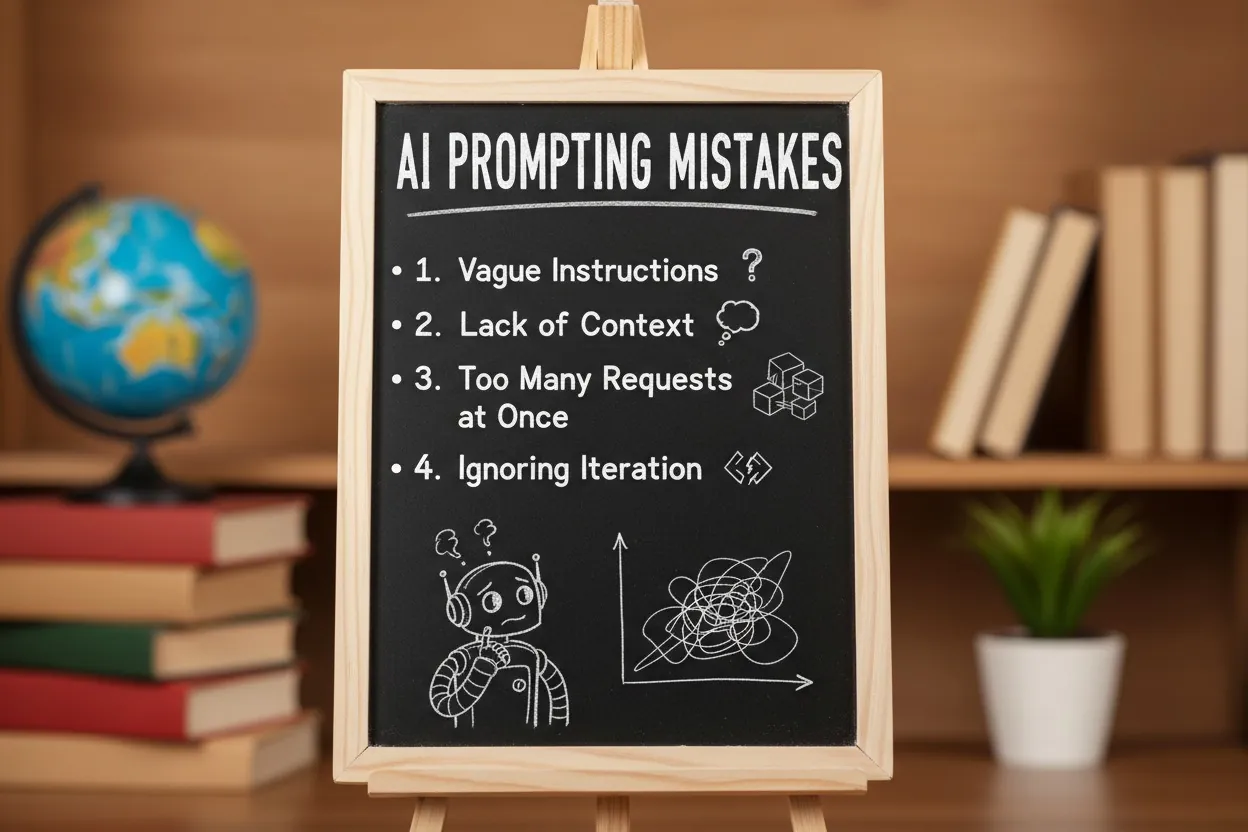
01Vague commands. “Write something about climate change.” You just handed a professional chef a grocery list that says “food.” The fix isn’t longer prompts (see mistake 04). It’s specific ones. Audience, action, tone, length, platform — all of it, defined upfront. Here’s what the gap looks like in practice:
The model must guess every variable: who this is for, what platform, what action it should drive, what tone, what length, what to exclude.
Toggle between a vague and specific prompt. The specificity score reflects parsable variables — not polish. A short, specific prompt beats a long vague one every time.
02No role context. AI models perform differently depending on the persona you assign before the task. “You are a skeptical CFO reviewing this pitch” generates fundamentally different output than the same prompt without that frame. Santu & Feng (TELeR taxonomy study, ACM SIGKDD 2023 workshop[5]) found that role assignment consistently shifted model output quality and specificity across task categories. You’re not tricking the model. You’re giving it a richer prior.
03One-shot thinking. Most people treat a prompt like a vending machine: press once, get product, evaluate. The people getting elite output treat it like a conversation. First prompt is a rough sketch. Second is refinement. Third tests edge cases. This is distinct from mistake 08 (treating a first draft as final) — one-shot thinking fails before iteration even begins; it’s the assumption that one pass is enough.
04Prompts that are too long. Counter-intuitive — but there’s documented evidence. “Lost in the Middle” by Liu et al. (Stanford and UC Berkeley, ACL 2023, 30 retrieval and QA tasks[2]) found models systematically underperform on information placed mid-context. Your critical constraint buried in paragraph four is at high risk of being underweighted. Put the most important instructions at the beginning and end. Cut everything in the middle that isn’t load-bearing.
05Asking for the wrong format. “Give me a summary” when you need “three bullet points a non-technical manager can act on by end of week.” Format is not a cosmetic request — it changes what the model prioritizes in generation. Length, structure, reading level, heading depth, whether to use examples — all available, all undefined by default.
Mistakes 6–11: The Blind Spots
These are worse. Not because they’re harder to fix — they’re usually not — but because they’re invisible while you’re making them. The framing failures are detectable: you can see a vague prompt. These produce outputs that look fine right up until they aren’t.
06No negative guidance. You tell the model what to do. You don’t tell it what not to do. This is likely the single highest-ROI fix most intermediate prompters can make. “Don’t use jargon,” “don’t include a conclusion paragraph,” “don’t reference competitor X by name,” “avoid passive voice.” Negative constraints dramatically narrow the possibility space. Without them, you’re hoping the model infers your exclusions from context. It often doesn’t — especially for soft stylistic preferences that weren’t in its training data for this exact task type.
07Hallucination blindness. You know hallucinations happen. You’ve read the articles. And then you get a well-formatted, confident answer with a specific statistic and a plausible citation — and you publish it without checking. Huang et al. (2023, systematic survey of 32 LLM studies, University of Waterloo[3]) found that factual hallucinations — where a model produces specific false claims with citation-like confidence — are the hardest category for users to detect without domain expertise. The model isn’t lying. It’s completing a pattern. The output format of a hallucinated citation is identical to the format of a real one.
Hallucinations are hardest to catch precisely where you rely on AI most — in domains where you lack the expertise to spot the error. Source: Huang et al. (2023)[3].
Hallucinations are detectable in principle. The second-order problem is they’re most dangerous exactly where they’re least detectable: in domains where you lack expertise. A hallucinated statistic about a topic you know well jumps out. The same hallucination about a topic you’re researching because you don’t know it? You can’t spot it. The prompting mistake isn’t just skipping fact-checking — it’s not knowing that your ability to catch errors degrades exactly where you’re most dependent on the model.
Practical fix: for any factual claim that will affect a decision or a published output, treat AI-generated specifics (statistics, citations, dates, names) as hypotheses requiring independent verification. The model’s confidence level is not a reliability signal.
08Treating the first draft as final. Different from mistake 03. This happens even when people iterate — they iterate until they get something they like, then stop. But the first draft constrained all drafts that followed. The iteration optimized within a local maximum. Sometimes the right move is to start fresh with what you now know. Prompt chaining — breaking complex tasks into staged sub-prompts — is one structural fix. Another: after getting a satisfying output, explicitly ask “What assumptions did you make in this response that I should reconsider?”
09Confusing task and goal. The task is what you’re asking the model to do. The goal is why. “Summarize this document” is a task. If your goal is “convince my CTO to approve this budget,” the task alone won’t get you there. The model will summarize faithfully. It won’t write a document that addresses a technically skeptical executive’s specific objection patterns — unless you encode that. Goal-encoding consistently shifts output usefulness more than any phrasing improvement.
10Sycophancy blindness. AI models are trained in part on human feedback that rewards responses people rate positively. People tend to rate agreeable responses positively. This creates a documented pull toward outputs that validate the user’s premises rather than challenge them. Sharma et al. (2023, Anthropic research[4]) found models will frequently adjust stated opinions to match perceived user preferences — even when the user’s position was factually incorrect. The diagnostic question isn’t “is this good?” It’s “what are the three most serious weaknesses in this?” The model is capable of genuine critique. Its default training pull is toward agreement. Your prompt needs to pull harder in the other direction.
The compound failure: sycophancy (mistake 10) sets the frame; hallucination (mistake 07) fills it in. Neither paper[3][4] describes this loop — it only appears when both failure modes are read together.
Sycophancy (Sharma et al., 2023)[4] and hallucination (Huang et al., 2023)[3] are treated as separate failure modes in the research literature. But they compound in a specific way neither paper addresses: when a user holds a factually wrong premise and the model sycophantically validates it, any hallucinated supporting detail that follows gains extra credibility — it’s reinforcing a belief the user already held. The hallucination doesn’t get detected because the model confirmed the frame first. This compound failure is especially dangerous in high-stakes decision contexts where the user prompts AI to research a position they’ve already committed to.
11Context amnesia. Each new conversation starts fresh. What you might not realize is how much context you’re silently assuming the model has — your tone preferences, brand guidelines, project constraints, your audience’s sophistication level. It has none of it. Fix: maintain a personal “context block” — 150–200 words capturing who you are, what you’re building, your defaults, your constraints — and paste it at the start of any important session. Thirty seconds of setup. Consistently saves ten minutes of output remediation.
“Most prompting problems aren’t about phrasing. They’re about not knowing what you actually want until you see what you got — and not building the loop that converts that signal into better prompts.”
Editorial synthesis — sources: Liu et al., ACL 2023[2]; Santu & Feng, SIGKDD 2023[5]; Sharma et al., Anthropic 2023[4]
Mistakes 12–15: The Strategic & Modern Errors
This is where the real output gap lives between competent and elite prompters. These mistakes are underrepresented in most prompting guides because they require understanding the architecture of the tool, not just the mechanics of writing a prompt.
12Giving no examples. Few-shot prompting — providing 2–3 examples of the output you want before making your request — is one of the most consistent quality levers in the literature. Brown et al. (GPT-3, NeurIPS 2020, 42 NLP tasks[1]) demonstrated meaningful improvements with even a single example. The reason: examples don’t just illustrate format — they define the implicit constraints your verbal description almost certainly left ambiguous. “Write in a professional but conversational tone” means nothing. A single example of a sentence with that tone means everything. Show the model what you want. Don’t describe it, demonstrate it.
Nuance here: absolute performance deltas from few-shot prompting may be narrower on 2025–2026 frontier models than in the original GPT-3 research — modern models follow zero-shot instructions much better. But the principle holds, especially for stylistic and format tasks where the gap between “what you say” and “what you mean” is hardest to close verbally.
13Model mismatch. Using a frontier reasoning model for tasks that don’t require it, or using a general model for tasks where a specialized one dominates. The specific errors in 2025–2026:
- Using GPT-4o for deep multi-step reasoning when o3 or Claude Opus is appropriate — and vice versa, using expensive reasoning models for simple extraction tasks.
- Using a general frontier model for high-volume structured tasks (e.g., classifying 50,000 rows) when a fine-tuned smaller model costs a fraction and outperforms on that specific task.
- Using a chat interface for pipeline work when the same prompt with JSON mode and schema constraints would eliminate downstream parsing errors entirely.
Most people default to whatever model they’re comfortable with. That’s a habit, not a strategy. Model selection is part of the prompt decision.
14No feedback loop. You prompt. You get output. You use or discard it. You don’t write down what worked, what failed, or why. Six months later you’re reinventing the same wheel for the fourth time. The gap between competent and elite prompters isn’t technique — it’s this. Elite prompters maintain prompt libraries: actual documents, versioned, annotated with what task they solve, what constraints matter, what not to include. BestPrompt.art maintains structured templates if you want a starting framework. The payoff is asymmetric: building a library takes hours; using it saves hours per week indefinitely.
15Stuck in 2023 technique. Prompting has moved fast. Four specific developments that most “prompting mistakes” articles don’t cover — because they weren’t mainstream when those articles were written:
JSON mode & schema-constrained generation
Most frontier models now support constrained generation — specify a JSON schema and the model generates only valid conforming output. Eliminates parsing errors in pipelines. If you’re still post-processing free-text to extract structured data, you’re using 2022 technique. The schema is part of the prompt.
200k+ token windows change the prompt math
Context windows have grown 50–100x since GPT-3. You can now include full documents, codebases, multi-week conversation histories. The new failure mode isn’t truncation — it’s relevant-retrieval inside a large context (see mistake 04, which still applies within long contexts).
Ask the model to improve your prompt first
Before running a complex task, give the model your draft prompt and ask it to identify ambiguities, missing constraints, or structural improvements. Peer et al. (2024 preprint[6]) documented iterative self-critique consistently outperforming single-shot prompting on complex tasks. Two minutes of meta-prompting saves ten minutes of output revision.
Tool-calling & multi-step agents
Via API, tool-calling enables the model to invoke external functions, search the web, run code, or call other models as part of a single task. Understanding when to decompose into an agentic loop vs. a single prompt is now the highest-leverage skill for pipeline builders. Single prompts can’t self-correct; agents can. Agent prompt patterns at BestPrompt.
“The gap between competent and elite prompting isn’t technique. It’s the feedback loop — and almost nobody builds it. The best prompt you’ve ever written is useless if you don’t save it.”
Editorial synthesis — sources: Brown et al. (2020)[1]; Sharma et al. (2023)[4]; Liu et al. (2023)[2]; Peer et al. (2024)[6]
Compound Failures: How Mistakes Interact
Individual mistakes are manageable. Certain combinations are not. These are the pairs that appear together most often — and why the combined damage exceeds the sum of parts.
Impact Ranking With Honest Caveats
Not all 15 mistakes cost equally. This table ranks by output impact — but the caveat column is not decoration. The ranking applies to professional, high-stakes content. Several mistakes drop significantly in casual brainstorming contexts. The methodology for impact scores is directional assessment based on available peer-reviewed evidence, plus practitioner experience; not an audited empirical ranking.
| # | Mistake | Severity | Impact | Caveat |
|---|---|---|---|---|
| 07 | Hallucination blindness | Critical | Near-zero risk for pure creative fiction; drops to Moderate for clearly hypothetical tasks | |
| 10 | Sycophancy blindness | Critical | Lower impact for format/creative tasks; highest impact for strategy, analysis, decision-support prompts | |
| 09 | Task vs. goal confusion | High | Drops for tasks where “task” and “goal” are identical (e.g., “translate this sentence”) | |
| 04 | Prompts too long | High | Less relevant for pure generation tasks with no retrieval component; most relevant for complex instructions with multiple constraints | |
| 12 | No examples (no few-shot) | High | Narrower absolute delta on 2025–2026 frontier models at zero-shot tasks; still dominant for stylistic and format work | |
| 14 | No feedback loop | High | Irrelevant for one-off tasks; compounds over weeks/months for recurring work. The most underrated mistake on this list. | |
| 11 | Context amnesia | High | Low impact for self-contained tasks; high for brand voice, style-dependent, or multi-session work | |
| 06 | No negative guidance | High | Lower impact when the model’s default behavior matches what you want; highest for style, tone, exclusion requirements | |
| 15 | Ignoring 2025–26 tools | High | Irrelevant for basic chat use; compounds for pipeline builders, operations, and high-volume applications | |
| 01 | Vague commands | Moderate | Most visible and most commonly fixed; frontier models handle vague prompts better than older models | |
| 08 | First draft = final | Moderate | Low impact for simple tasks where first-draft quality is sufficient; highest for complex, high-stakes outputs | |
| 02 | No role context | Moderate | Mixed evidence; some research suggests role prompting is inconsistent across model families; treat as useful default, not a fix-all | |
| 05 | Wrong format ask | Moderate | Easy to catch and fix post-output; lower downstream damage than structural mistakes | |
| 13 | Model mismatch | Moderate | Primarily a cost and efficiency issue for chat users; becomes a quality issue at pipeline/production scale | |
| 03 | One-shot thinking | Moderate | Low impact when first-shot output quality is sufficient; compounds with mistake 14 (no feedback loop) into a stagnation pattern |
Severity is based on available peer-reviewed literature plus practitioner evidence. “Critical” = documented failure mode with research backing and high consequence in professional contexts. Impact bars are directional, not audited numerical scores.
What to Actually Do
Start with the three that compound
Here’s what this actually is for you: mistakes 06, 09, and 14 compound with everything else. Negative guidance shapes the output. Goal-encoding shapes what you do with it. A feedback loop means you’re not relearning this next month. Fix those three before you touch anything else.
What you do: Spend 20 minutes this week building your personal context block and a starter prompt library with 10 entries. Your context block needs: who you are, what you’re building, your default audience, your tone constraints, and three things you never want in outputs. Your library needs: the task name, the prompt text, what worked, what didn’t, when to use it. BestPrompt’s template library reduces this to under 10 minutes of setup.
Here’s what’s going to stop you: you’ll do this for one project and not maintain it. The library decays. The context block gets stale. The payoff requires a small weekly habit — five minutes of prompt annotation — not a one-time setup. The setup is easy. The maintenance is the discipline.
Stop doing this: stop evaluating outputs without asking “did I tell the model what I was actually trying to achieve?” Task-only prompts — “write,” “summarize,” “analyze” — without goal encoding are leaving the most impactful variable undefined. That’s not a prompting skill problem. It’s a clarity-of-intent problem. Fix the intent first.
The organizational version of these mistakes is more expensive
Here’s what this actually is at organizational scale: when individuals make these mistakes, the cost is wasted time. When teams make them systematically, you get something worse — a team of 10 people each validating their own premises with AI and calling it “AI-assisted research.” Mistake 10 (sycophancy blindness) looks like a personal prompting error individually. At organizational scale, it becomes a process failure: a decision layer that systematically confirms whatever the proposer already believed. That specific risk doesn’t appear in individual-use prompting guides because it only becomes visible at team scale.
What you do: standardize context blocks and prompt libraries at team level. One shared document, version-controlled. This converts mistake 11 (context amnesia) and mistake 14 (no feedback loop) from individual habits into organizational infrastructure. Two hours of setup. The compound benefit accrues every time someone uses a prompt someone else already optimized. Add one standard: for any AI-assisted research that will inform a decision, the output must include explicit prompts for “what are the strongest counterarguments?” before the document leaves the session.
Here’s what’s going to stop you: the person who owns AI tooling at your organization almost certainly isn’t the person who understands prompt quality. Infrastructure ownership is IT or ops. Quality calibration requires someone who uses the tools for real work. You need both at the same table — and that’s a people problem, not a prompting problem.
Stop doing this: stop measuring AI success by adoption rate. Adoption tells you how many people clicked. It tells you nothing about whether outputs are accurate, appropriately skeptical, or building toward a library that improves over time. The difficulty of measuring output quality doesn’t make it less real. Measure it anyway — even imperfectly.
FAQ
What is the most common AI prompting mistake?
Vague commands are the most frequent. But task-goal confusion (mistake 09) does the most damage — you can see a vague prompt, but you often can’t see that you encoded the wrong objective until you’re already acting on bad output. The most underrated mistake is 14 (no feedback loop): it’s the reason prompting skill stagnates after the beginner phase for most users.
How do I stop AI from hallucinating?
You can’t eliminate hallucinations, but you can reduce their damage. Ask the model to say “I’m not sure” when uncertain. Cross-reference any specific statistic, date, citation, or named claim independently before using it. The second-order problem — that hallucinations are hardest to detect where you’re least expert — means external verification isn’t optional for high-stakes content. Treat model confidence level as irrelevant to reliability: hallucinations often come in the same formatting and tone as correct information.
Does prompt length matter?
Yes, and longer is not reliably better. Liu et al. (ACL 2023)[2] documented that models underperform on instructions placed mid-prompt. Keep critical constraints at start and end. A focused 150-word prompt usually outperforms a 600-word exhaustive one for retrieval-heavy tasks. Overlong prompts also create a different problem: they signal to the model that everything is roughly equally important, when typically one constraint matters most.
What is few-shot prompting and does it still work?
Few-shot prompting means including 2–3 examples of the output you want before making your actual request. Brown et al. (NeurIPS 2020)[1] demonstrated consistent improvements across 42 tasks with even a single example. The absolute delta may be smaller on 2025–2026 frontier models that follow zero-shot instructions better — but the technique remains dominant for stylistic and format tasks, where verbal descriptions of tone or structure almost always leave ambiguity that an example resolves.
How do I get honest critical feedback instead of agreement?
Ask explicitly for the critical version. “What are the three most serious weaknesses in this argument?” rather than “Is this argument strong?” Assigning a skeptical persona also reduces sycophantic responses — “You are a devil’s advocate reviewing this plan for a board that will push back on every assumption.” The model is capable of genuine critique. Its default training pull is toward agreement. Your prompt needs to explicitly counter that pull.
What is meta-prompting and should I use it?
Meta-prompting means using the model itself to improve your prompt before running the real task. Give the model your draft prompt and ask it to identify ambiguities, unstated assumptions, or missing constraints. Peer et al. (2024 preprint[6]) documented this approach consistently outperforming single-shot prompting on complex tasks. It takes two minutes and prevents ten minutes of revision. Use it whenever the task has high stakes, multiple constraints, or an unclear output definition.
What is a prompt library and is it worth building?
A prompt library is a curated, saved collection of prompts that produced good results on recurring tasks — annotated with what they solve, what constraints matter, and what not to include. If you use AI regularly for work, yes, it’s worth building. The payoff is asymmetric: building it takes hours, using it saves hours per week indefinitely. The failure mode is building it once and not maintaining it — treat it as a living document, not a one-time setup. BestPrompt.art has structured library frameworks as a starting point.
What separates intermediate from elite AI prompters?
Intermediate prompters have fixed the visible mistakes: they write specific prompts, define format, iterate. Elite prompters operate at the system level: they maintain prompt libraries, understand how sycophancy and hallucination interact, encode goals not just tasks, use negative constraints deliberately, and build feedback loops that compound their skill over time. The gap isn’t talent. It’s the difference between using a tool and building a practice around it.
-
[1]
Tier 1Brown, T., et al. — Language Models are Few-Shot Learners↗ arxiv.org/abs/2005.14165
-
[2]
Tier 1Liu, N., et al. — Lost in the Middle: How Language Models Use Long Contexts↗ arxiv.org/abs/2307.03172
-
[3]
Tier 1Huang, L., et al. — A Survey on Hallucination in Large Language Models↗ arxiv.org/abs/2309.01219
-
[4]
Tier 1Sharma, M., et al. — Towards Understanding Sycophancy in Language Models↗ arxiv.org/abs/2310.13548
-
[5]
Tier 2Santu, S. K. K. & Feng, D. — TELeR: A General Taxonomy of LLM Prompts↗ arxiv.org/abs/2305.11430
-
[6]
Tier 2Peer, E., et al. — Prompt Optimization via Meta-Prompting↗ arxiv.org/abs/2401.12954
-
[7]
Company reportOpenAI — ChatGPT 400M Weekly Active Users↗ openai.com/index/400-million-users
Keywords: AI prompting mistakes, how to write better prompts, prompt engineering tips, ChatGPT prompting errors, few-shot prompting guide, sycophancy AI, hallucination prevention
Meta (158 chars): AI prompting mistakes kill output quality daily. Hallucinations, sycophancy, vague commands — 15 documented errors, compound failures, and fixes that actually compound.