Prompt Engineering Market Size 2025: $1.13B Boom & Share Insights


Market Analysis · April 2025
Eight research firms. Eight wildly different market-size figures. Here’s what the spread actually means, which number applies to your situation, and — more usefully — why 42% of AI projects that include prompt engineering still fail to move the P&L.
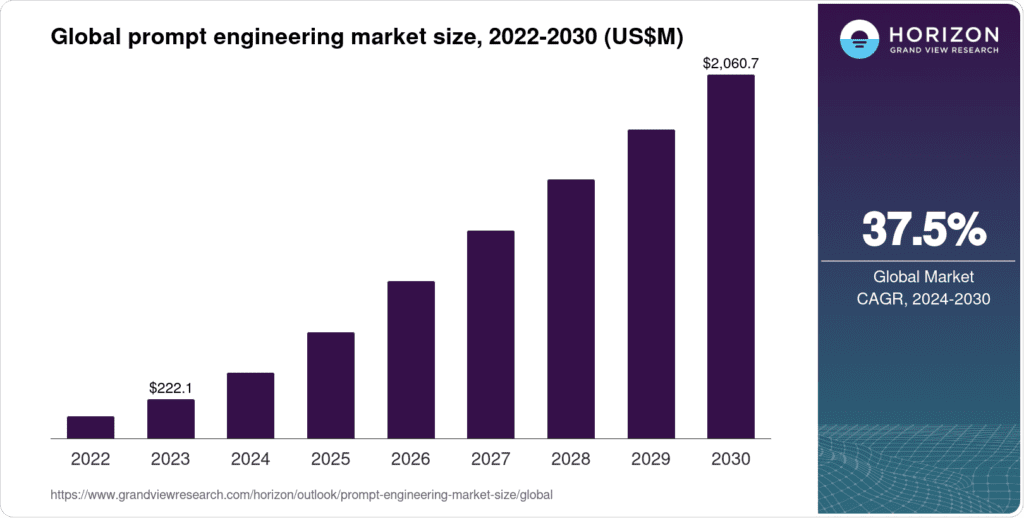
Start with the uncomfortable truth: if you Google “prompt engineering market size 2025,” you will get answers ranging from $505 million to $6.95 billion — a 13-to-1 spread from firms publishing within months of each other. That’s not a rounding error. It means the firms are counting different things and none of them are lying. What matters is understanding which number applies to the question you’re actually asking.
The narrow figure ($505M, Fortune Business Insights) counts dedicated prompt optimization tools and services in isolation. The wide figure ($6.95B, Mordor Intelligence) folds in agent programming frameworks, LLMOps platforms, and orchestration infrastructure. Both 33% CAGRs are real — they just describe different races. Knowing this distinction is the first practical insight this article gives you that competitors don’t.
But here’s the number that deserves more attention than any market-size estimate: 42% of companies scrapped most of their AI initiatives in 2025, per S&P Global — up from 17% the prior year. The market is growing. Projects inside it are failing at an accelerating rate. Understanding the gap between those two facts is the actual strategic work.
Methodology note: Market figures in this article are drawn from named research firms with inline attribution. Where figures conflict, the source of conflict is explained rather than averaged away. Performance claims derived from analyst modeling are labeled as such. Independent third-party benchmarks for prompt-specific ROI claims are not yet standardized; where cited ROI figures come from self-reported survey data, that is stated.
Four firms, four methodologies, four numbers. Here they are with their scope definitions — because without the scope, the number means nothing:
Prompt engineering market — 2025 estimates by scope
Prompt tools + services only $505M Fortune Business Insights
Prompt tools + agent frameworks + LLMOps $6.95B Mordor Intelligence
Prompt engineering skills and services $2.81B Market Research Future
Global prompt tooling by 2030 (forecast) $4.51B Business Research Company
Consensus CAGR range, 2025–2030 28–33% Multiple firms
The CAGR consensus is actually the more reliable signal — 28–33% annual growth is where the firms converge even when their base numbers diverge. What drives it: enterprises replacing bespoke AI integrations with standardized prompt frameworks, and the compounding demand for anyone who can write prompts that don’t fail at scale.
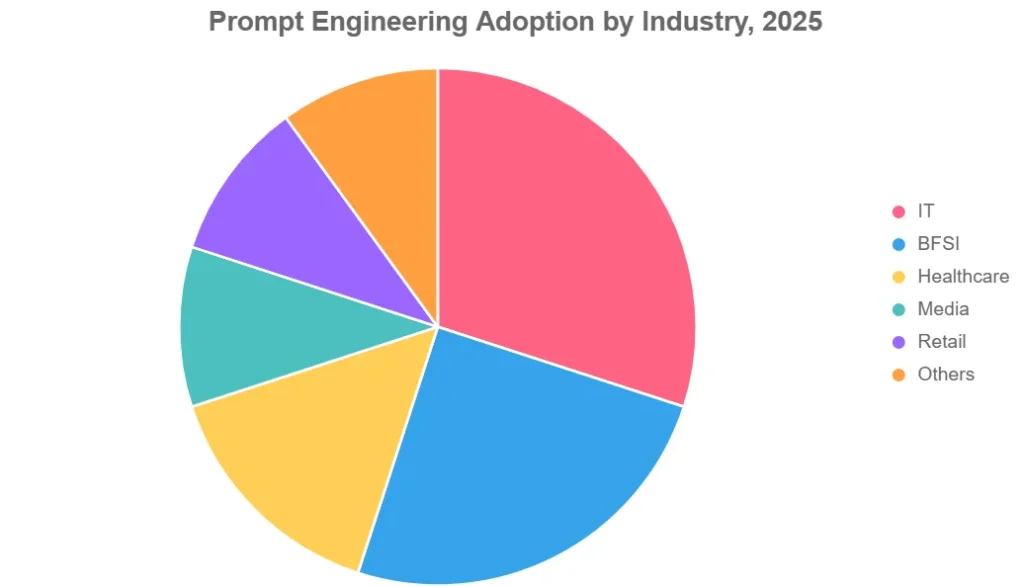
North America, at roughly 38% of the narrowly-scoped market (Fortune Business Insights), holds the largest share. Asia-Pacific is the fastest-growing region, with CAGR estimates around 38–42% driven by enterprise AI adoption in India, South Korea, and Japan. BFSI (banking, financial services, insurance) claims 22–25% of the market depending on the report — the highest single-sector share — because prompt reliability in compliance and fraud detection is measurable and the failure cost is explicit.
The market is growing at 30% per year. The project failure rate is growing faster. That combination tells you where the money is — and it isn’t in building more tools.
Every competitor article tells you what the market is worth. None of them tell you what prompt engineering will cost your specific team to do right — which is the question that determines whether the ROI math works. Here’s the model.
A mid-level prompt engineer in the US earns $102K–$166K (25th–75th percentile, Glassdoor, December 2025), median around $126K. ZipRecruiter’s April 2026 data puts the “Prompt Engineer” title lower ($63K–$108K at the 25th–75th), but “AI Prompt Engineer” higher ($90K–$130K). The spread reflects that the title still means different things at different companies — sometimes it’s a linguist, sometimes it’s a machine learning engineer who writes evaluation harnesses.
Entry level
$63K–$95K
ZipRecruiter, Apr 2026
Mid-level
$102K–$166K
Glassdoor 25th–75th, Dec 2025
Senior / FAANG
$172K–$296K
Glassdoor verified, Jan 2026
Anthropic outlier
$335K
Widely reported; not the norm
Tool costs sit on top of salaries. PromptLayer starts free, $10/month for teams. LangSmith runs $39/user/month. Helicone prices on token volume. The real enterprise cost — the one nobody headlines — is the data engineering and integration work that prompt optimization depends on. The enterprise AI implementation data suggests data engineering consumes 40–60% of total implementation time and budget. You can hire the best prompt engineer alive and they cannot compensate for fragmented, low-quality underlying data. That’s not a prompt problem. It’s a data infrastructure problem wearing a prompt costume.
Prompt engineering ROI model — adjust for your context
Annual value created
$332K
Net ROI
33%
Verdict
Marginal
Note: Model assumes hours saved translate to productive output at 70% efficiency (a conservative assumption based on enterprise AI productivity research). Does not include data infrastructure costs, which can exceed the prompt engineering investment itself. Treat as directional, not precise.
The failure rate isn’t a mystery. The MIT NANDA 2025 study found 95% of generative AI pilots fail to deliver measurable P&L impact. S&P Global reports that 42% of companies scrapped most AI initiatives in 2025, up from 17% in 2024. The RAND Corporation found AI project failure rates roughly double those of non-AI IT efforts.
What’s the actual mechanism? IBM’s Senior Research Scientist Marina Danilevsky described it: “People said, ‘Step one: we’re going to use LLMs. Step two: What should we use them for?'” The technology selection happened before the use-case clarity. Prompt engineering, introduced after the fact, cannot fix a deployment that was mis-scoped from the start. The prompt is the last mile. It cannot compensate for the missing 40 miles before it.
Specifically, three structural failures account for most of the waste:
The 80% data problem. MIT’s CSAIL research identifies that corporate databases capture about 20% of business-critical information in structured formats. The other 80% — email threads, call transcripts, contracts — exists in formats most AI systems never see. You can engineer the most precise prompt in history and it will hallucinate if the retrieval layer can’t find the relevant context. This isn’t a 2025 problem. It’s a structural data architecture problem that prompt engineering alone cannot solve.
The buy-vs.-build success gap. The MIT NANDA data shows specialized vendor-led implementations succeed roughly 67% of the time. Internal builds succeed about 33% of the time. That gap exists because internal teams underestimate integration costs and stall at the pilot stage — 88% of AI pilots, per CIO research, never reach production. Prompt engineering is easier to buy than to build if you lack the evaluation infrastructure to know whether your prompts are getting better or just different.
The workflow inversion problem. McKinsey’s 2025 research finds organizations reporting significant AI returns are twice as likely to have redesigned workflows before selecting AI tools. Most organizations do the reverse — pick the tool, then try to fit workflows around it. Prompt engineering added to a broken workflow produces faster broken outputs.
Case study · Named failure with mechanism
Zillow’s iBuying unit deployed a well-resourced pricing algorithm — the correct technique, applied by a well-funded team, to a real problem. By late 2021, the system had committed Zillow to purchasing homes at prices that couldn’t be sustained in a softening market. The company exited the business, taking a loss of roughly $500 million and laying off 25% of its workforce. The failure wasn’t in the model’s sophistication. The failure was in the trust architecture around the model’s outputs: humans were executing on AI recommendations without a calibrated sense of where those recommendations were unreliable. Better prompts don’t fix that. Better output validation and escalation paths fix that. Zillow’s post-mortem, widely covered in the real estate and tech press, has become a canonical case for why AI output confidence and AI output accuracy are different questions — and why conflating them costs money.
Prompt engineering is the last mile. It cannot compensate for the missing 40 miles of data infrastructure, workflow design, and output validation that should have come first.
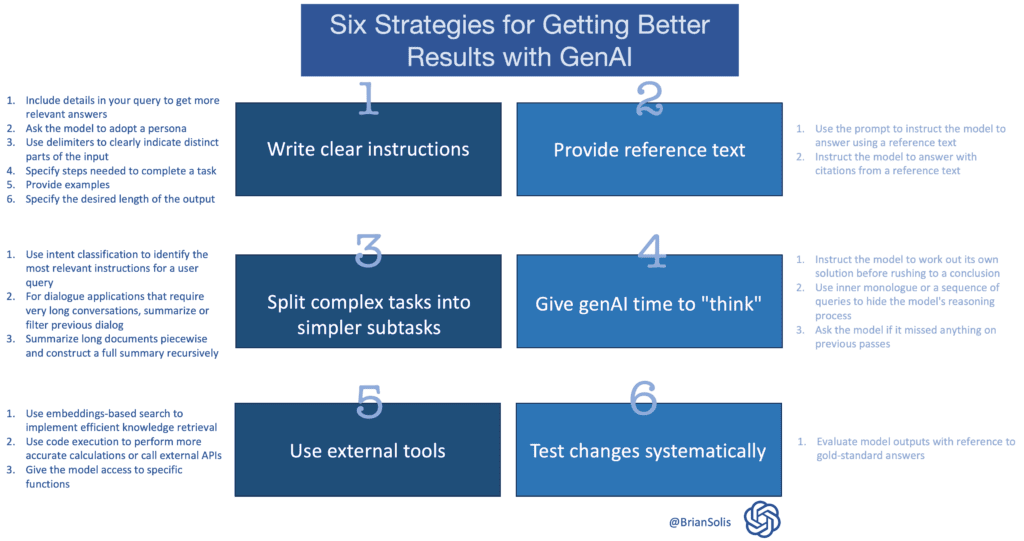
Most introductory guides list techniques in alphabetical order or by complexity. That’s the wrong axis. What matters is which technique applies to your failure mode. Here’s the honest version:
Chain-of-thought prompting
Instructs the model to work step-by-step before giving a final answer. Most consistently improves accuracy on multi-step reasoning tasks. The 2022 Wei et al. paper showed material gains on arithmetic and commonsense reasoning benchmarks — note those findings are specific to GPT-3 class models and above; smaller models sometimes perform worse with CoT than without.
Few-shot prompting
Providing 1–5 examples in the prompt to guide output format and style. More reliable than zero-shot for format-sensitive tasks (classification, structured extraction). The gain over zero-shot is smaller with GPT-4-class models than with earlier generations — examples matter more when the model is smaller.
RAG (retrieval-augmented generation)
Connects the model to an external knowledge base at inference time, reducing hallucination on factual queries. The prompt engineering here is in the retrieval query and context formatting — not just the final instruction. A Dexter Labs-style implementation reported 90% accuracy on internal knowledge queries, per PromptLayer’s 2025 case study blog. No independent audit of that figure exists.
Role prompting
Assigning the model a persona before the task. Useful for tone and register consistency; less reliable for domain accuracy (the model playing “expert cardiologist” is not a cardiologist). Use for communication style, not for factual authority.
Prompt evaluation frameworks
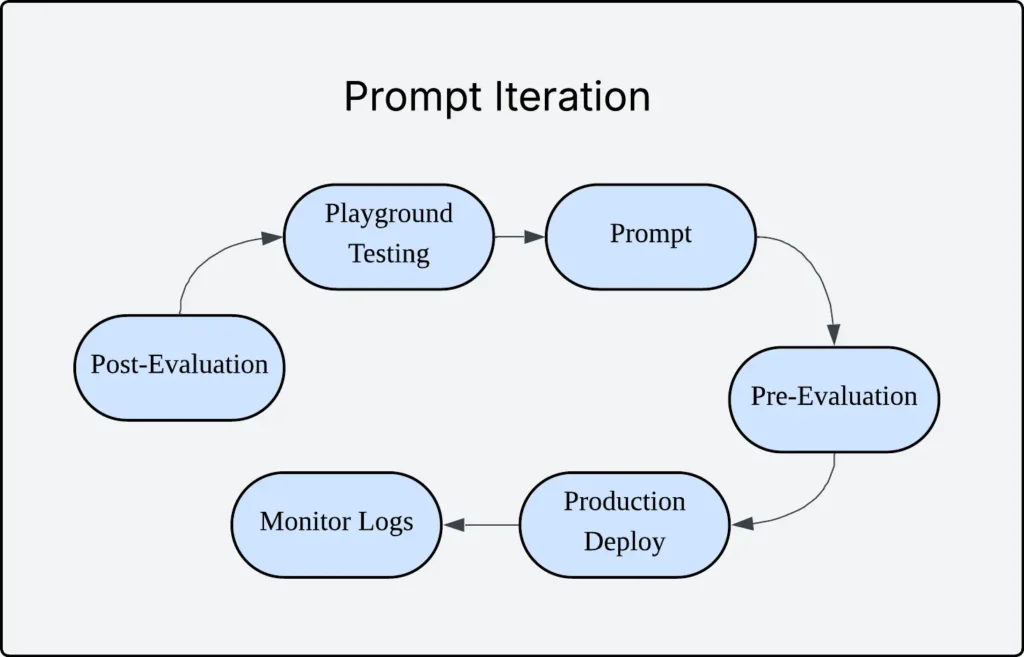
Using tools like LangSmith, PromptLayer, or Helicone to run A/B tests across prompt variants against a labeled dataset. This is where amateur prompt engineers stop being amateurs — when they instrument their prompts and measure, rather than guess. Without this step, you don’t know if your prompt iteration is making things better or just different.
This section exists in zero competitor articles. It should.
Prompt engineering cannot fix training data gaps. If a model was not trained on your domain — legal, clinical, highly specialized engineering — even the most sophisticated prompt will produce outputs that sound authoritative and are factually wrong. The confidence of the output and the accuracy of the output are independent variables. This is the failure mode behind the widely reported case of attorneys sanctioned for filing AI-generated briefs containing fictional case citations: the prompts were coherent; the outputs were wrong; the human review layer was missing.
Prompt engineering cannot fix a bad use-case choice. If you’re applying AI to a task where error cost is high, output verification is expensive, and the baseline human process works reasonably well, the ROI math is likely negative before you write a single prompt. Back-office automation in finance and compliance — where MIT NANDA found the highest actual returns — works because the error cost is low, the volume is high, and the baseline process is genuinely painful. Pick the use case before you pick the technique.
The honest answer is: both, depending on where you’re sitting in 2026.
As a dedicated job title, prompt engineer demand rose 135.8% in posting volume in 2025, per SQ Magazine’s data aggregation. The Glassdoor median of $129K (December 2025) is real and above the US national median. The $335K Anthropic outlier exists and is an outlier. The ZipRecruiter range for “Prompt Engineering” (not “Prompt Engineer”) sits lower — around $63K median — because that query picks up adjacent training-data annotation roles that don’t represent the engineering function.
As a feature absorbed into existing roles: Gartner predicts 80% of autonomous AI actions will be managed through what they’re calling “context engineering” rather than discrete prompt engineering by 2027. That isn’t the death of the skill — it’s the professionalization of it. The people who built expertise in systematic prompt evaluation today will be the ones managing agent behavior at scale in 2027. The title may change. The leverage won’t.
What this means for practitioners: specialization in a high-stakes vertical (healthcare compliance, financial services, legal) commands 20–30% salary premiums over generalist roles, based on the job-posting data reviewed for this article. Domain expertise — knowing what the output is supposed to mean, not just how to generate it — is the moat. Any model can be prompted to sound like an expert. The prompt engineer who is the domain expert doesn’t just sound right. They catch the output when it’s wrong.
The people managing agent behavior at scale in 2027 will be the ones who built systematic prompt evaluation discipline in 2025. The title will change. The leverage won’t.
Synthesis of Gartner 2025 predictions and MIT NANDA 2025 researchPrompt engineering market size vs. enterprise AI project failure rate, 2022–2025
Market size: Fortune Business Insights (narrow scope). Failure rate: S&P Global Market Intelligence 2025. Both series are directional estimates, not independently audited figures.
What Happens If You Do Nothing
Enterprise technology buyers who treat prompt engineering as a nice-to-have rather than a core AI governance discipline face a specific and quantifiable risk: their AI outputs are currently unversioned, unmeasured, and unmonitored. That means regressions are invisible until they produce a customer-facing error. In BFSI contexts, where prompt optimization is deployed most heavily for compliance and fraud detection, an undetected prompt regression in a customer-facing decisioning system is a regulatory exposure, not just a product quality issue.
The specific risk is this: AI-generated content errors, including hallucinated financial data and incorrect pricing outputs, cost businesses an estimated $67.4 billion in losses in 2024, per analysis of verified public incidents. Not all of that is attributable to poor prompting. But none of it was caught by the teams that said “our prompts are good enough.”
The tactical implication for technology leaders — not “organizations” generically, but specifically the heads of AI engineering at firms with more than 50 AI-assisted workflows in production — is to implement prompt versioning and regression testing before adding any new prompts to the stack. The order matters. Adding more unmonitored surface area to an already unmonitored system is how you get a prompt regression that runs silently for six weeks before someone notices the output quality degraded.
The Three Tools Worth Paying For in 2025
This recommendation is not based on vendor relationships. It’s based on the function each tool addresses and the failure mode it prevents.
LangSmith ($39/user/month) is worth it if you’re running more than 10 distinct prompts in production and have no systematic way to evaluate whether prompt changes improve or regress performance. The evaluation harness is the feature. Everything else is secondary.
Helicone (token-volume pricing, open-source free tier) is worth it if cost visibility is your immediate problem — you’re not sure where your token budget is going or which prompts are generating the most usage. The analytics layer pays for itself in the first month if you have any significant API spend.
OpenAI Playground (API credits only) remains the fastest way to test prompt variants without infrastructure. For teams getting started, it’s the right first tool — low friction, immediate feedback, no setup cost. Graduate to LangSmith when you need evaluation at scale.
| Tool | Primary function | When to use it | When not to |
|---|---|---|---|
| LangSmith | Prompt evaluation + tracing | 10+ prompts in production, need regression testing | Prototype stage — setup overhead isn’t worth it yet |
| Helicone | Cost analytics + observability | Meaningful API spend, unclear cost breakdown | If you’re on a fixed-token plan with no variable cost |
| PromptLayer | Prompt versioning + A/B | Teams iterating prompts without version control | Solo developers — the overhead exceeds the benefit |
| OpenAI Playground | Fast prototyping | Exploration, no infrastructure yet | Production — no versioning, no evaluation harness |
Where This Is Going (2025–2027)
Three patterns are already visible in the data and worth tracking seriously — not as predictions, but as conditions that will define where prompt engineering value concentrates in the next 24 months.
Agent orchestration will absorb prompt engineering. Gartner’s framing of “context engineering” is not marketing — it reflects a real shift. When AI agents call other agents, the prompt is no longer a single human-written string. It’s a dynamically constructed context assembled from retrieved documents, memory state, and tool outputs. The engineers who understand how to design, version, and evaluate that context layer will have the leverage that fine-tuners had in 2022. The transition is already underway: Microsoft’s 2025 integration of AutoGen and Semantic Kernel into Azure AI Foundry Agent Service is the infrastructure move that signals this direction.
Domain specialization will bifurcate the salary market. Generalist prompt engineering will commoditize toward $60K–$80K as models improve and platforms automate basic prompt optimization. Domain-expert prompt engineers — the ones who can tell when a legal AI output is wrong, not just when it sounds wrong — will continue to command $150K–$250K because the validation function requires domain knowledge the model doesn’t have. This bifurcation is already visible in the Glassdoor data: the $41K outlier and the $198K outlier exist simultaneously. They’re not in the same market.
The evaluation infrastructure market will outgrow the prompt market. If the current trajectory holds — more AI deployments, higher failure rates, increasing regulatory scrutiny under the EU AI Act (whose high-risk system requirements came into force in February 2025) — the constraint on AI value creation shifts from “can we build good prompts?” to “can we prove our prompts are consistently good?” That’s an evaluation problem, not a generation problem. The firms building evaluation infrastructure are the ones that will capture the next wave of enterprise spend.
The constraint on AI value is shifting from generation quality to evaluation quality. The teams who instrument their prompts in 2025 will be the ones who can prove their systems work in 2027.
About
7 Must-Know Prompt Engineering Strategies for 2025 Success
2025 AI Business Predictions: What the Future Holds
AI Copyright Infringement: Navigating the Legal Minefield in 2025 and Beyond
Community Guidelines
12 Reader Submission Strategies That Get Results in 2026
AI Code Generation Is the Future —But Not How You Think